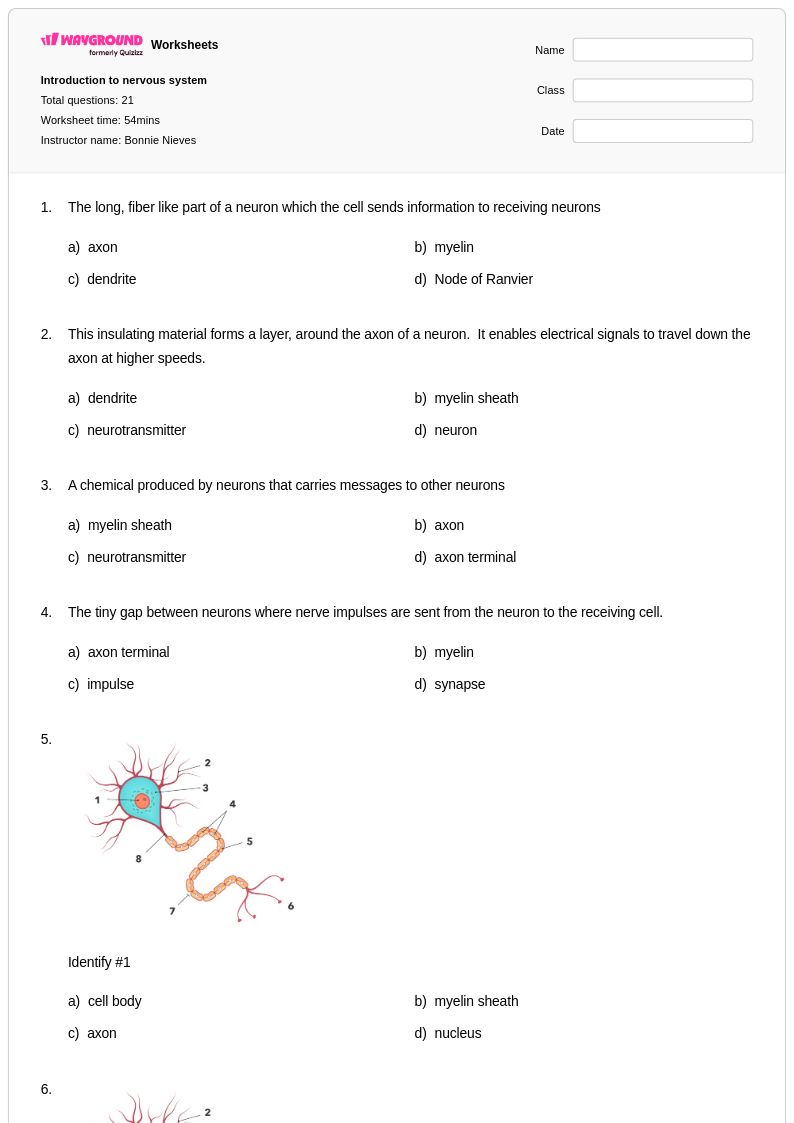
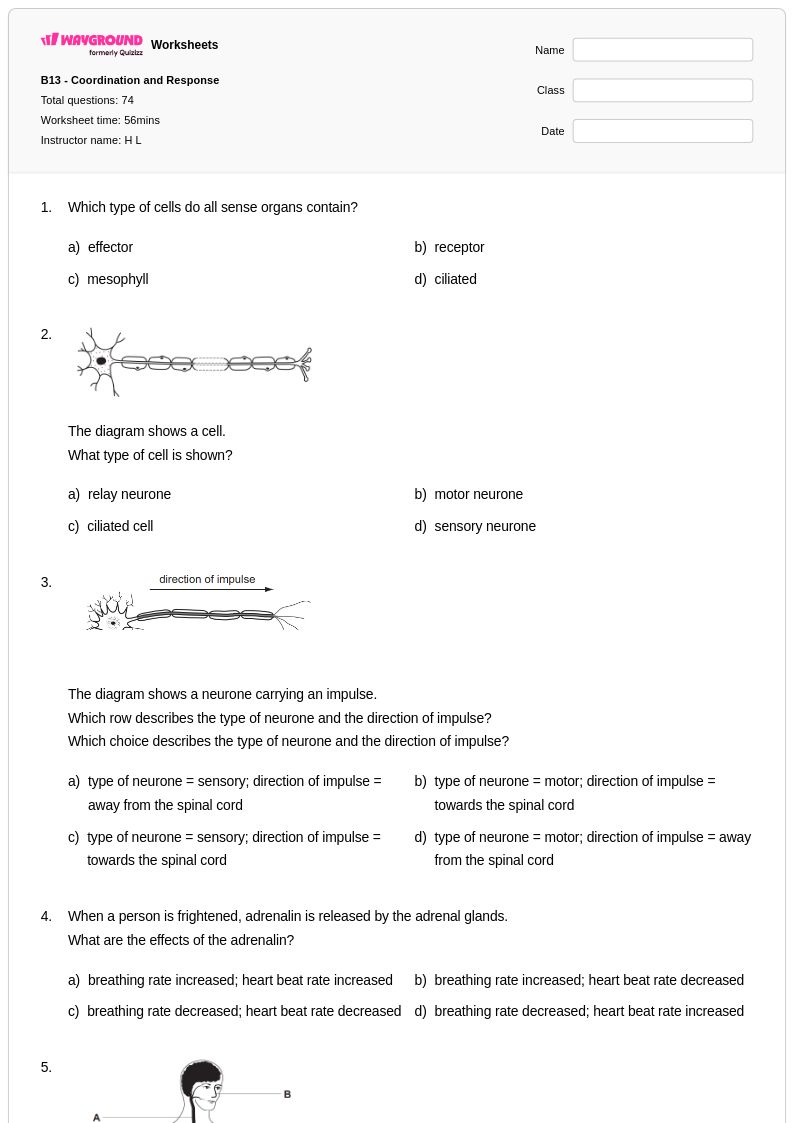
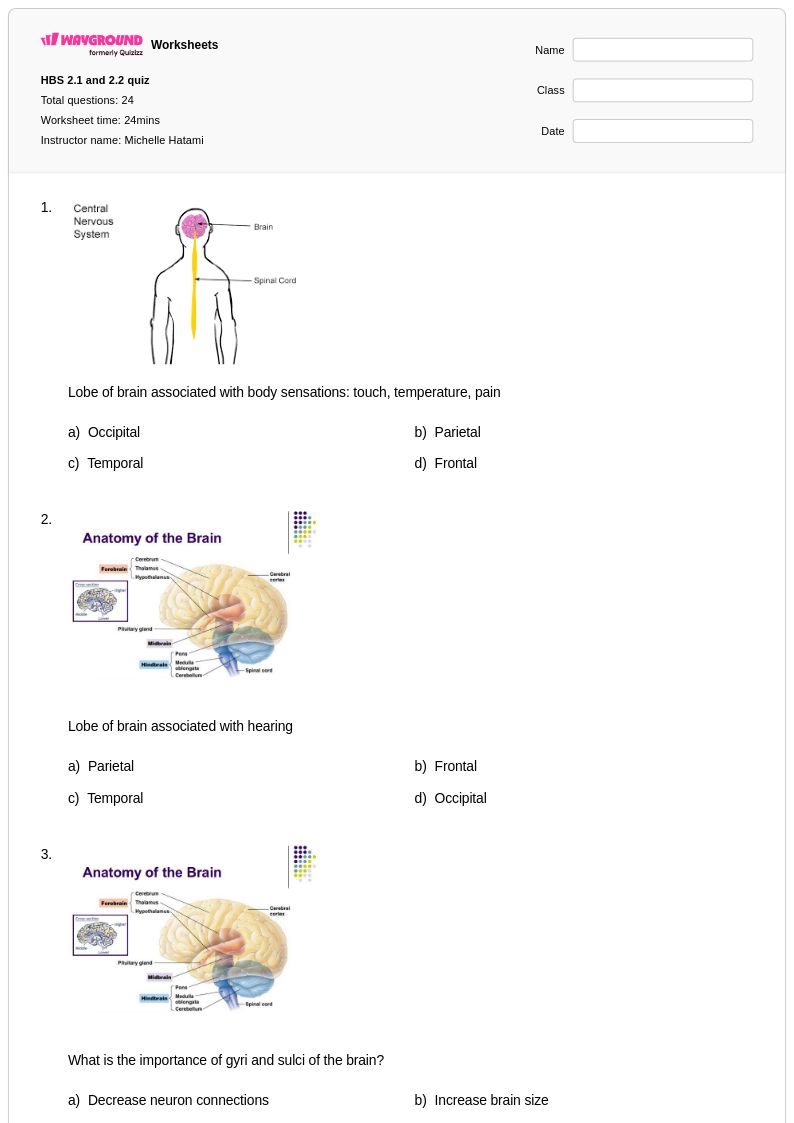
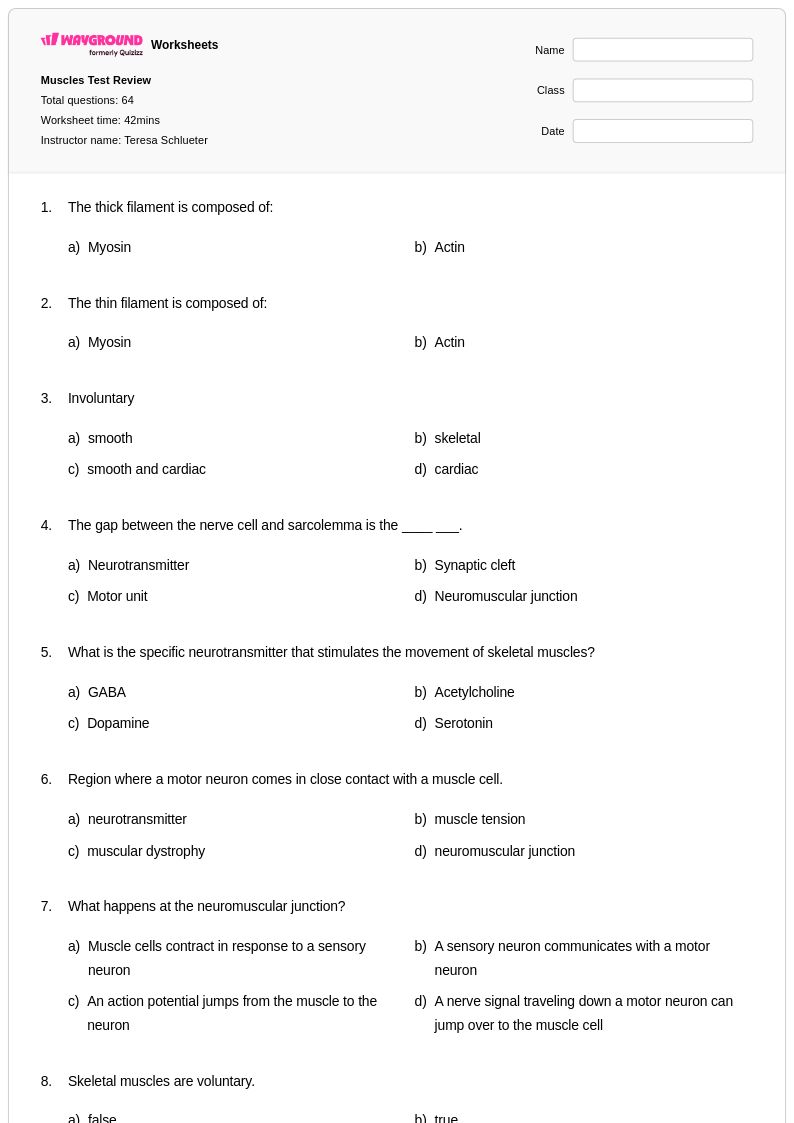
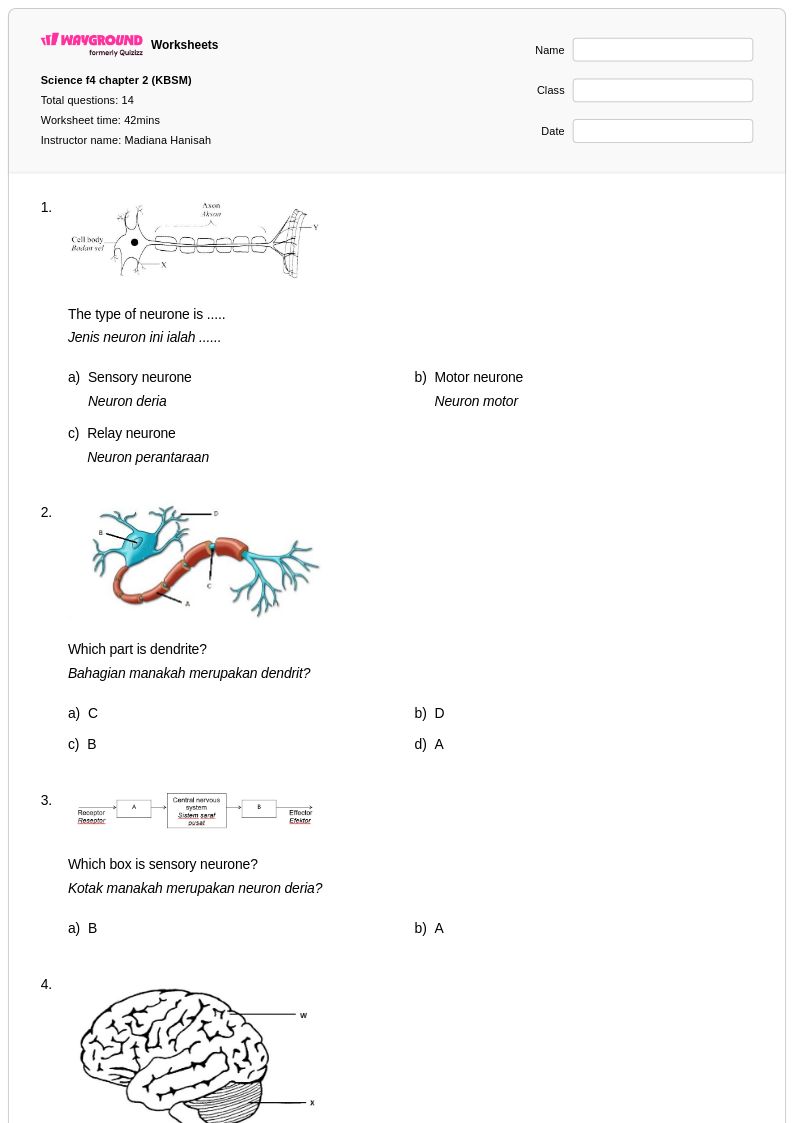
Class 10 neuron worksheets and printables help students master nerve cell structure, signal transmission, and nervous system functions through comprehensive practice problems with answer keys available as free PDF downloads.
Class 10 neuron worksheets available through Wayground (formerly Quizizz) provide comprehensive coverage of neural structure, function, and cellular processes essential for advanced high school biology coursework. These expertly crafted resources strengthen students' understanding of neuron anatomy, including dendrites, cell bodies, axons, and synaptic terminals, while developing critical thinking skills around action potential propagation, neurotransmitter release, and synaptic transmission mechanisms. The worksheet collection encompasses practice problems that challenge students to analyze nerve impulse conduction, compare different types of neurons, and evaluate the relationship between neural structure and function. Each resource includes detailed answer keys to support independent learning and comes in convenient pdf format, offering free printables that reinforce complex neurobiological concepts through varied question formats and visual analysis activities.
Wayground (formerly Quizizz) empowers educators with millions of teacher-created neuron worksheet resources that feature robust search and filtering capabilities, enabling quick identification of materials aligned with specific learning standards and curricular objectives. The platform's differentiation tools allow teachers to customize worksheets based on individual student needs, while flexible formatting options provide both printable pdf versions and interactive digital alternatives that accommodate diverse classroom environments. These comprehensive collections support effective lesson planning by offering ready-to-use materials for introducing new concepts, providing targeted remediation for struggling learners, and creating enrichment opportunities for advanced students. Teachers can seamlessly integrate these resources into their instruction to reinforce neural science concepts, assess student comprehension of complex biological processes, and provide meaningful skill practice that builds foundational knowledge for advanced neuroscience studies.
FAQs
How do I teach neuron structure and function to my students?
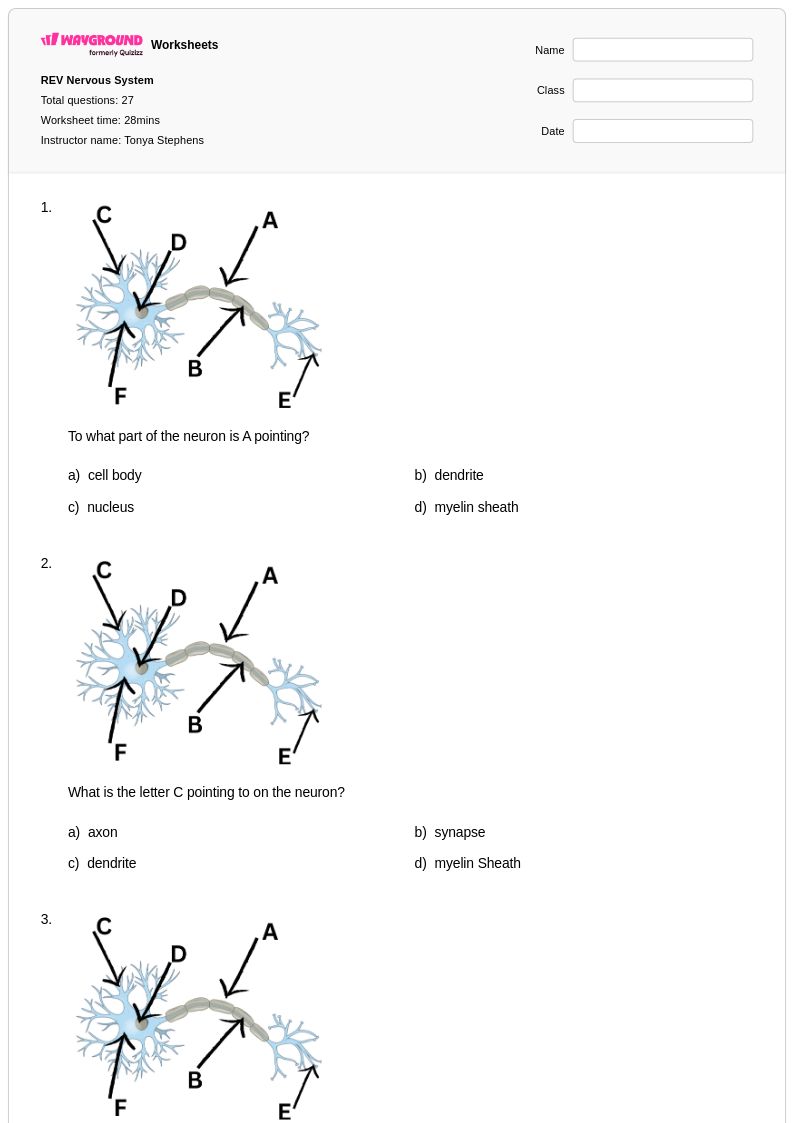
Begin with the physical structure of the neuron, walking students through the dendrites, cell body (soma), axon, myelin sheath, and axon terminals before connecting each component to its functional role. Use labeled diagrams to anchor vocabulary, then layer in how electrical signals (action potentials) are generated and how chemical signals cross the synapse. Building from structure to function helps students see neurons as integrated systems rather than a list of disconnected parts.
What exercises help students practice identifying neuron parts?
Labeling diagrams is the most effective starting point, requiring students to identify dendrites, the axon, cell body, myelin sheath, nodes of Ranvier, and synaptic terminals on an unlabeled image. Follow-up exercises should ask students to describe the function of each structure, not just name it, which forces deeper processing. Matching and fill-in-the-blank questions that connect structure to signal transmission reinforce this understanding with low-stakes repetition.
What misconceptions do students commonly have about how neurons work?
A very common misconception is that electrical signals travel like current through a wire, when in reality the action potential is a wave of ion exchange across the membrane. Students also frequently confuse the direction of signal travel, assuming signals can move in any direction along an axon rather than understanding the unidirectional nature enforced by the refractory period and synaptic structure. Many students also conflate the electrical signal within the neuron with the chemical signal at the synapse, treating them as the same process.
How do I use neuron worksheets to assess student understanding before a test?
Use diagram-labeling and short-answer worksheets as formative checkpoints after instruction on neuron anatomy and again after covering action potentials and synaptic transmission. Pay close attention to whether students can articulate the function of each structure, not just recall the label, as functional understanding is the more common gap heading into assessments. Answer key comparisons let students self-assess, which research consistently shows improves retention before summative testing.
How do I use Wayground's neuron worksheets in my classroom?
Wayground's neuron worksheets are available as free PDF downloads for traditional print-and-distribute use as well as in interactive digital formats for technology-integrated classrooms. Teachers can host them directly as a quiz on Wayground, allowing students to complete work on their own devices while the platform tracks responses. Each worksheet includes a complete answer key, reducing prep time and making them practical for both guided instruction and independent study sessions.
How can I differentiate neuron worksheets for students at different skill levels?
For students who are still building foundational knowledge, start with structured labeling tasks and word banks before moving to open-recall questions. For advanced learners, assign worksheets that require students to trace the full pathway of a signal from stimulus to response, integrating multiple concepts in sequence. Wayground also supports individual accommodations such as read aloud, reduced answer choices, and extended time, which can be assigned to specific students without disrupting the experience for the rest of the class.