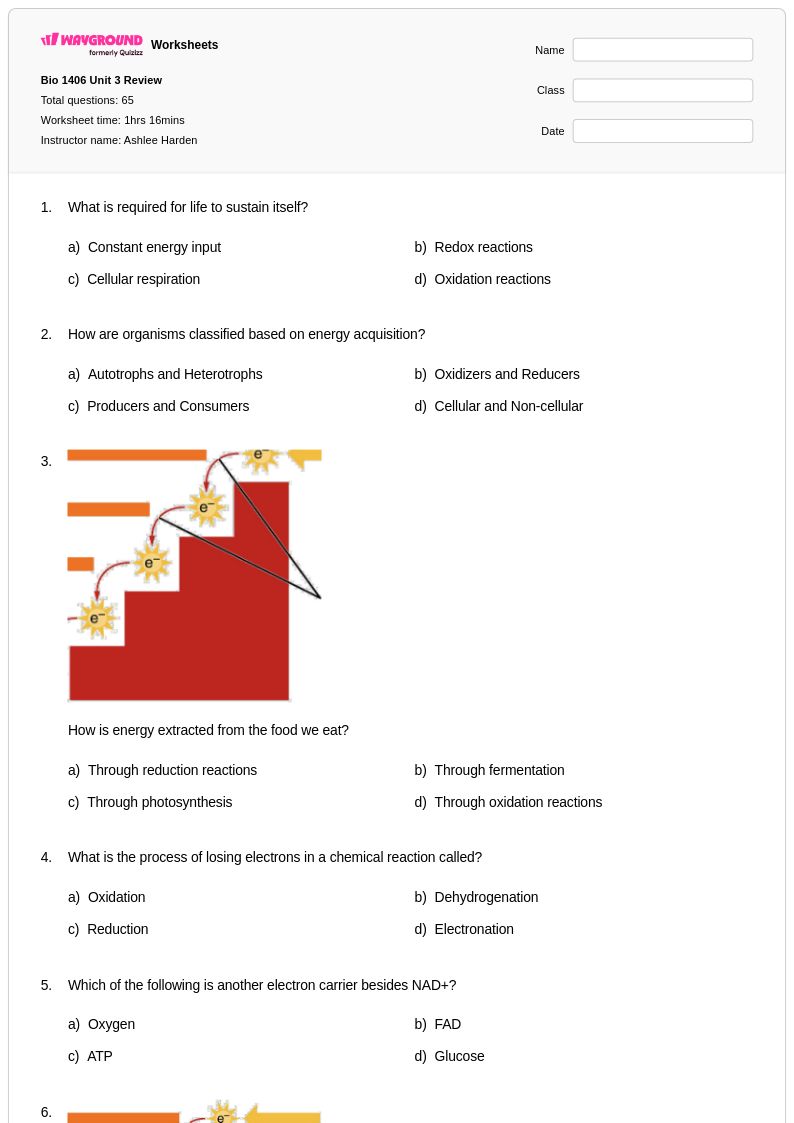
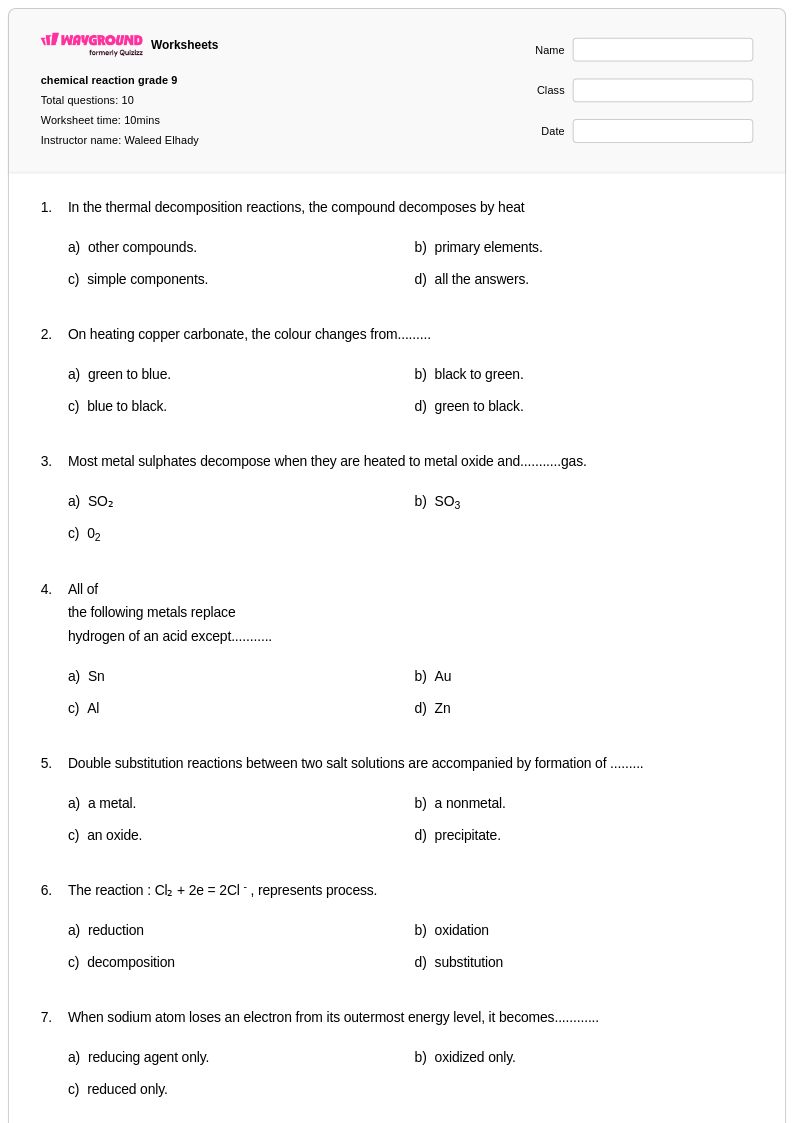
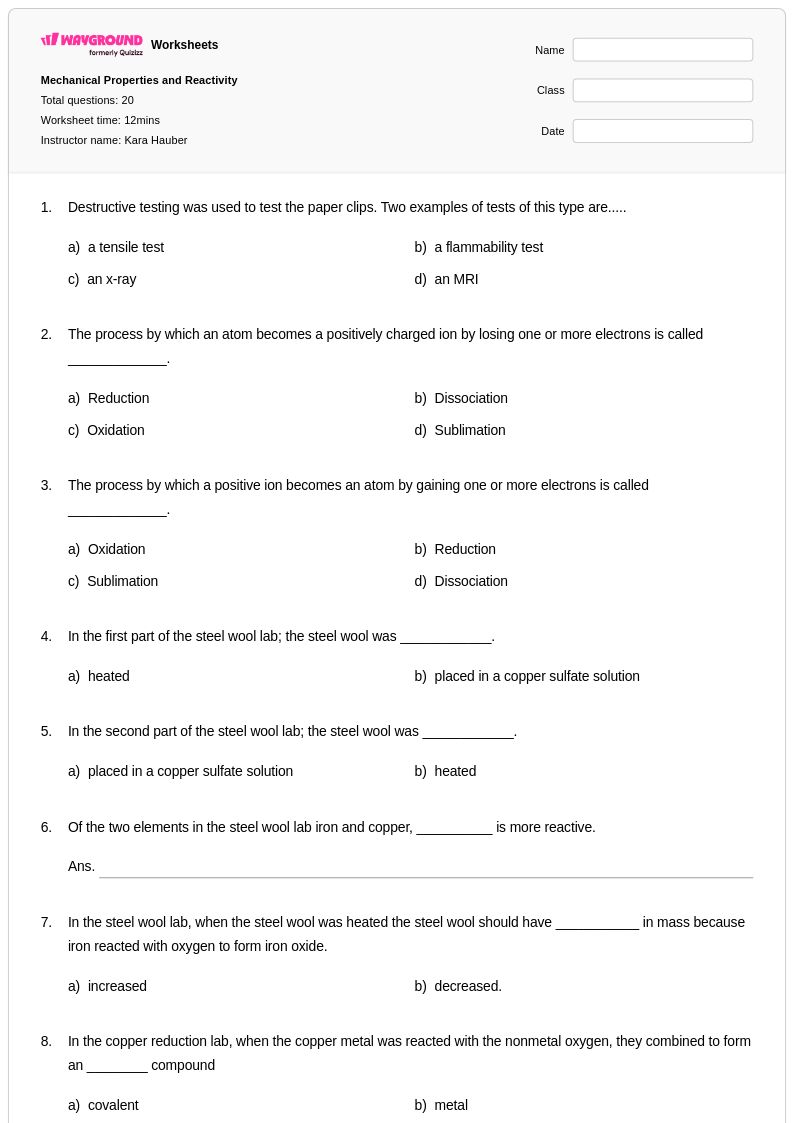
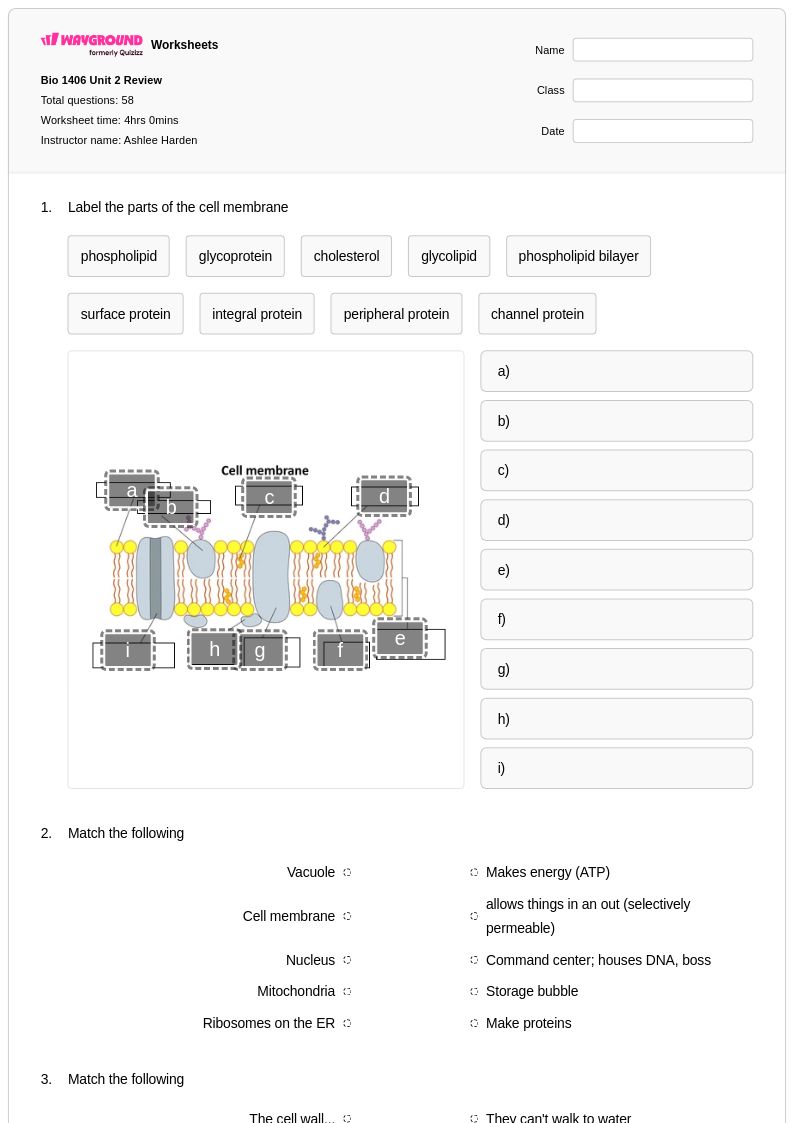
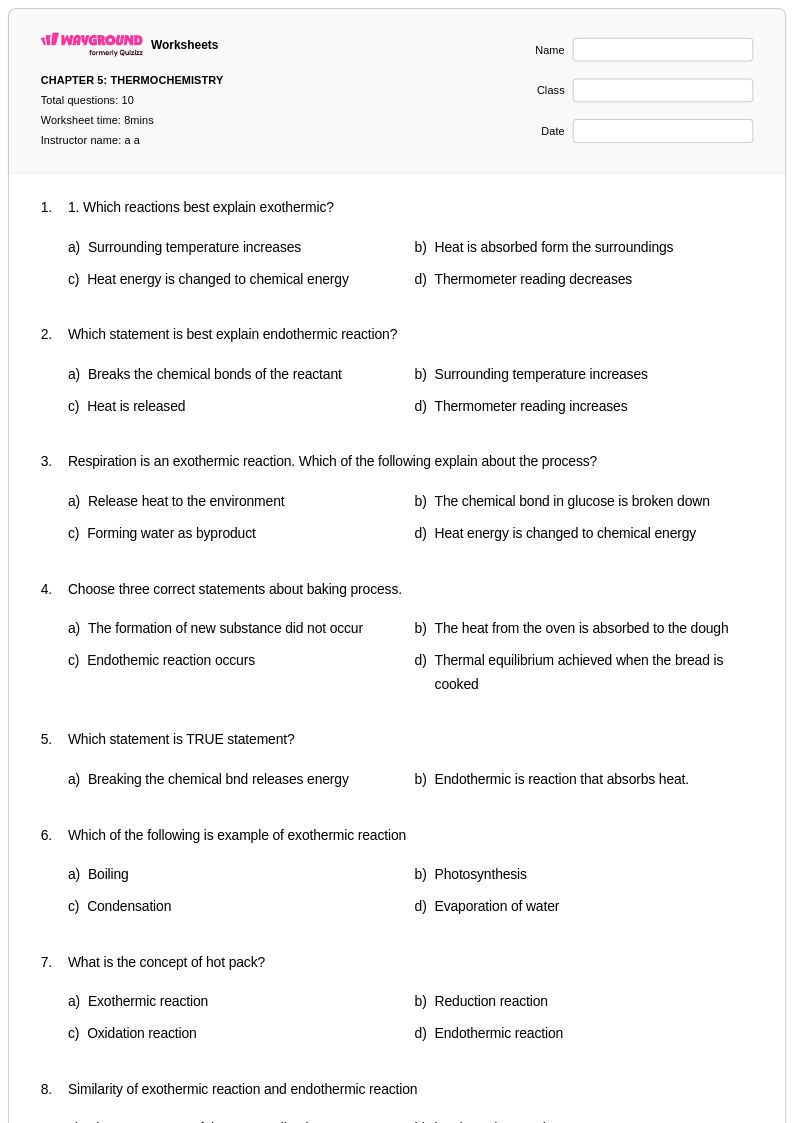
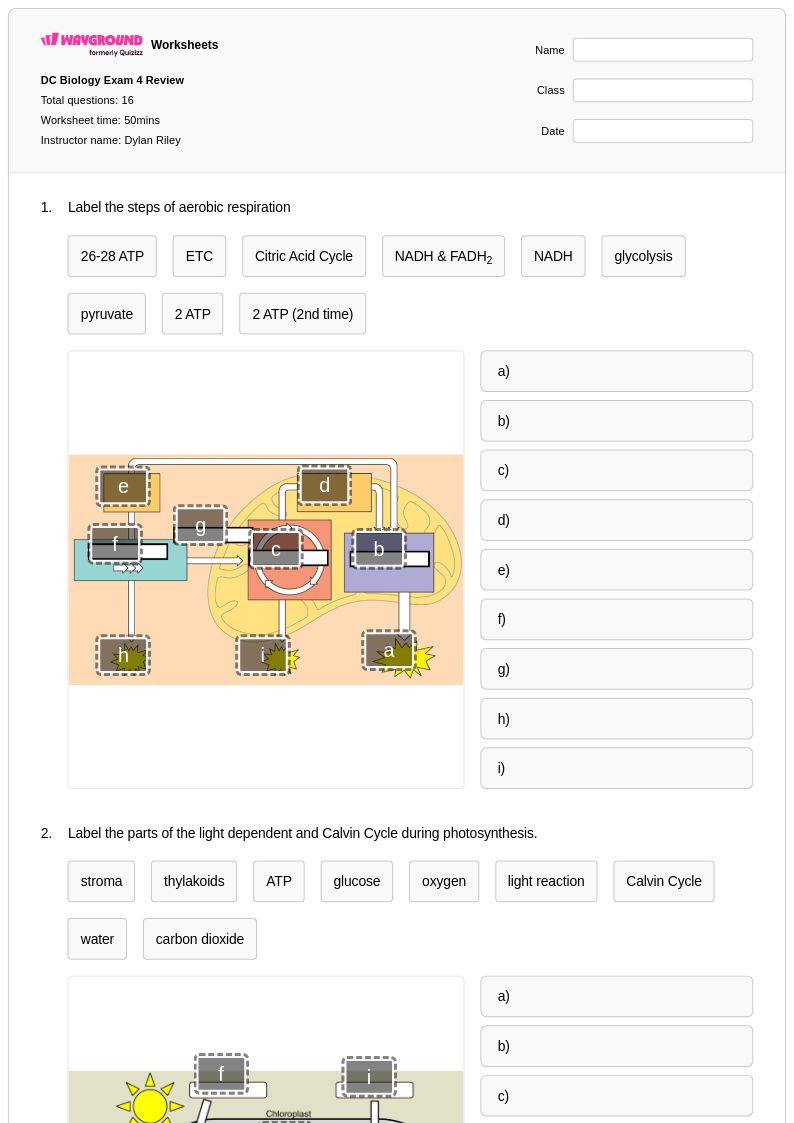
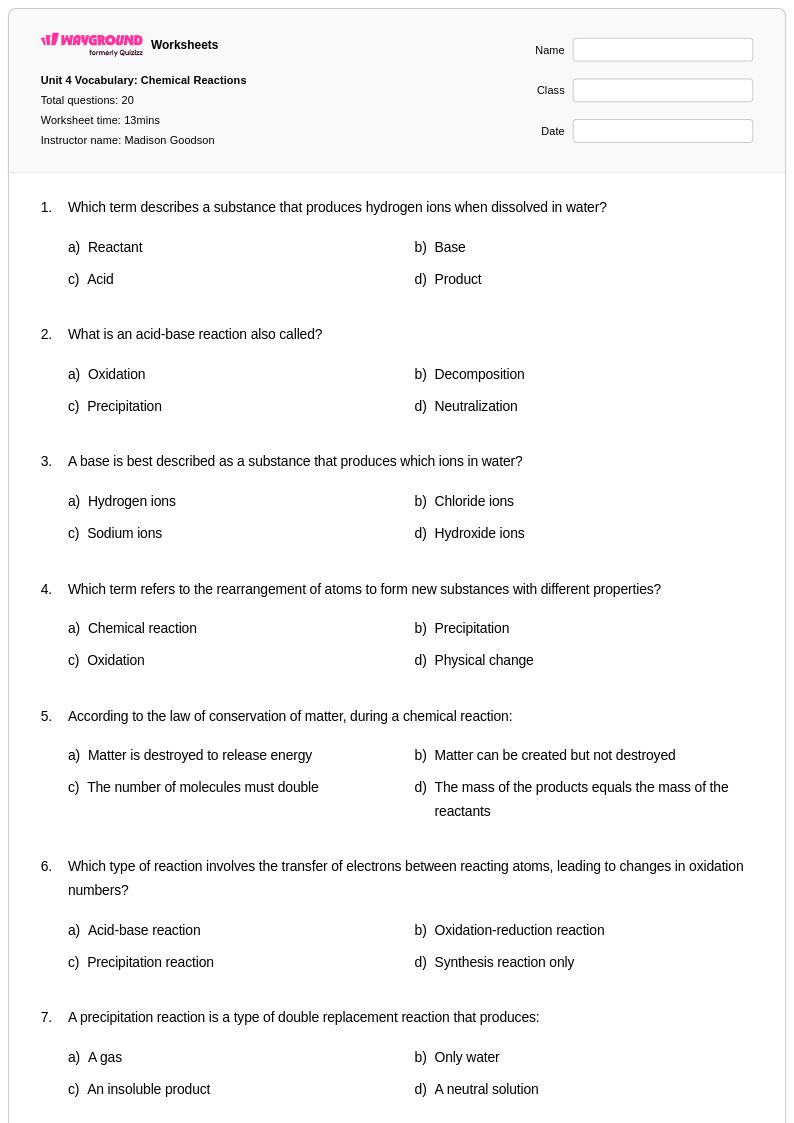
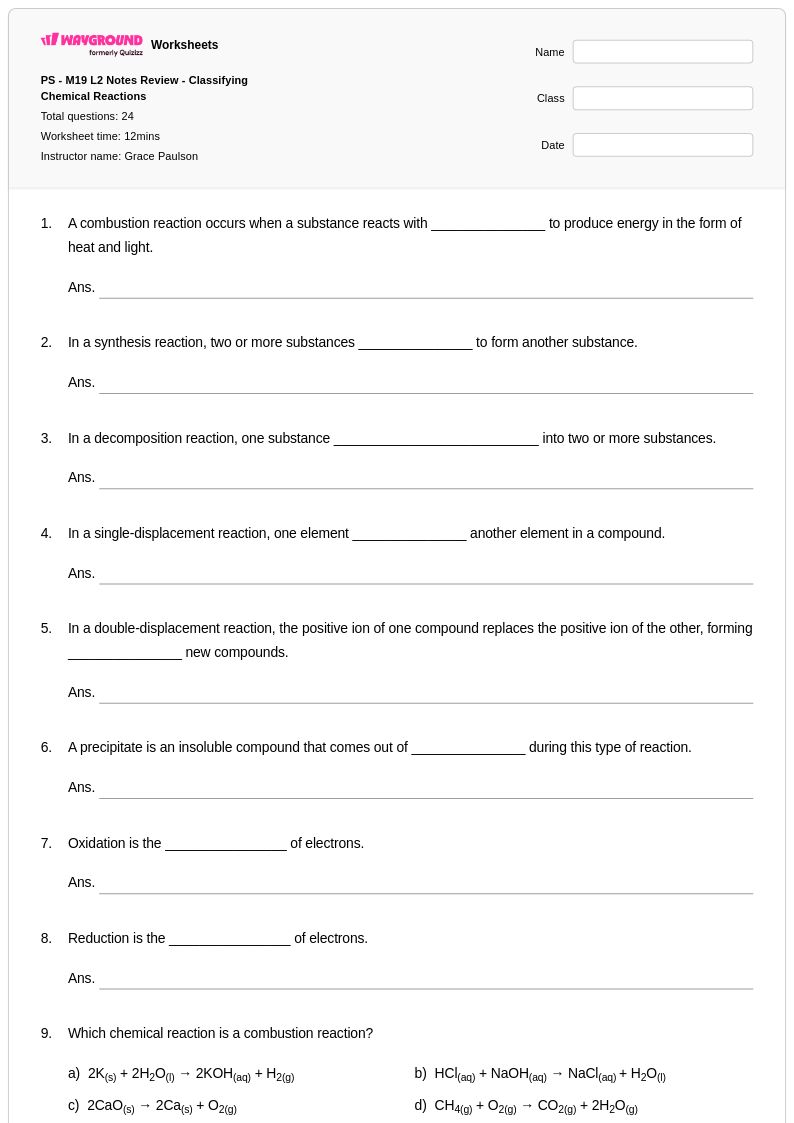
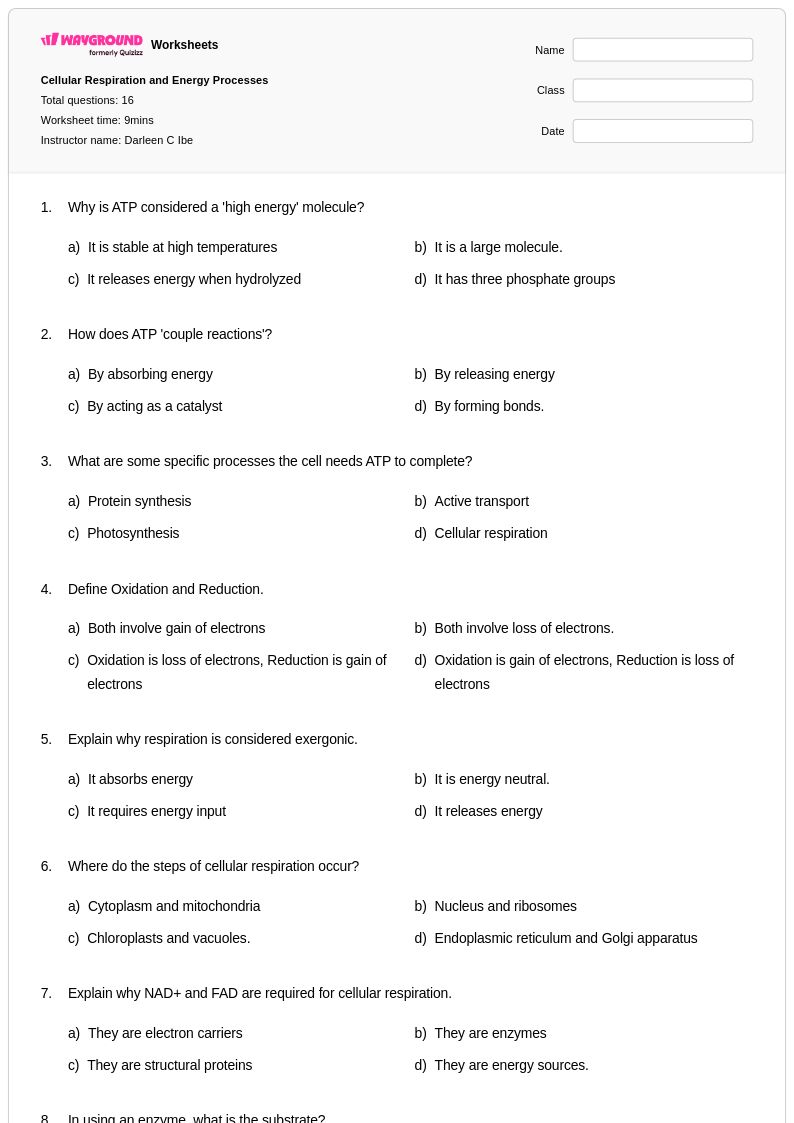
Wayground's free oxidation reduction reactions worksheets provide comprehensive practice problems and answer keys to help chemistry students master redox equations, electron transfer, and balancing chemical reactions through printable PDF exercises.
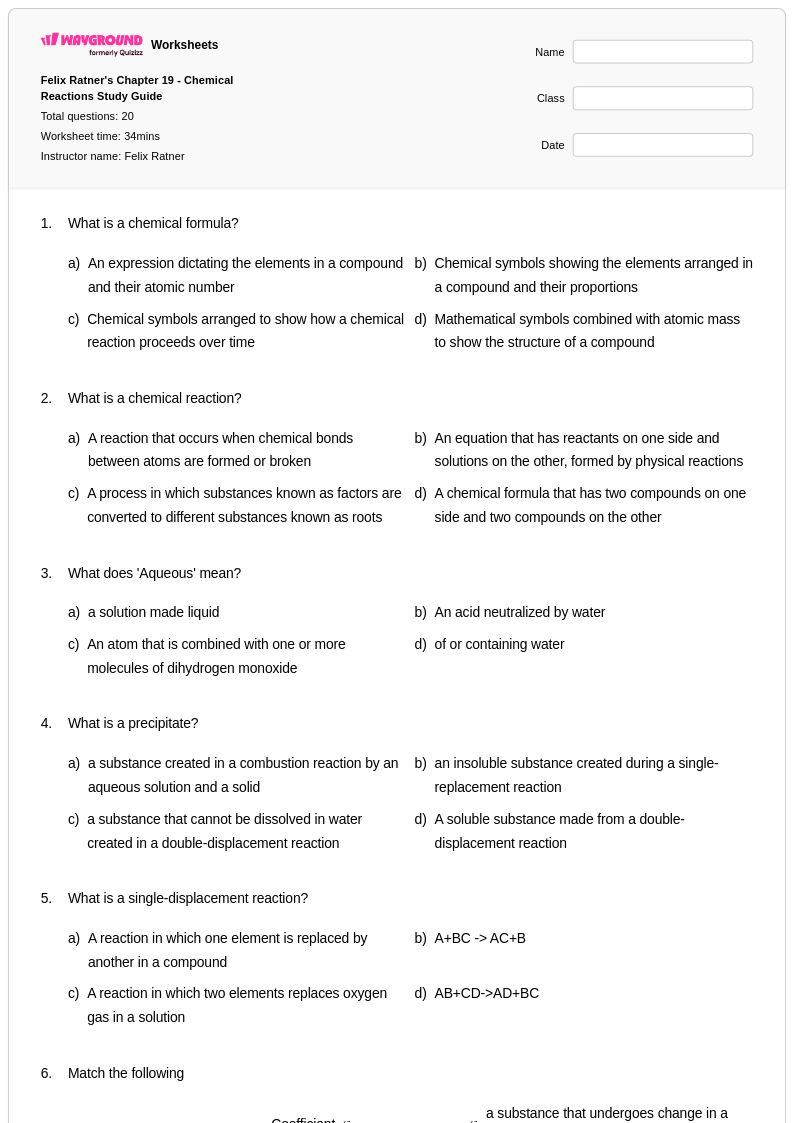
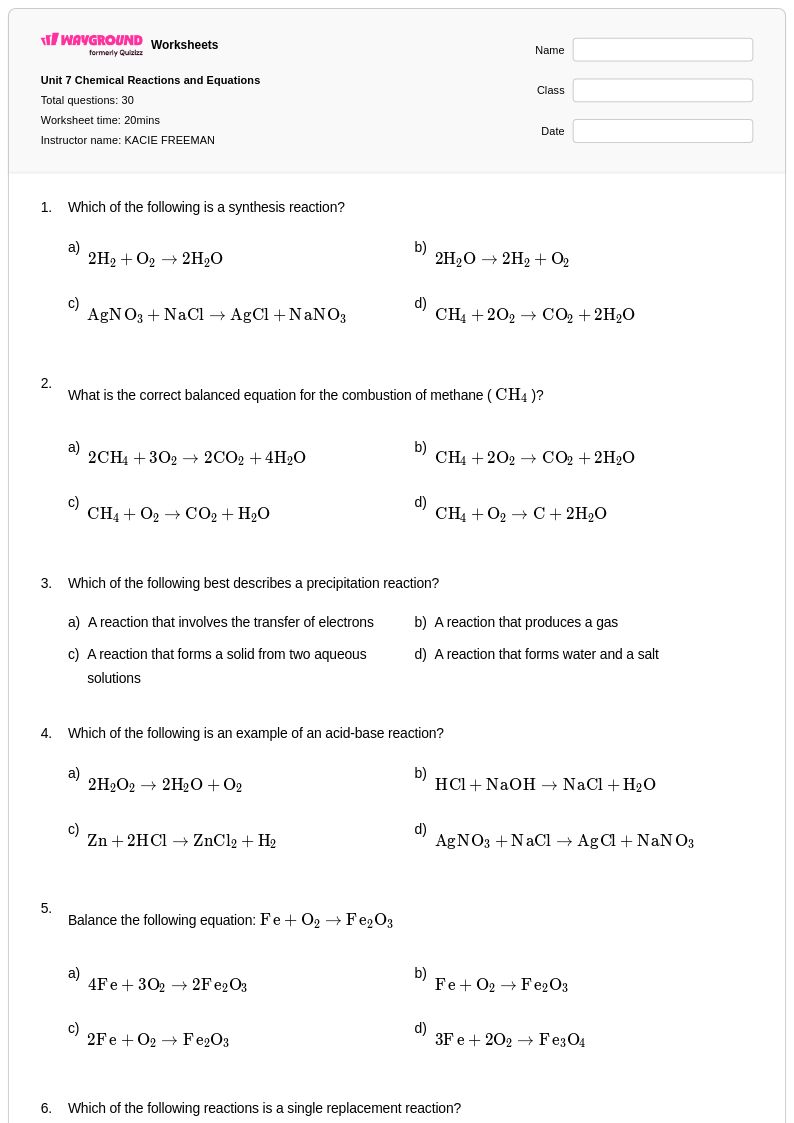
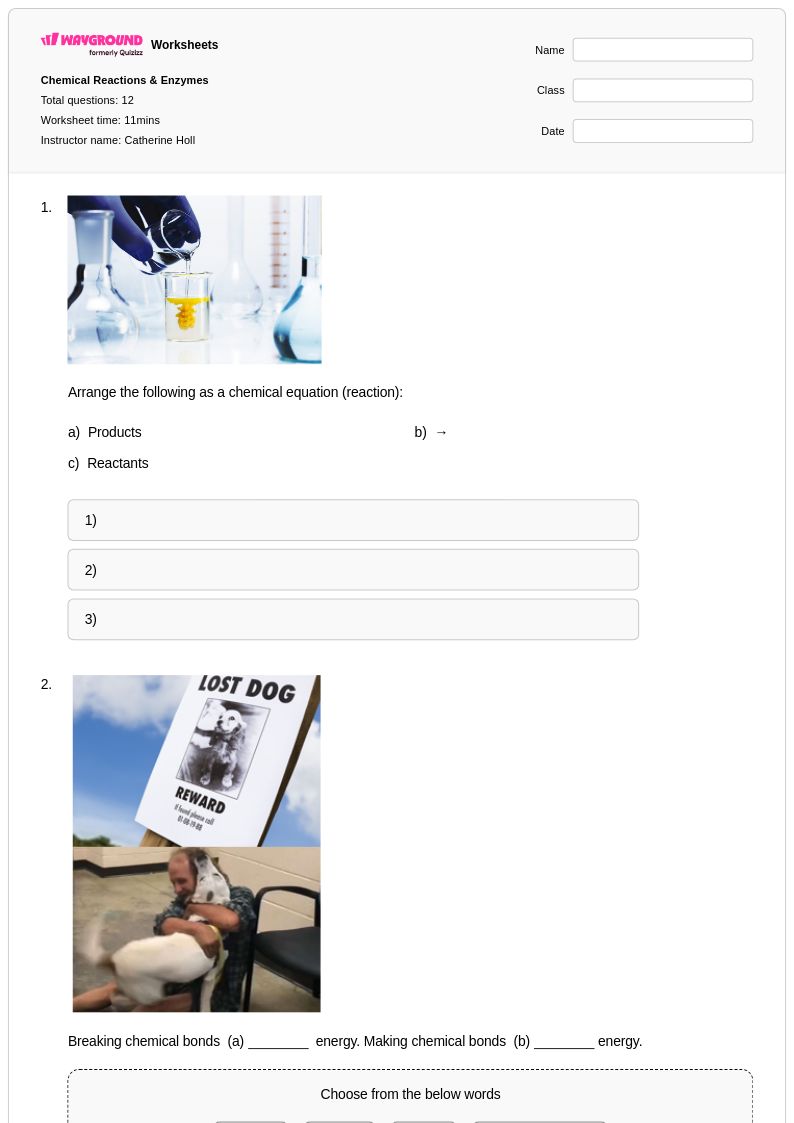
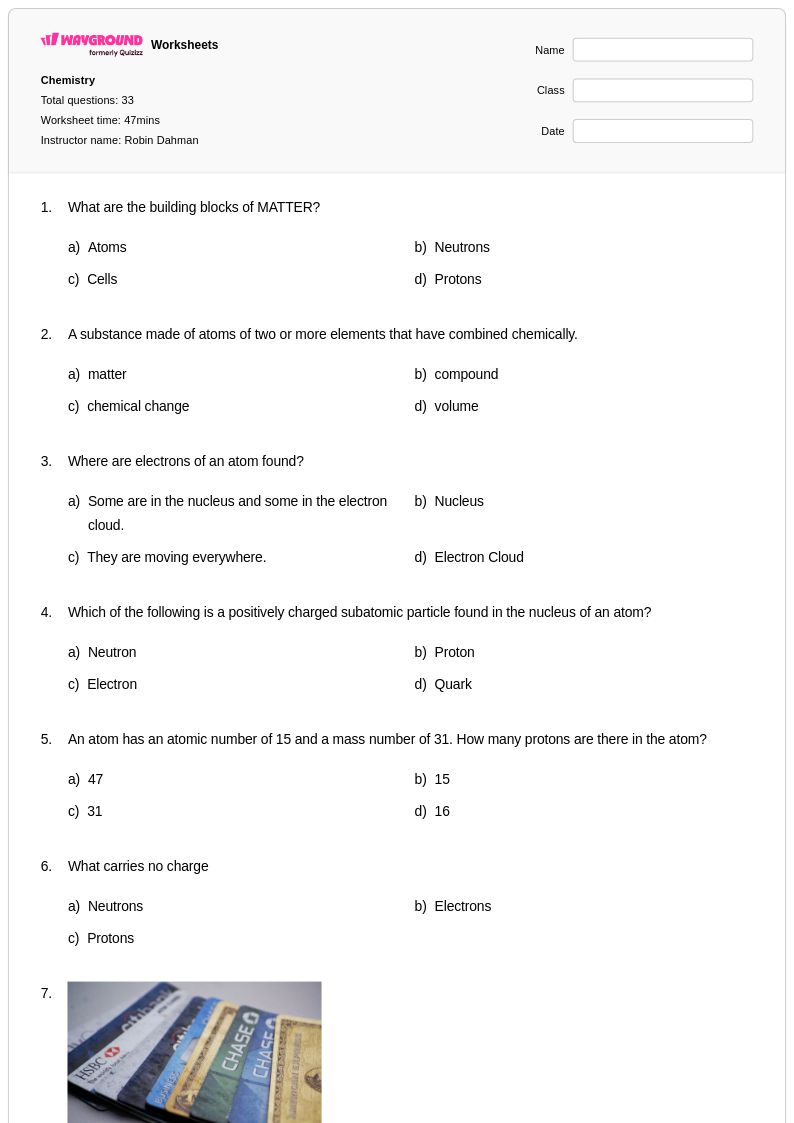
Oxidation reduction reactions represent one of the most fundamental and challenging concepts in chemistry, requiring students to master electron transfer processes, balancing complex equations, and identifying oxidizing and reducing agents. Wayground's extensive collection of oxidation reduction reaction worksheets provides comprehensive practice problems that systematically build student understanding of redox chemistry through carefully scaffolded exercises. These printable resources feature detailed answer keys that guide students through the step-by-step process of determining oxidation states, writing half-reactions, and balancing redox equations using both the half-reaction method and oxidation number approach. The free pdf worksheets cover essential topics including galvanic cells, electrolysis, common oxidizing and reducing agents, and real-world applications of redox chemistry, ensuring students develop both conceptual understanding and problem-solving proficiency.
Wayground, formerly Quizizz, empowers chemistry educators with millions of teacher-created oxidation reduction reaction resources that can be easily searched, filtered, and customized to meet diverse classroom needs. The platform's robust collection includes worksheets aligned with national and state chemistry standards, offering teachers flexibility to select materials appropriate for introductory through advanced chemistry courses. Educators can differentiate instruction by choosing from varying difficulty levels, modify existing worksheets to target specific learning objectives, and access both digital and printable pdf formats to accommodate different teaching environments. These comprehensive tools support effective lesson planning by providing ready-to-use practice problems for skill development, targeted remediation materials for struggling students, and enrichment activities that challenge advanced learners to apply redox principles in complex chemical scenarios.
FAQs
How do I teach oxidation-reduction reactions to chemistry students?
Start by grounding students in the concept of electron transfer before introducing oxidation states, since redox chemistry only clicks once students can track where electrons are going. Use the mnemonic OIL RIG (Oxidation Is Loss, Reduction Is Gain) early and reinforce it consistently. From there, progress from assigning oxidation numbers to identifying oxidizing and reducing agents, and finally to balancing full redox equations using the half-reaction method. Scaffolding these steps sequentially prevents students from conflating separate skills.
What exercises help students practice balancing redox equations?
The most effective practice sequence moves from assigning oxidation numbers in simple compounds, to writing and balancing half-reactions, to combining them into full redox equations in both acidic and basic solutions. Worksheets that require students to show each step explicitly, rather than just the final balanced equation, help surface errors in electron accounting before they become entrenched habits. Problems that mix the half-reaction method with the oxidation number method also build flexibility, which is essential for standardized exam performance.
What mistakes do students commonly make with oxidation-reduction reactions?
The most common error is misassigning oxidation states, particularly for elements in polyatomic ions or compounds where students incorrectly apply the rules hierarchy. Students also frequently forget to balance charge when combining half-reactions, adding water molecules or hydrogen ions inconsistently in acidic versus basic solutions. Another persistent misconception is confusing the oxidizing agent with the substance that is oxidized: the oxidizing agent is reduced, and students regularly invert this relationship. Targeted practice on each of these error types individually, before combining them, significantly reduces compounding mistakes.
How do I help students understand galvanic cells using worksheets?
Worksheets that pair a labeled cell diagram with structured questions about electron flow, ion migration through the salt bridge, and half-reaction identification are most effective for galvanic cell instruction. Students should practice calculating standard cell potential from half-reaction reduction potentials before attempting to predict spontaneity, since the numeric reasoning anchors the conceptual model. Problems that require students to identify the anode and cathode from the cell notation rather than the diagram build the abstract reading skill required for exam contexts.
How do I use Wayground's oxidation-reduction reactions worksheets in my class?
Wayground's oxidation-reduction reactions worksheets are available as printable PDFs for traditional classroom use and in digital formats for technology-integrated environments, accommodating different teaching setups and student preferences. You can also host any worksheet as a quiz directly on Wayground, which allows you to track student responses and identify error patterns in real time. Each worksheet includes a complete answer key, so students can self-check work during independent practice or you can use it for efficient grading. For students who need additional support, Wayground's accommodation settings allow you to enable Read Aloud, extended time, or reduced answer choices on an individual basis without alerting other students.
How do I differentiate redox chemistry instruction for students at different levels?
For students still developing foundational skills, begin with worksheets focused solely on assigning oxidation numbers and identifying which element is oxidized or reduced before introducing equation balancing. On-level students benefit from structured half-reaction practice with explicit scaffolding steps provided. Advanced students can be challenged with multi-step redox problems involving galvanic cell notation, electrolysis calculations, or real-world application scenarios such as corrosion or electroplating. Wayground allows teachers to filter resources by difficulty and apply individual accommodations, such as reduced answer choices or Read Aloud, to students who need additional support without disrupting the rest of the class.