Free Printable Stereochemistry of Alkene Additions Worksheets for Class 11
Explore Class 11 stereochemistry of alkene additions through Wayground's comprehensive collection of free worksheets and printables, featuring practice problems and answer keys to master spatial molecular arrangements and reaction mechanisms.
Explore printable Stereochemistry of Alkene Additions worksheets for Class 11
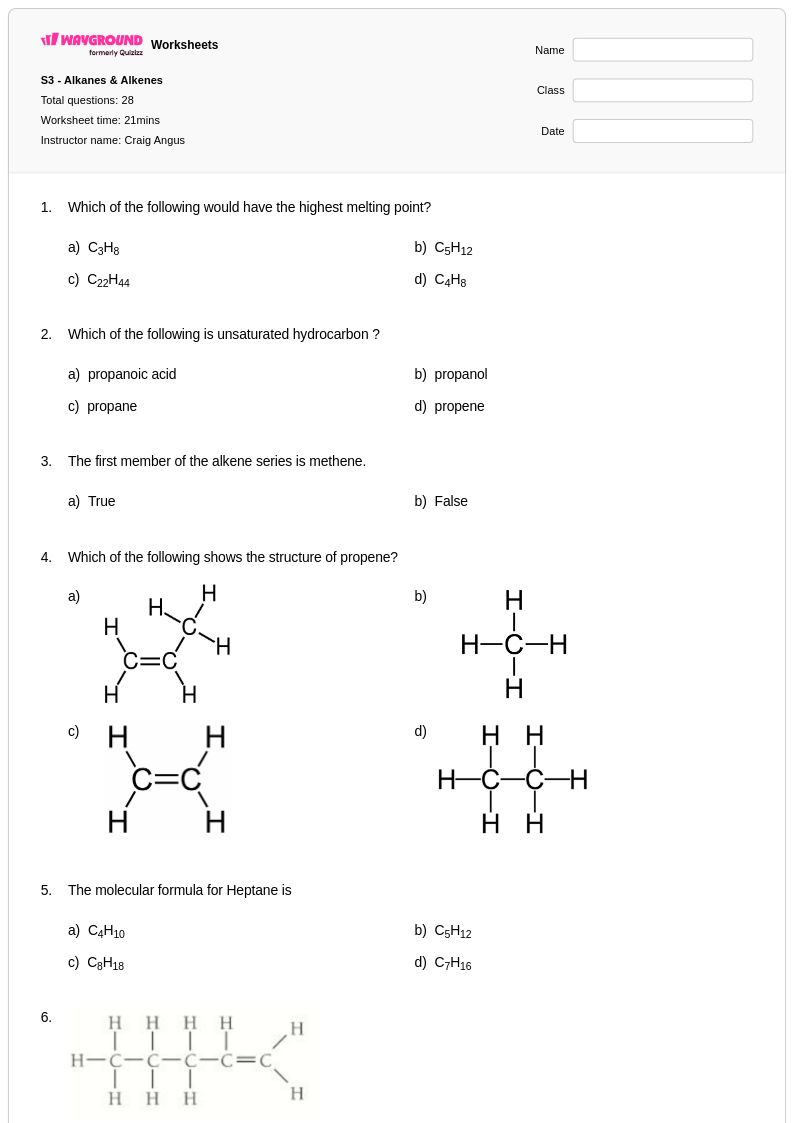
Stereochemistry of alkene additions represents a fundamental concept in Class 11 chemistry that challenges students to understand the three-dimensional aspects of organic reactions. Wayground's comprehensive collection of worksheets focuses specifically on this complex topic, providing students with structured practice problems that explore syn and anti addition mechanisms, regioselectivity, and stereoselectivity in reactions such as hydroboration-oxidation, epoxidation, and halogenation of alkenes. These carefully designed printables strengthen critical analytical skills by requiring students to predict reaction outcomes, draw three-dimensional molecular structures, and understand the spatial relationships that govern product formation. Each worksheet includes detailed answer keys that guide students through the step-by-step reasoning process, while the free pdf format ensures accessibility for both classroom instruction and independent study sessions.
Wayground, formerly Quizizz, empowers chemistry educators with millions of teacher-created resources specifically targeting stereochemistry concepts, supported by robust search and filtering capabilities that allow instructors to locate materials aligned with curriculum standards and learning objectives. The platform's differentiation tools enable teachers to customize worksheets according to individual student needs, whether for remediation of foundational concepts or enrichment activities for advanced learners. Available in both printable and digital formats, these resources facilitate flexible lesson planning and provide immediate access to high-quality practice materials that can be seamlessly integrated into laboratory discussions, homework assignments, or exam preparation sessions. The comprehensive nature of these worksheet collections supports systematic skill development in spatial reasoning and mechanistic understanding, essential competencies for success in advanced organic chemistry coursework.
FAQs
How do I teach stereochemistry of alkene additions effectively?
Start by grounding students in the distinction between syn and anti addition mechanisms before introducing specific reactions like hydroboration-oxidation, halogenation, and epoxidation. Use 3D models or drawings to make the spatial arrangement of atoms tangible before moving to 2D representations. Once students can visualize the approach of a reagent to a double bond, they can begin predicting stereochemical outcomes rather than memorizing them. Connecting mechanism to geometry is the key pedagogical move — students who understand why a reaction proceeds syn or anti will make far fewer errors on product prediction.
What exercises help students practice stereochemistry of alkene additions?
The most effective practice exercises ask students to draw the full stereochemical outcome of a reaction, including wedge-dash notation and the correct designation of stereocenters as R or S. Problems that compare mechanistically related reactions — for example, halogenation versus epoxidation — help students distinguish anti from syn addition in context. Graduated problem sets that begin with single stereocenters and progress to products with two or more stereocenters build confidence systematically. Including questions that ask students to explain their reasoning, not just draw a product, deepens mechanistic understanding.
What mistakes do students commonly make with stereochemistry of alkene additions?
The most persistent error is conflating regioselectivity with stereoselectivity — students often know which carbon receives a group but fail to account for the facial selectivity of the addition. A second common mistake is drawing syn and anti products interchangeably without tying the outcome to the mechanism. Students also frequently misassign R/S configuration to newly formed stereocenters because they rush the priority assignment step. Targeted practice that explicitly requires mechanism-to-product reasoning, rather than pattern matching, is the most effective way to address these misconceptions.
How do I use Wayground's stereochemistry of alkene additions worksheets in my class?
Wayground's stereochemistry of alkene additions worksheets are available as printable PDFs for traditional classroom use and in digital formats for technology-integrated learning environments, giving you flexibility depending on your setting. You can distribute the PDF version for in-class problem sets or assign the digital version for homework and independent review. Wayground also allows you to host worksheets as a quiz directly on the platform, which makes it easy to track student responses and identify where misconceptions persist. Complete answer keys are included with every worksheet, so students working independently have access to detailed explanations, not just final answers.
How do I differentiate stereochemistry instruction for students with different levels of organic chemistry background?
For students newer to organic chemistry, begin with reactions that produce a single stereocenter before introducing reactions that generate two stereocenters and diastereomeric relationships. More advanced students benefit from problems that require them to predict whether a reaction will yield a racemic mixture, a meso compound, or a single enantiomer, and to justify that prediction mechanistically. On Wayground, teachers can apply accommodations such as reduced answer choices to lower cognitive load for students who are still building fluency, or enable Read Aloud for students who benefit from audio support while reading complex reaction prompts.
How do syn and anti additions differ in terms of stereochemical outcomes?
In a syn addition, both groups are delivered to the same face of the double bond, resulting in a cis relationship between the added substituents on the product. Anti addition delivers the two groups to opposite faces, yielding a trans relationship. For reactions with two stereocenters, syn addition typically produces either a meso compound or a pair of enantiomers, while anti addition produces the opposite diastereomeric pair — the specific outcome depends on the geometry of the starting alkene. Understanding this distinction is central to correctly predicting the stereochemical outcome of any alkene addition reaction.