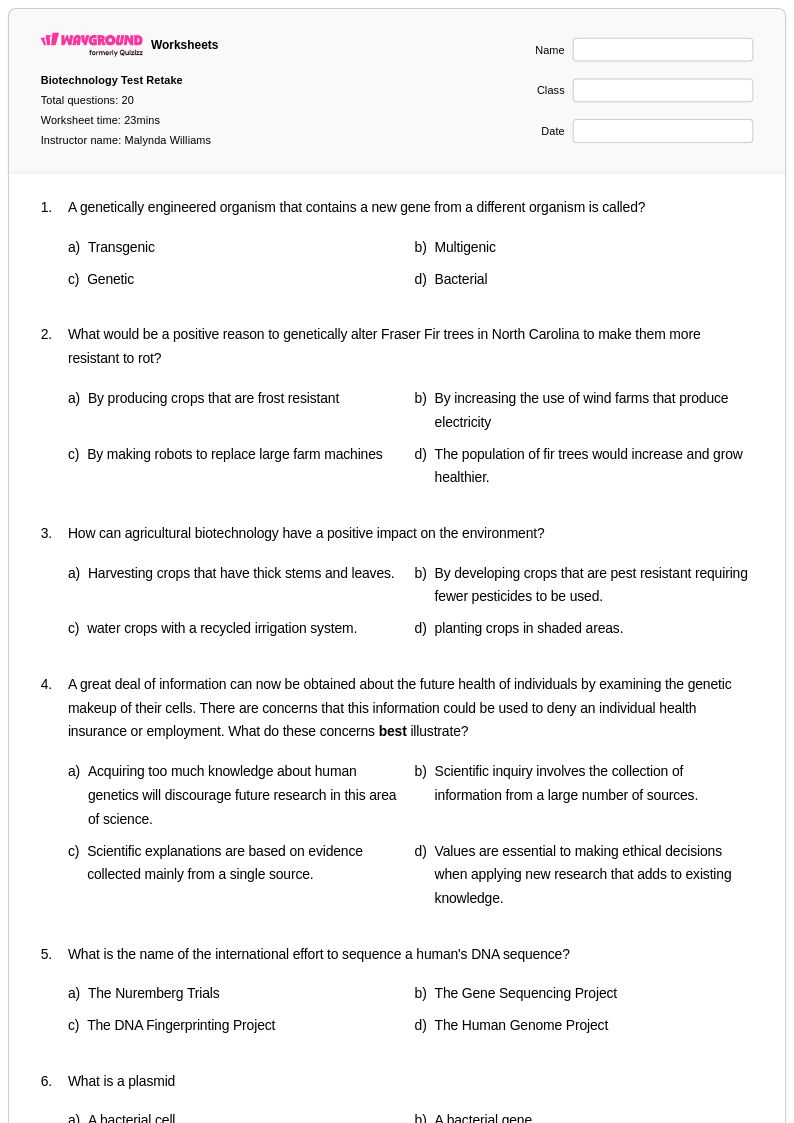
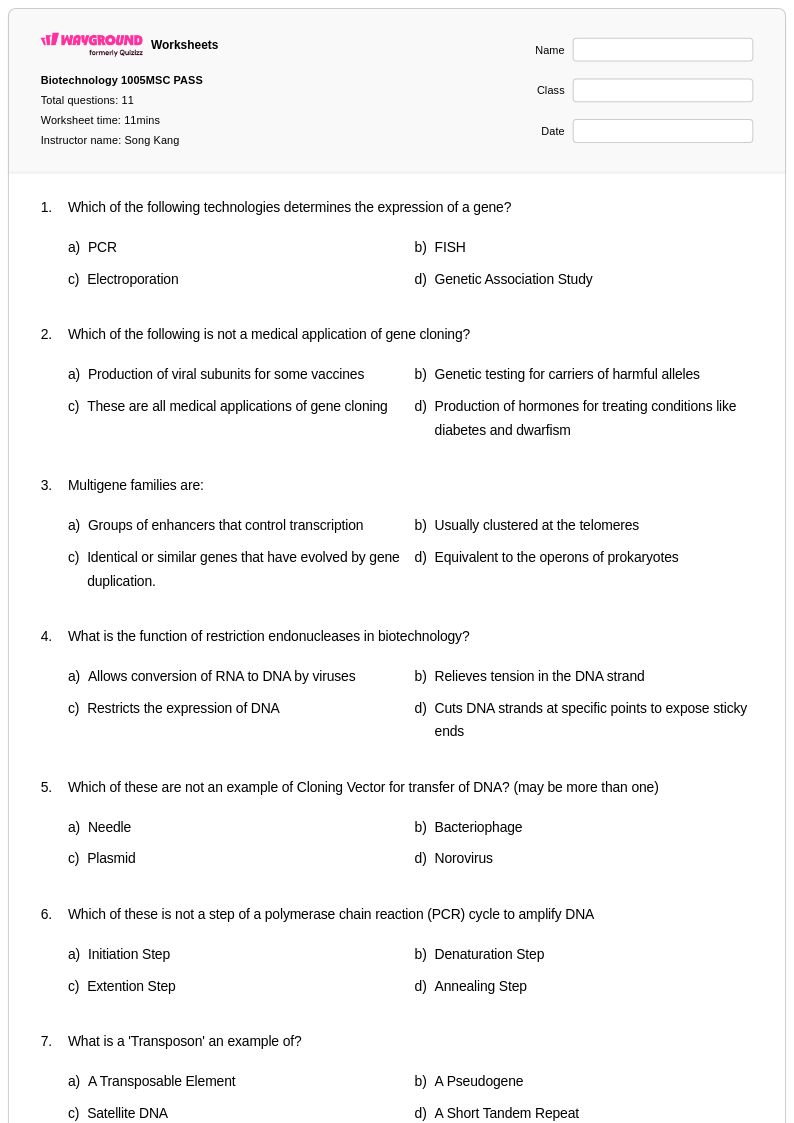
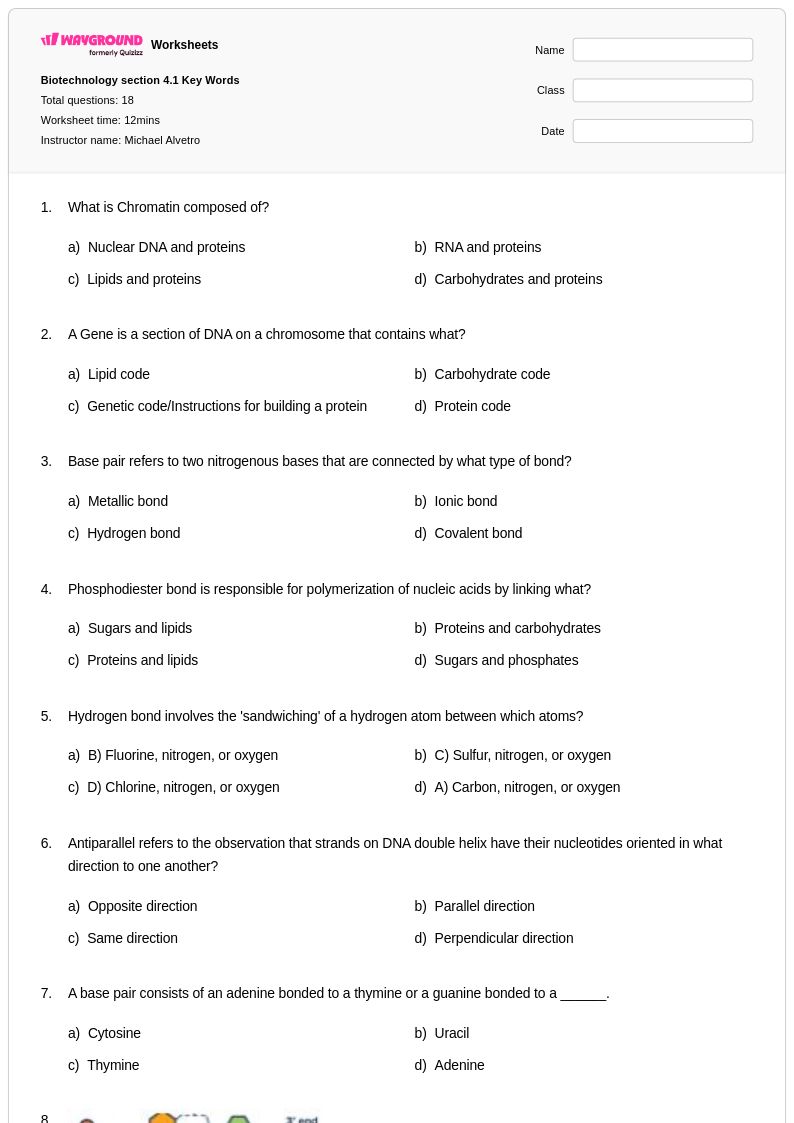
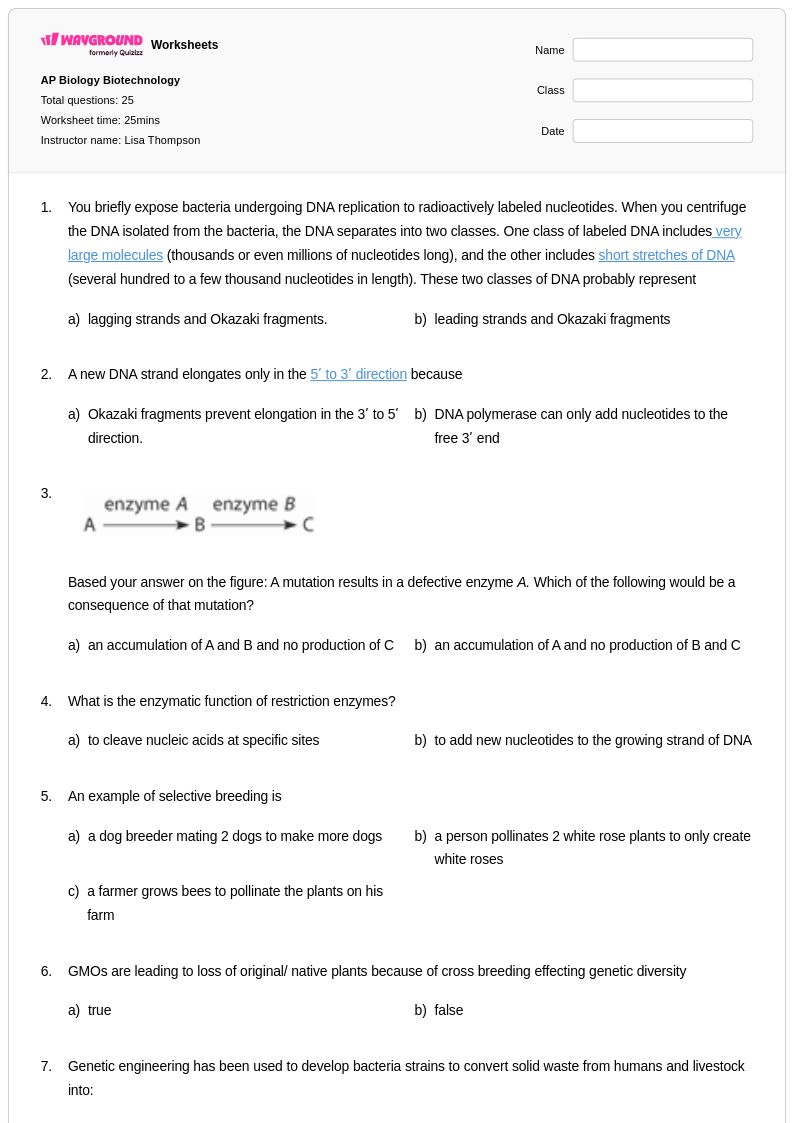
Explore Wayground's comprehensive collection of biotechnology worksheets and printables that help students master genetic engineering, molecular biology, and biomedical applications through engaging practice problems, free PDF resources, and detailed answer keys.
Biotechnology worksheets available through Wayground (formerly Quizizz) provide comprehensive coverage of this rapidly evolving field that combines biological sciences with technological applications. These expertly crafted educational resources help students master fundamental concepts including genetic engineering, recombinant DNA technology, enzyme applications, fermentation processes, and biomedical innovations. Students develop critical thinking skills as they work through practice problems involving gene cloning, protein synthesis, bioremediation techniques, and pharmaceutical development. Each worksheet comes with a detailed answer key to support independent learning and self-assessment, while the free printable format ensures accessibility for all learners. The pdf resources cover both traditional biotechnology applications like brewing and agriculture, as well as cutting-edge advances in CRISPR gene editing, stem cell research, and personalized medicine.
Wayground (formerly Quizizz) empowers educators with millions of teacher-created biotechnology resources that streamline lesson planning and enhance student engagement across diverse learning environments. The platform's robust search and filtering capabilities allow teachers to quickly locate worksheets aligned with specific curriculum standards and learning objectives, whether focusing on basic biotechnology principles or advanced molecular techniques. Comprehensive differentiation tools enable instructors to customize content difficulty and complexity to meet individual student needs, supporting both remediation for struggling learners and enrichment opportunities for advanced students. The flexible digital and printable formats facilitate seamless integration into classroom instruction, homework assignments, and laboratory exercises, while the extensive collection ensures teachers have access to current, scientifically accurate materials that reflect the latest developments in biotechnology research and applications.
FAQs
How do I teach biotechnology in a high school biology class?
Effective biotechnology instruction begins with foundational concepts like DNA structure and protein synthesis before introducing applied techniques such as recombinant DNA technology, gene cloning, and CRISPR gene editing. Teachers should connect each technique to real-world applications in medicine, agriculture, and environmental science to make abstract molecular processes concrete. Structured worksheets that progress from basic principles to complex applications help students build conceptual understanding systematically before tackling ethical and societal dimensions of the field.
What are the most important biotechnology concepts students need to understand?
Core concepts include genetic engineering, recombinant DNA technology, enzyme applications, fermentation, and biomedical innovations such as pharmaceutical development and stem cell research. Students also need a working understanding of gene cloning, protein synthesis, and bioremediation techniques to engage meaningfully with both traditional and cutting-edge biotechnology. Grounding students in both classical applications like brewing and agriculture and modern advances like CRISPR and personalized medicine gives them the full scope of the field.
What exercises help students practice biotechnology skills and concepts?
Practice problems that walk students through gene cloning sequences, recombinant DNA construction, and protein synthesis pathways are particularly effective for reinforcing procedural understanding. Application-based exercises connecting biotechnology techniques to scenarios in pharmaceutical development, bioremediation, or agricultural modification deepen conceptual transfer. Worksheets that incorporate both traditional biotechnology processes and contemporary innovations like CRISPR ensure students engage with the breadth of the field rather than isolated topics.
What mistakes do students commonly make when learning biotechnology?
Students frequently confuse the roles of restriction enzymes and ligases in recombinant DNA technology, or misapply the steps of gene cloning out of sequence. Another common error is conflating general genetic concepts like transcription and translation with their specific applications in biotechnology contexts, such as how protein synthesis is exploited in pharmaceutical production. Students also tend to overgeneralize CRISPR as a simple find-and-replace tool without understanding the molecular mechanisms or limitations involved.
How can I differentiate biotechnology instruction for students at different skill levels?
For students who need additional support, simplified worksheets focusing on foundational vocabulary and basic genetic engineering principles provide scaffolding before introducing complex molecular techniques. Advanced students benefit from enrichment problems involving multi-step gene cloning scenarios, ethical analysis of CRISPR applications, or comparative study of personalized medicine strategies. On Wayground, teachers can apply individual accommodations such as reduced answer choices to lower cognitive load for struggling learners, or extended time settings, while other students complete the same activity under standard conditions.
How do I use Wayground's biotechnology worksheets in my classroom?
Wayground's biotechnology worksheets are available as printable PDFs, making them straightforward to distribute during class, assign as homework, or incorporate into lab sessions. They are also available in digital formats for technology-integrated classrooms, and teachers can host any worksheet as a live or self-paced quiz directly on Wayground. Each worksheet includes a detailed answer key, supporting both teacher-led correction and independent student self-assessment. The range of topics covered, from fermentation and enzyme applications to CRISPR and stem cell research, allows teachers to select resources aligned to their specific unit focus without building materials from scratch.