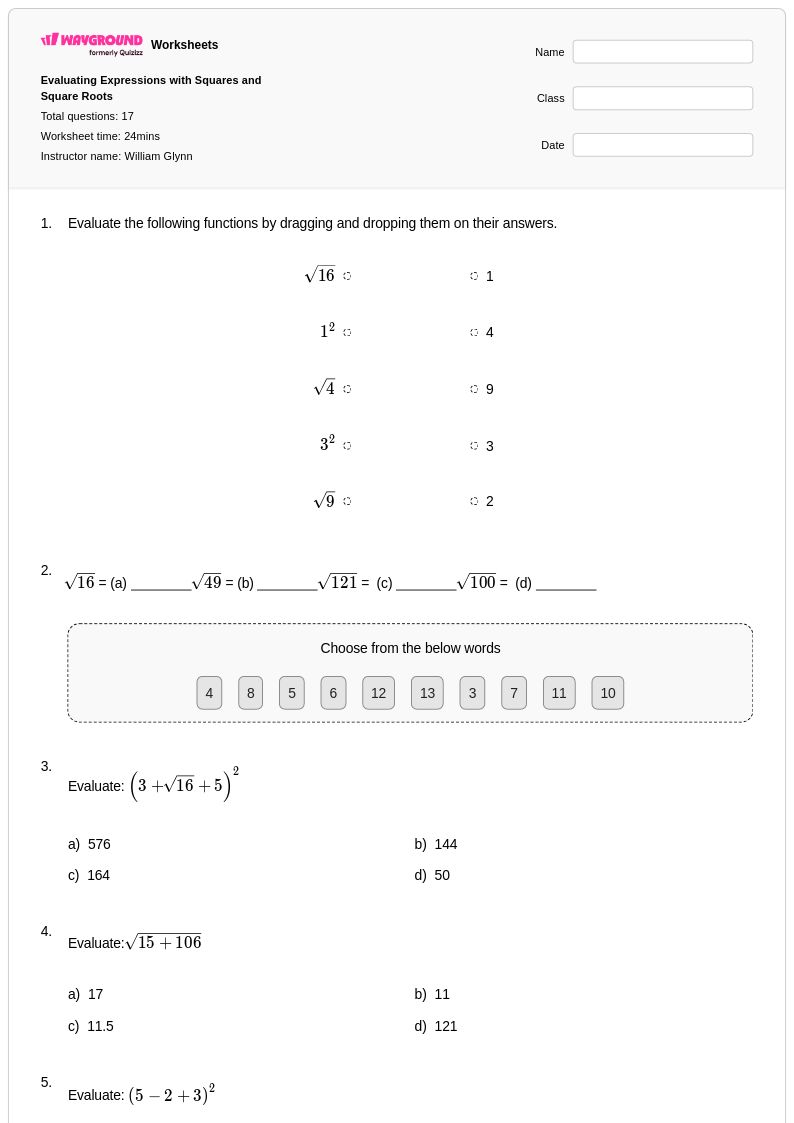
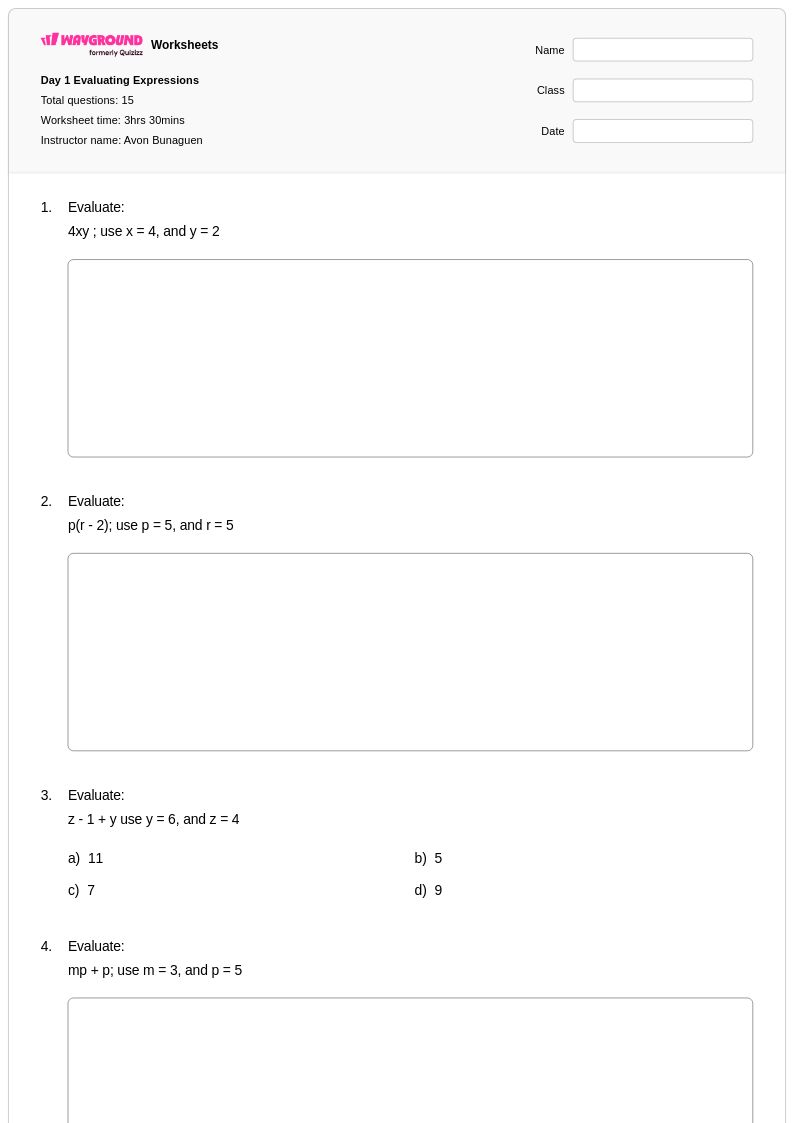
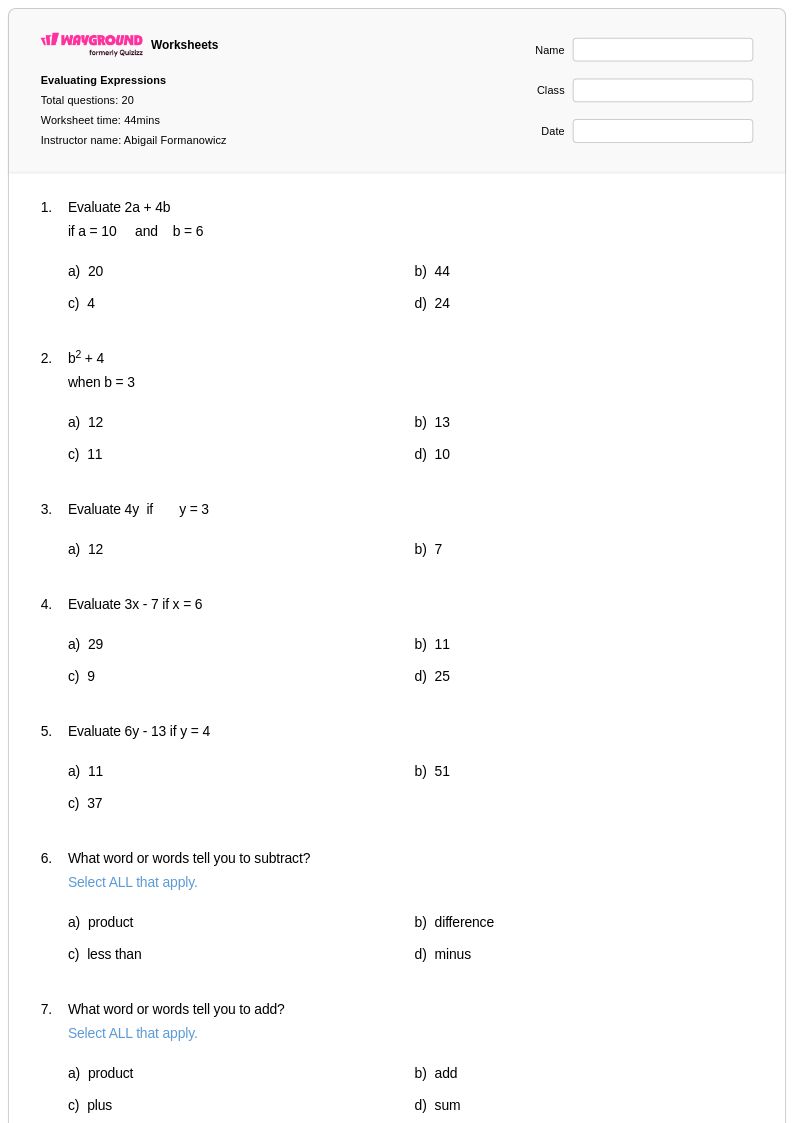
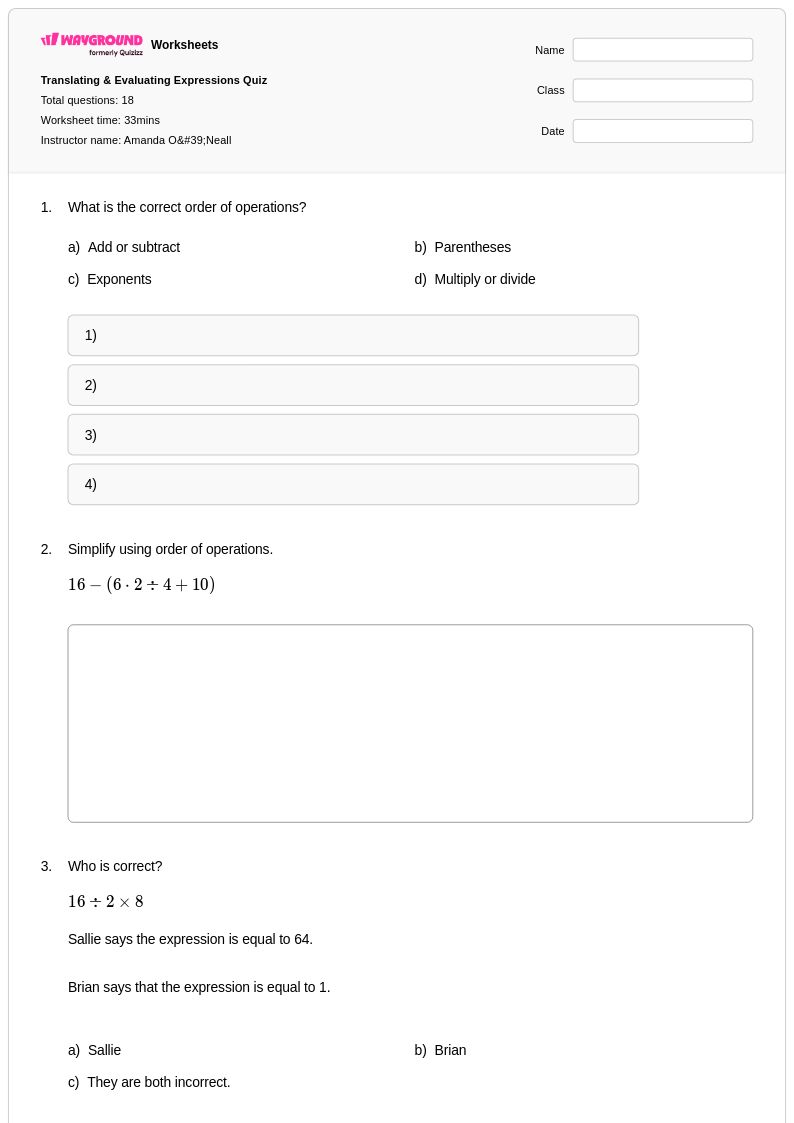
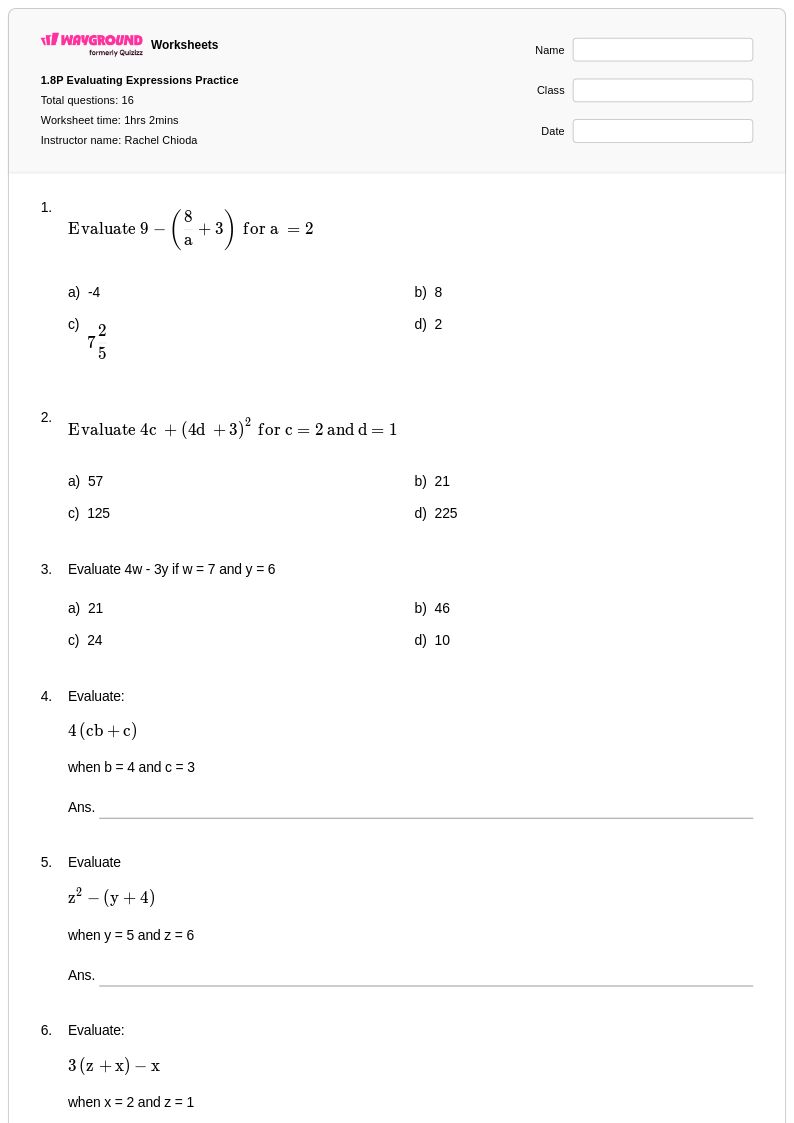
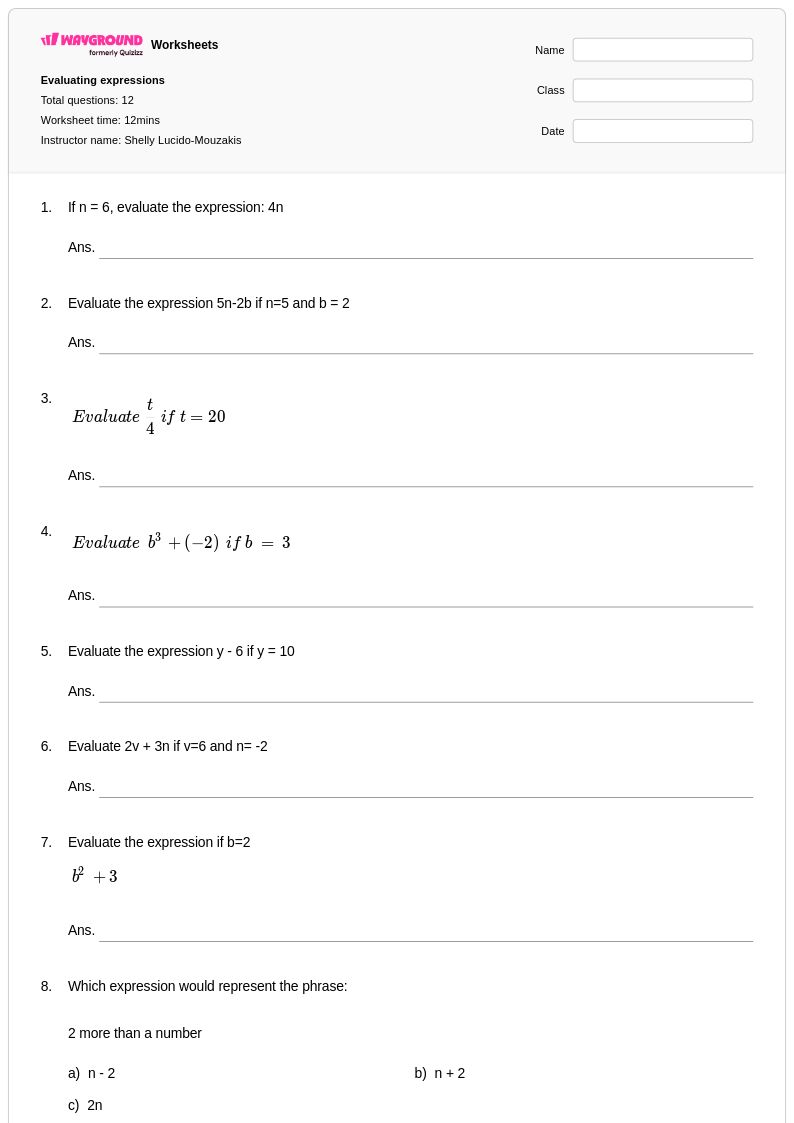
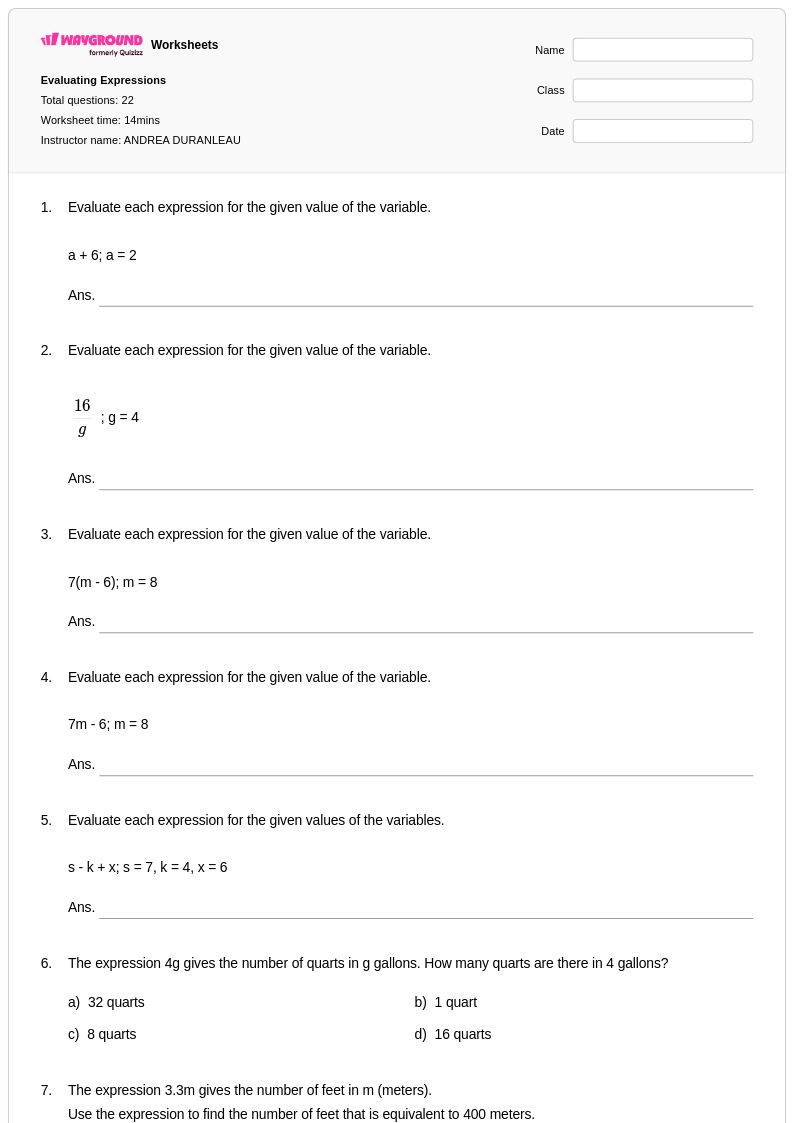
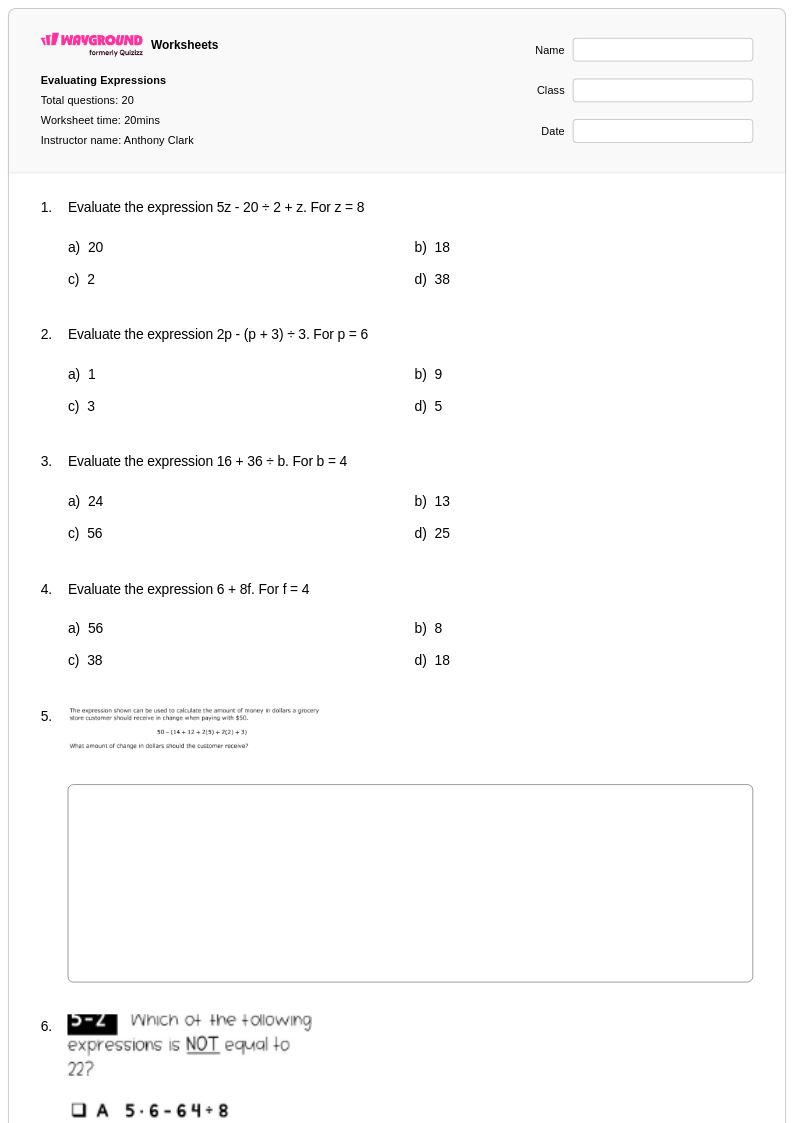
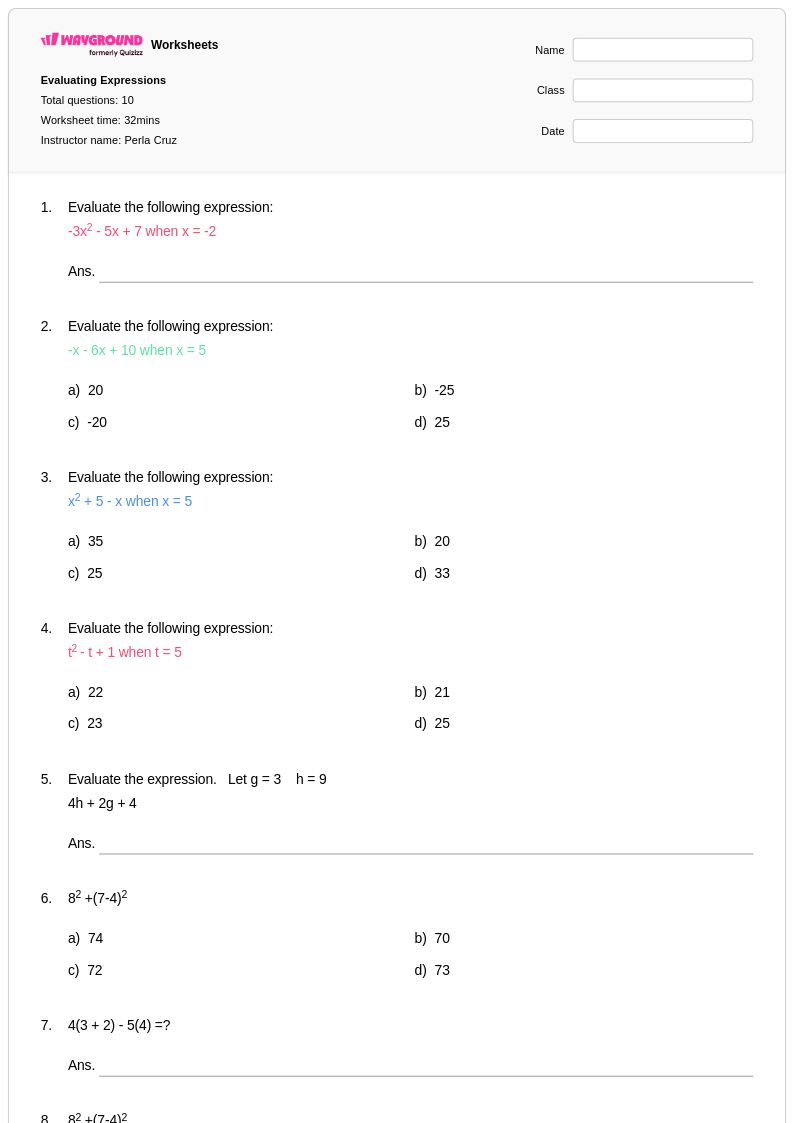
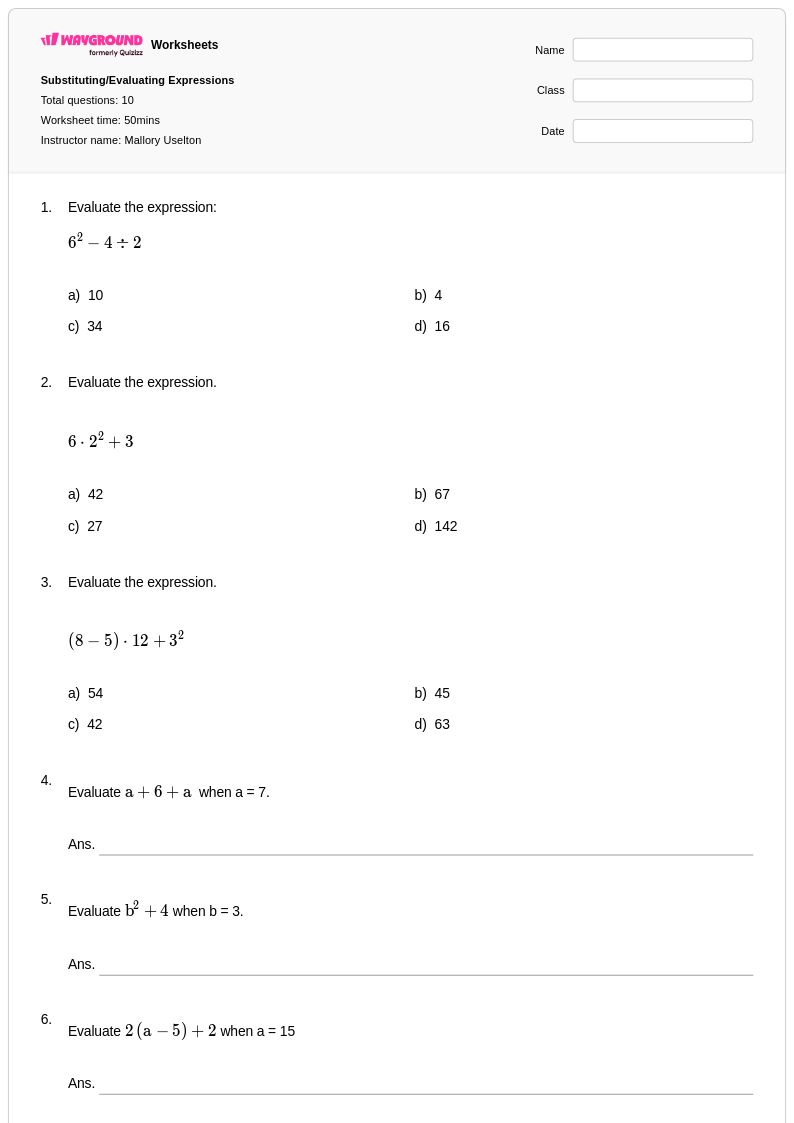
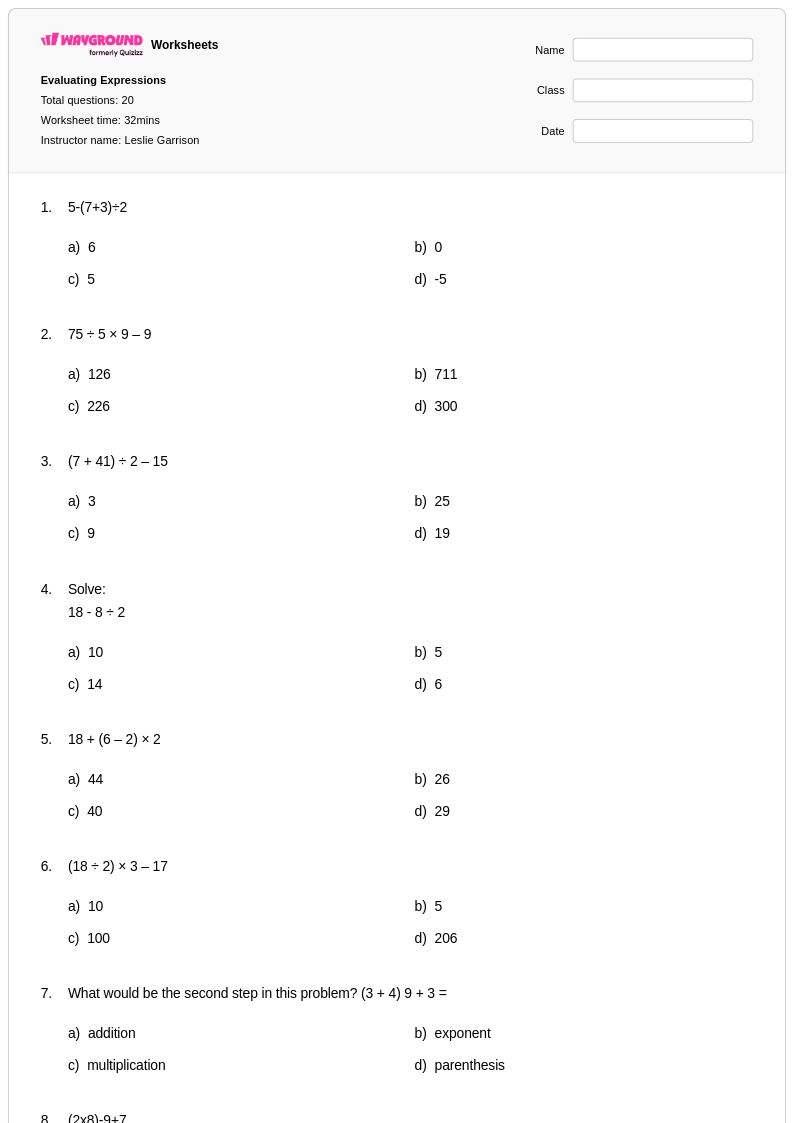
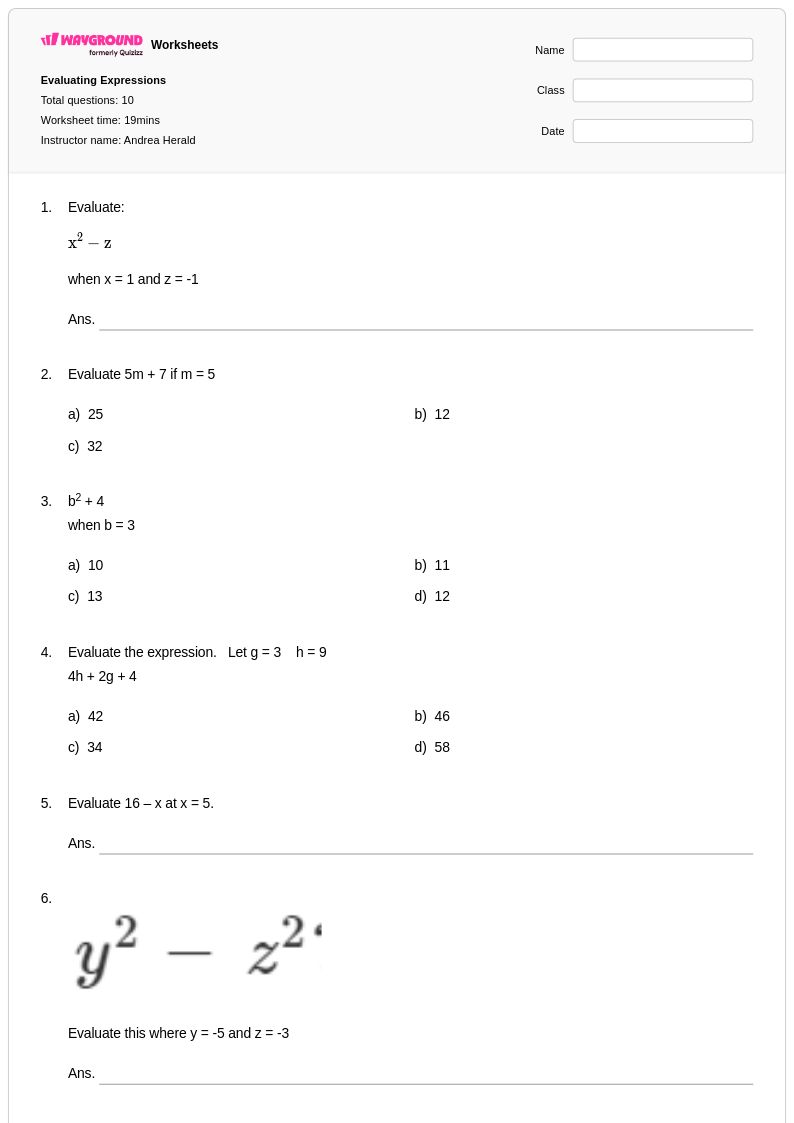
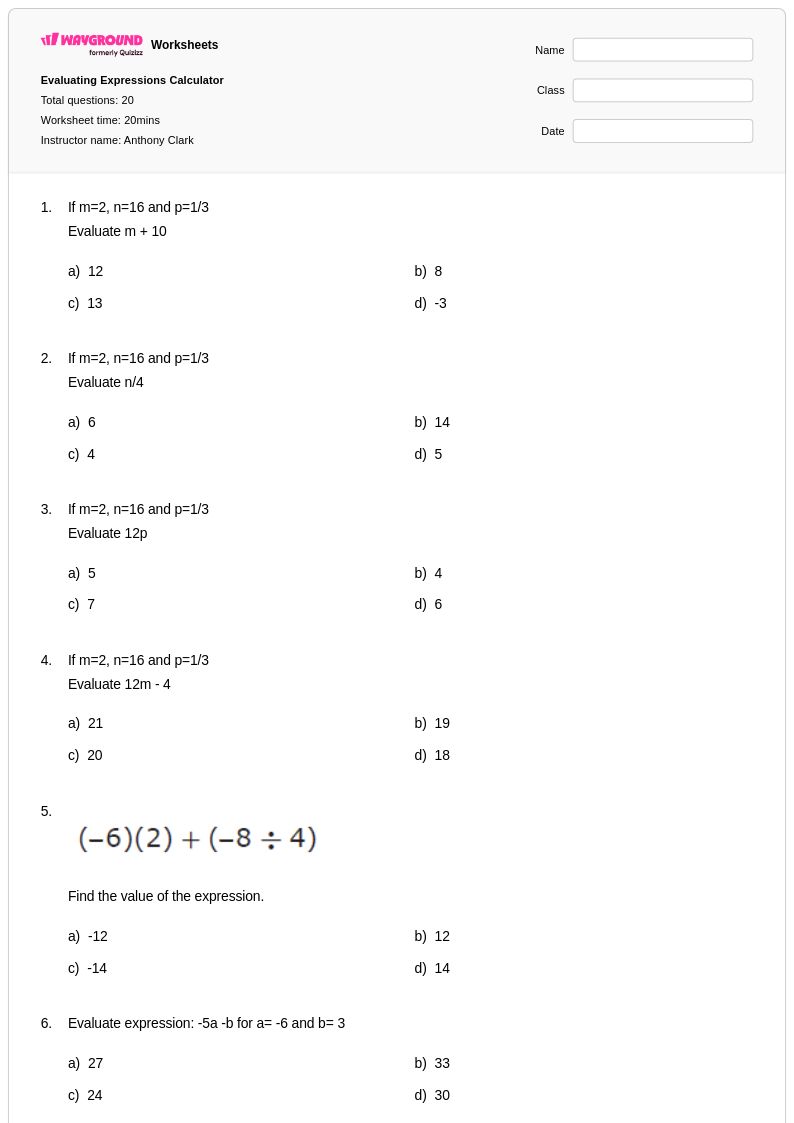
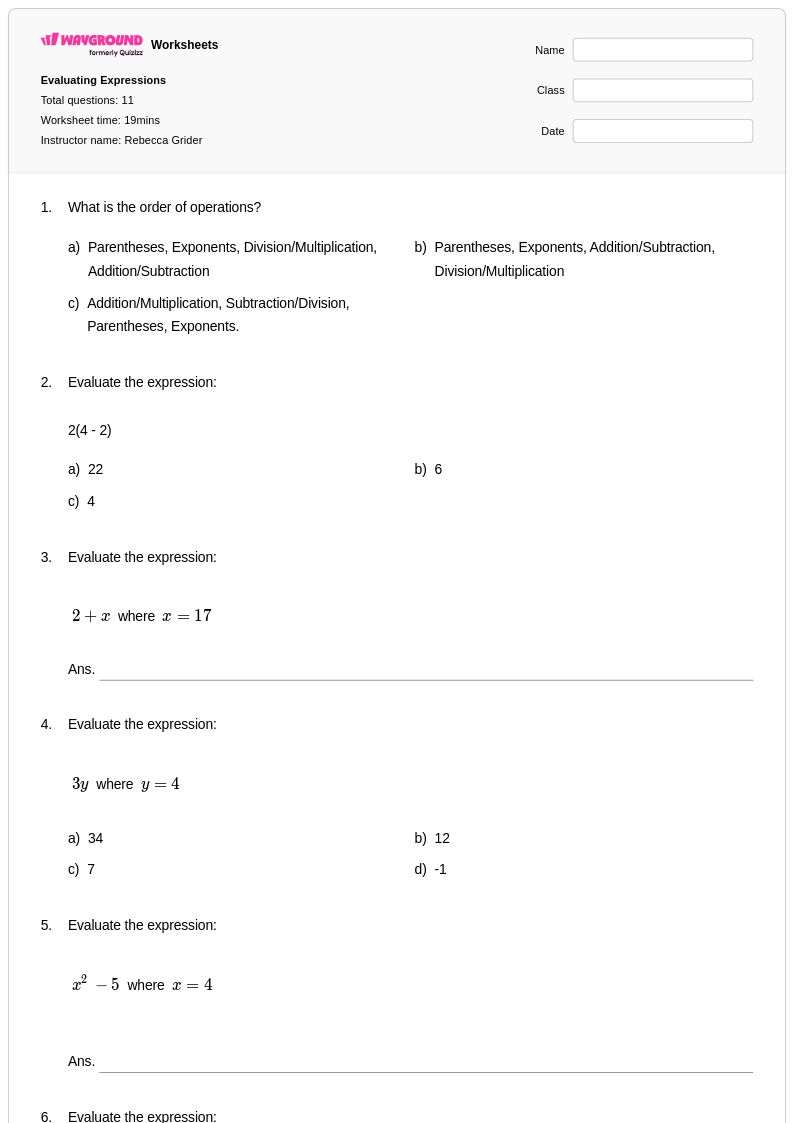
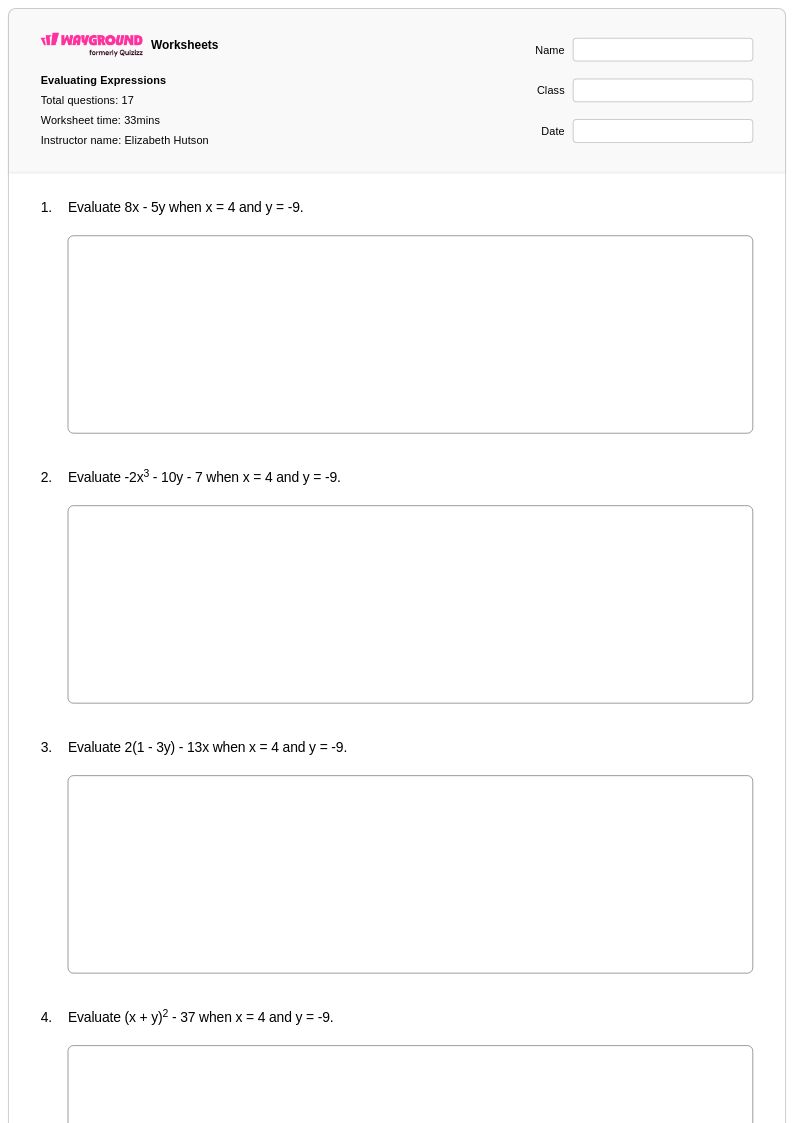
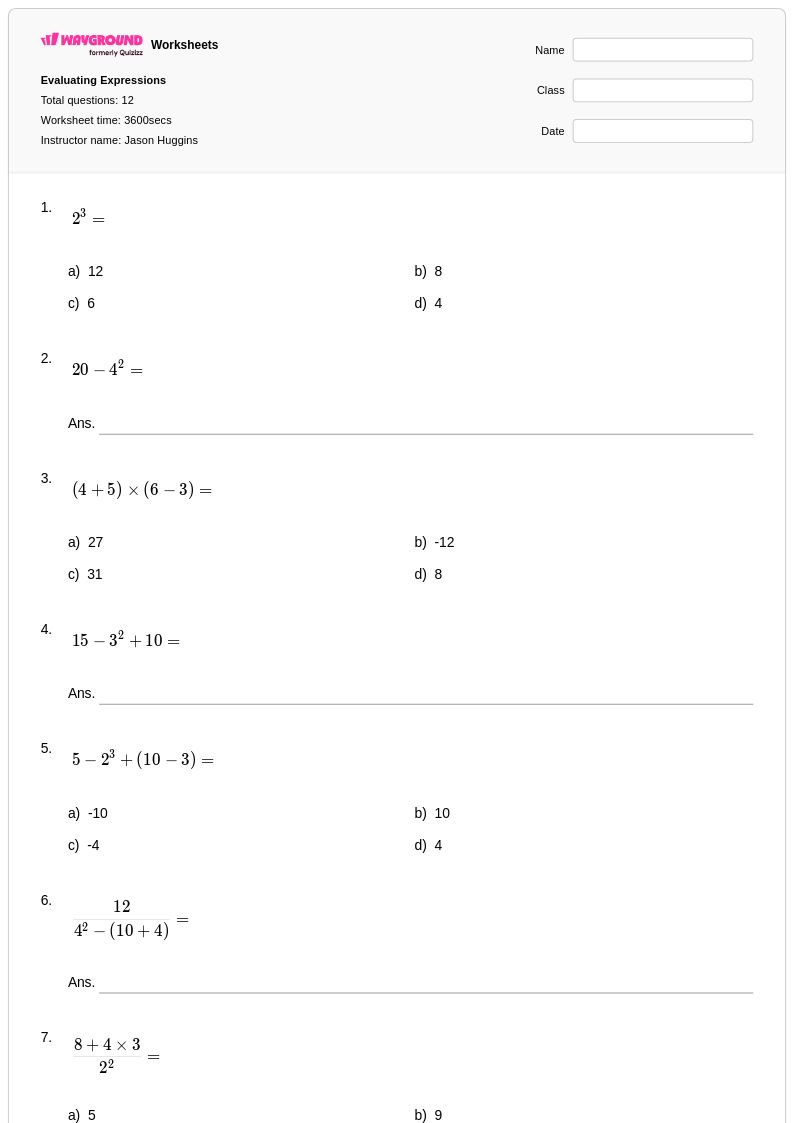
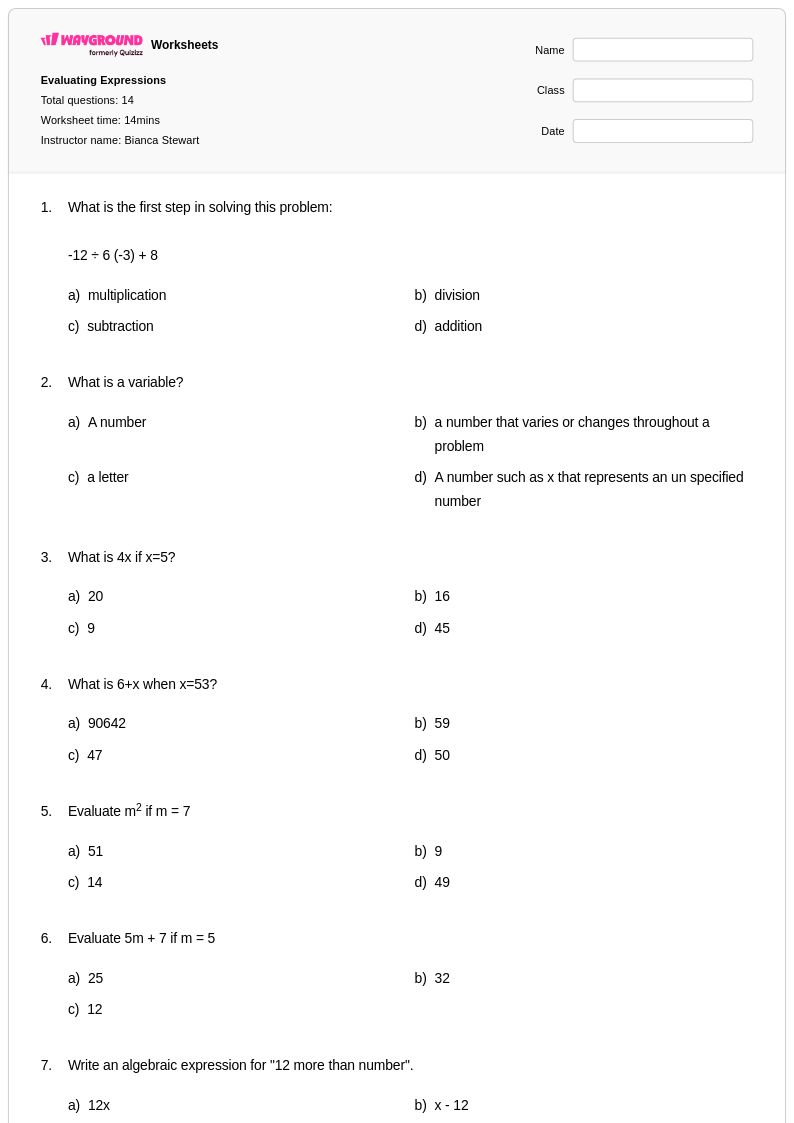
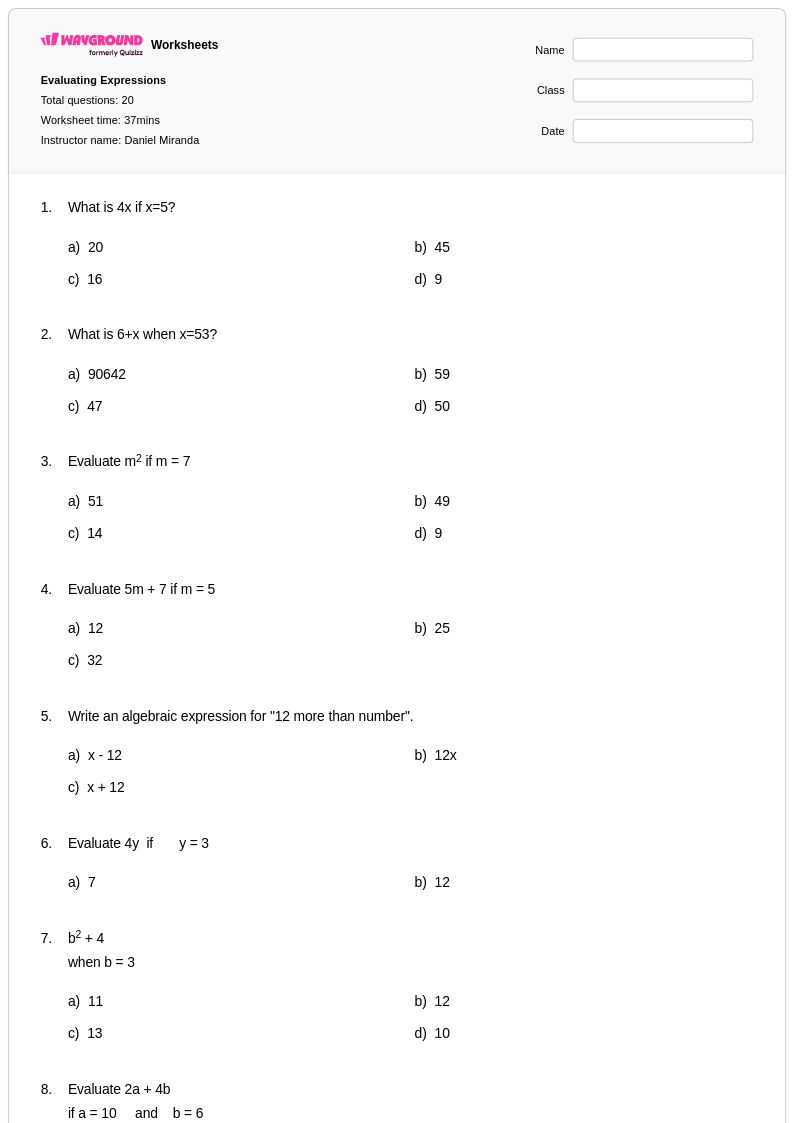
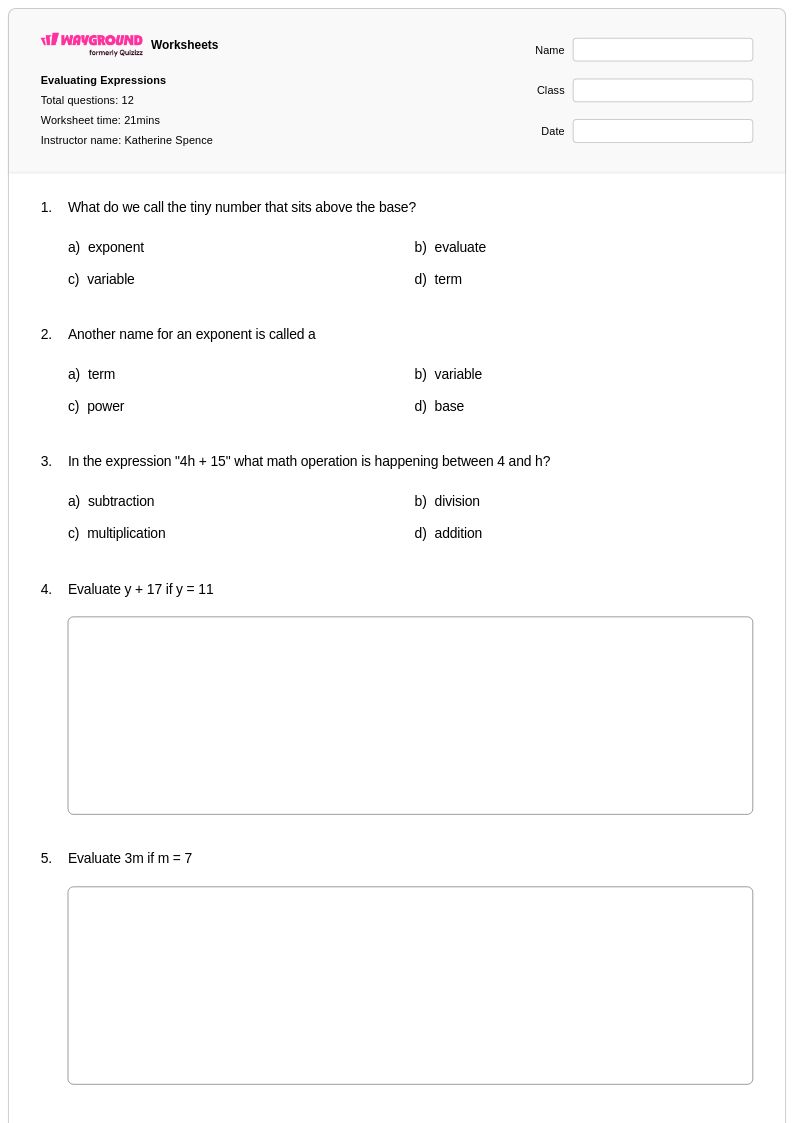
Evaluating expressions worksheets available through Wayground (formerly Quizizz) provide comprehensive practice opportunities for students to master this fundamental algebraic skill. These carefully designed worksheets guide students through the systematic process of substituting values for variables and applying the correct order of operations to calculate numerical results. Students develop critical mathematical reasoning as they work through diverse practice problems that range from simple single-variable expressions to complex multi-variable algebraic statements. Each worksheet includes a complete answer key and is available as a free printable pdf, making it easy for educators to incorporate meaningful expression evaluation practice into their mathematics instruction while providing students with immediate feedback on their computational accuracy.
Wayground (formerly Quizizz) empowers teachers with an extensive collection of millions of teacher-created evaluating expressions worksheets that streamline lesson planning and differentiated instruction. The platform's robust search and filtering capabilities allow educators to quickly locate materials that align with specific mathematical standards and match their students' current skill levels. Teachers can easily customize existing worksheets or create entirely new practice sets, with options for both printable pdf formats and interactive digital versions that accommodate diverse learning preferences. These flexible resources support comprehensive mathematics education by enabling targeted remediation for struggling students, enrichment opportunities for advanced learners, and consistent skill practice that reinforces proper expression evaluation techniques across varied mathematical contexts.
FAQs
How do I teach evaluating expressions?
Start with the concept of a variable as a placeholder, then walk students through substitution before layering in order of operations. A common sequence: evaluate single-variable expressions with whole numbers first, then introduce parentheses and exponents, then move to multi-variable problems. Keeping substitution and order-of-operations as two distinct, explicit steps — rather than one blended process — helps students avoid the most common errors early on.
What exercises help students practice evaluating expressions?
The most effective practice moves from simple to complex in a deliberate order: single-variable expressions with integers, then expressions involving fractions or decimals, then multi-variable problems with exponents and nested parentheses. Mixing in error-analysis problems — where students identify and correct a worked example with a mistake — builds the kind of careful checking that pure computation drills don't.
What mistakes do students commonly make when evaluating expressions?
Three errors come up constantly: substituting the value but then ignoring order of operations (adding before multiplying, for example), mishandling negative values after substitution (especially when the variable is squared), and treating a coefficient like 3x as 3+x rather than 3×x. Targeted practice that isolates each of these — rather than mixing all problem types from the start — helps students catch and correct the specific habit causing their errors.
How do I use Wayground's evaluating expressions worksheets in my class?
Each worksheet comes with a complete answer key, so students can check their own work during independent practice. You can run it as a digital quiz hosted on Wayground, or download the printable PDF for paper-based practice — useful for schools managing screen time or for low-tech settings. If you go the print route, the Wayground for Teachers app lets you scan or capture student submissions for grading without re-entering everything by hand.
How does evaluating expressions fit into the algebra curriculum?
In Common Core math, evaluating expressions is the entry point into algebraic reasoning — students first encounter it when they learn to read and write expressions using variables, before they ever solve equations. Mastering substitution and order of operations here is what makes solving one-step and two-step equations accessible later, because students already understand what it means to find the value of an expression for a given input. Without this foundation, equation-solving tends to become rote symbol manipulation rather than meaningful reasoning.
How can I differentiate evaluating expressions practice for mixed-ability classes?
For students who struggle, reducing the number of answer choices on digital questions lowers cognitive load while they're still building fluency with substitution. The Read Aloud accommodation helps students who have difficulty parsing multi-step written expressions independently. On the worksheet itself, you can apply a larger font size or wider spacing for students who lose their place mid-problem — small formatting changes that make a real difference without altering the math.