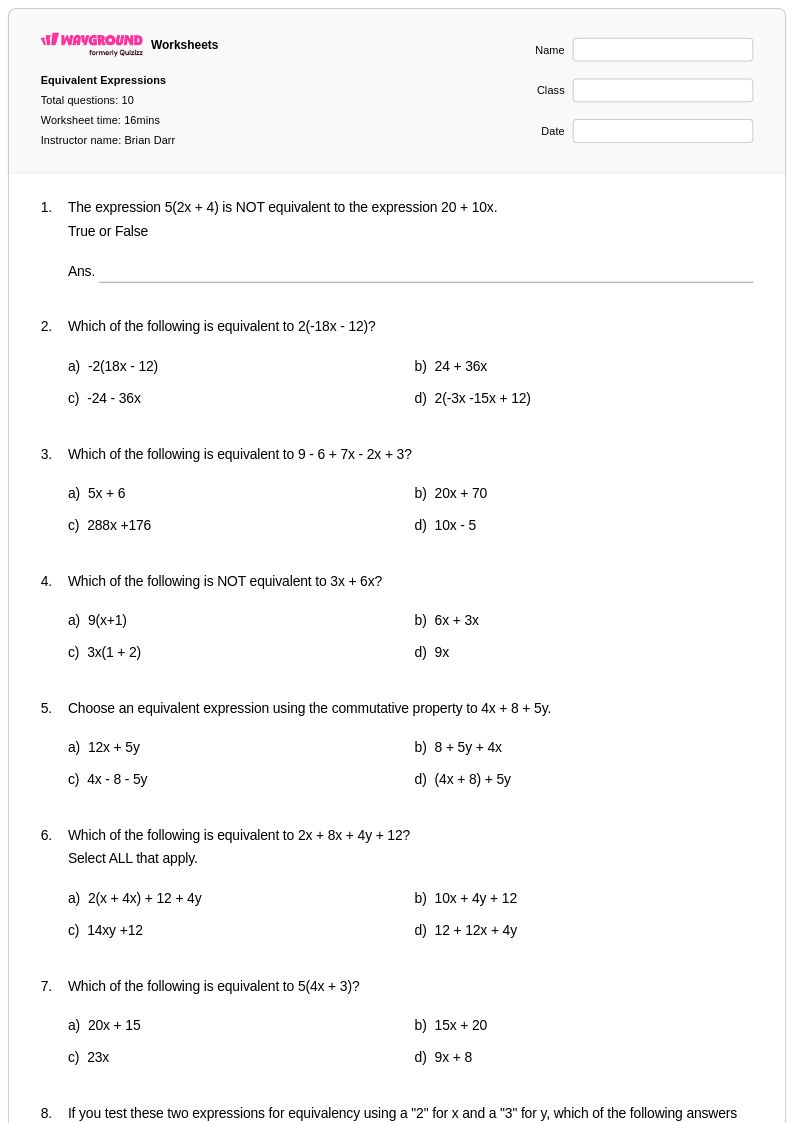
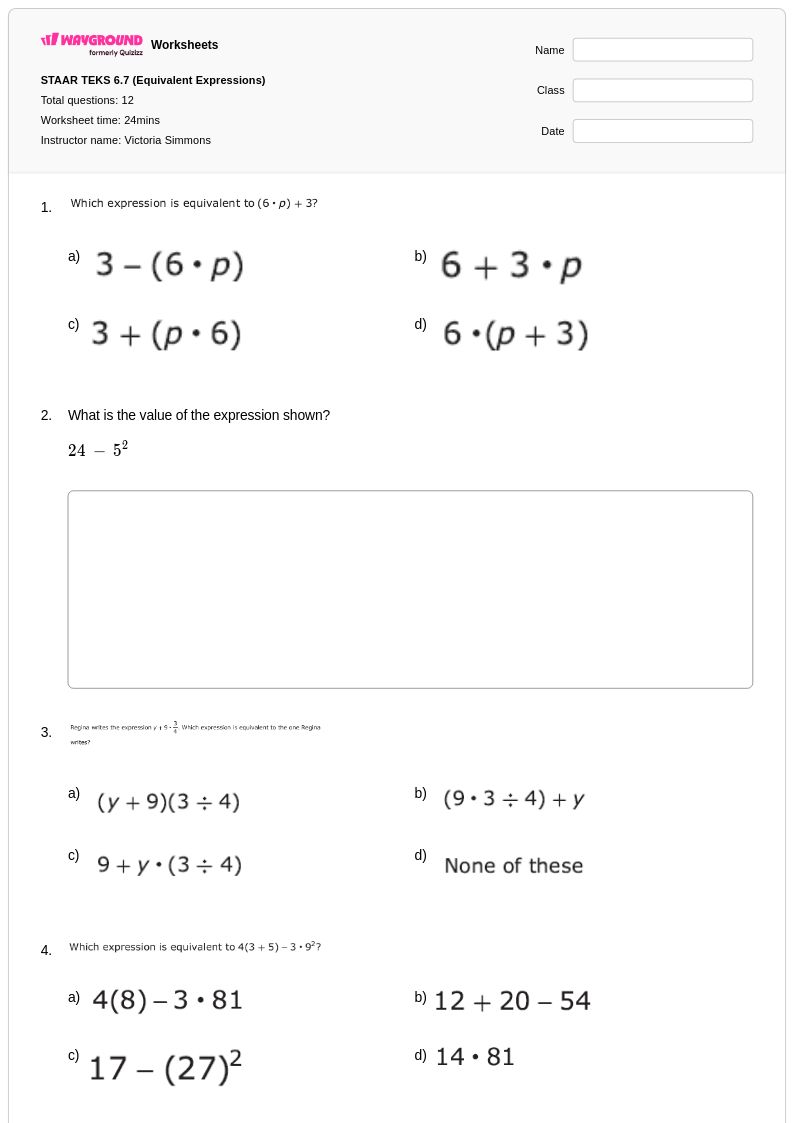
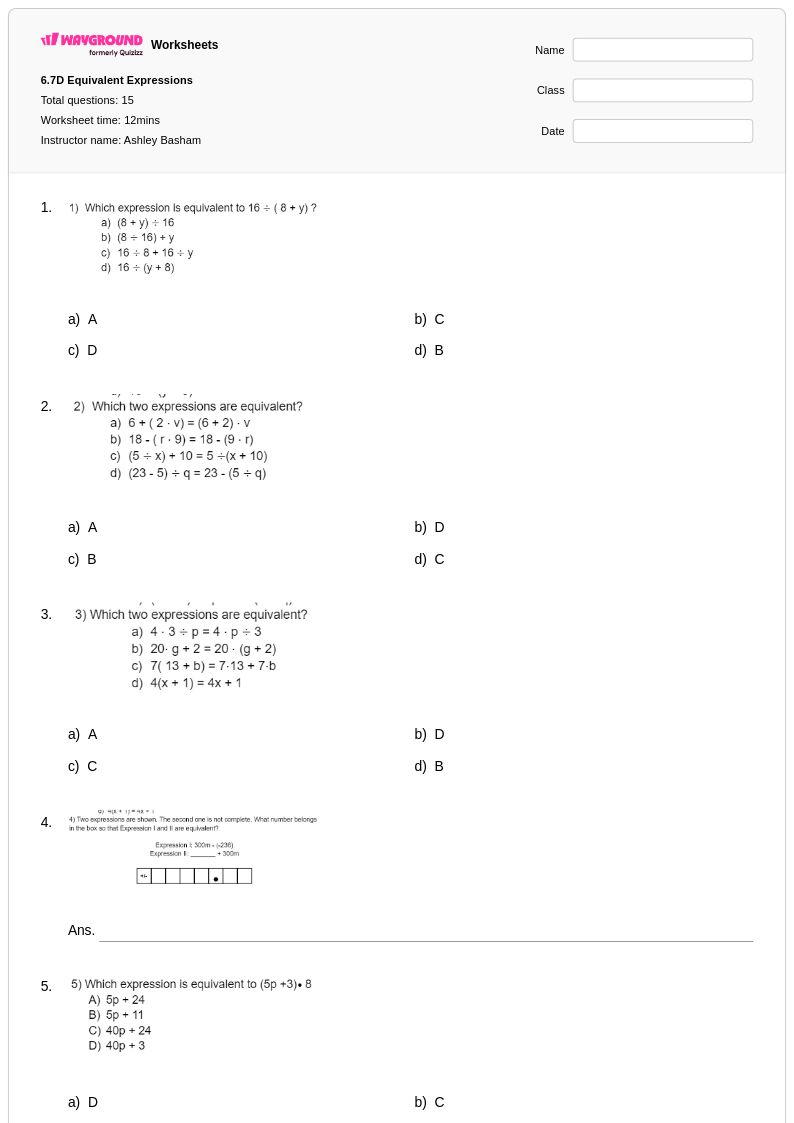
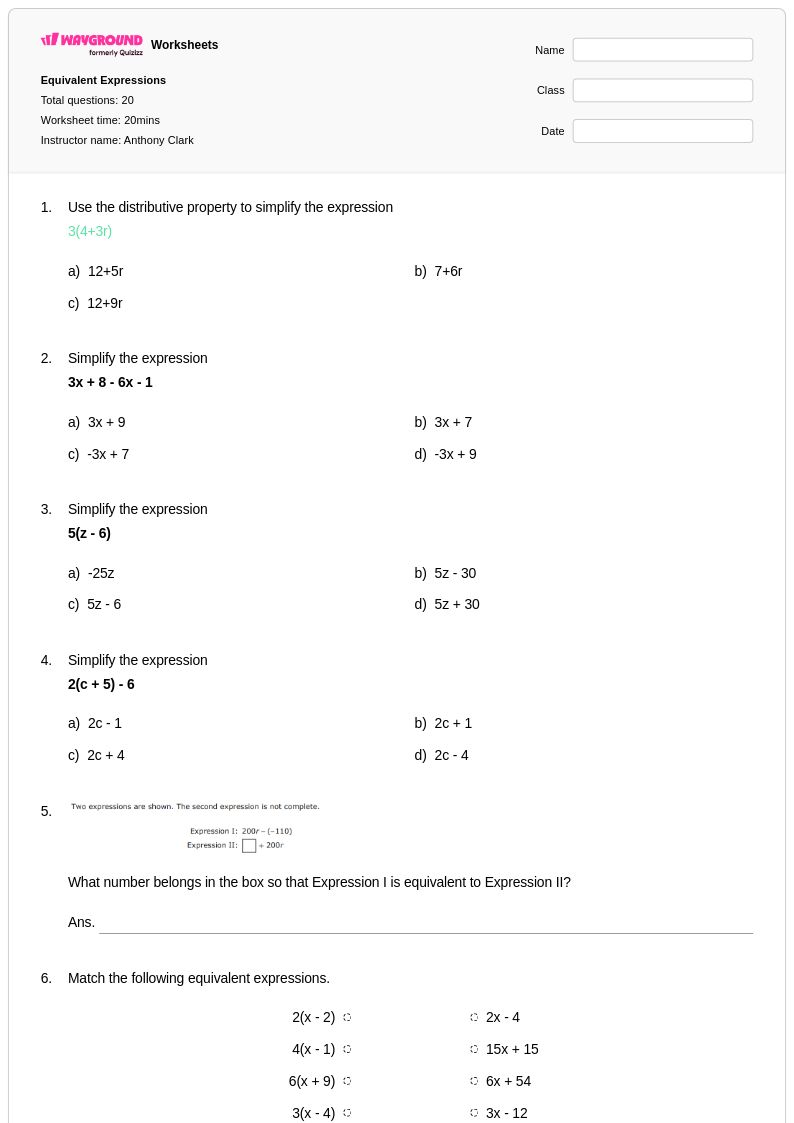
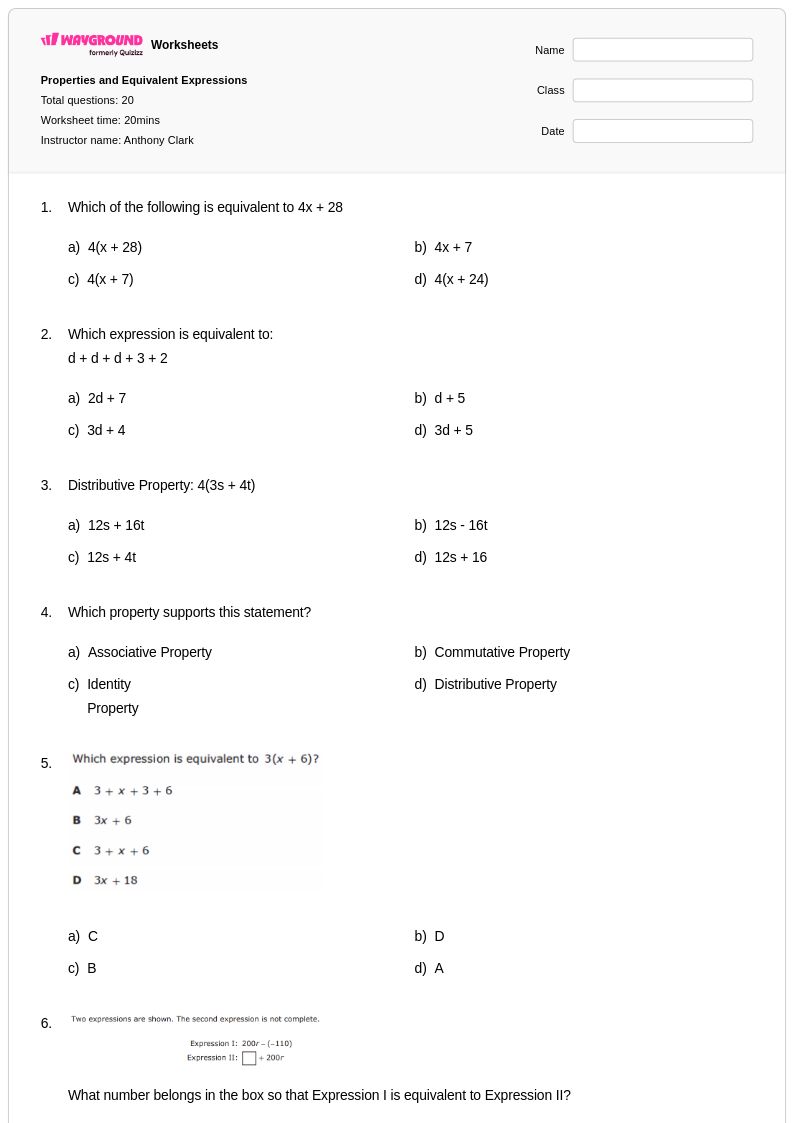
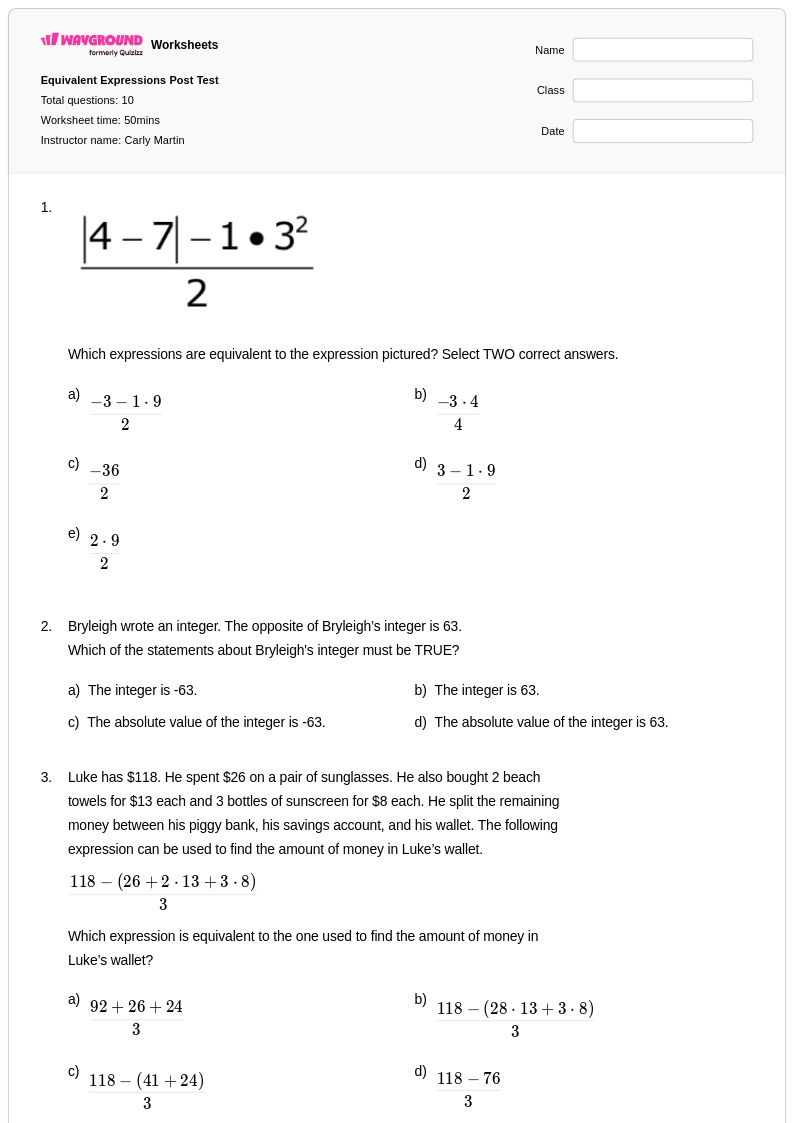
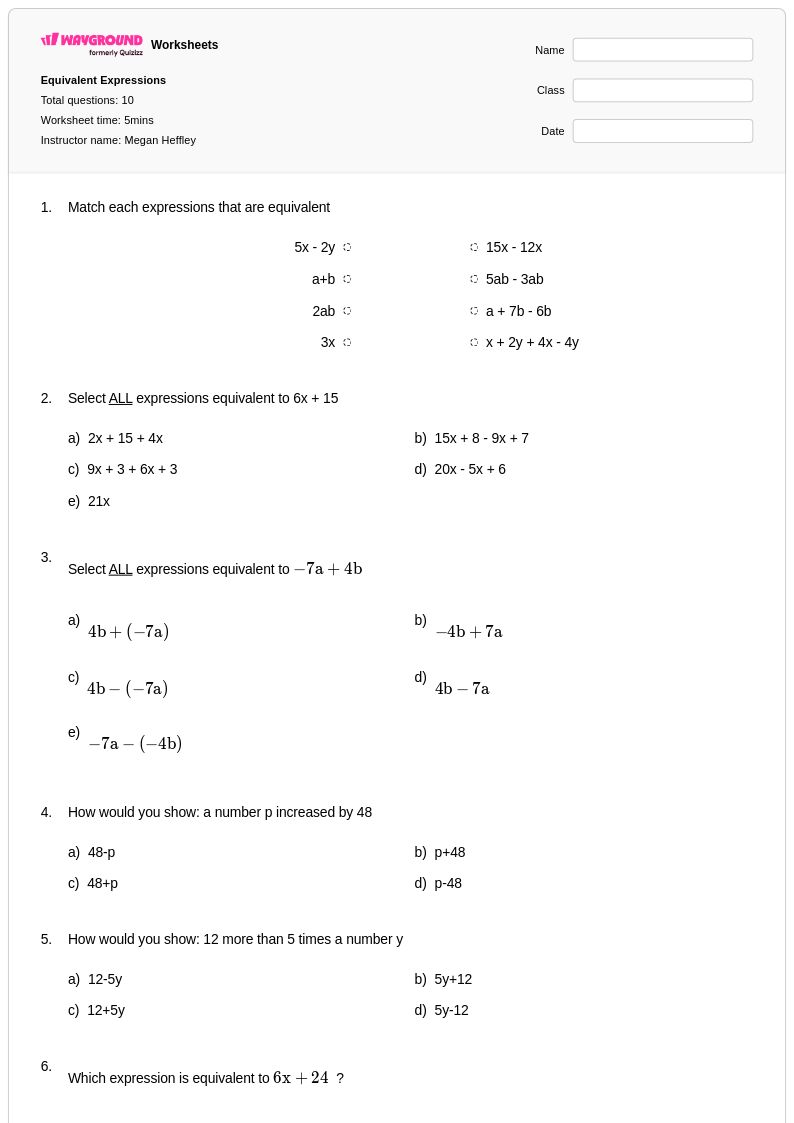
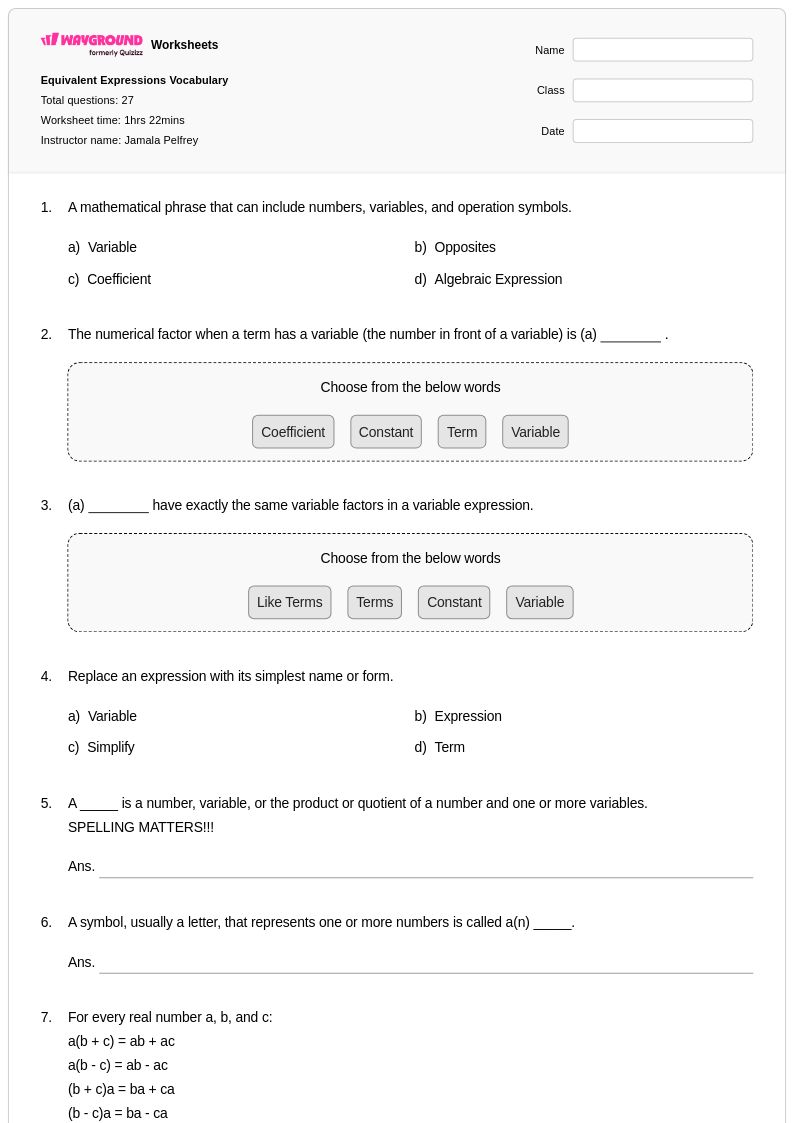
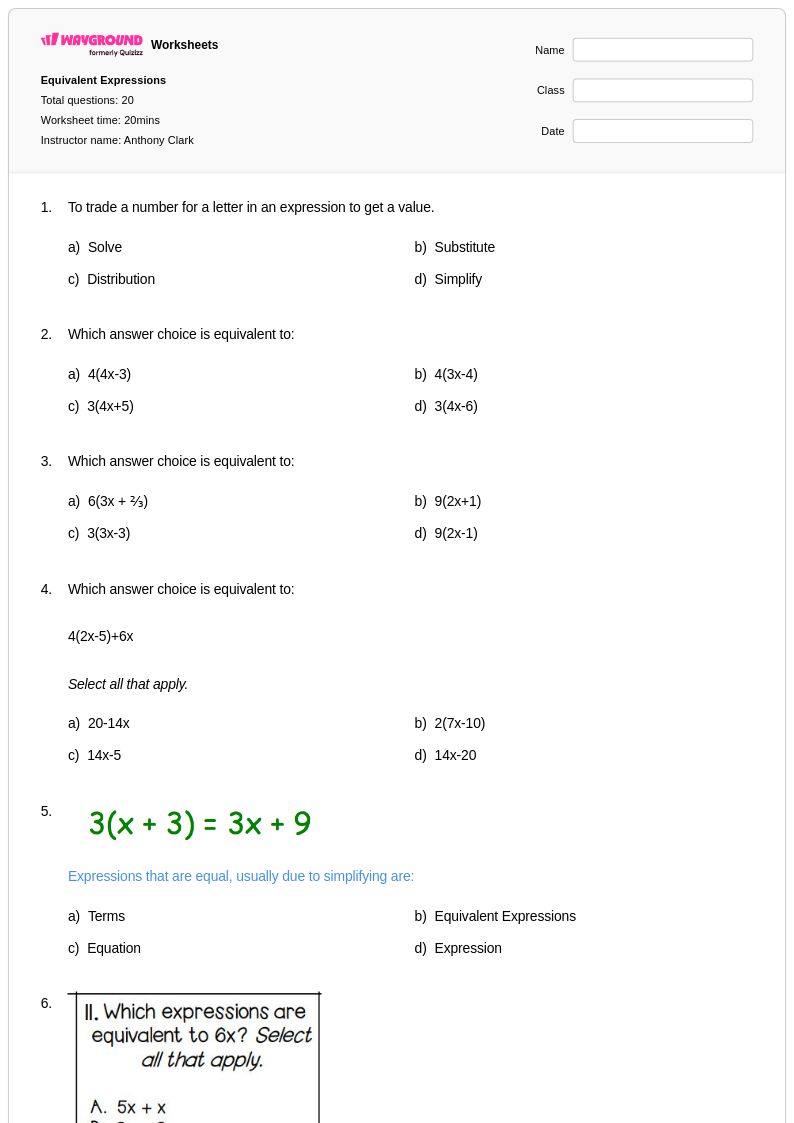
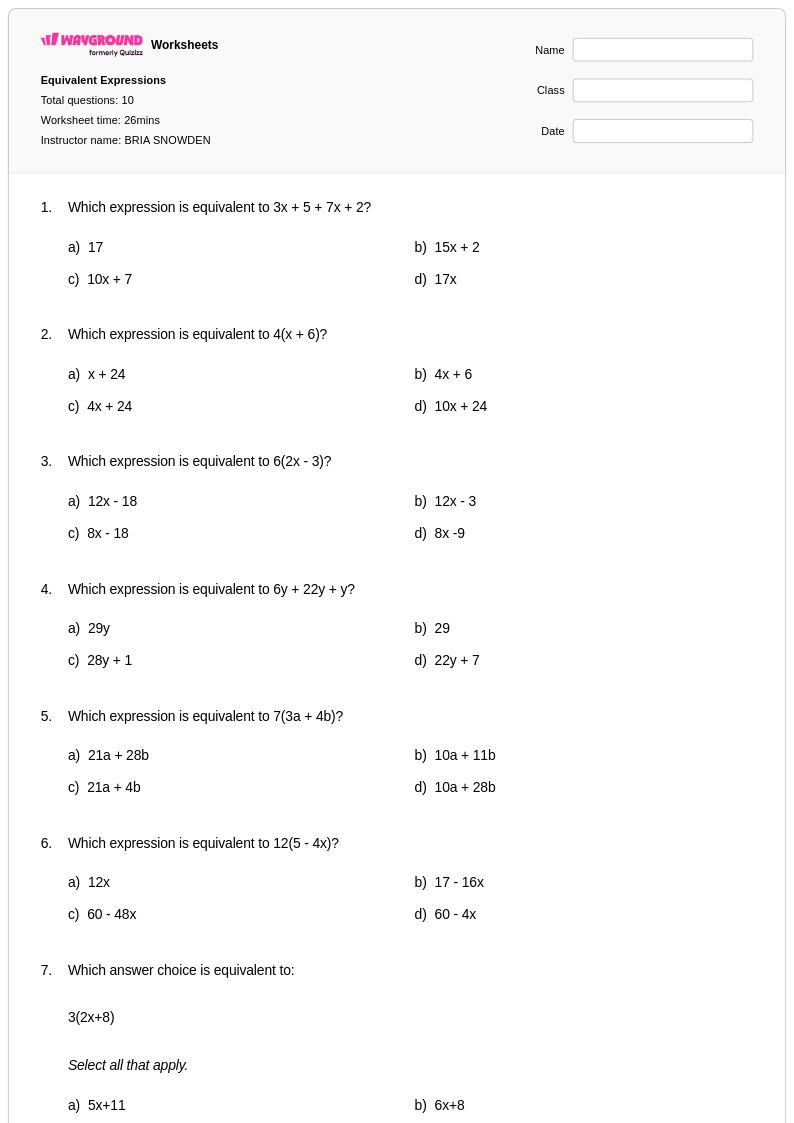
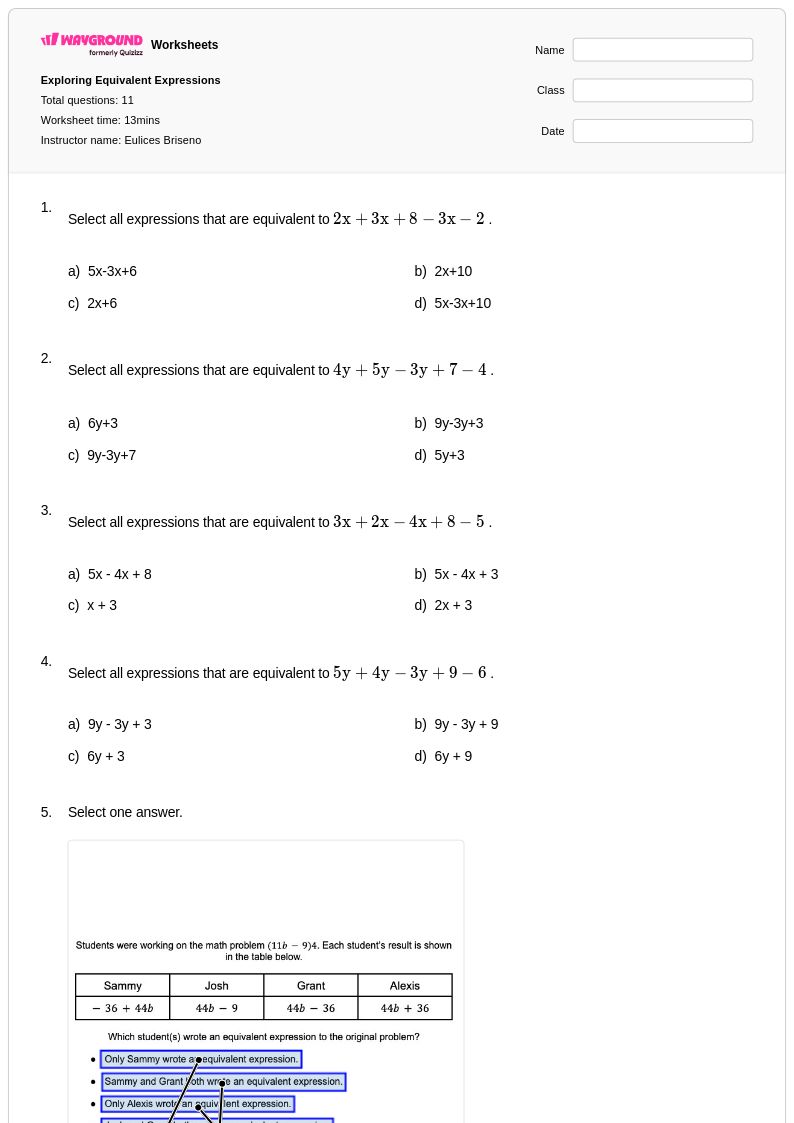
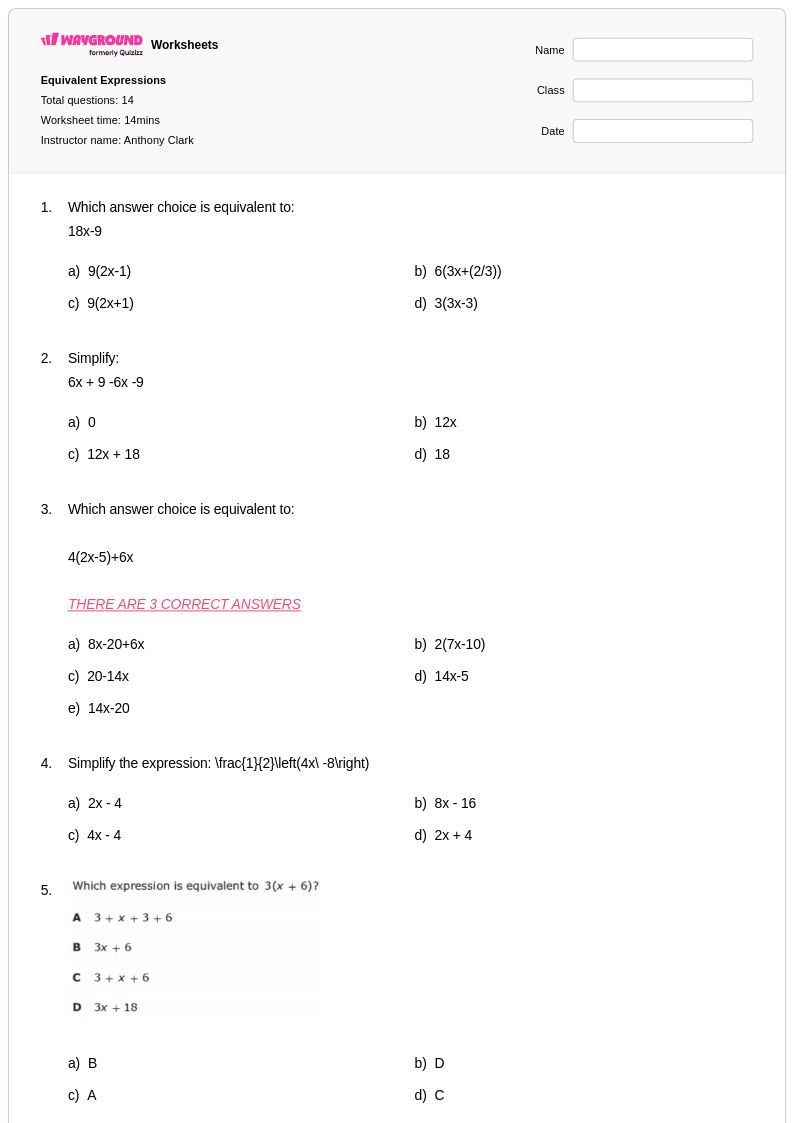
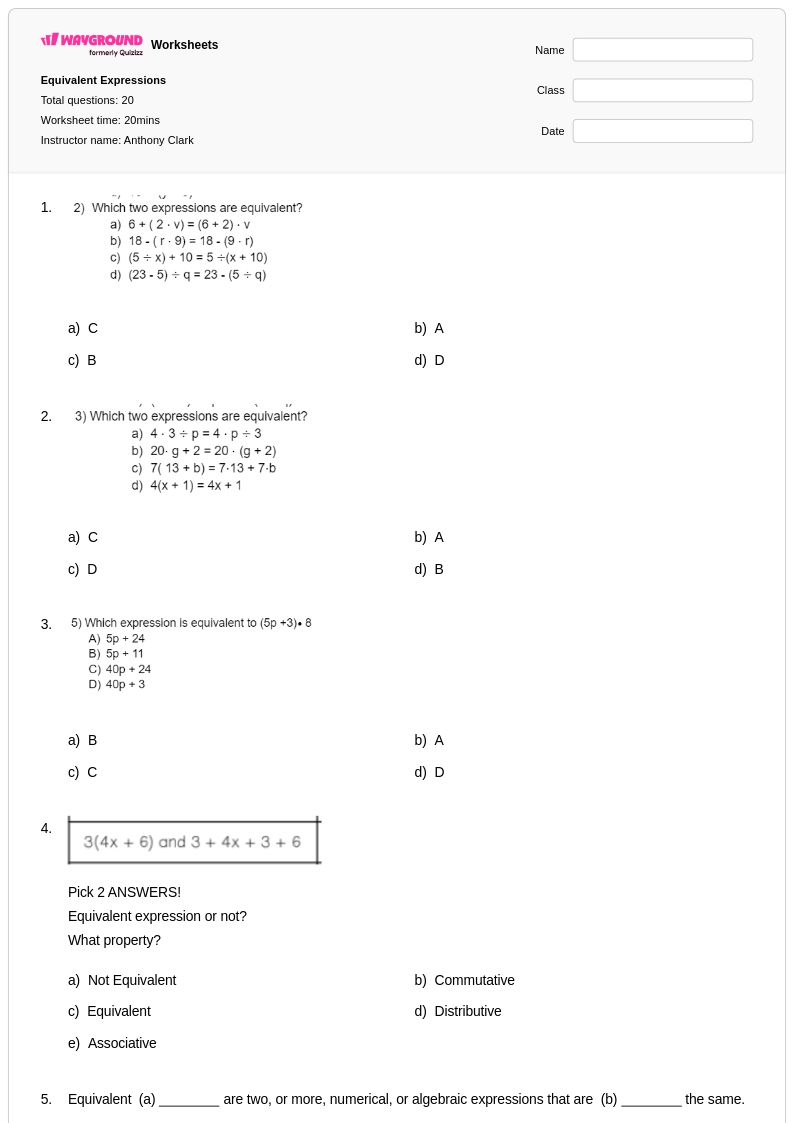
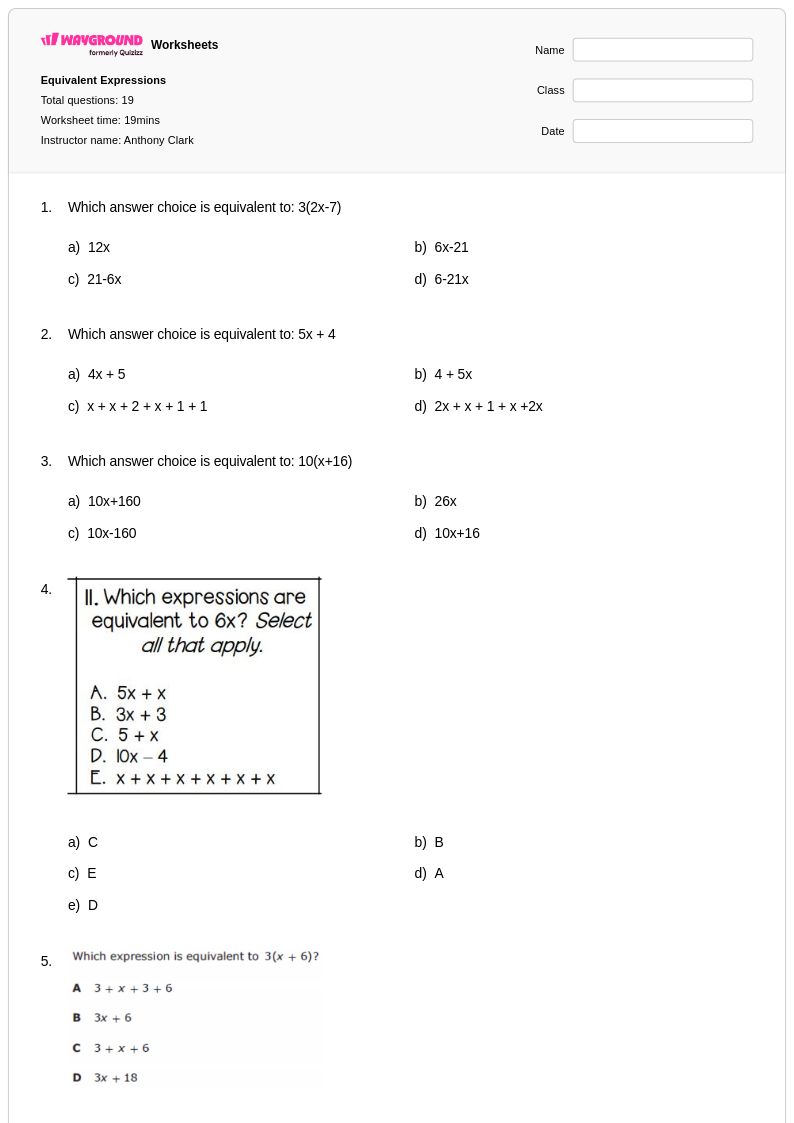
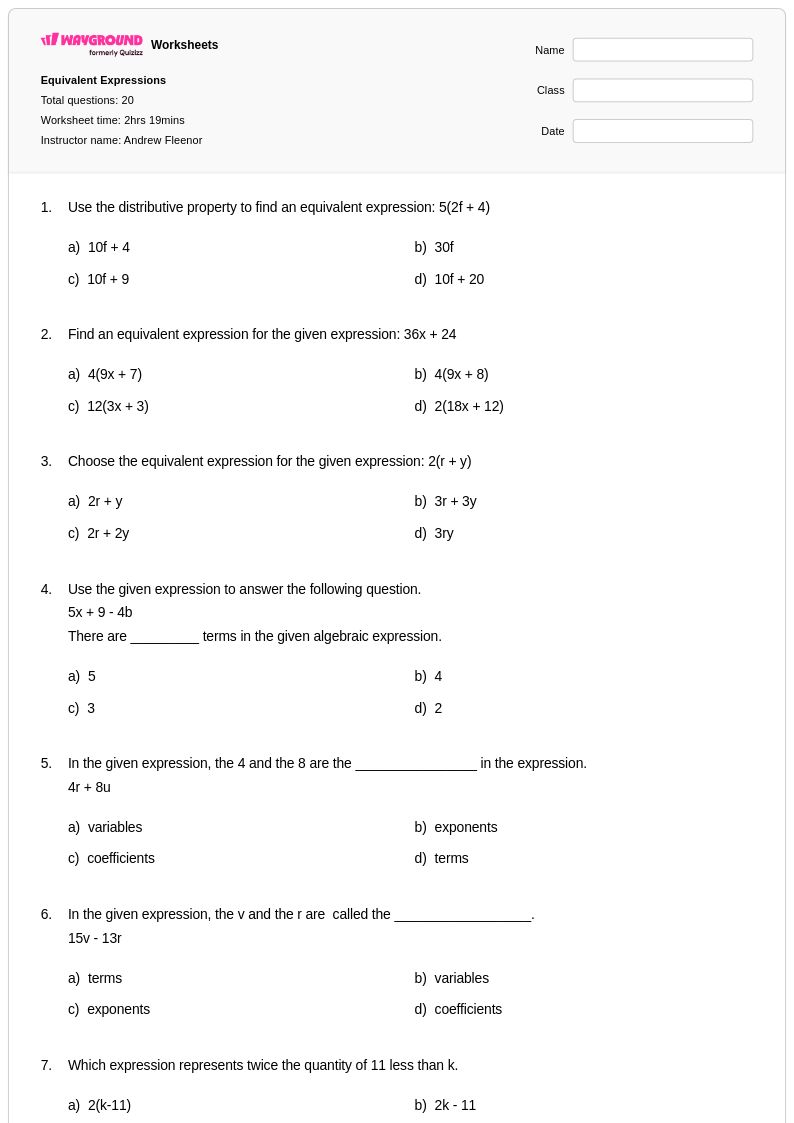
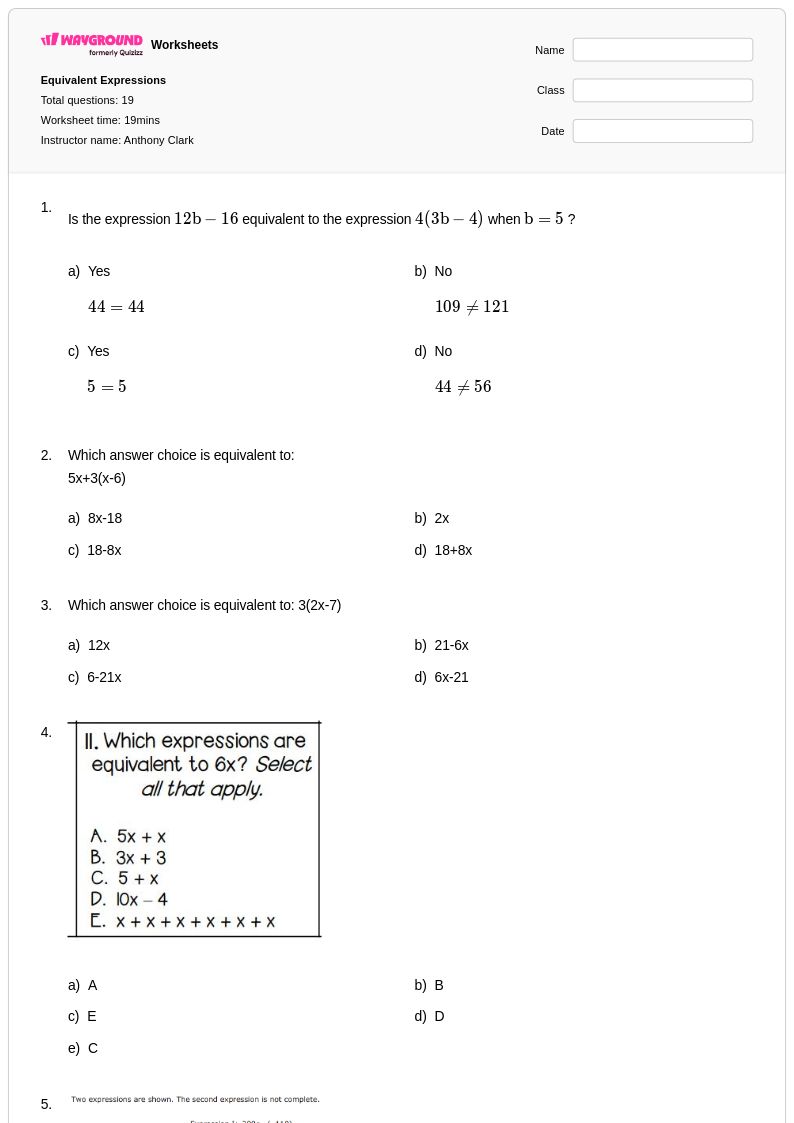
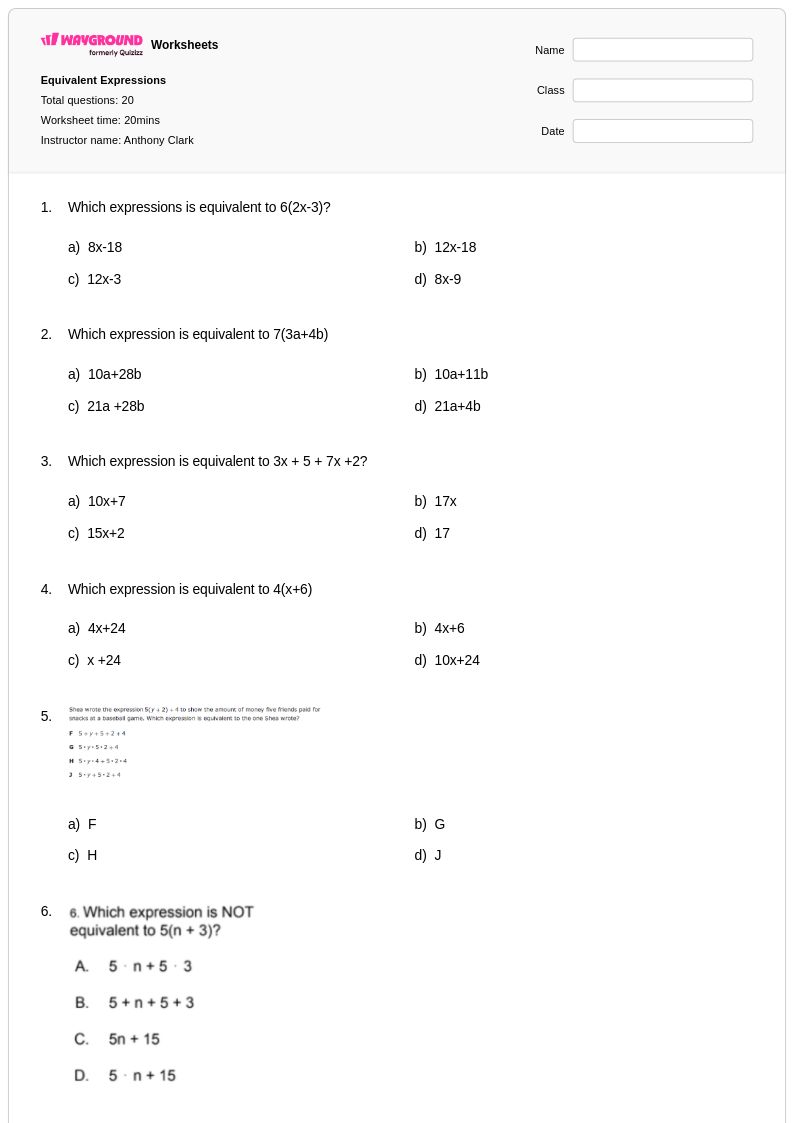
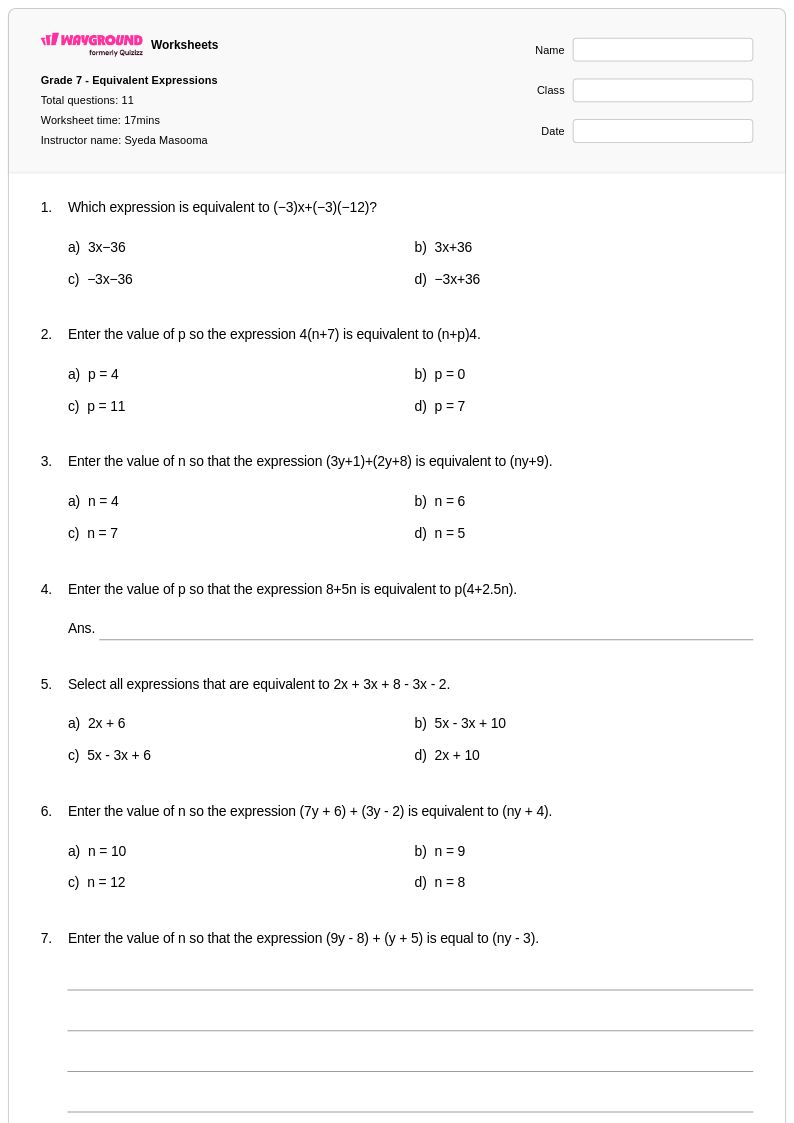
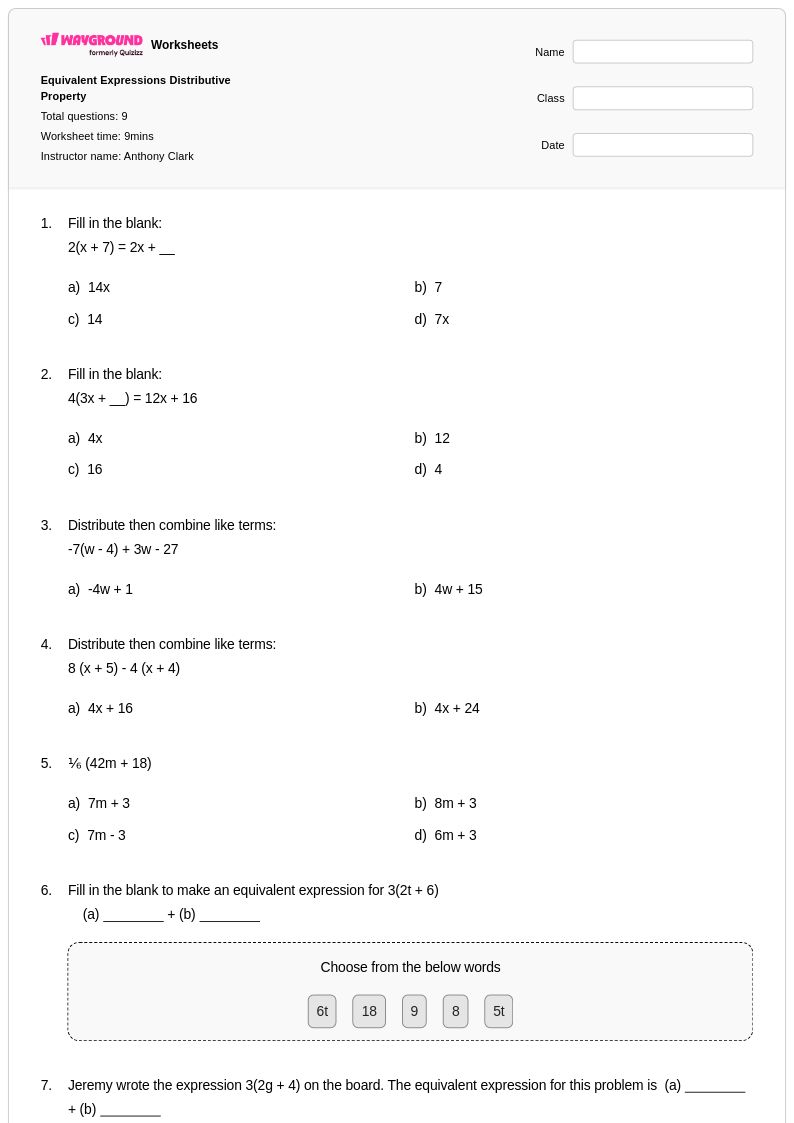
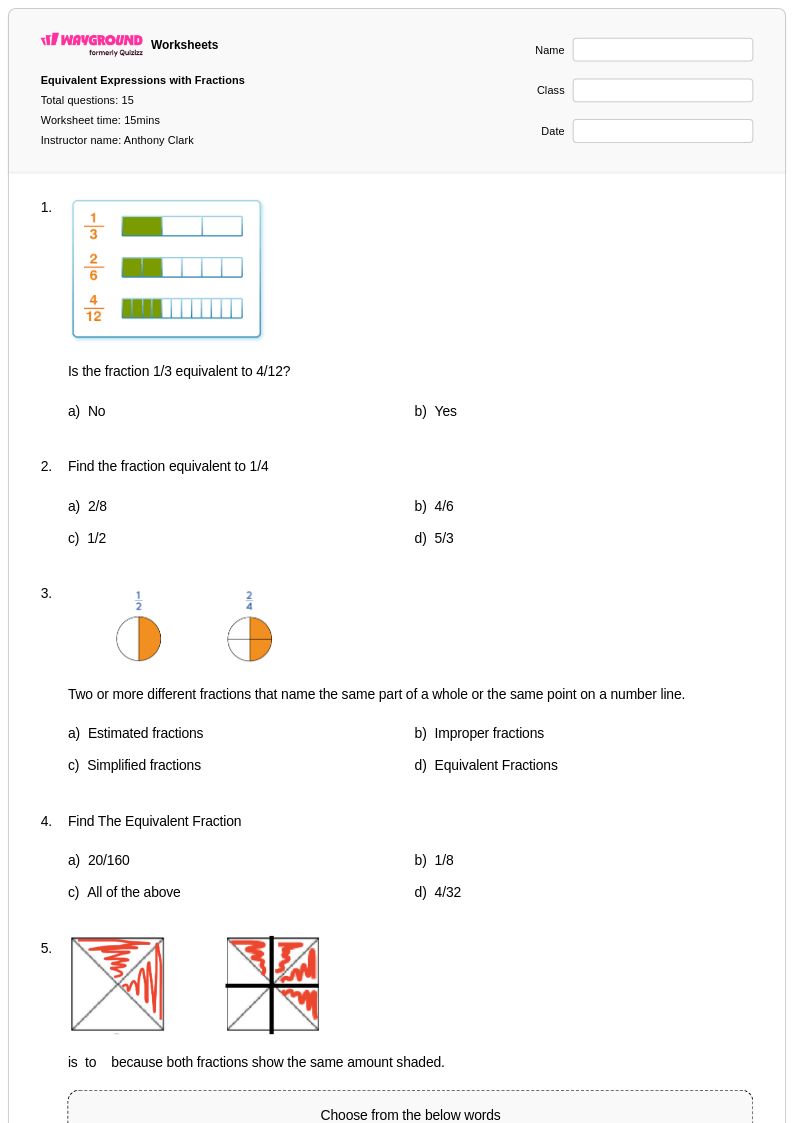
Master equivalent expressions with Wayground's comprehensive collection of free worksheets, featuring printable PDFs with practice problems and answer keys to help students identify, create, and simplify algebraically equivalent mathematical expressions.
Equivalent expressions worksheets available through Wayground (formerly Quizizz) provide comprehensive practice opportunities for students to master the fundamental skill of recognizing and creating algebraically equivalent forms. These carefully designed practice problems strengthen students' understanding of mathematical properties such as the distributive, associative, and commutative properties while developing their ability to manipulate algebraic expressions through factoring, expanding, and simplifying techniques. The worksheets feature a diverse range of problems that progress from basic numerical expressions to more complex algebraic forms, ensuring students build confidence in identifying when two expressions represent the same mathematical relationship. Each worksheet includes a complete answer key and is available as a free printable pdf, making it easy for educators to incorporate these resources into their mathematics instruction and assessment practices.
Wayground (formerly Quizizz) empowers teachers with an extensive collection of equivalent expressions worksheets drawn from millions of teacher-created resources that have been carefully curated and organized for easy discovery. The platform's robust search and filtering capabilities allow educators to quickly locate materials that align with specific mathematical standards and match their students' current skill levels, while built-in differentiation tools enable seamless customization for remediation or enrichment purposes. Teachers can access these resources in both printable and digital formats, including downloadable pdfs, providing the flexibility needed for various classroom environments and learning modalities. This comprehensive approach to worksheet management streamlines lesson planning while ensuring that students receive targeted practice opportunities that reinforce their understanding of equivalent expressions and build the algebraic reasoning skills essential for advanced mathematical concepts.
FAQs
How do I teach equivalent expressions?
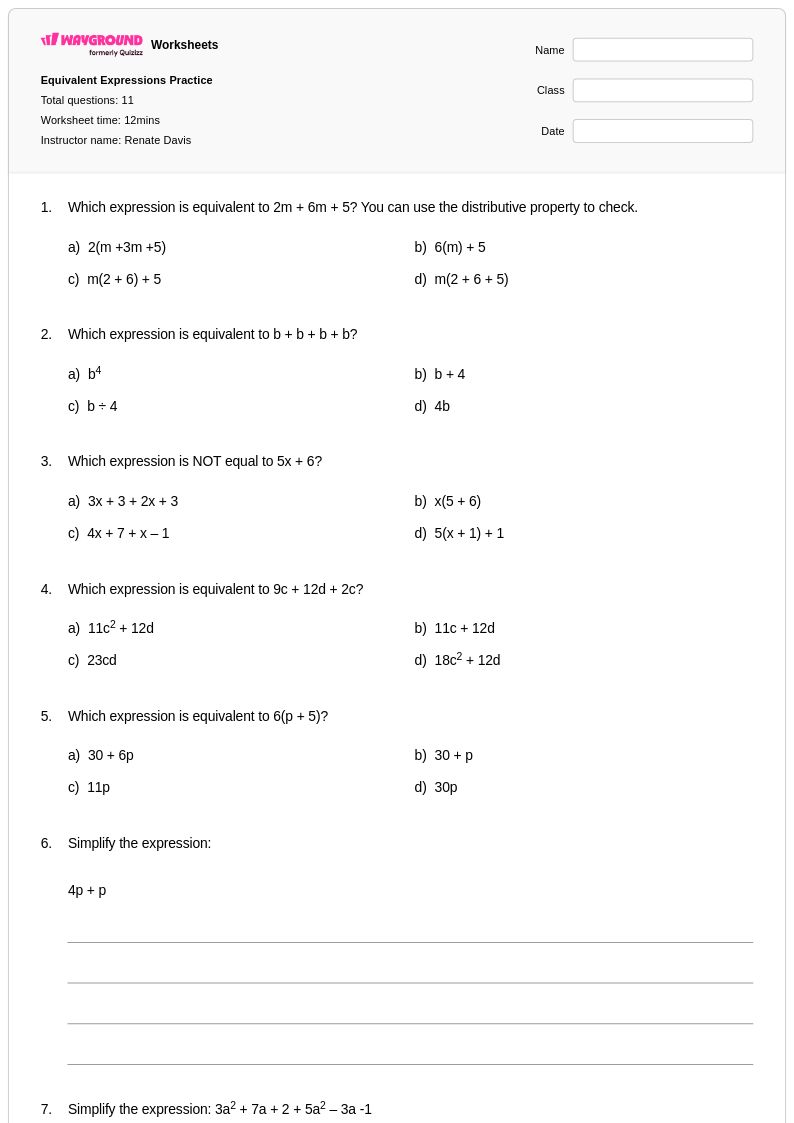
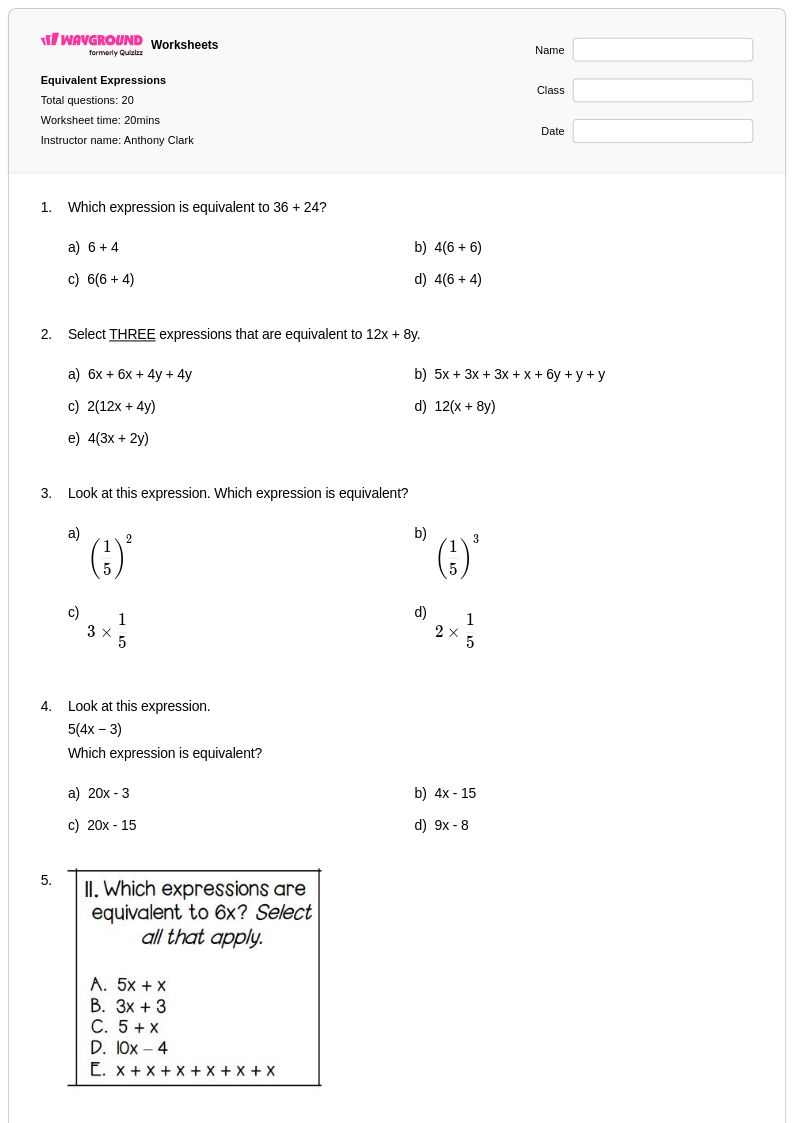
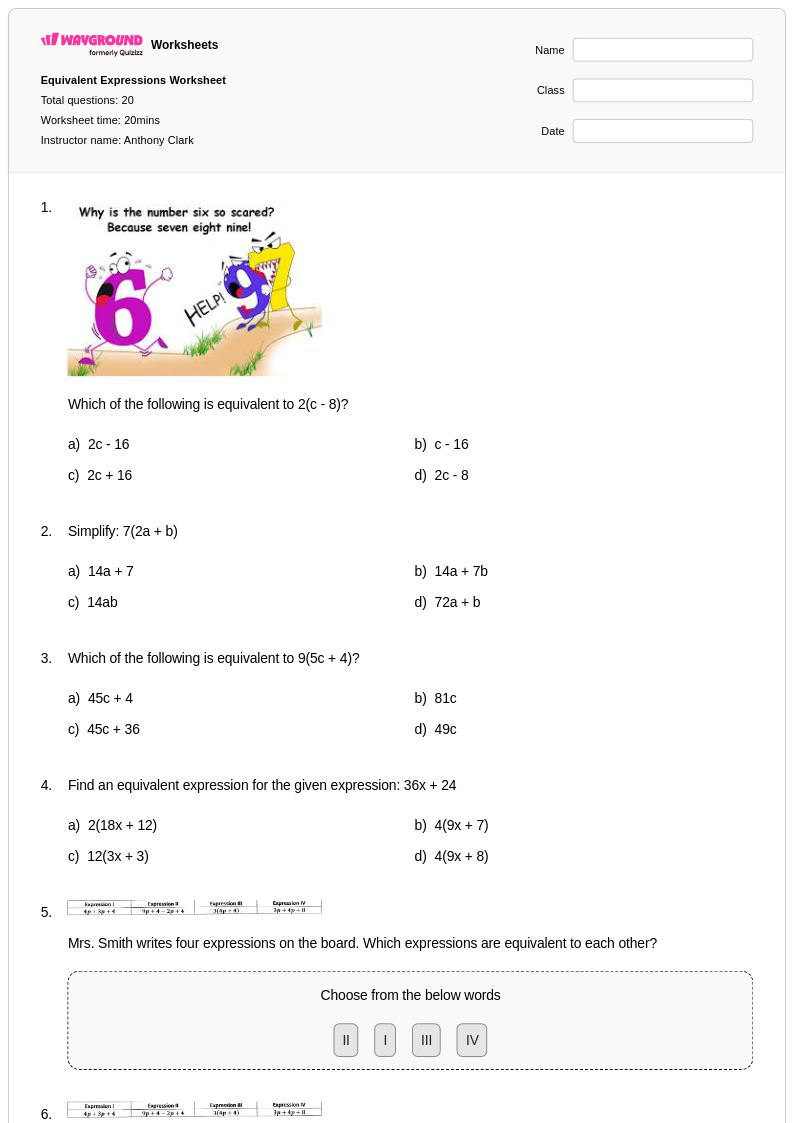
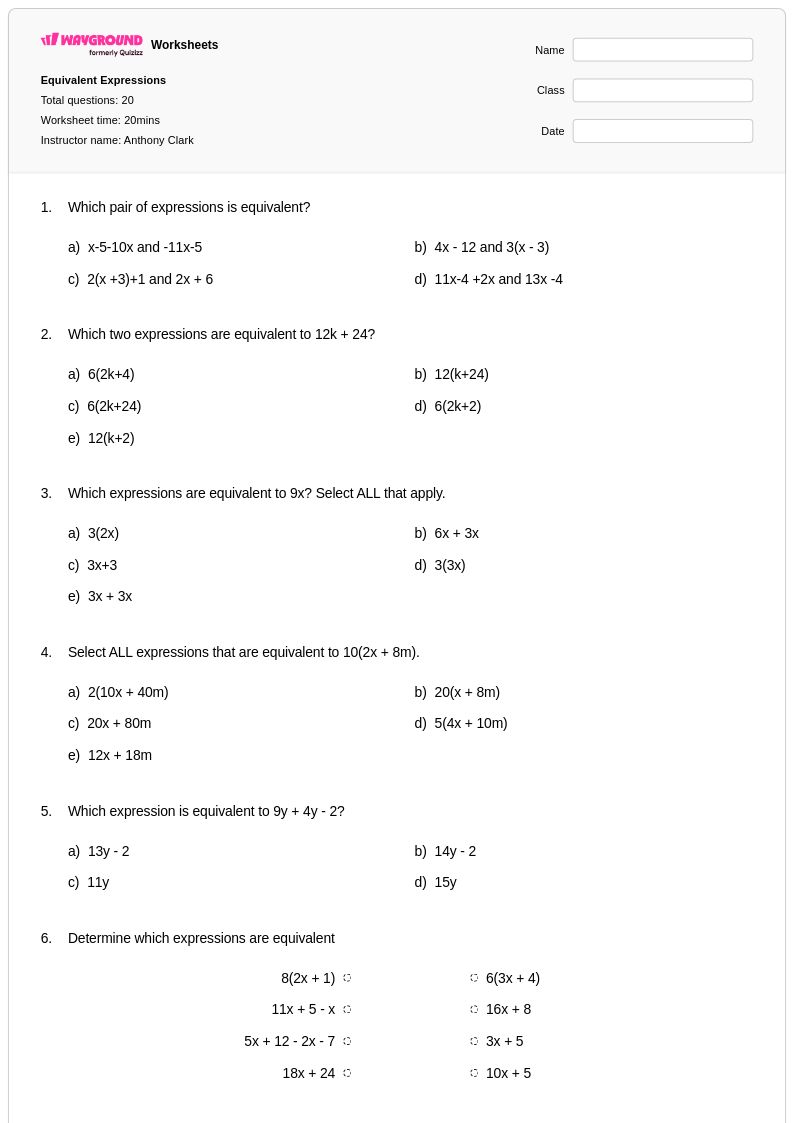
Start with the distributive property as the anchor concept — students need to see concretely why 3(x + 2) and 3x + 6 are the same before they can generalize. Use numerical examples first (does 3(4 + 2) equal 3×4 + 3×2?), then move to expressions with variables. Once students trust the distributive property, introduce combining like terms and factoring as the reverse process. Connecting expansion and factoring as inverse operations helps students see equivalent expressions as a system rather than a bag of disconnected rules.
What exercises help students practice equivalent expressions?
The most effective practice mixes three task types: identifying whether two given expressions are equivalent, transforming a single expression into an equivalent form (expand, factor, or simplify), and generating their own equivalent expression for a given one. The third type is often skipped but reveals the deepest understanding. Wayground's equivalent expressions worksheets cover all three, progressing from basic numerical forms to multi-term algebraic expressions, with factoring included as a subtopic for students ready for that challenge.
What mistakes do students commonly make with equivalent expressions?
The most persistent error is misapplying the distributive property — students will write 3(x + 2) = 3x + 2, forgetting to multiply both terms. A close second is treating subtraction like addition when combining like terms, so 5x − 2x becomes 7x instead of 3x. Students also frequently confuse 'equivalent' with 'equal': they think two expressions must look the same to be equivalent, which makes it hard for them to accept that x + x and 2x represent the same relationship.
How do I use Wayground's equivalent expressions worksheets in my class?
You can run these worksheets as a digital quiz hosted on Wayground — students complete them on any device and results come back to you instantly. If you prefer paper, download the printable PDF and assign it in class; every worksheet includes a complete answer key, and you can grade submitted work using the Wayground for Teachers app by scanning or capturing student responses. Both formats use the same problems, so the choice comes down to what your classroom setup calls for that day.
Is equivalent expressions aligned to Common Core standards?
Yes. Common Core introduces equivalent expressions in the middle grades, where students first apply properties of operations to generate equivalent numerical expressions, then extend that work to algebraic expressions with variables. The progression moves from recognizing equivalence using the distributive property toward factoring and expanding linear expressions — the same arc these worksheets follow. This work lays the groundwork for solving equations and understanding functions in later grades.
How can I differentiate equivalent expressions practice for mixed-ability classes?
For students who struggle with multi-step transformations, Wayground's reduced answer choices accommodation narrows the options displayed, helping them focus on the reasoning rather than getting lost in the choices. The read-aloud feature supports students who have difficulty parsing dense algebraic notation in written form. On the worksheet side, you can generate alternate versions with larger font sizes or a dyslexia-friendly font without changing the math content — so every student is working on the same concept at an accessible entry point.