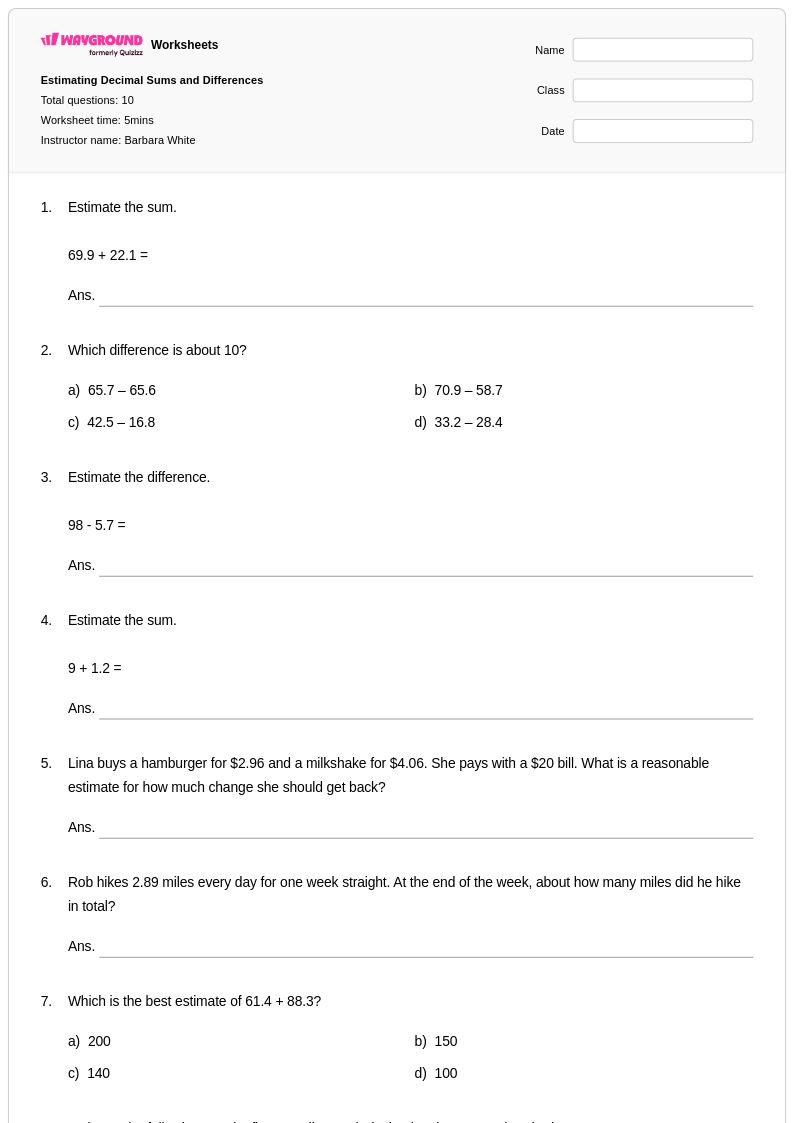
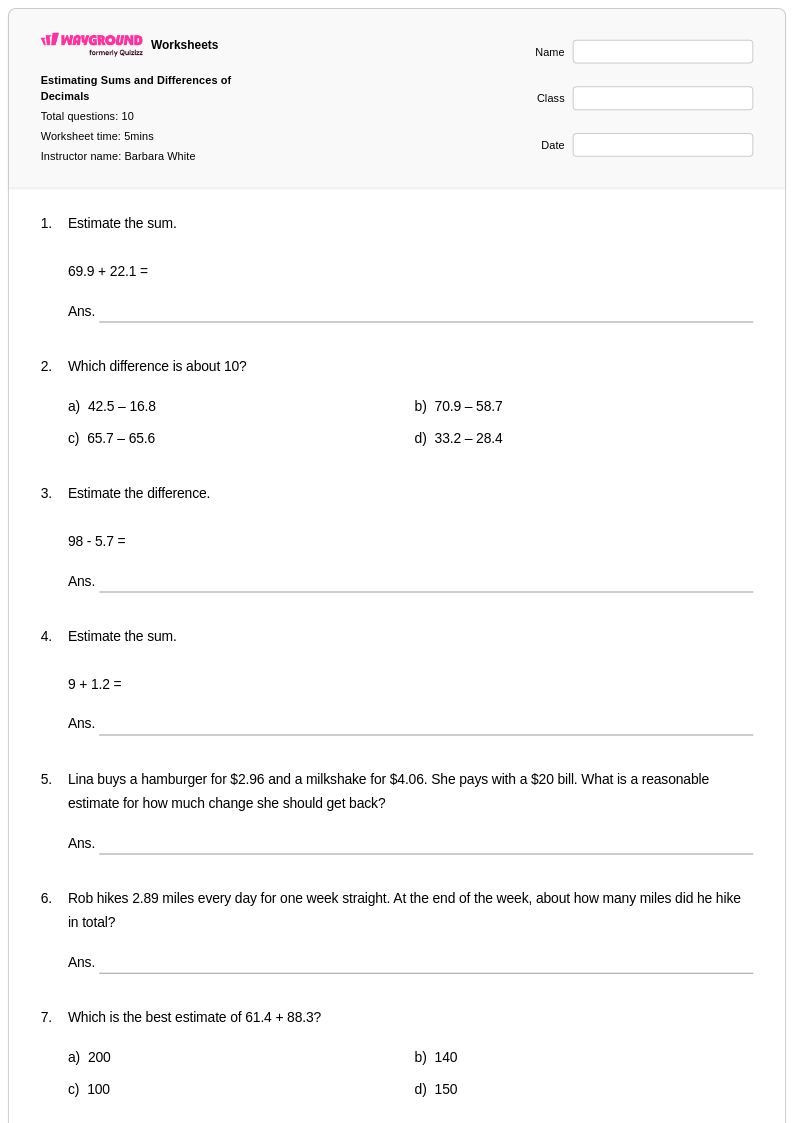
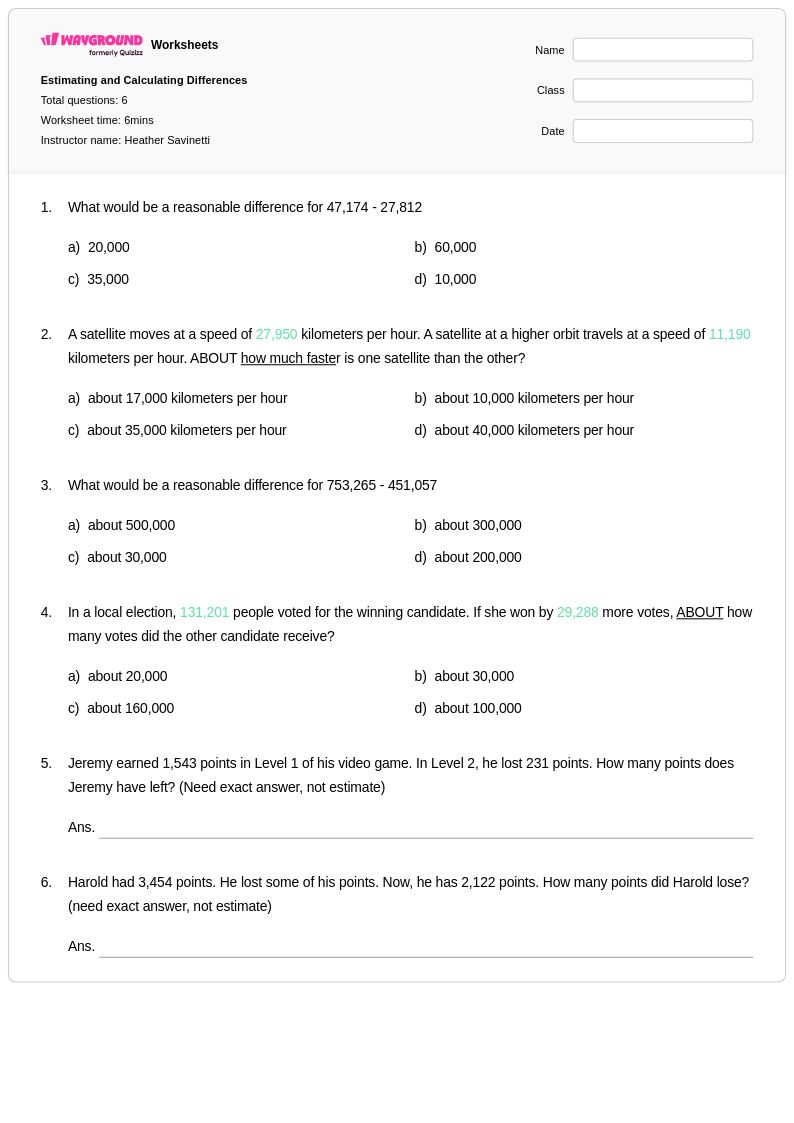
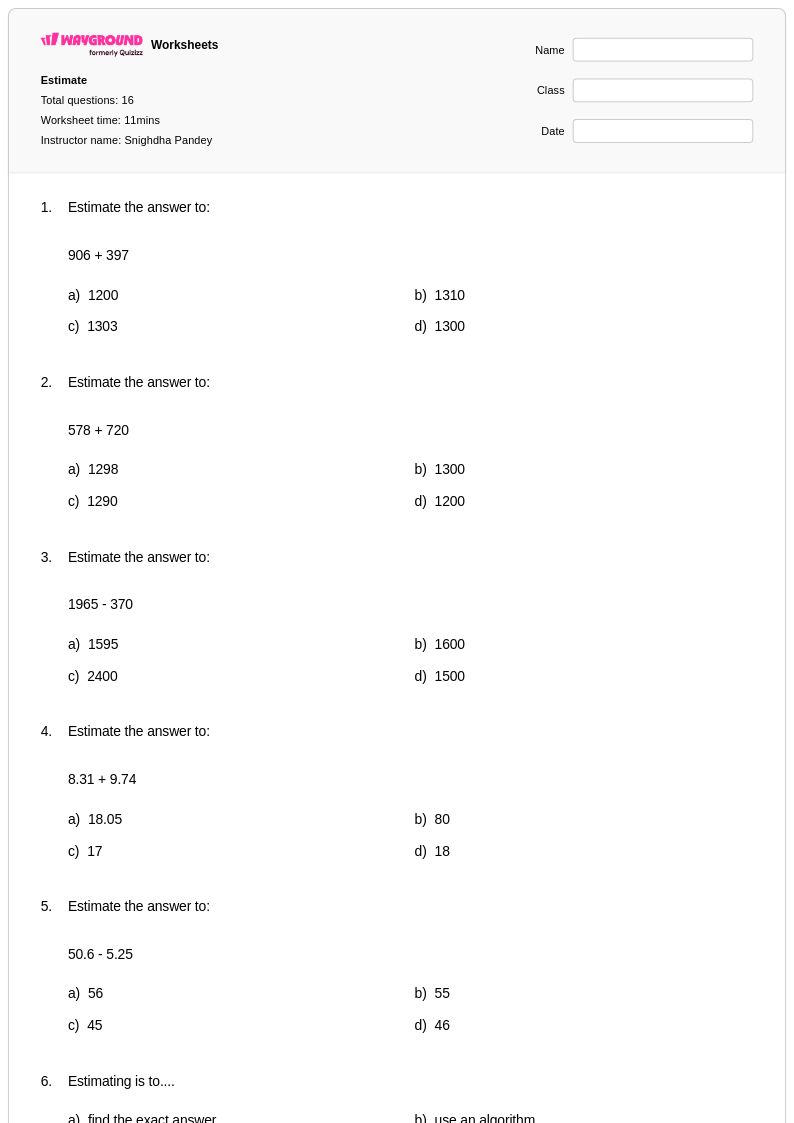
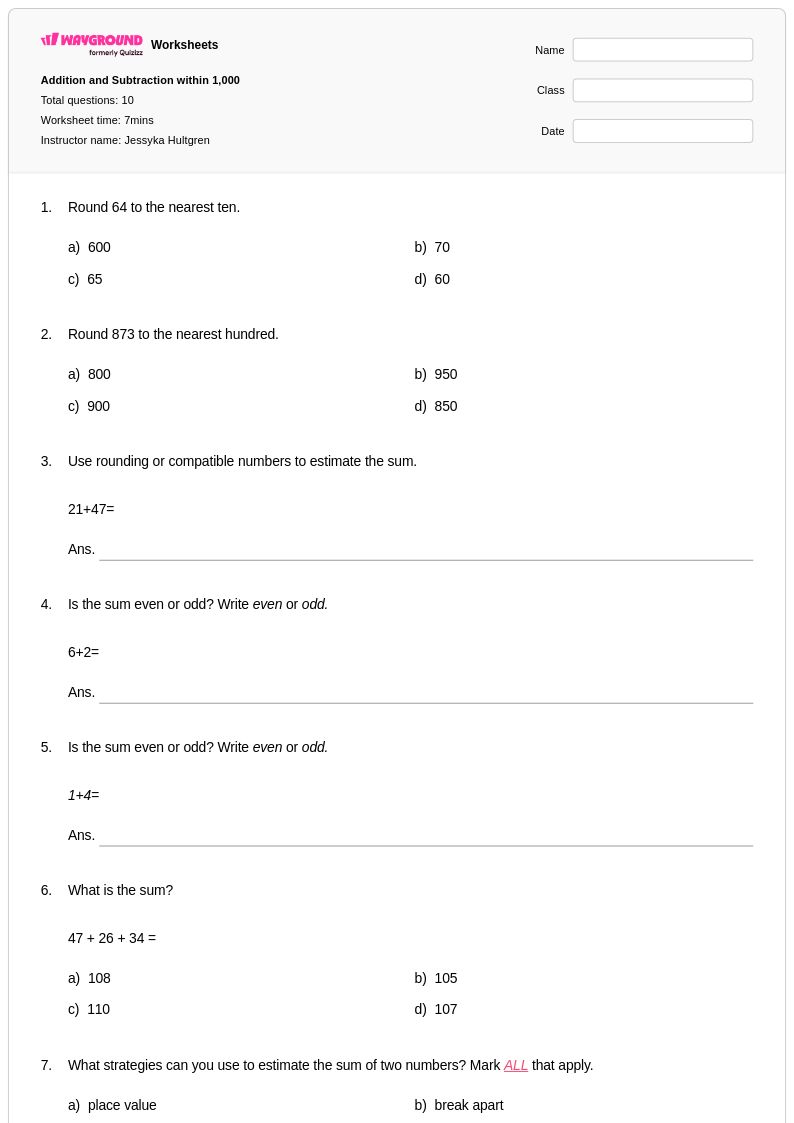
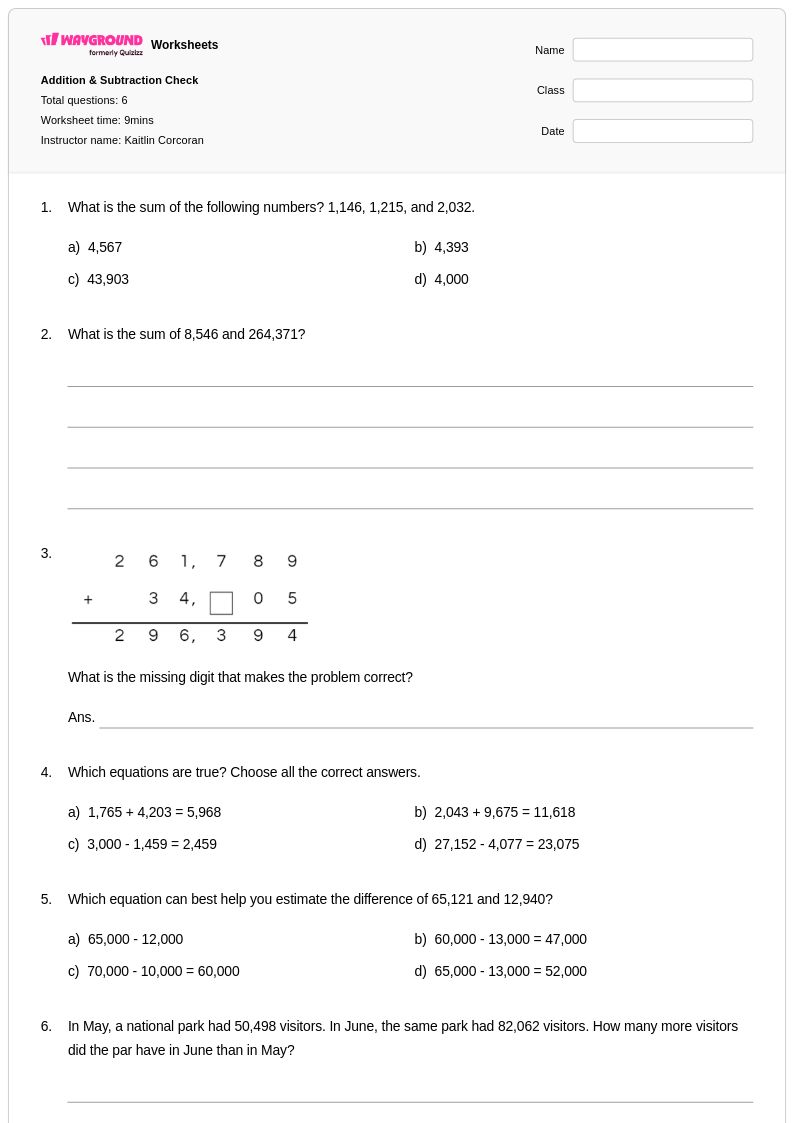
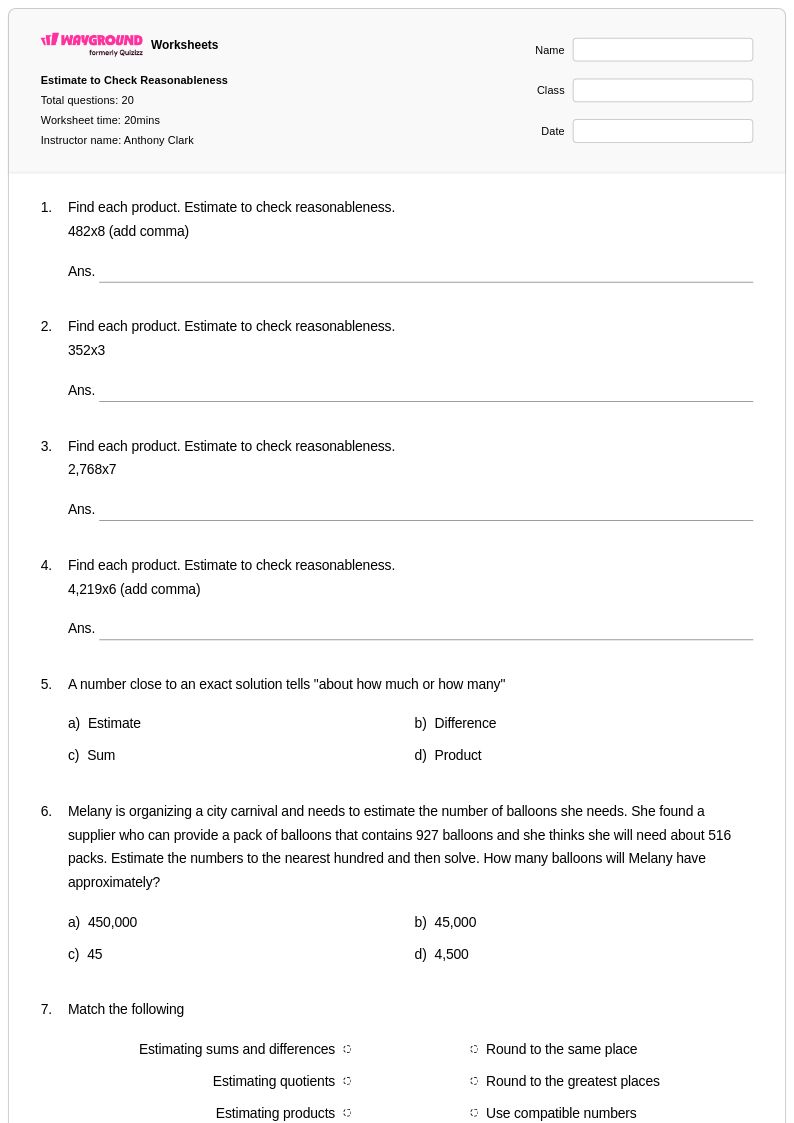
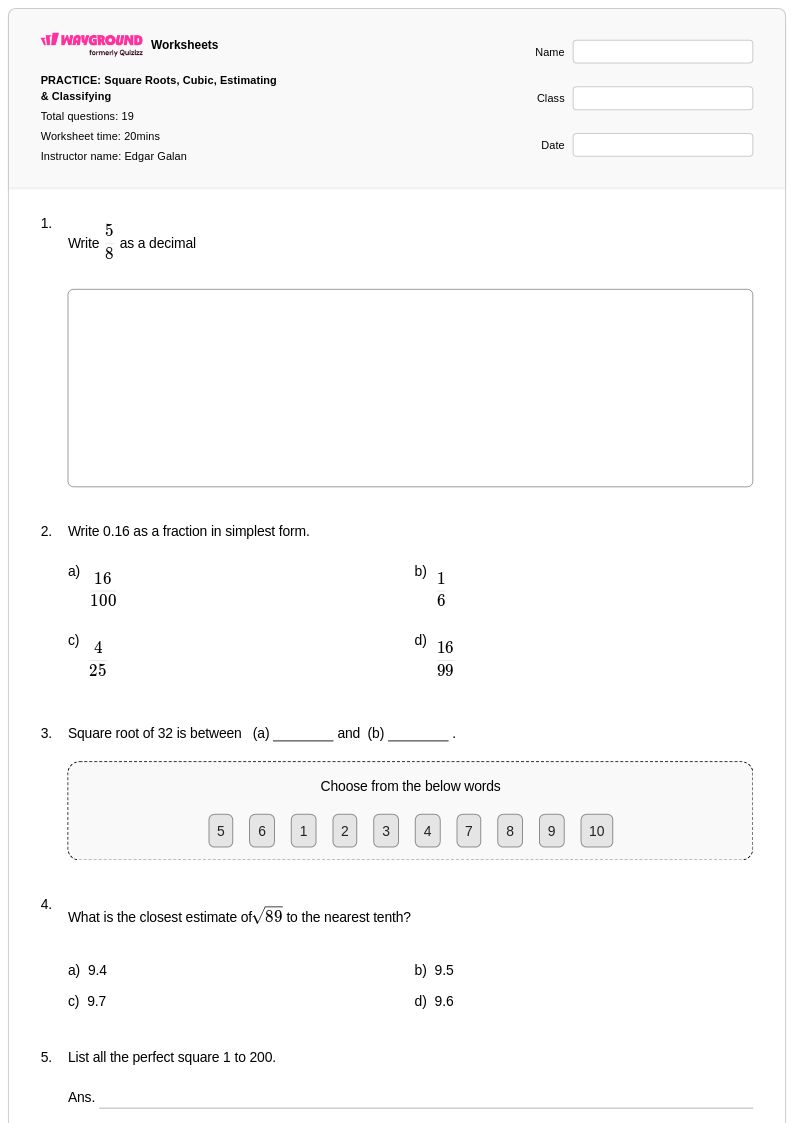
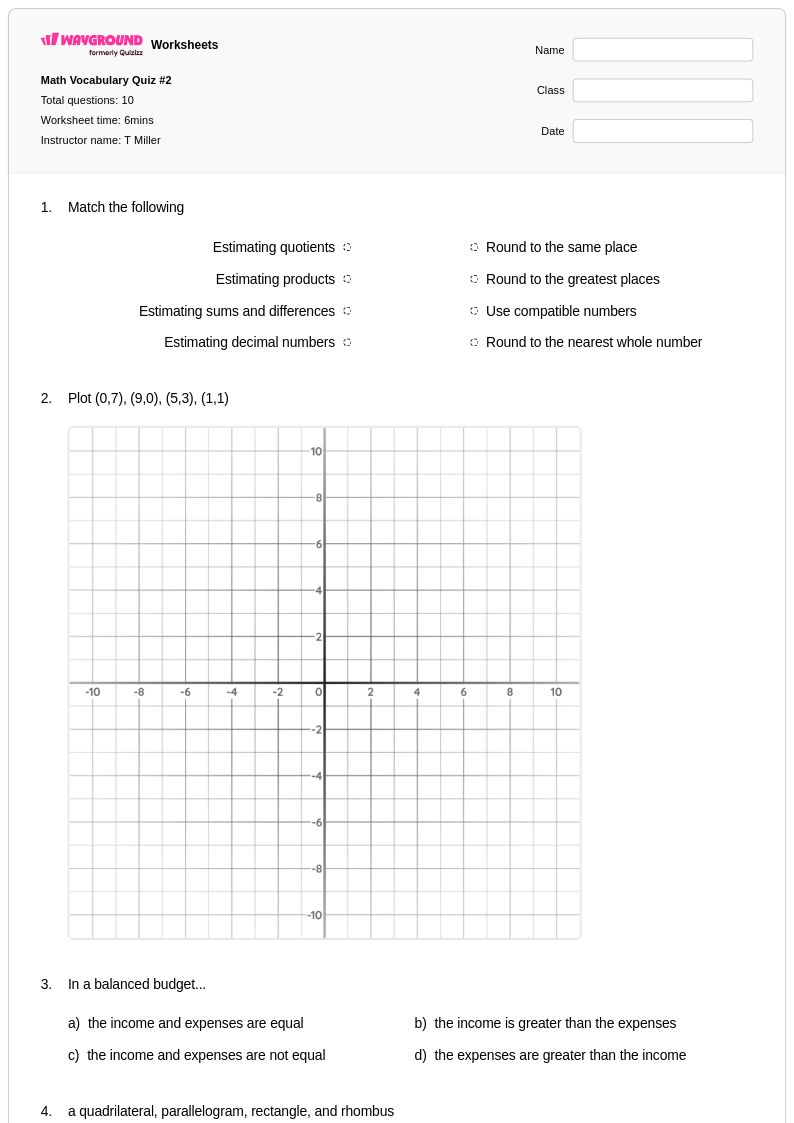
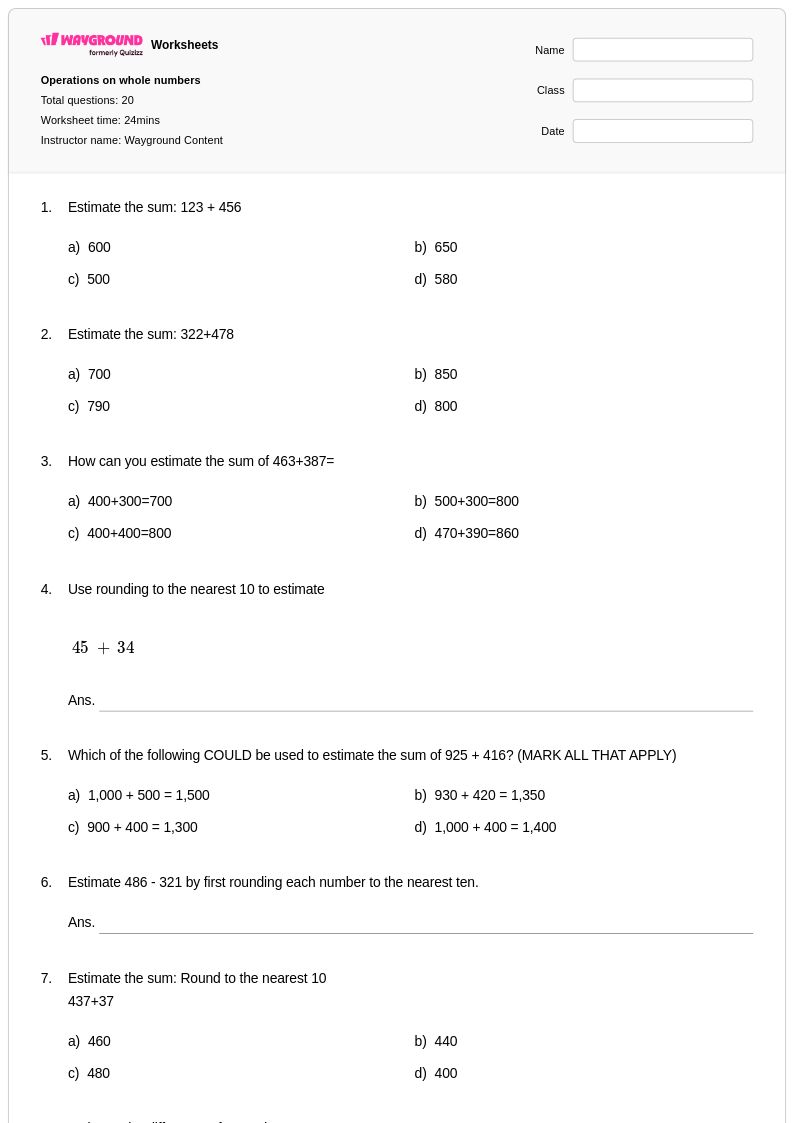
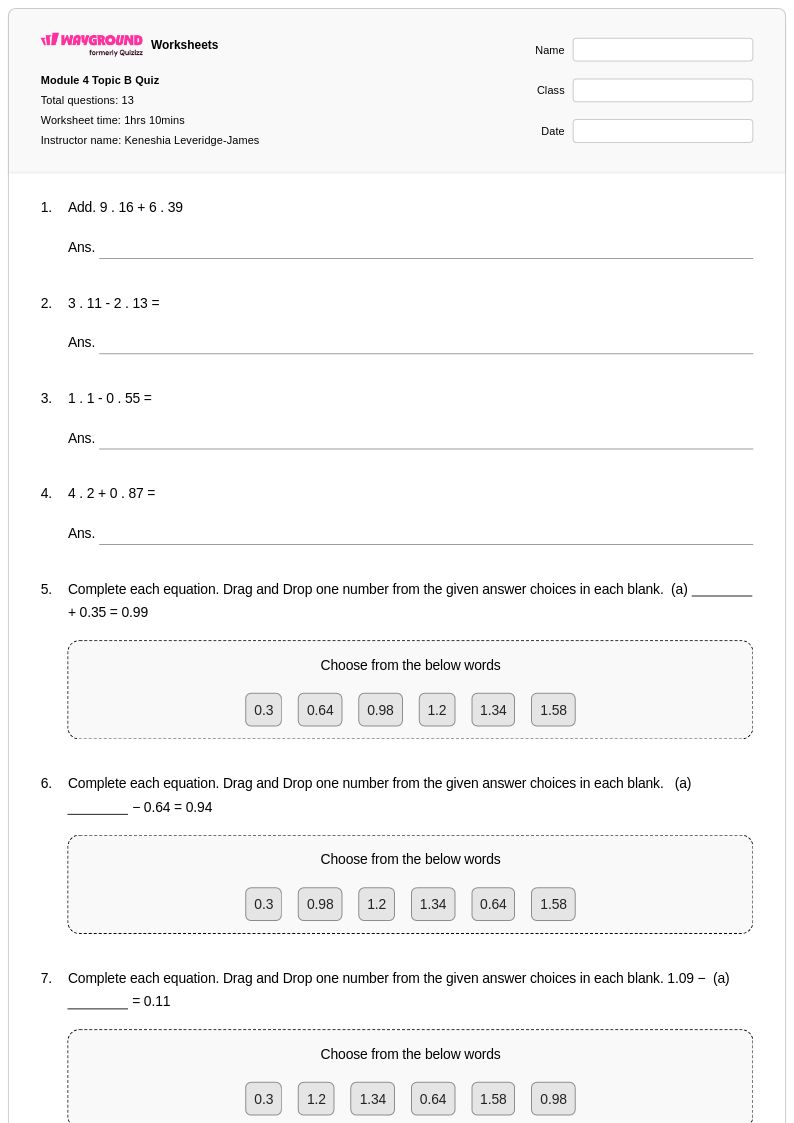
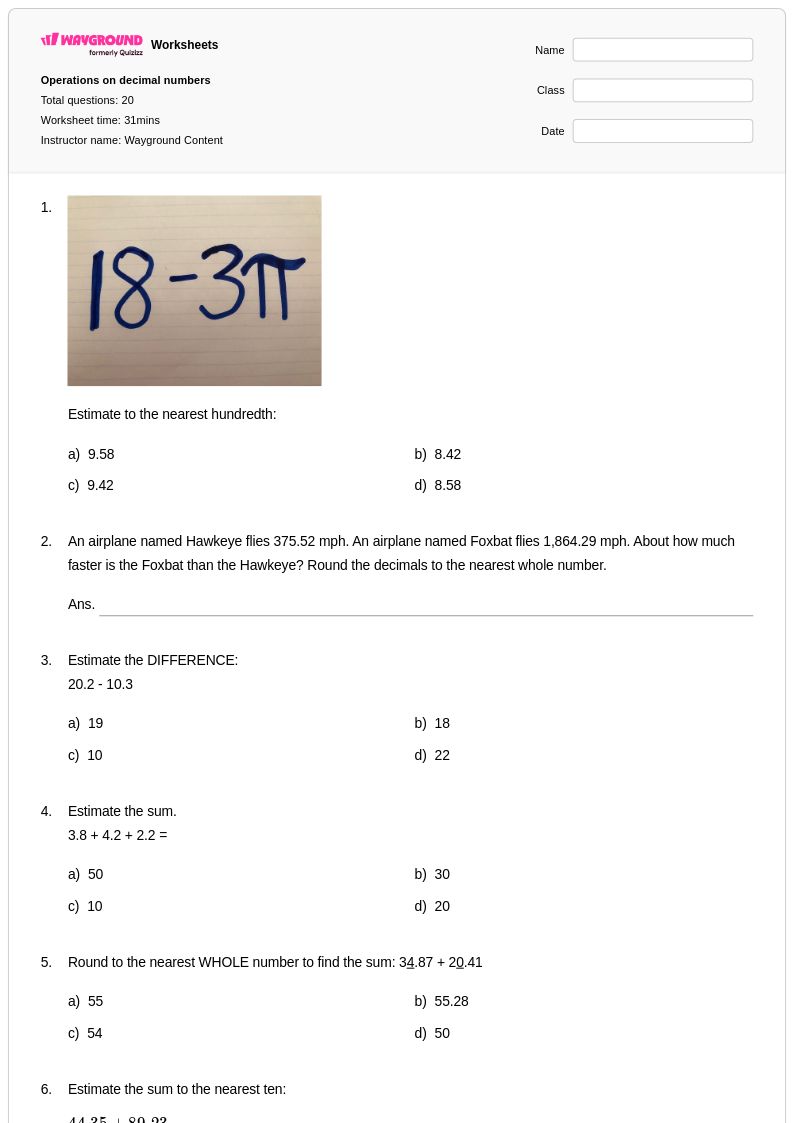
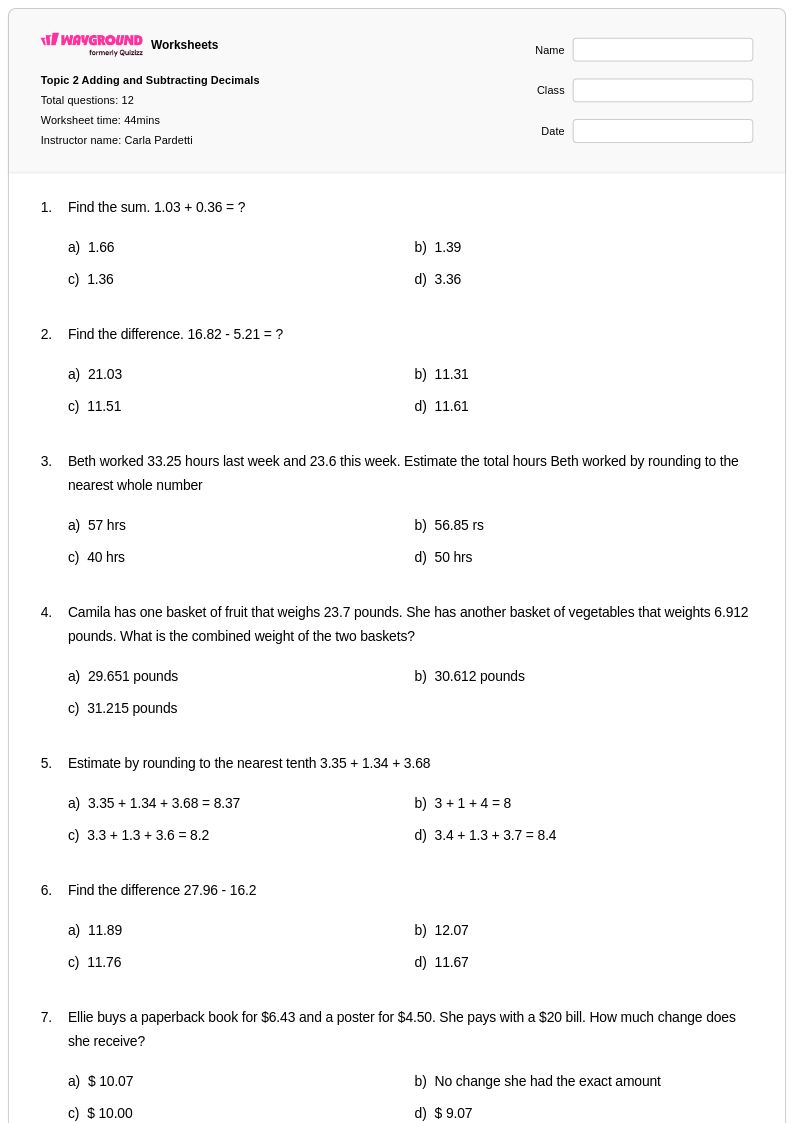
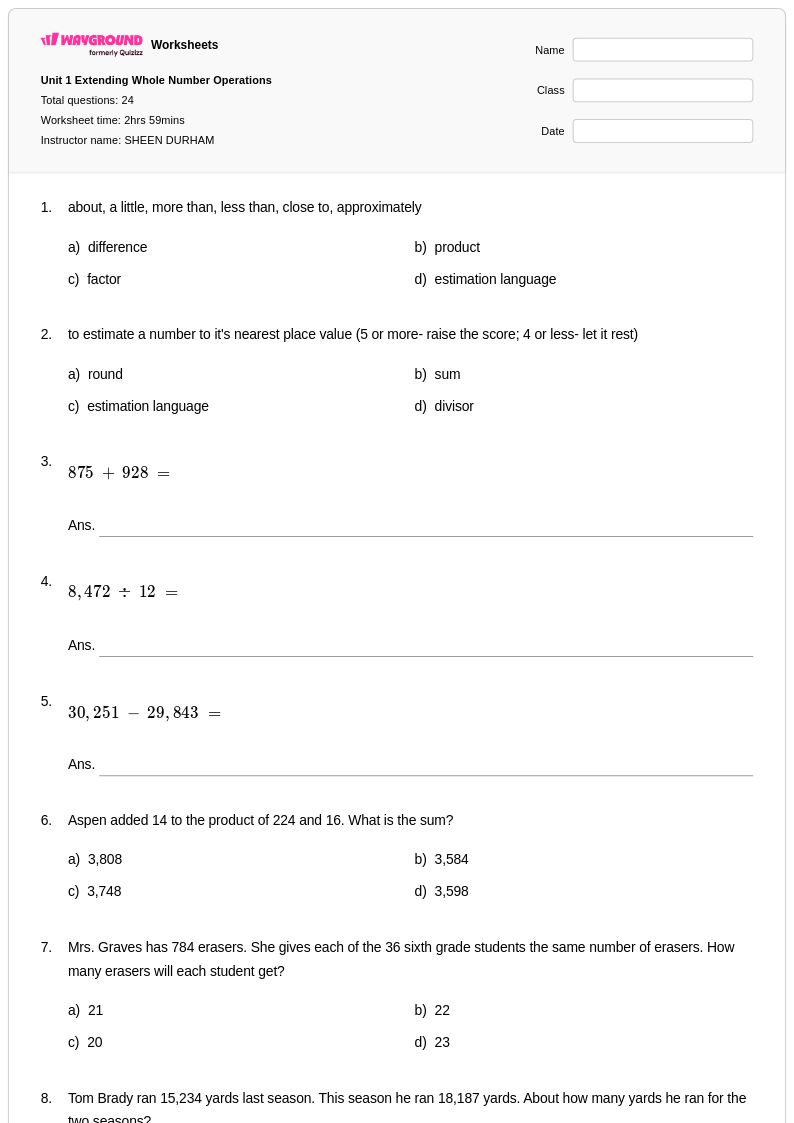
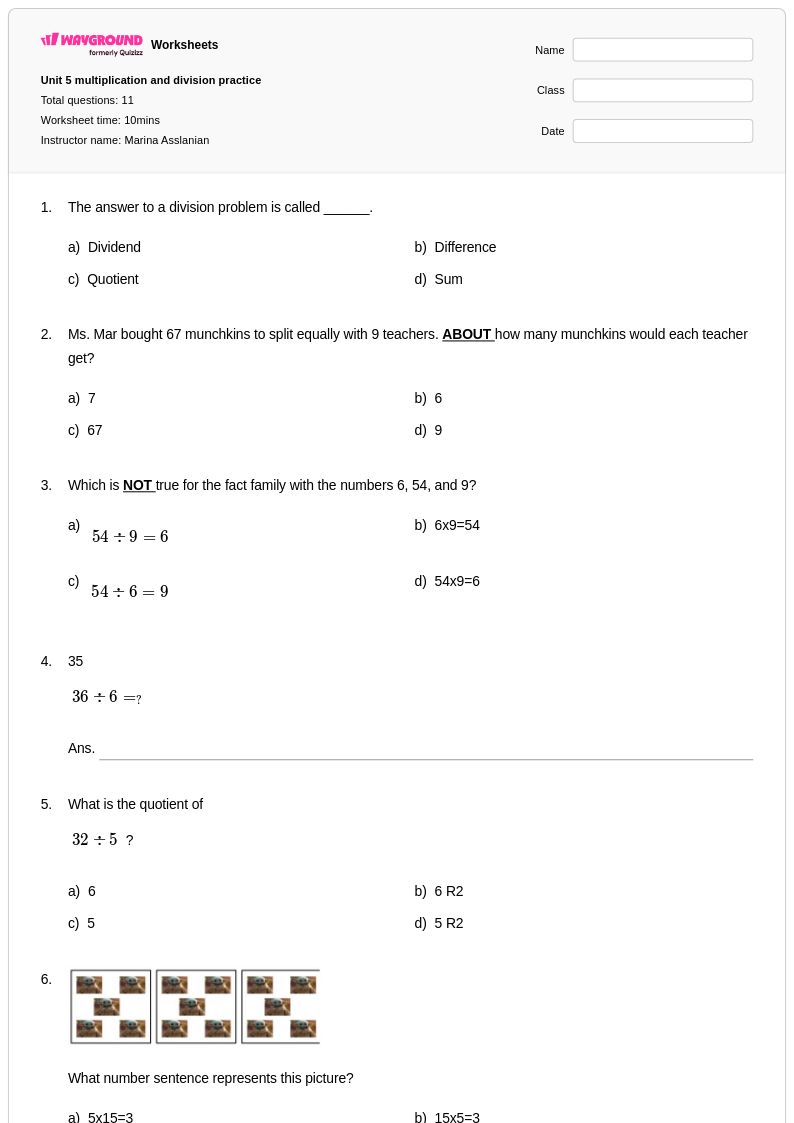
Help students master estimating differences with Wayground's free printable worksheets featuring practice problems and answer keys that develop essential number sense skills through engaging mathematical exercises.
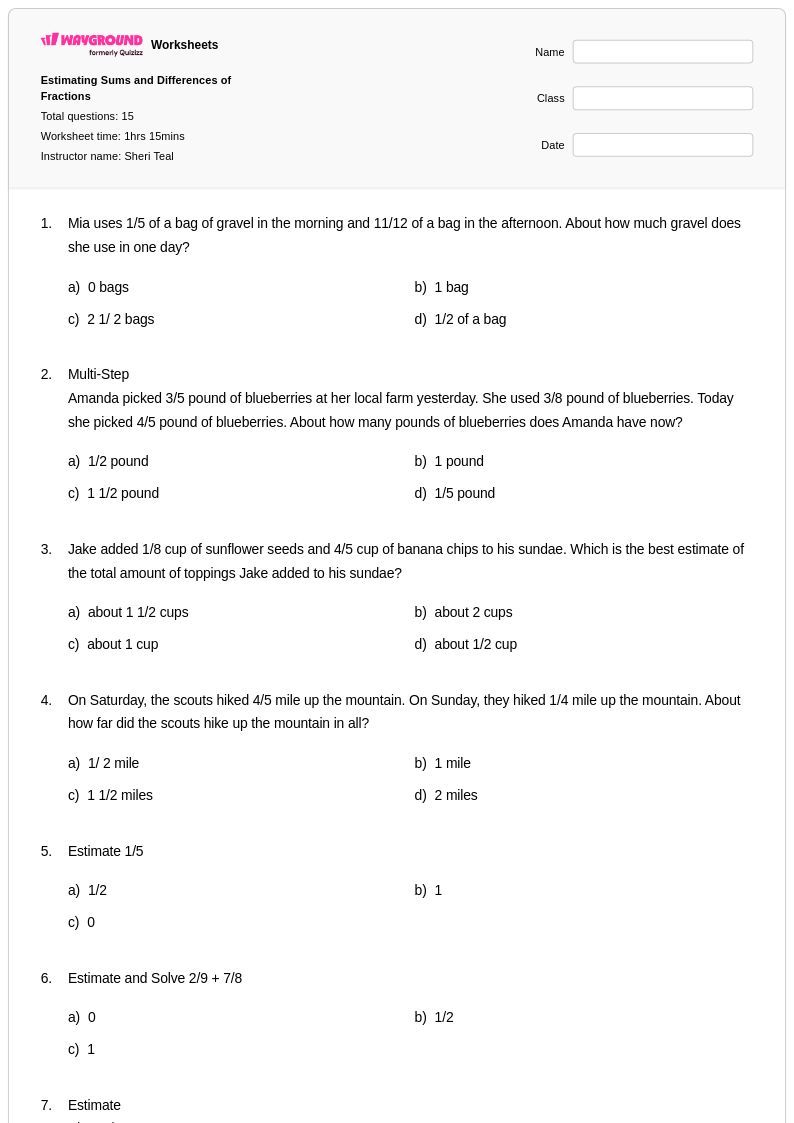
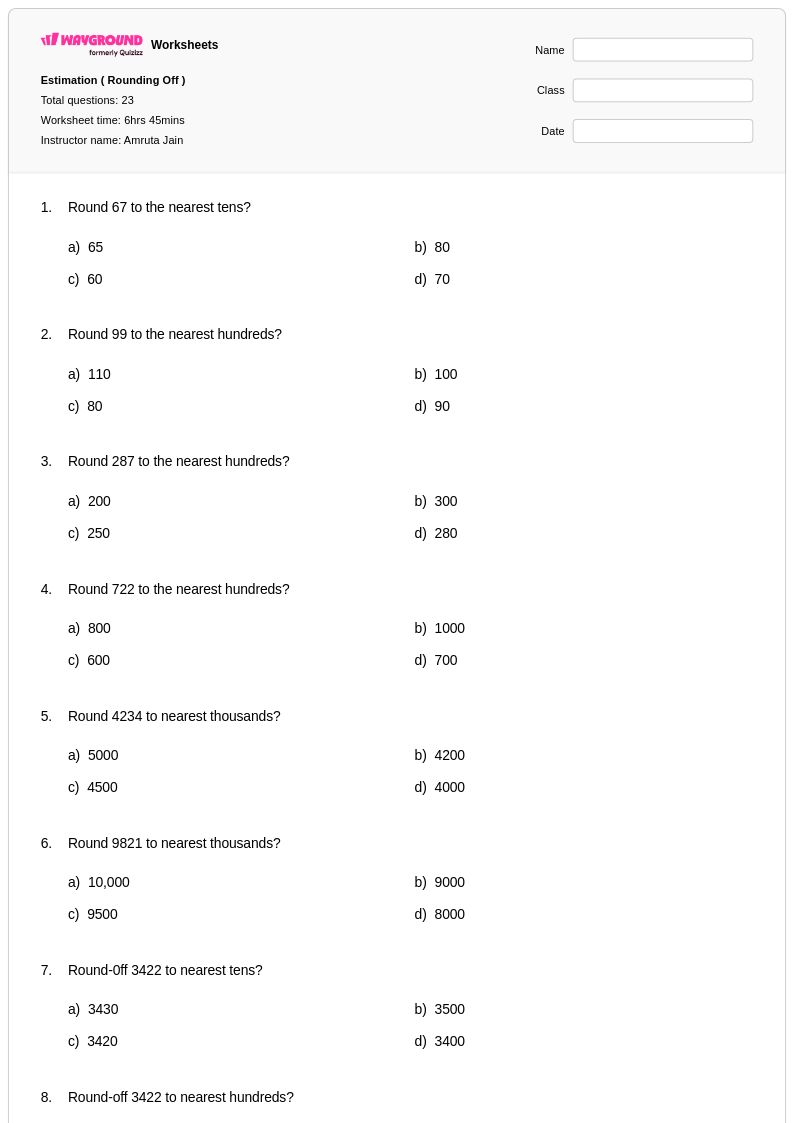
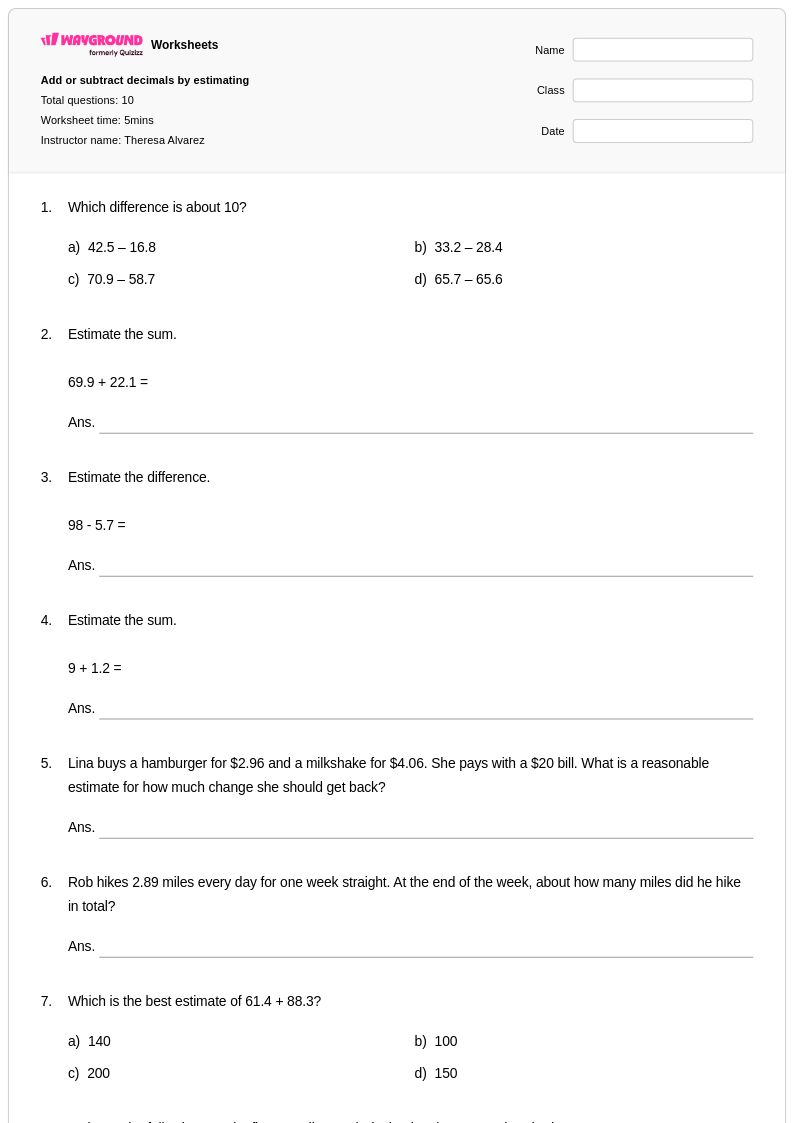
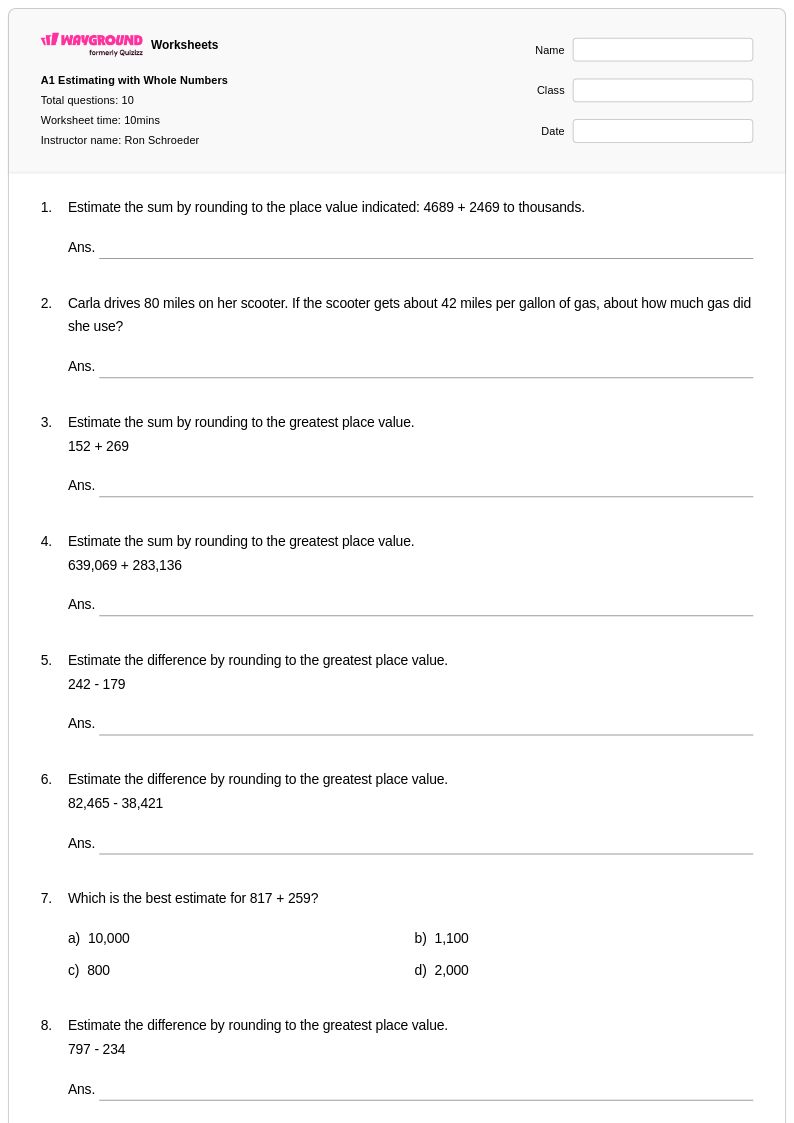
Estimating differences worksheets from Wayground (formerly Quizizz) provide comprehensive practice opportunities for students to develop critical mathematical reasoning skills through strategic approximation techniques. These carefully designed resources help learners master the art of calculating approximate differences between numbers without performing exact computations, strengthening their number sense and mental math capabilities. Each worksheet collection includes varied practice problems that progress from simple two-digit subtraction estimates to more complex multi-digit scenarios, complete with detailed answer keys that support both independent study and classroom instruction. The free printable materials offer educators flexible pdf resources that can be seamlessly integrated into lesson plans, homework assignments, or assessment preparation, ensuring students build confidence in making reasonable mathematical estimates.
Wayground's extensive library of teacher-created estimating differences worksheets draws from millions of educational resources, providing educators with robust search and filtering capabilities to locate materials perfectly suited to their instructional needs. The platform's standards-aligned content supports differentiated instruction through customizable difficulty levels and problem types, enabling teachers to address diverse learning requirements within their classrooms. These digital and printable worksheet collections facilitate effective lesson planning by offering ready-to-use materials for skill practice, targeted remediation for struggling learners, and enrichment opportunities for advanced students. Teachers can easily adapt the pdf formats for various instructional contexts, from whole-group practice sessions to individual skill-building exercises, making these estimating differences resources invaluable tools for developing students' mathematical fluency and conceptual understanding.
FAQs
How do I teach estimating differences?
Start by making sure students understand why estimation matters: it's a check on their own work, not a shortcut around it. The most effective sequence is to teach rounding first, then connect it directly to subtraction — have students round both numbers before subtracting, then compare their estimate to the exact answer. Front-end estimation (using only the leading digits) is worth introducing as a second strategy once rounding feels solid, since it's faster for mental math. Anchor every lesson in real contexts: 'You have $83 and something costs $47 — do you have enough?' keeps the skill from feeling abstract.
What exercises help students practice estimating differences?
The most useful practice moves from structured to open-ended. Begin with problems where students round both numbers to the same place value and subtract. Then introduce problems where they have to choose which place value to round to — that decision-making is where real number sense develops. Mixed sets that include both exact and estimation problems are especially effective because students have to decide which approach fits, rather than applying the same procedure on autopilot.
What mistakes do students commonly make when estimating differences?
The most common error is rounding one number but not the other, which produces an estimate that's barely different from the exact answer. A close second: students round to inconsistent place values (one number to the nearest ten, the other to the nearest hundred), then wonder why their estimate seems off. Watch also for students who treat estimation as a multi-step written process — if they're reaching for pencil and paper to estimate, they've missed the point. Estimation should feel faster than exact computation, not slower.
How do I use Wayground's estimating differences worksheets in my classroom?
Each worksheet is available as a printable PDF or as a digital quiz hosted on Wayground — same problems, either format. For digital use, you can assign it as an interactive quiz students complete on a device; for paper practice, download and print the PDF, then use the Wayground for Teachers app to scan and grade student submissions without manual marking. Every worksheet includes a complete answer key, so it works equally well for independent practice, homework, or a quick formative check.
Is estimating differences aligned to Common Core standards?
Yes. Common Core builds estimation into its number and operations strand across multiple grade bands. In the early grades, students round whole numbers as a foundation; by grades 4 and 5, they're expected to use rounding to assess the reasonableness of answers to multi-digit and decimal computations. Estimating differences sits squarely in that progression — it's the practical application of rounding, and Common Core treats it as a reasoning skill, not just a procedural one. Students who can estimate differences fluently are better positioned for the multi-digit and decimal operations that follow.
How can I differentiate estimating differences practice for mixed-ability classes?
For students who struggle, reducing answer choices in digital mode lowers the cognitive load enough that they can focus on the estimation strategy itself rather than getting lost in the options. The Read Aloud accommodation helps students who have difficulty parsing multi-step word problems independently. On the worksheet side, Wayground lets you generate alternate versions with larger font sizes or a dyslexia-friendly font — small changes that remove barriers without altering the math. Advanced students benefit most from open-ended problems where they choose the rounding strategy, since that's where estimation thinking deepens.