Free Printable Atomic Orbital Diagram Worksheets for Class 11
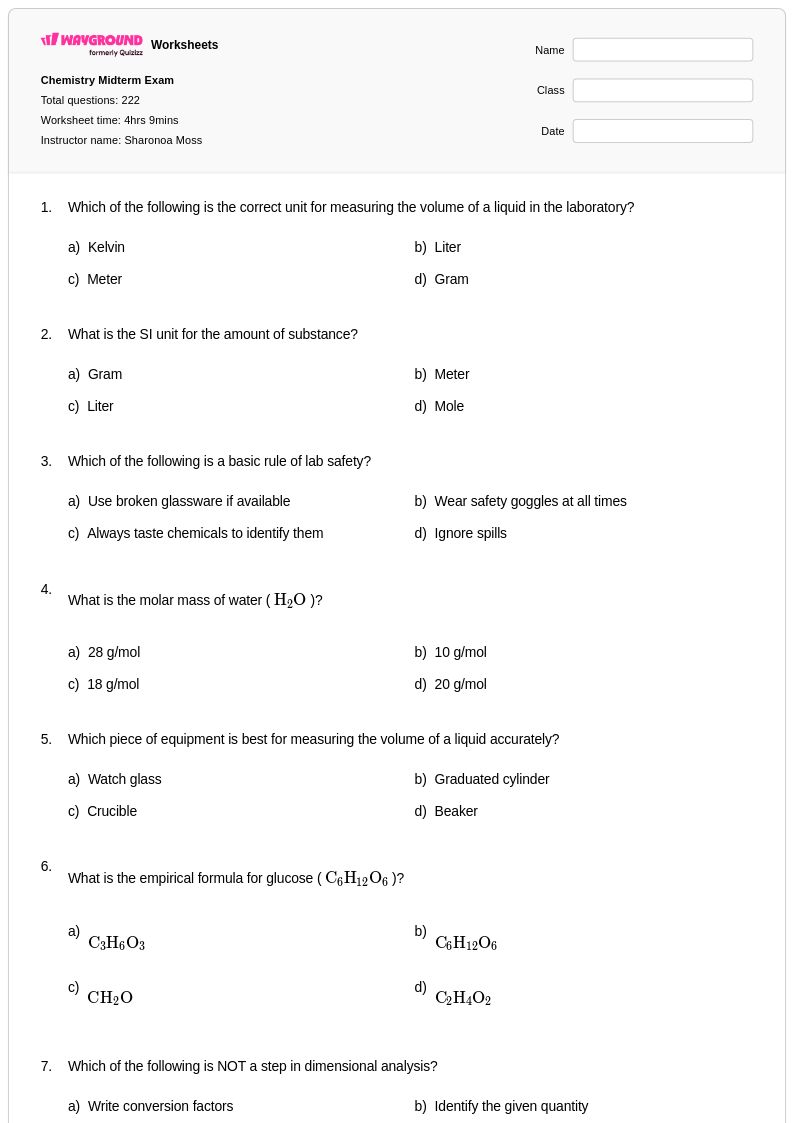
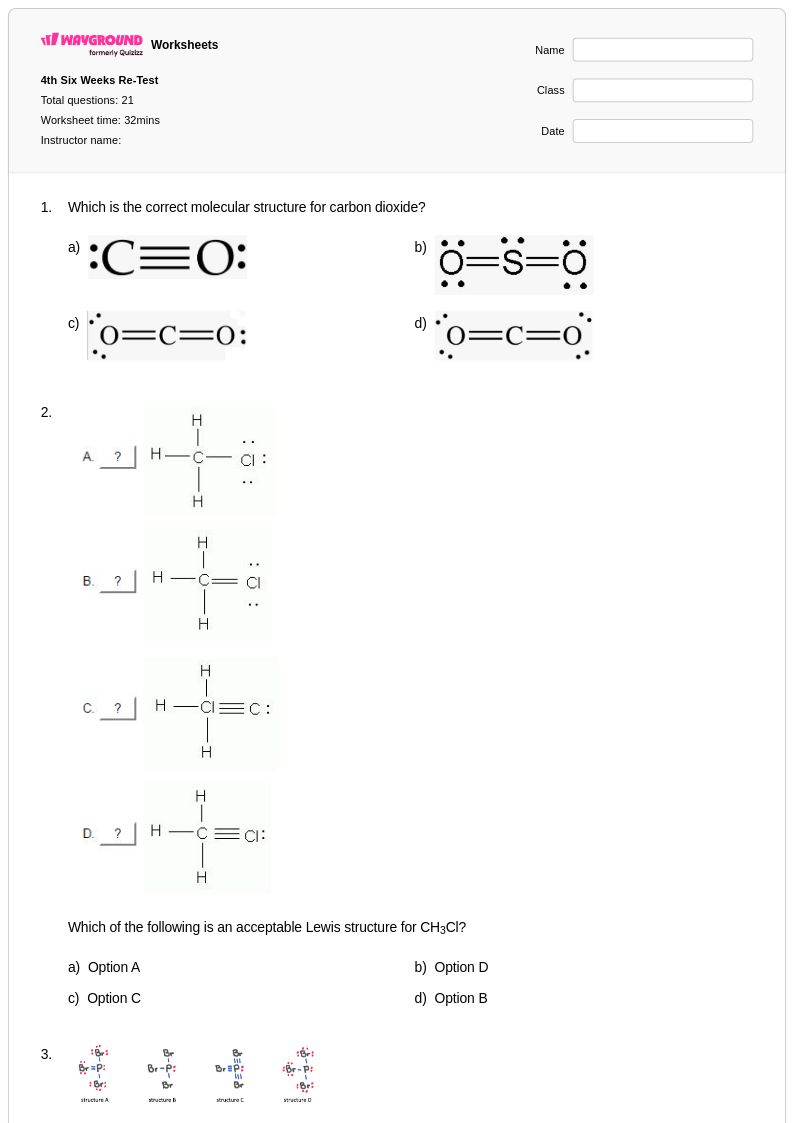
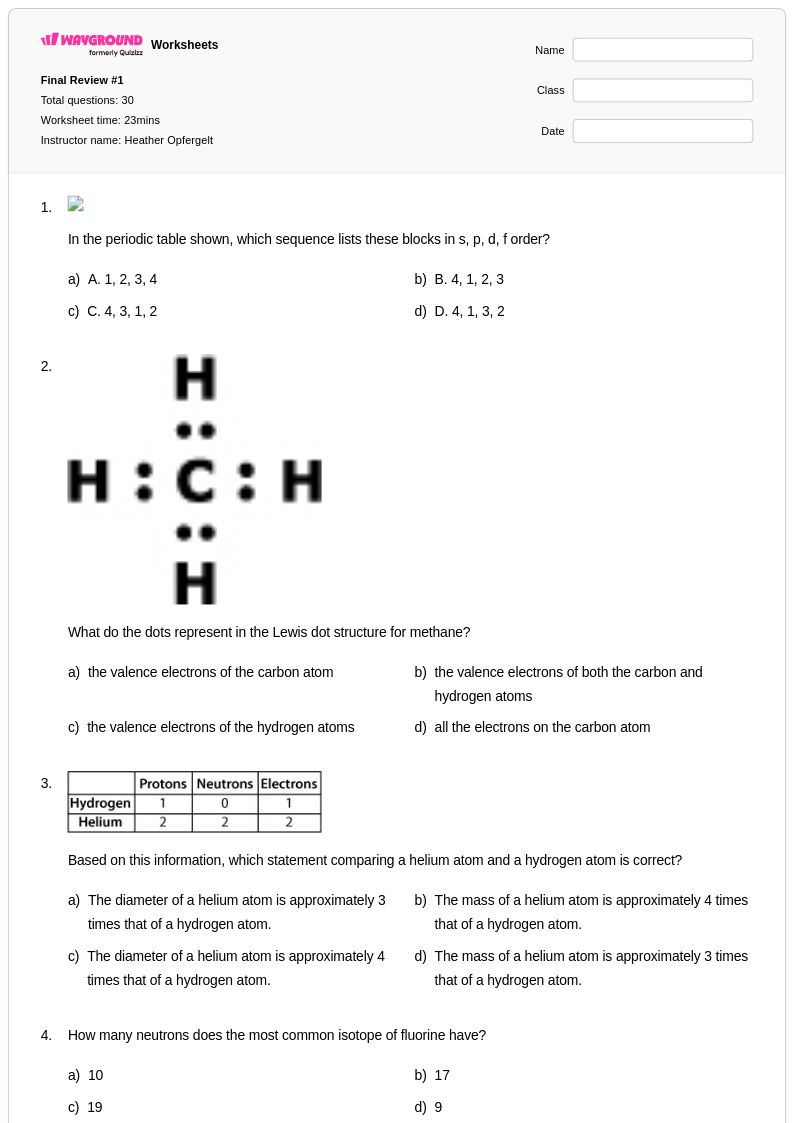
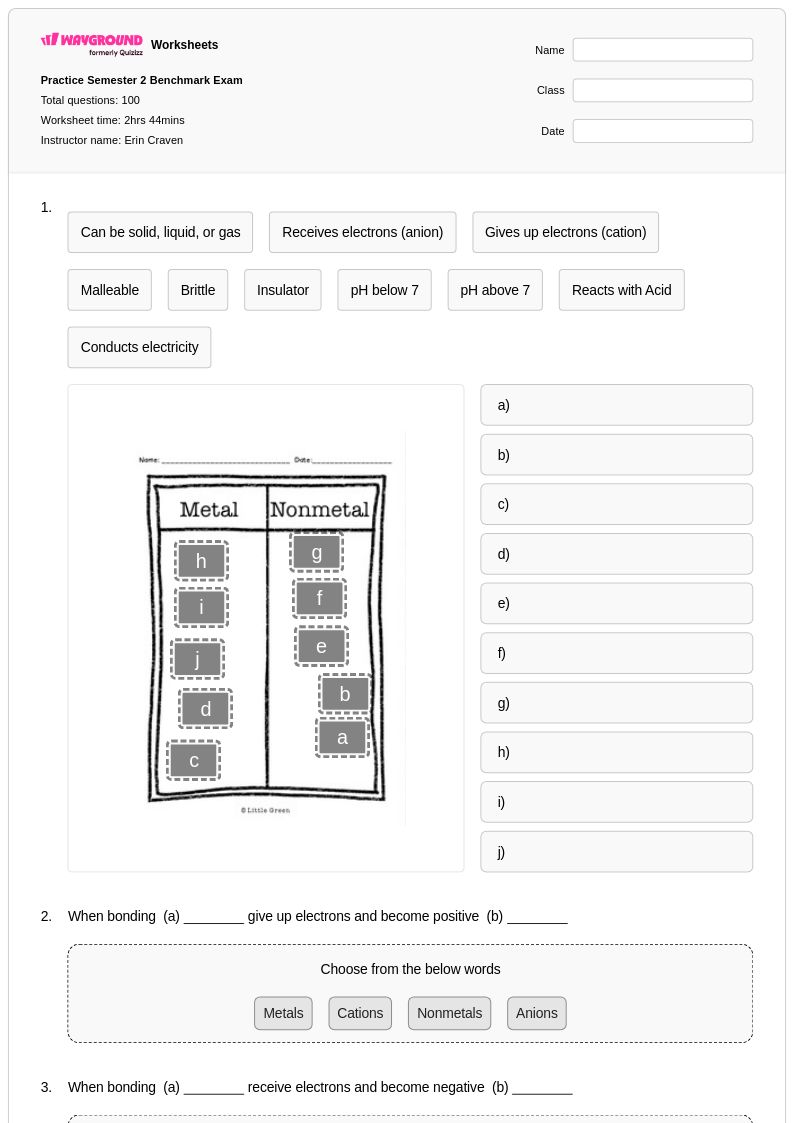
Class 11 atomic orbital diagram worksheets from Wayground provide free printables and practice problems with answer keys to help students master electron configuration and orbital shapes in chemistry.
Explore printable Atomic Orbital Diagram worksheets for Class 11
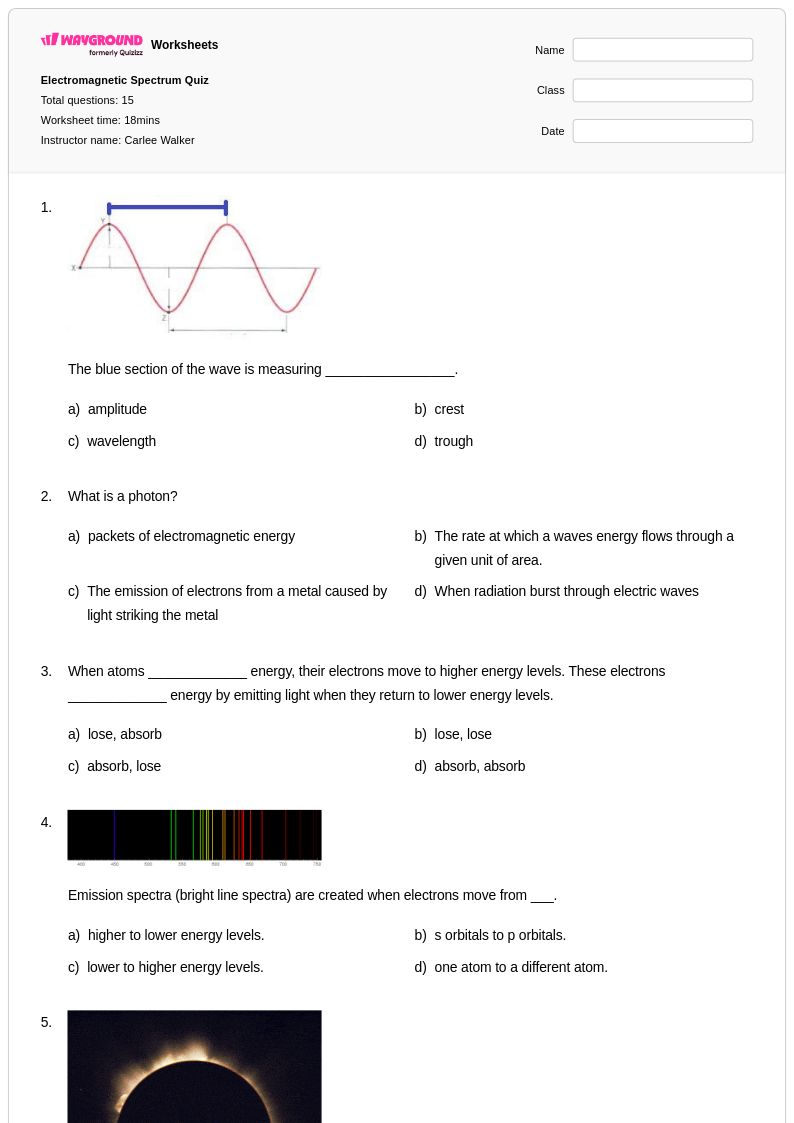
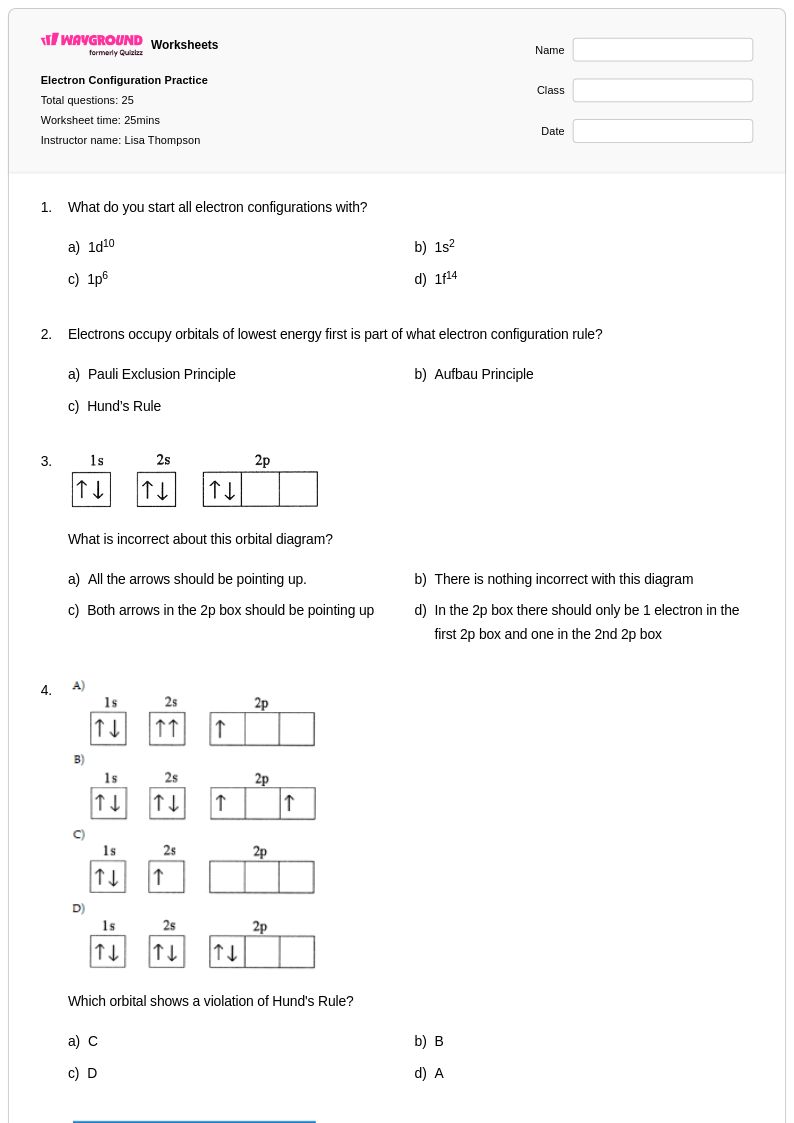
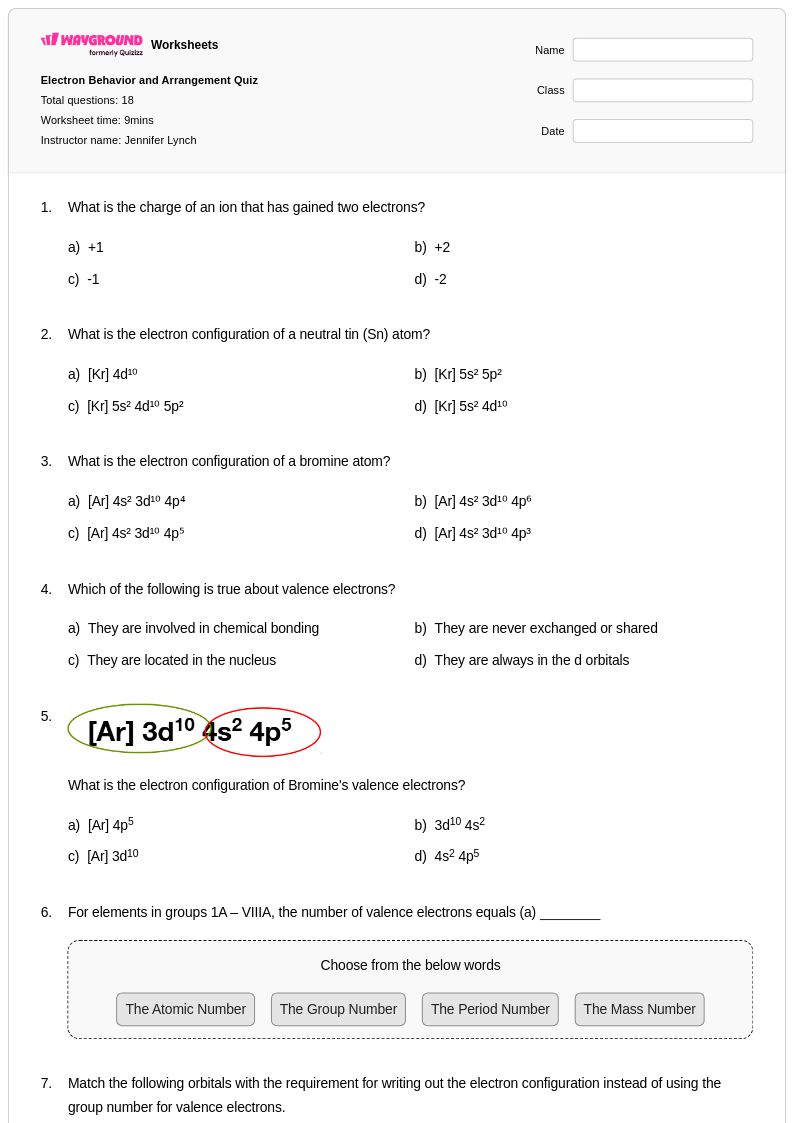
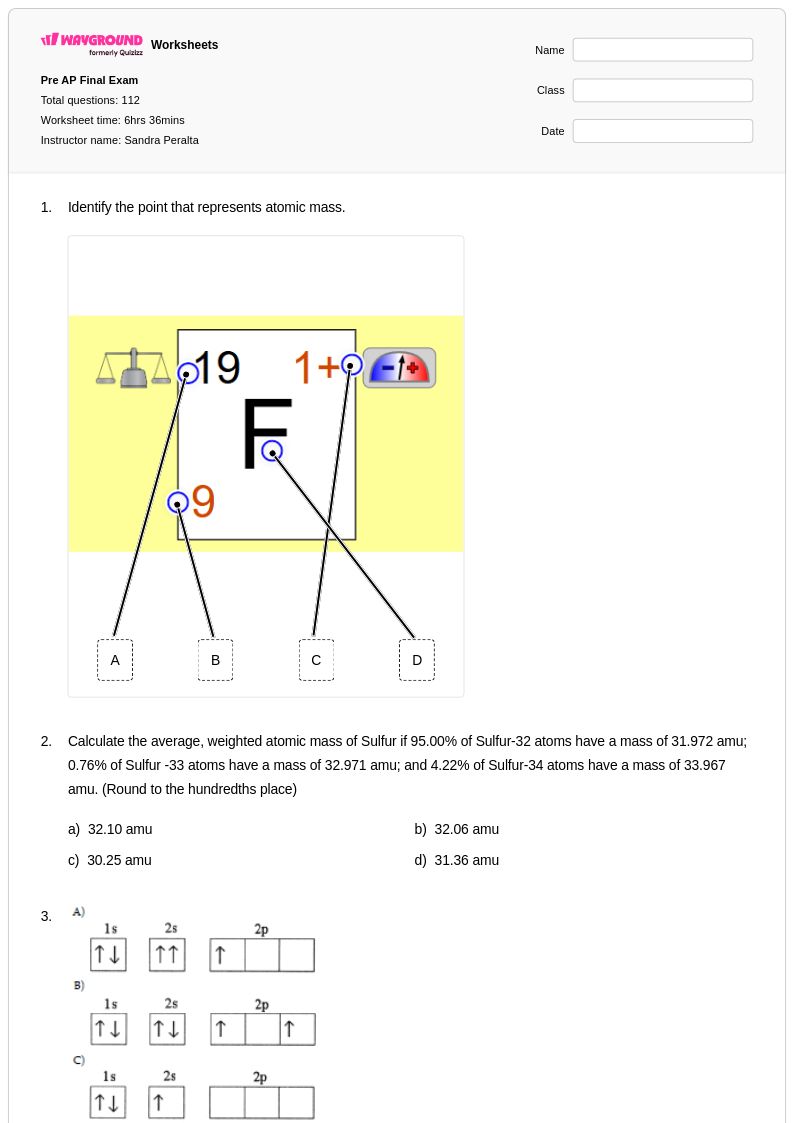
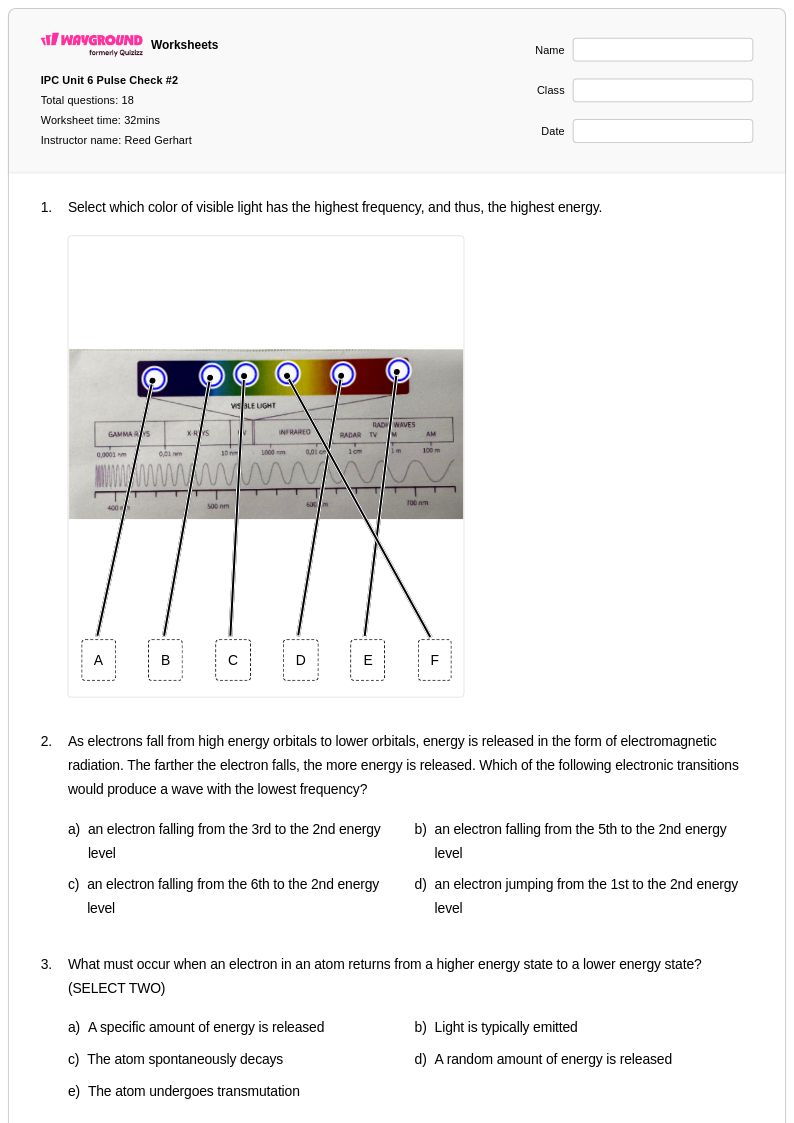
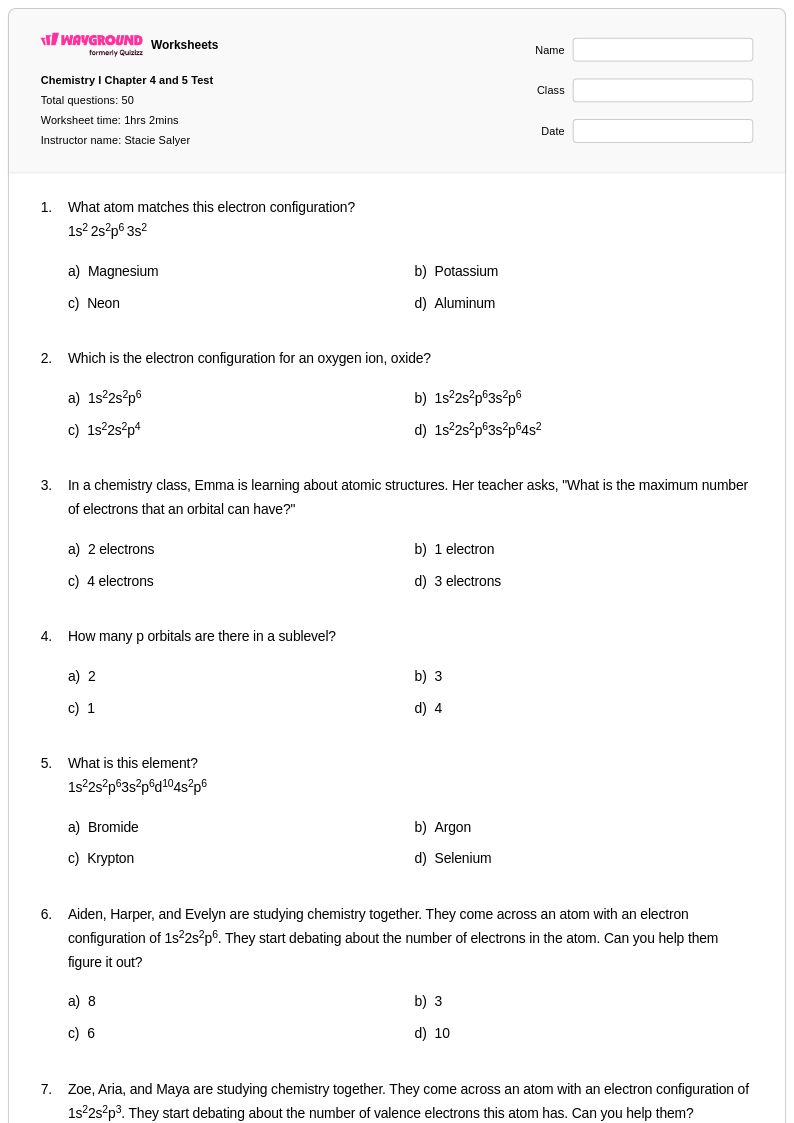
Atomic orbital diagram worksheets for Class 11 students available through Wayground (formerly Quizizz) provide comprehensive practice in visualizing and understanding electron configuration within atoms. These expertly designed worksheets strengthen critical skills in quantum mechanics fundamentals, including identifying s, p, d, and f orbital shapes, determining electron spin directions, and applying Hund's rule and the Aufbau principle. Students work through systematic practice problems that reinforce their ability to construct accurate orbital diagrams for elements across the periodic table, while printable pdf formats and complete answer keys ensure efficient learning and self-assessment. The free resources cover essential concepts from simple hydrogen orbitals to complex transition metal configurations, helping students master the spatial relationships between electrons and their energy levels.
Wayground (formerly Quizizz) empowers educators with millions of teacher-created atomic orbital diagram resources that support diverse classroom needs and learning objectives. The platform's robust search and filtering capabilities enable teachers to quickly locate worksheets aligned with specific chemistry standards and Class 11 curriculum requirements, while differentiation tools allow for customized content that addresses varying student skill levels. Teachers can seamlessly access both printable and digital formats, including downloadable pdf versions, making lesson planning more efficient whether for in-person or remote instruction. These versatile worksheet collections serve multiple pedagogical purposes, from initial skill introduction and guided practice to targeted remediation for struggling students and enrichment activities for advanced learners, ultimately supporting comprehensive mastery of electron configuration principles.
FAQs
How do I teach atomic orbital diagrams to chemistry students?
Start by grounding students in the three core rules that govern electron placement: the aufbau principle (fill lowest energy orbitals first), the Pauli exclusion principle (no two electrons share the same four quantum numbers), and Hund's rule (maximize unpaired electrons within a subshell before pairing). Build from simple atoms like hydrogen and helium before moving to multi-electron atoms, using visual diagrams with arrows to represent spin direction. Connecting orbital notation explicitly to electron configuration notation helps students see how both representations describe the same underlying structure.
What exercises help students practice drawing orbital diagrams?
Effective practice starts with single-subshell diagrams for elements in periods 1 and 2, then progressively introduces d-subshell filling for transition metals, where common errors tend to cluster. Exercises that ask students to convert between orbital notation and electron configuration notation reinforce both formats simultaneously. Including problems that require students to identify the number of unpaired electrons from a completed diagram adds an application layer that deepens conceptual understanding.
What mistakes do students commonly make when drawing atomic orbital diagrams?
The most frequent error is violating Hund's rule by pairing electrons in a subshell before all orbitals in that subshell are singly occupied. Students also commonly misorder orbital energy levels, particularly placing 4s above 3d instead of below it when filling. A third common misconception is treating orbital boxes as interchangeable with electron configuration notation, without recognizing that orbital diagrams carry additional information about electron spin and subshell occupancy.
How do I use atomic orbital diagram worksheets in my classroom?
Atomic orbital diagram worksheets on Wayground are available as printable PDFs for traditional classroom use and in digital formats for technology-integrated environments, including the option to host them as a quiz directly on Wayground. Printable versions work well for guided note-taking or lab-style practice, while digital formats allow teachers to assign work asynchronously or track student responses in real time. Each worksheet includes a detailed answer key, making them equally useful for independent student practice, peer review activities, or targeted remediation.
How can I differentiate atomic orbital diagram instruction for students at different skill levels?
For students who need additional support, reduce the complexity of atoms assigned and use partially completed diagrams as scaffolds before requiring independent construction. On Wayground, teachers can apply individual accommodations such as read aloud for question text or reduced answer choices to lower cognitive load for specific students, without affecting the experience of the rest of the class. Advanced students can be challenged with transition metal configurations and exceptions like chromium and copper, where the expected aufbau filling pattern does not apply.
How do quantum numbers relate to atomic orbital diagrams?
Each orbital in a diagram corresponds to a unique set of quantum numbers: the principal quantum number (n) defines the energy level, the angular momentum quantum number (l) defines the subshell shape, the magnetic quantum number (ml) identifies the specific orbital within a subshell, and the spin quantum number (ms) distinguishes the two electrons that can occupy a single orbital. Orbital diagrams make this abstract framework concrete by representing each allowed ml value as a box and each electron's ms value as an up or down arrow. This connection helps students understand why, for example, a p subshell contains exactly three boxes and can hold a maximum of six electrons.