Free Printable Mass Spectrometry Worksheets for Class 11
Enhance your Class 11 chemistry understanding with our comprehensive mass spectrometry worksheets featuring printable PDFs, practice problems, and answer keys to master analytical techniques and molecular identification.
Explore printable Mass Spectrometry worksheets for Class 11
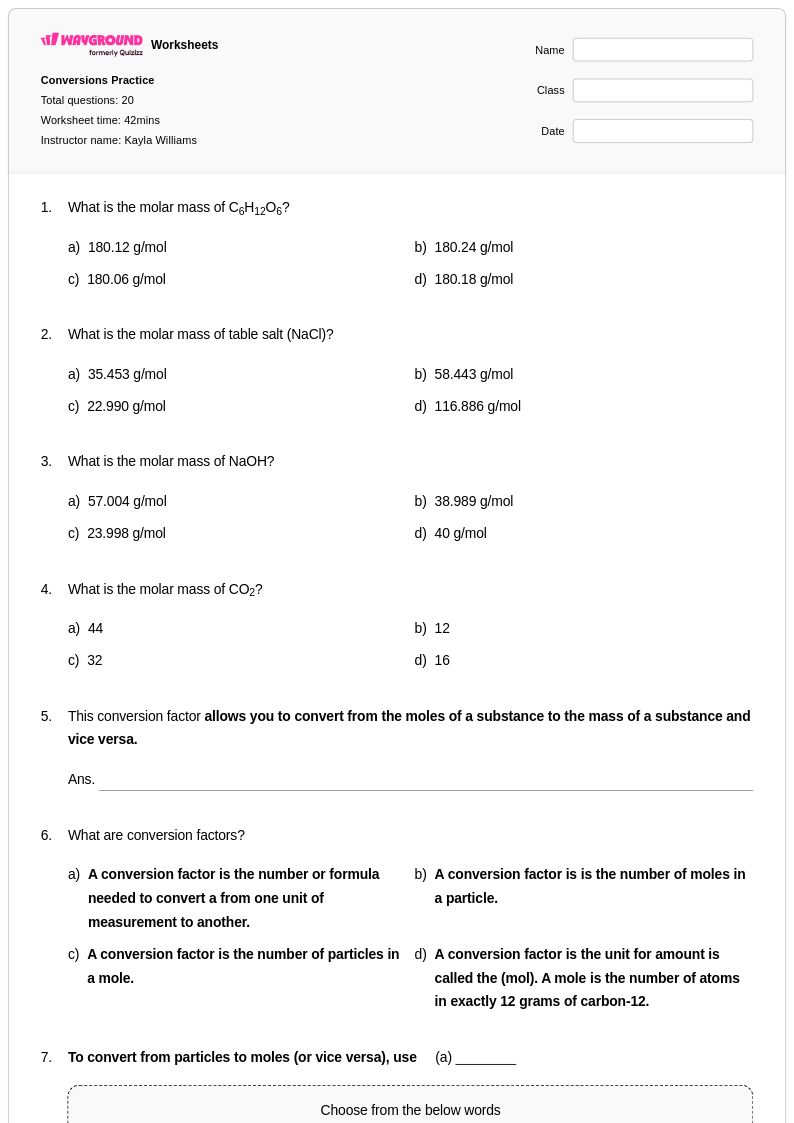
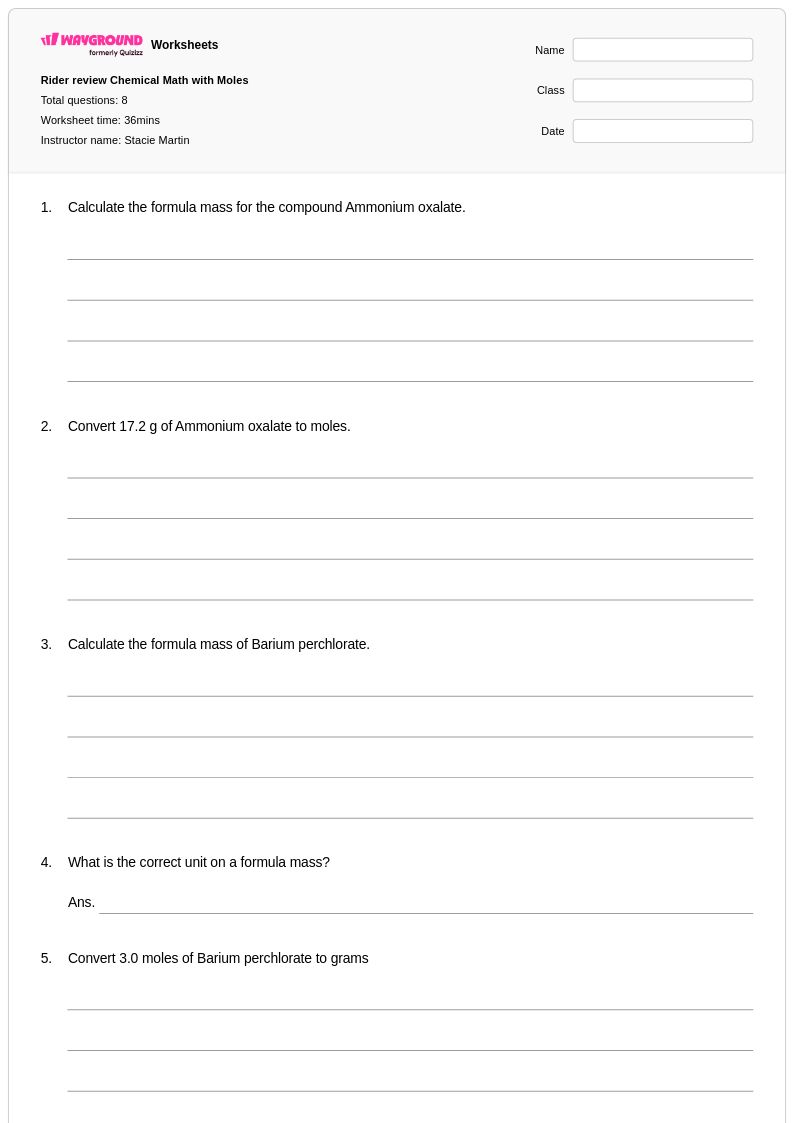
Mass spectrometry worksheets for Class 11 chemistry students available through Wayground (formerly Quizizz) provide comprehensive coverage of this essential analytical technique used to identify and quantify chemical compounds. These expertly designed practice problems guide students through the fundamental principles of mass spectrometry, including ionization methods, mass-to-charge ratios, fragmentation patterns, and spectral interpretation. Students develop critical analytical skills as they work through exercises involving molecular ion peaks, isotope patterns, and structural elucidation from mass spectral data. The worksheets feature detailed answer keys that support independent learning and self-assessment, while the free printable format ensures accessibility for all classroom environments. These resources strengthen students' ability to connect theoretical chemistry concepts with real-world analytical applications, preparing them for advanced studies in organic chemistry and analytical science.
Wayground (formerly Quizizz) empowers chemistry educators with millions of teacher-created mass spectrometry resources that streamline lesson planning and enhance student engagement. The platform's robust search and filtering capabilities allow teachers to quickly locate worksheets aligned with specific curriculum standards and learning objectives, while differentiation tools enable customization for students with varying ability levels. These comprehensive collections are available in both printable pdf format and interactive digital versions, providing flexibility for traditional classroom instruction and remote learning environments. Teachers can efficiently address individual student needs through targeted remediation exercises or challenge advanced learners with enrichment activities that explore complex spectral analysis scenarios. The extensive resource library supports systematic skill development in mass spectrometry interpretation, ensuring students build confidence in analyzing complex chemical data and applying analytical reasoning to solve challenging chemistry problems.
FAQs
How do I teach mass spectrometry to high school or college chemistry students?
Start by grounding students in the core instrument stages: ionization, mass analysis, and detection. Use annotated mass spectra early so students can connect the m/z axis to real molecular fragments before introducing fragmentation rules. Building from base peak identification toward full structural elucidation helps students develop analytical reasoning progressively rather than memorizing disconnected steps.
What types of practice problems help students get better at reading mass spectra?
Effective mass spectrometry practice should include m/z ratio calculations, molecular ion peak identification, isotope pattern recognition, and fragmentation pathway analysis. Students benefit most from problems that require them to work backward from a spectrum to propose a molecular structure, as this mirrors real analytical chemistry workflows. Scaffolded problem sets that begin with simple molecules and increase in complexity help build confidence before tackling advanced structural elucidation.
What mistakes do students commonly make when interpreting mass spectra?
The most frequent error is confusing the molecular ion peak (M+) with the base peak, leading students to misidentify the molecular weight. Students also commonly misread isotope patterns, particularly for compounds containing chlorine or bromine, because they underestimate the significance of M+2 peaks. A third common misconception is treating fragmentation as random rather than understanding that bonds break at predictable sites based on stability of the resulting carbocations or radicals.
How do I use Wayground's mass spectrometry worksheets in my chemistry class?
Wayground's mass spectrometry worksheets are available as printable PDFs for traditional lab and classroom use, as well as in digital formats for technology-integrated environments, making them suitable for in-class practice, homework, or exam review. Teachers can also host the worksheets as a quiz directly on Wayground, enabling real-time student responses and automated scoring. Each worksheet includes detailed answer keys and step-by-step solutions, reducing the prep burden for teachers assigning independent or guided practice.
How can I differentiate mass spectrometry instruction for students at different levels?
For struggling students, reduce cognitive load by focusing first on identifying the molecular ion peak and one or two simple fragmentation losses before introducing complex spectra. Advanced learners can be challenged with multi-stage structural elucidation problems that combine mass spectrometry data with IR or NMR evidence. On Wayground, teachers can also apply accommodations such as reduced answer choices or read-aloud features for individual students without disrupting the rest of the class.
At what point in a chemistry course should mass spectrometry be introduced?
Mass spectrometry is typically introduced after students have a solid foundation in molecular structure, bonding, and basic organic functional groups, as spectral interpretation requires recognizing fragment ions that correspond to specific structural units. In AP Chemistry or introductory college organic chemistry, it is commonly taught alongside or following other spectroscopic methods such as IR spectroscopy. Introducing it in context, such as during a unit on analytical techniques or molecular identification, helps students understand its practical purpose rather than treating it as an abstract concept.