Explore Wayground's free congruence worksheets and printables that help students master geometric congruence through engaging practice problems, with comprehensive PDF resources and answer keys for effective learning.
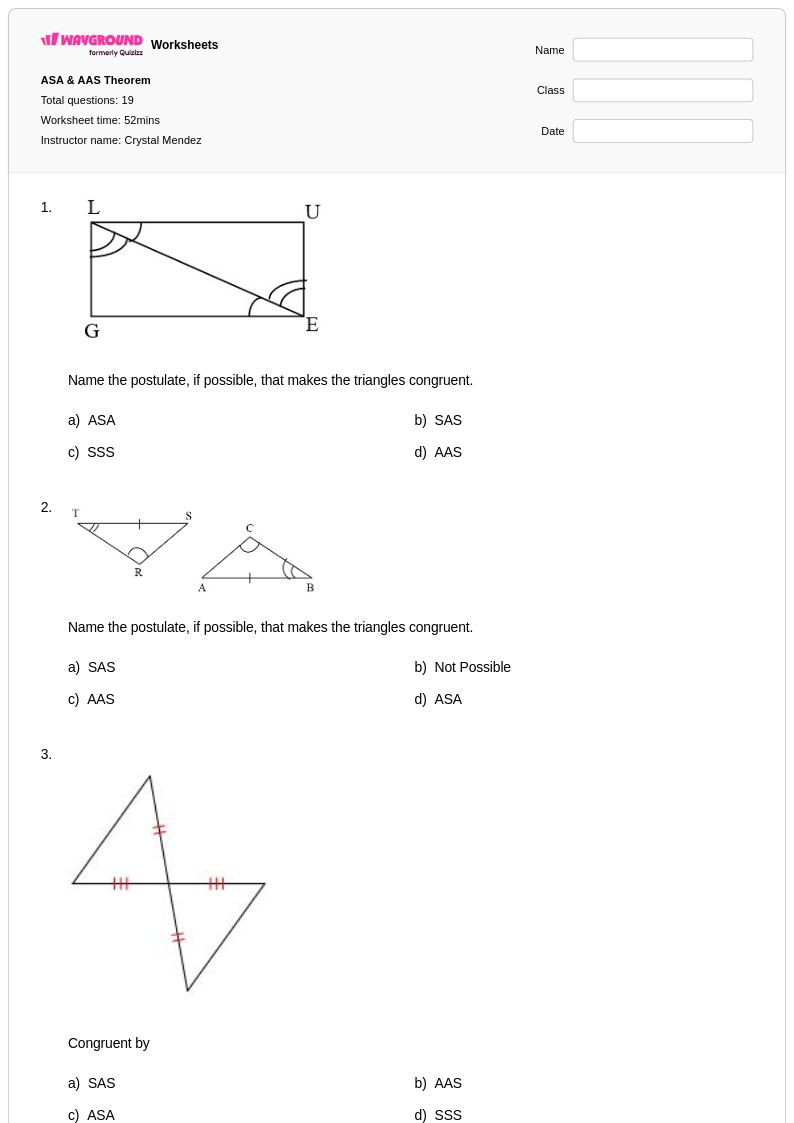
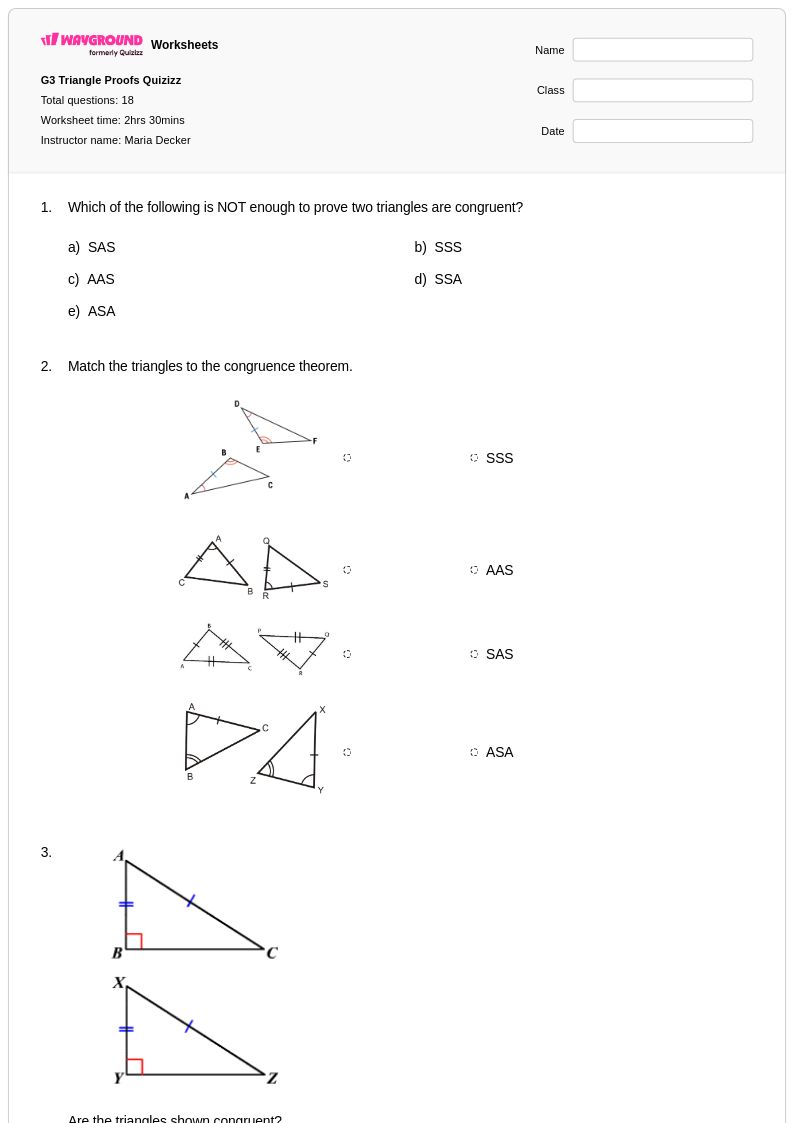
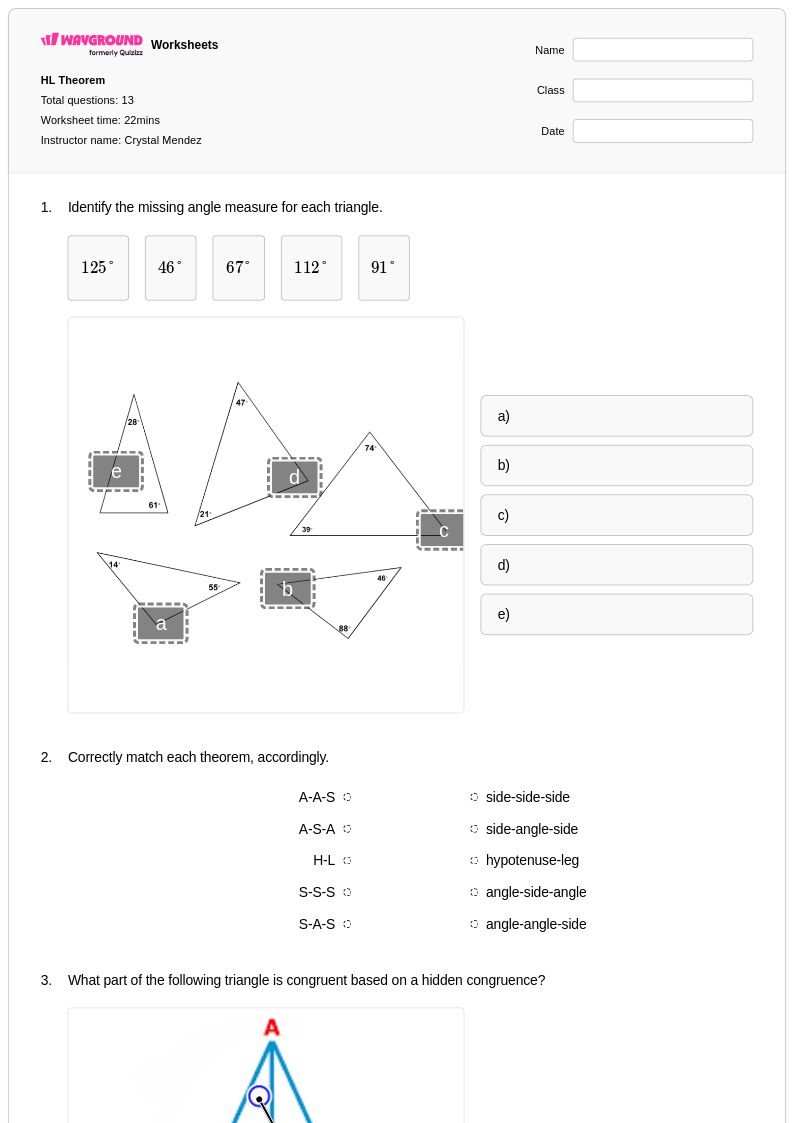
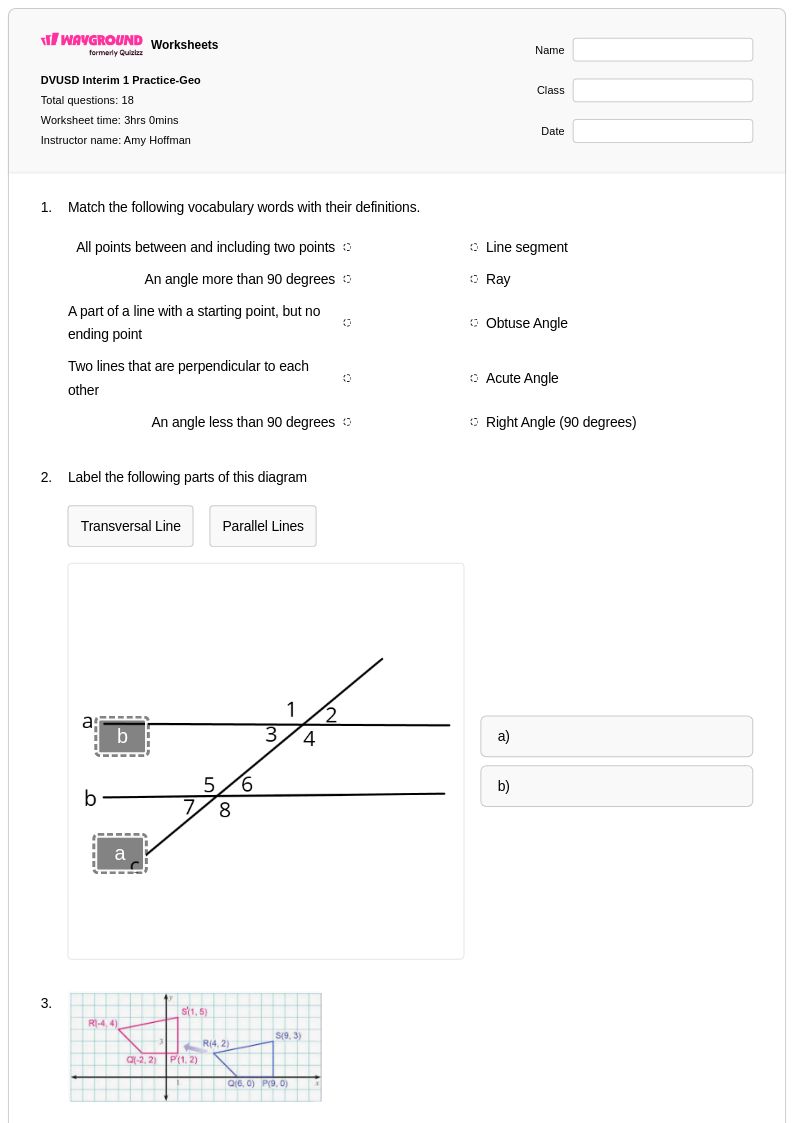
Congruence worksheets available through Wayground (formerly Quizizz) provide comprehensive practice opportunities for students to master one of geometry's fundamental concepts. These expertly designed resources focus on developing critical skills including identifying congruent figures, applying congruence postulates and theorems, proving triangle congruence through SSS, SAS, ASA, AAS, and HL methods, and solving problems involving corresponding parts of congruent triangles. Each worksheet collection includes detailed answer keys that support both independent study and classroom instruction, while the free printables offer educators flexibility in delivering targeted practice problems that reinforce geometric reasoning and proof-writing abilities essential for mathematical success.
Wayground (formerly Quizizz) empowers mathematics educators with an extensive library of millions of teacher-created congruence resources that streamline instructional planning and support diverse learning needs. The platform's robust search and filtering capabilities enable teachers to quickly locate worksheets aligned with specific curriculum standards, while built-in differentiation tools allow for seamless customization based on individual student proficiency levels. These comprehensive collections are available in both printable pdf formats for traditional classroom use and digital formats for technology-integrated learning environments, making them invaluable for targeted skill practice, remediation sessions, and enrichment activities that deepen students' understanding of geometric congruence principles and their real-world applications.
FAQs
How do I teach geometric congruence effectively?
Begin with matching figures that have identical size and shape, then have students label corresponding sides and angles before introducing formal notation. Progress to triangle congruence methods—SSS, SAS, ASA, AAS, and HL—and use worked proofs to model how each conclusion follows from given information.
What exercises help students practice congruence?
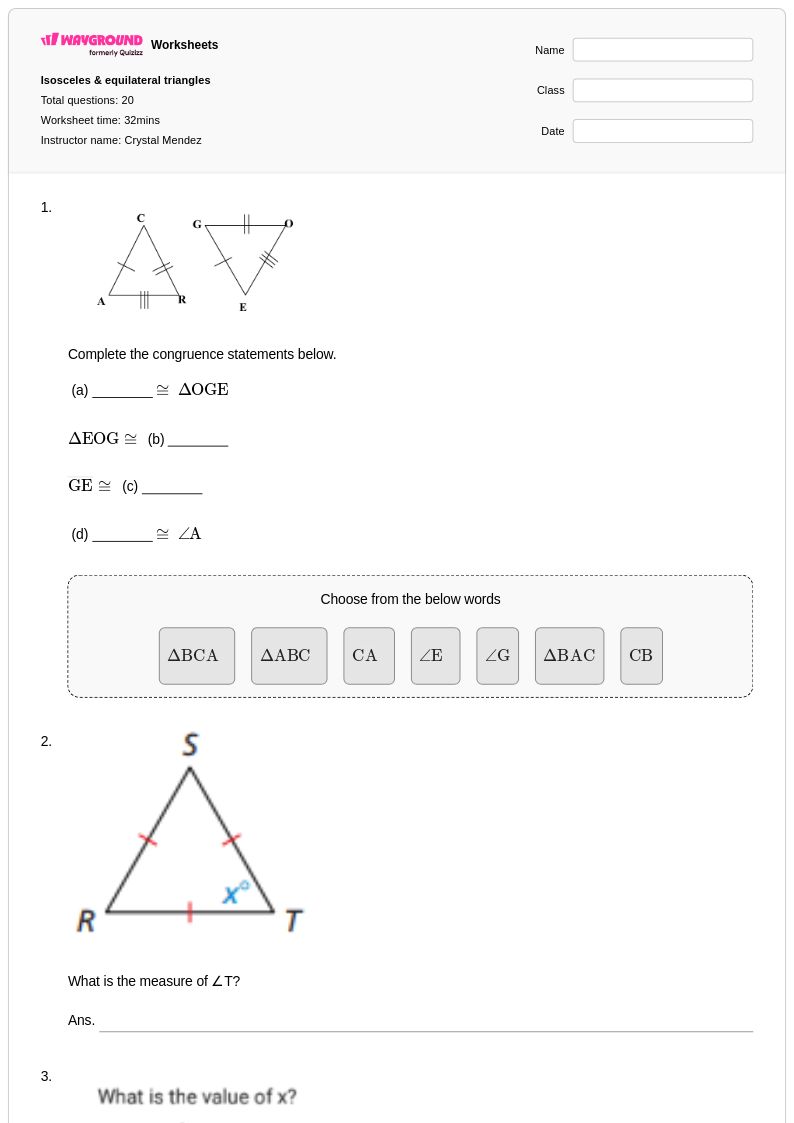
Effective exercises include identifying congruent figures, matching corresponding parts, writing congruence statements, and selecting the correct triangle congruence method. Students should then apply congruence theorems and corresponding parts of congruent triangles to solve unknown-angle, unknown-length, and proof problems.
What mistakes do students commonly make when proving triangles congruent?
Students often match vertices in the wrong order, use SSA as if it were a valid general congruence condition, or confuse congruence with similarity. They may also claim corresponding parts are congruent before establishing that the triangles themselves are congruent, so require every proof step to include a valid justification.
How can I use Wayground congruence worksheets in class?
Wayground worksheets are available as printable PDFs and digital formats, accommodating different teaching environments and student preferences. Teachers can host a worksheet as a digital quiz on Wayground or print and assign it on paper; every worksheet includes a complete answer key, and physical submissions can be scanned or captured for grading with the Wayground for Teachers app.
How does congruence fit into the Common Core geometry progression?
Congruence reflects Common Core’s emphasis on using transformations and logical arguments to establish geometric relationships. Students progress from recognizing equal shapes and corresponding parts to applying rigid motions, triangle congruence criteria, and proof-based reasoning.
How can I differentiate congruence practice for mixed-ability students?
Assign recognition and correspondence problems to students building foundations, guided triangle proofs to developing learners, and multi-step theorem applications for enrichment. Wayground also supports extended time, Read Aloud, reduced answer choices, and reading mode, while alternate worksheet versions can use adjusted spacing, larger text, a dyslexia-friendly font, or translation.