Free Printable Double Displacement Worksheets for Year 12
Explore Wayground's comprehensive Year 12 double displacement chemistry worksheets featuring printable PDFs, free practice problems, and detailed answer keys to help students master chemical reaction prediction and balancing equations.
Explore printable Double Displacement worksheets for Year 12
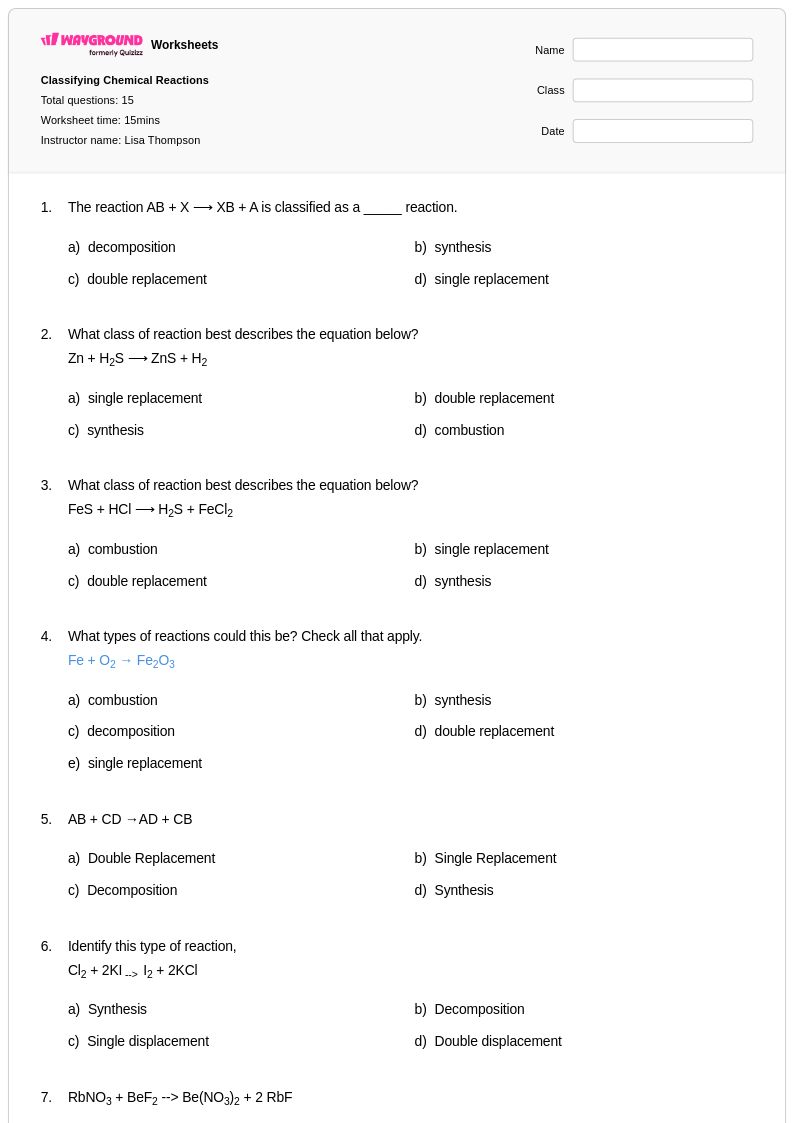
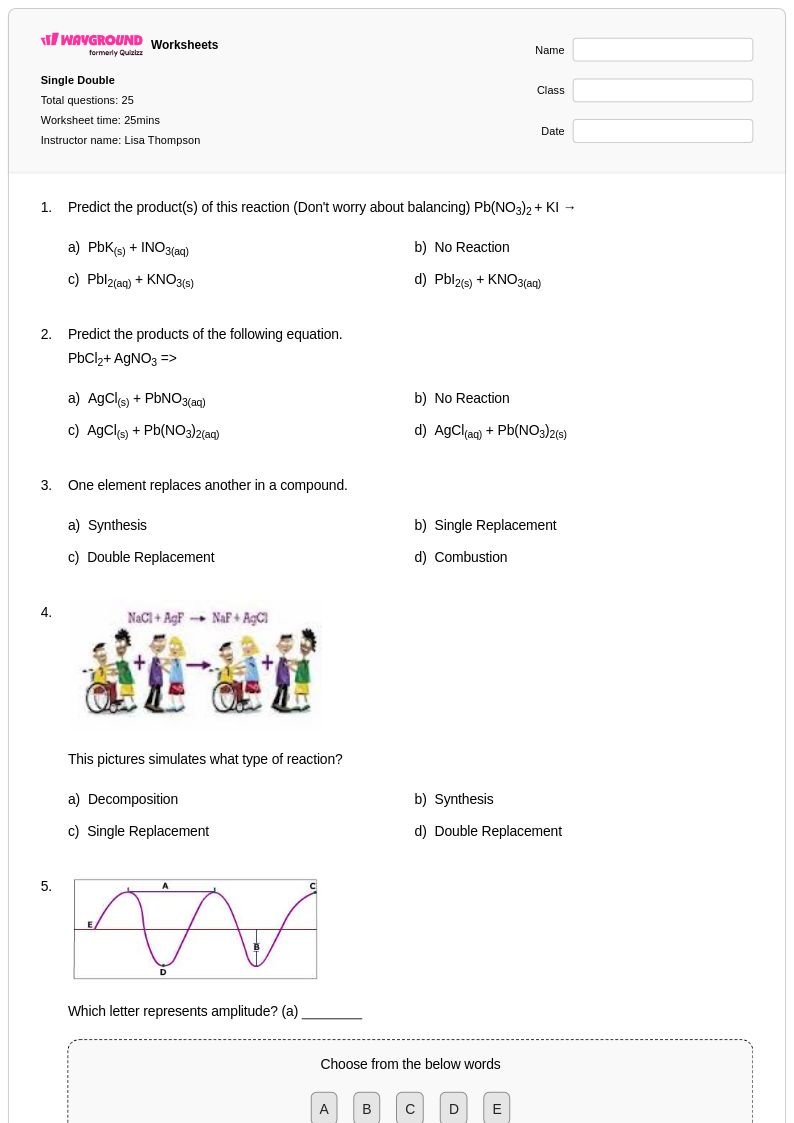
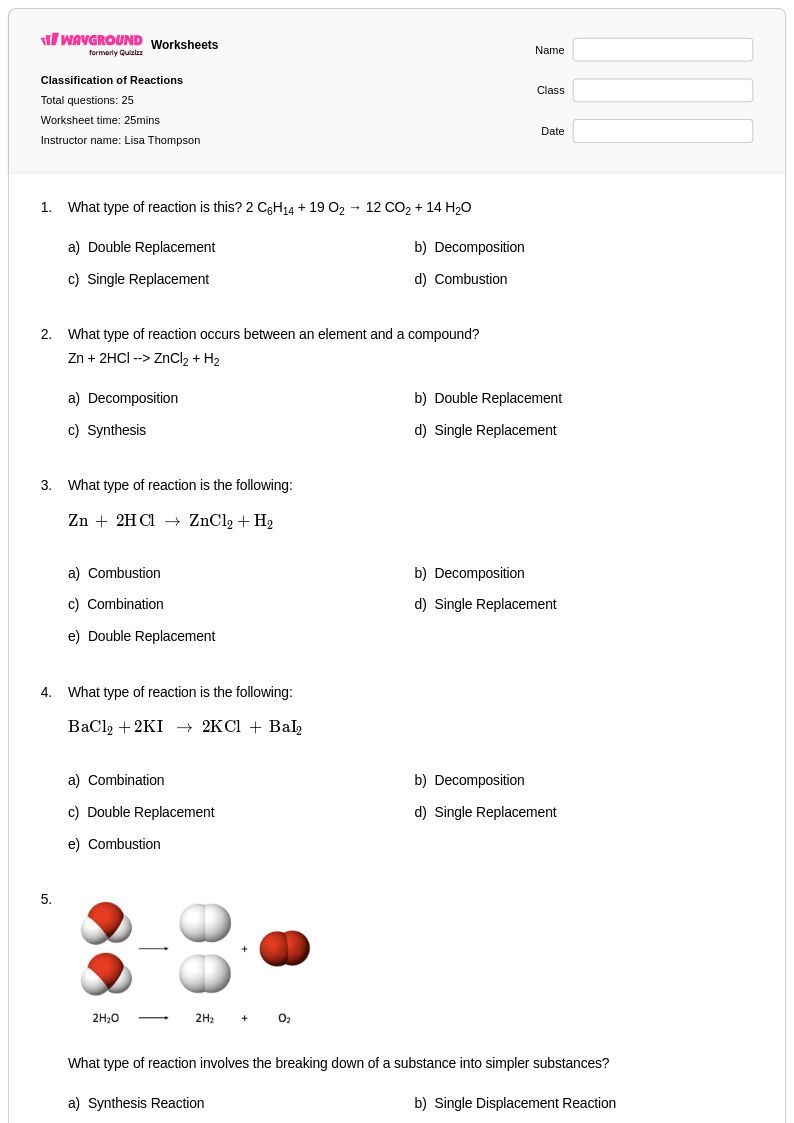
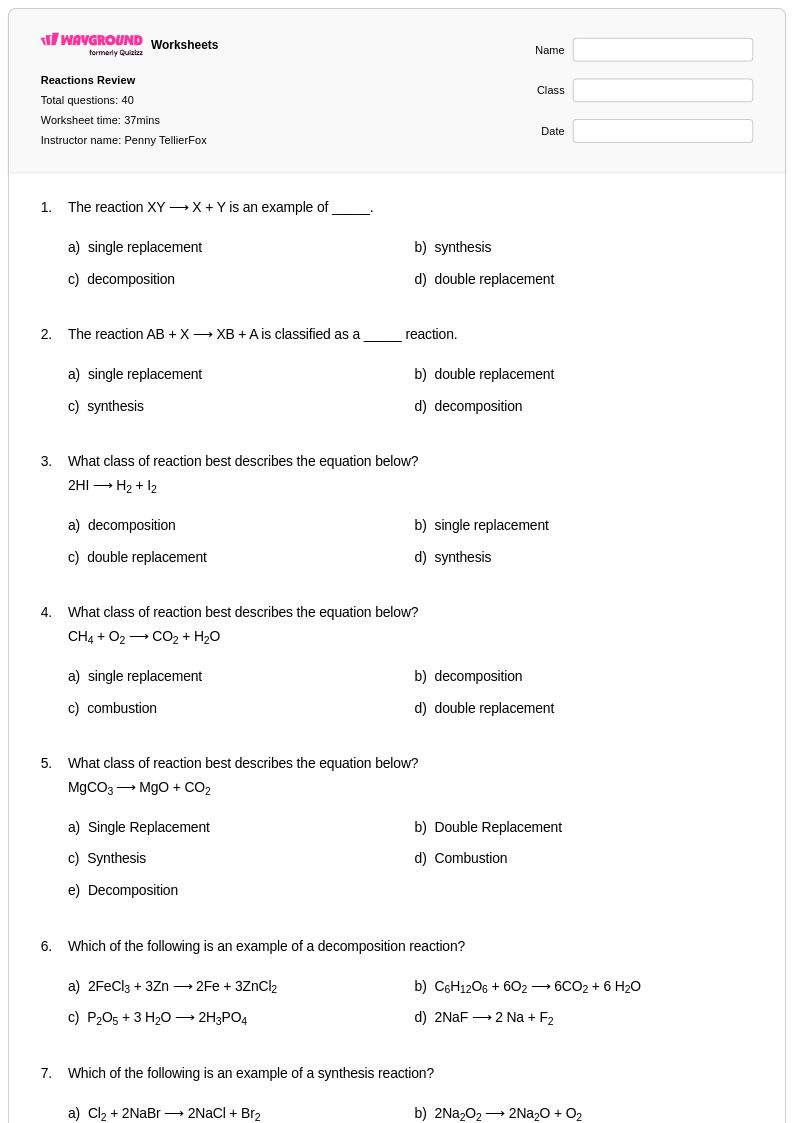
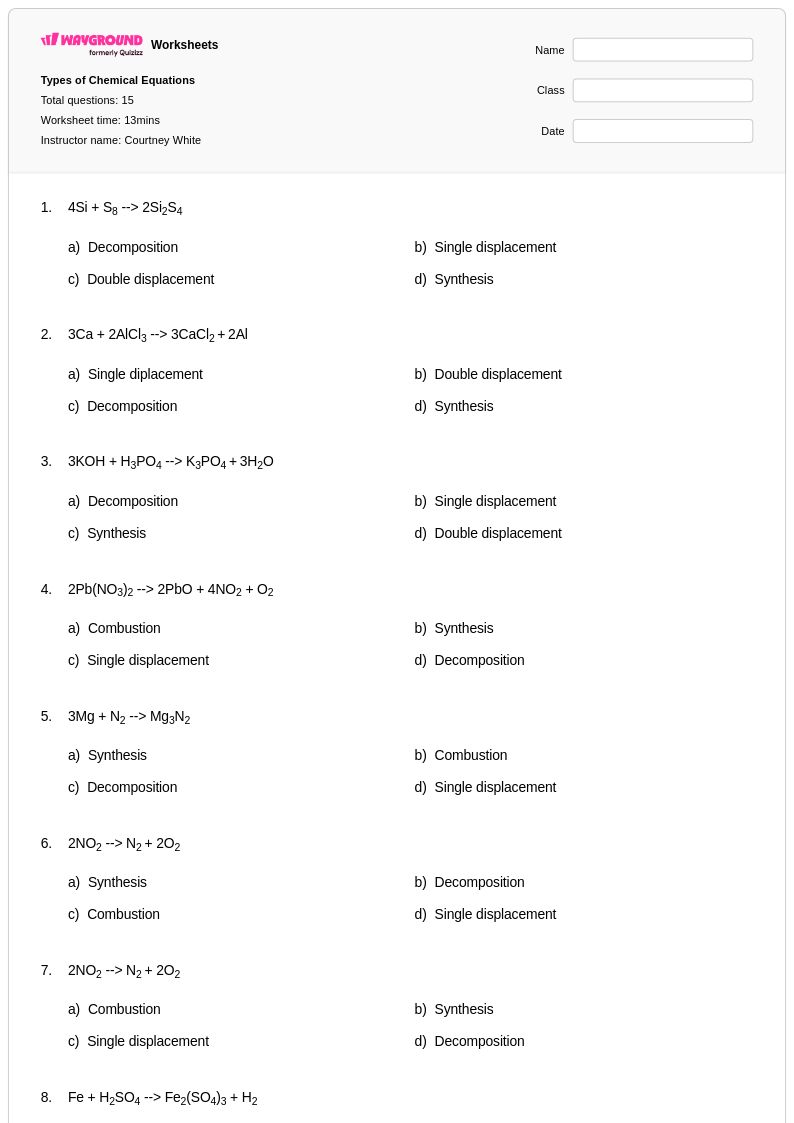
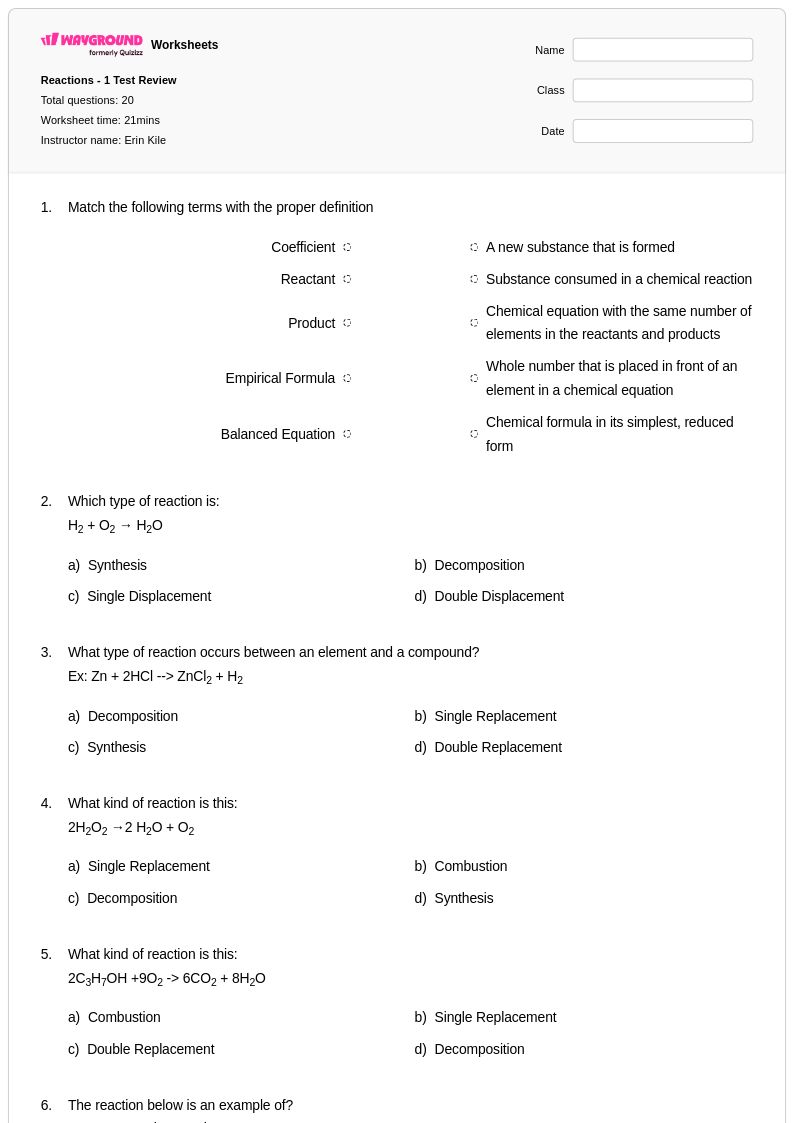
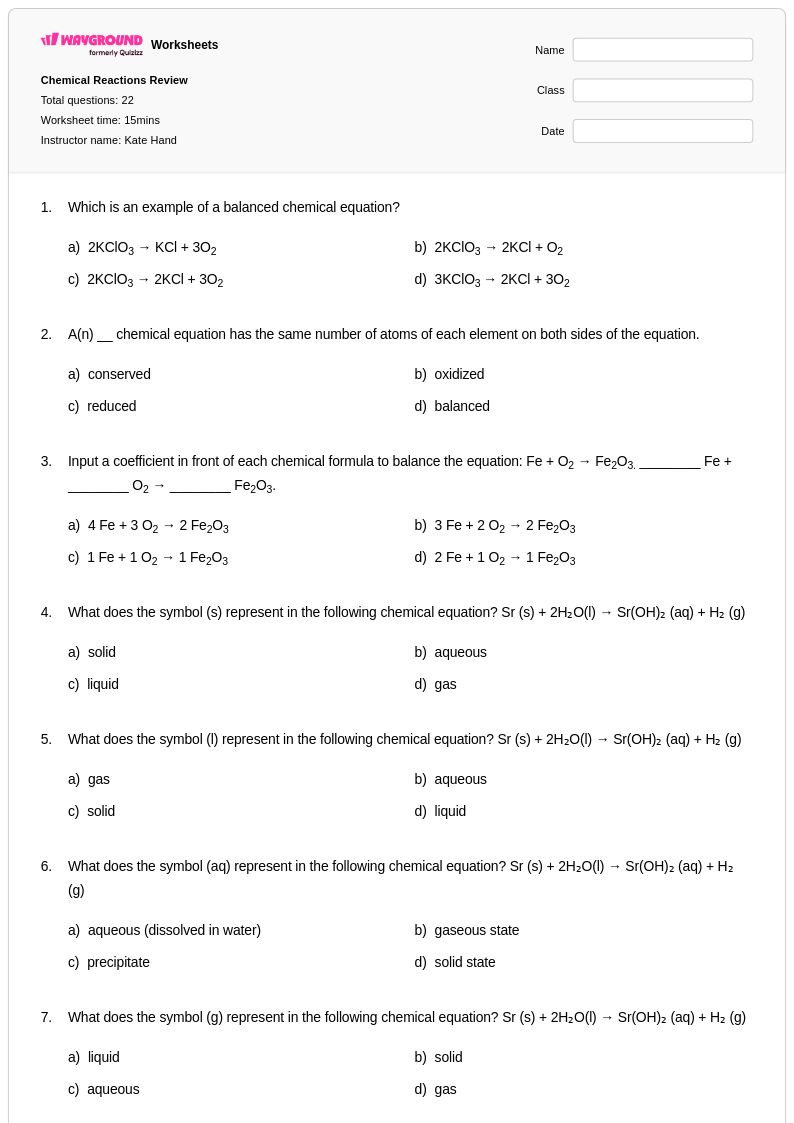
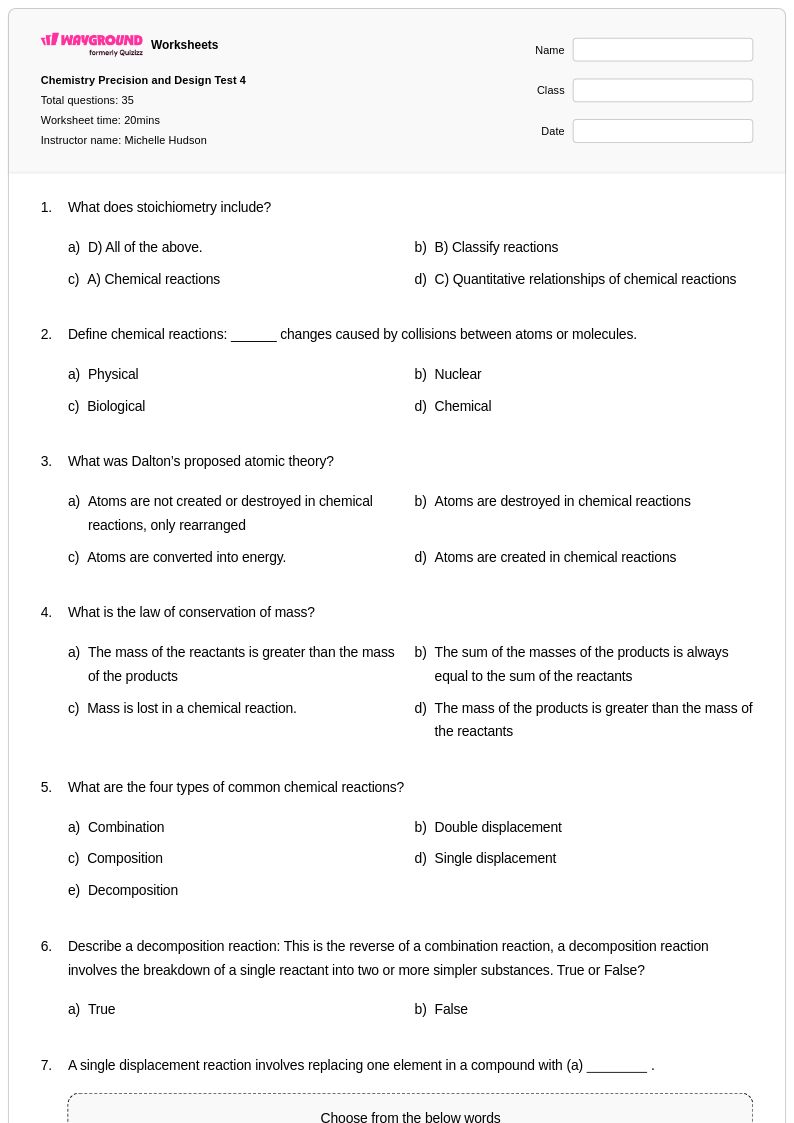
Double displacement reactions represent a cornerstone concept in Year 12 chemistry, requiring students to master the intricate process of ionic exchange between compounds in aqueous solutions. Wayground's comprehensive collection of double displacement worksheets provides educators with expertly crafted resources that guide students through predicting products, balancing equations, and identifying precipitation, acid-base, and gas-forming reactions. These practice problems systematically build proficiency in recognizing reaction patterns, applying solubility rules, and writing complete ionic and net ionic equations. Each worksheet comes with detailed answer keys that support independent learning and enable teachers to efficiently assess student understanding, while the free printable format ensures accessibility for diverse classroom needs and homework assignments.
Wayground's extensive library, featuring millions of teacher-created resources, empowers educators to locate precisely the right double displacement materials through advanced search and filtering capabilities that align with specific curriculum standards and learning objectives. The platform's differentiation tools allow teachers to customize worksheets for varying skill levels, supporting both remediation for struggling students and enrichment opportunities for advanced learners. Available in both printable pdf format and interactive digital versions, these resources seamlessly integrate into lesson planning workflows, whether teachers need quick practice exercises, comprehensive review materials, or targeted skill-building activities. This flexibility enables educators to address individual learning gaps, reinforce complex concepts, and provide multiple pathways for students to demonstrate mastery of double displacement reaction principles.
FAQs
How do I teach double displacement reactions to chemistry students?
Start by ensuring students understand ionic compound notation and the concept of ions before introducing double displacement reactions. Use a clear visual framework showing how cations and anions swap partners — often called the 'partner swap' or 'double replacement' model — before moving into solubility rules and predicting whether a precipitate, gas, or water forms. Connecting each reaction type (precipitation, acid-base, gas-forming) to a real-world example helps students build mental hooks for the patterns they need to recognize.
What exercises help students practice predicting products in double displacement reactions?
Effective practice starts with guided exercises where students identify the two ionic reactants, separate them into their ions, and systematically swap cation-anion pairs to write potential products. From there, students should practice applying solubility rules to determine whether a precipitate forms, then move on to writing full ionic and net ionic equations. Varied problem sets that include precipitation reactions, acid-base neutralizations, and gas-forming reactions give students exposure to the full range of double displacement scenarios.
What mistakes do students commonly make with double displacement reactions?
The most frequent error is incorrectly swapping ions — students often exchange atoms rather than polyatomic ions as a unit, breaking apart groups like sulfate or nitrate incorrectly. Another common misconception is assuming a reaction always produces a precipitate without consulting solubility rules, leading to incorrect product predictions. Students also frequently struggle to balance the final equation after swapping, particularly when coefficients are needed to account for polyatomic ions that appear multiple times.
How do I help students who struggle with solubility rules in double displacement reactions?
Students who struggle with solubility rules benefit from having a reference chart available during initial practice, which reduces cognitive load while they focus on the ion-swapping logic. Gradually withdrawing the chart as fluency builds is more effective than expecting memorization upfront. On Wayground, teachers can enable the Reduced Answer Choices accommodation for students who find the full set of product options overwhelming, and Read Aloud support is available for students who need questions read to them during digital practice sessions.
How do I use Wayground's double displacement worksheets in my chemistry class?
Wayground's double displacement worksheets are available as printable PDFs for traditional classroom use and in digital formats for technology-integrated environments, including the option to host them as a quiz directly on Wayground. Teachers can use printable versions for in-class problem sets or homework, while digital versions support remote learning and allow for faster feedback. All worksheets include answer keys, so they work equally well for independent student practice, small group review, or teacher-led instruction.
How do I differentiate double displacement instruction for students at different skill levels?
For students who are newer to the concept, begin with simple binary ionic compound reactions before introducing polyatomic ions or solubility-based prediction. More advanced students can work through net ionic equations and identify spectator ions, adding a layer of analytical complexity. On Wayground, teachers can apply student-level accommodations such as extended time, reduced answer choices, or read aloud support to individual students without affecting the experience of the rest of the class.