Free Printable Nuclear Equations Worksheets for Year 12
Year 12 nuclear equations worksheets from Wayground help students master radioactive decay, fusion, and fission reactions through comprehensive printables with practice problems and answer keys.
Explore printable Nuclear Equations worksheets for Year 12
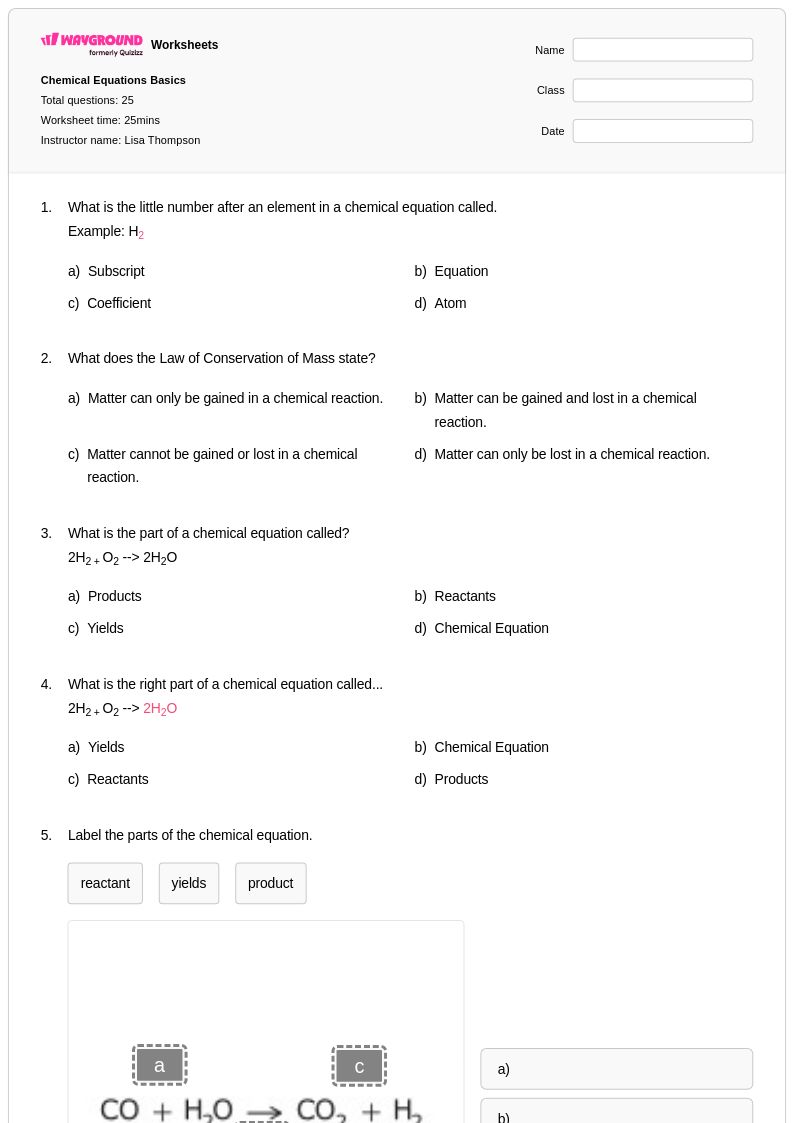
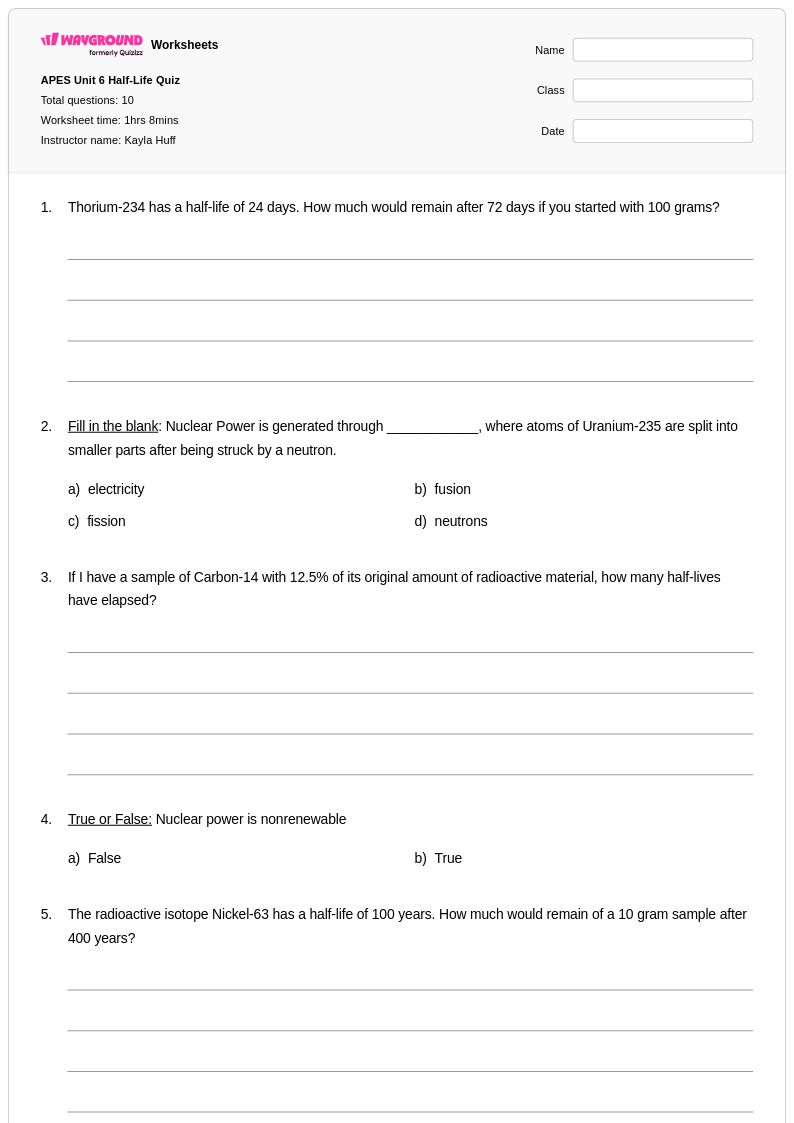
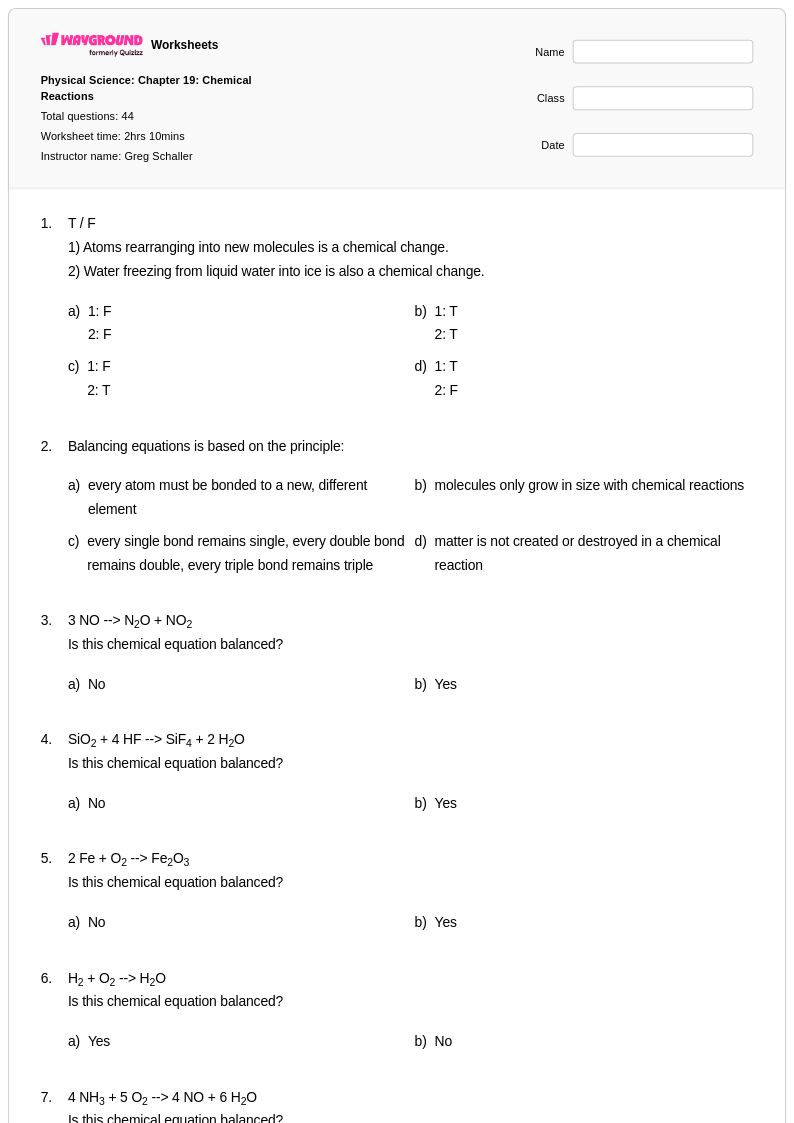
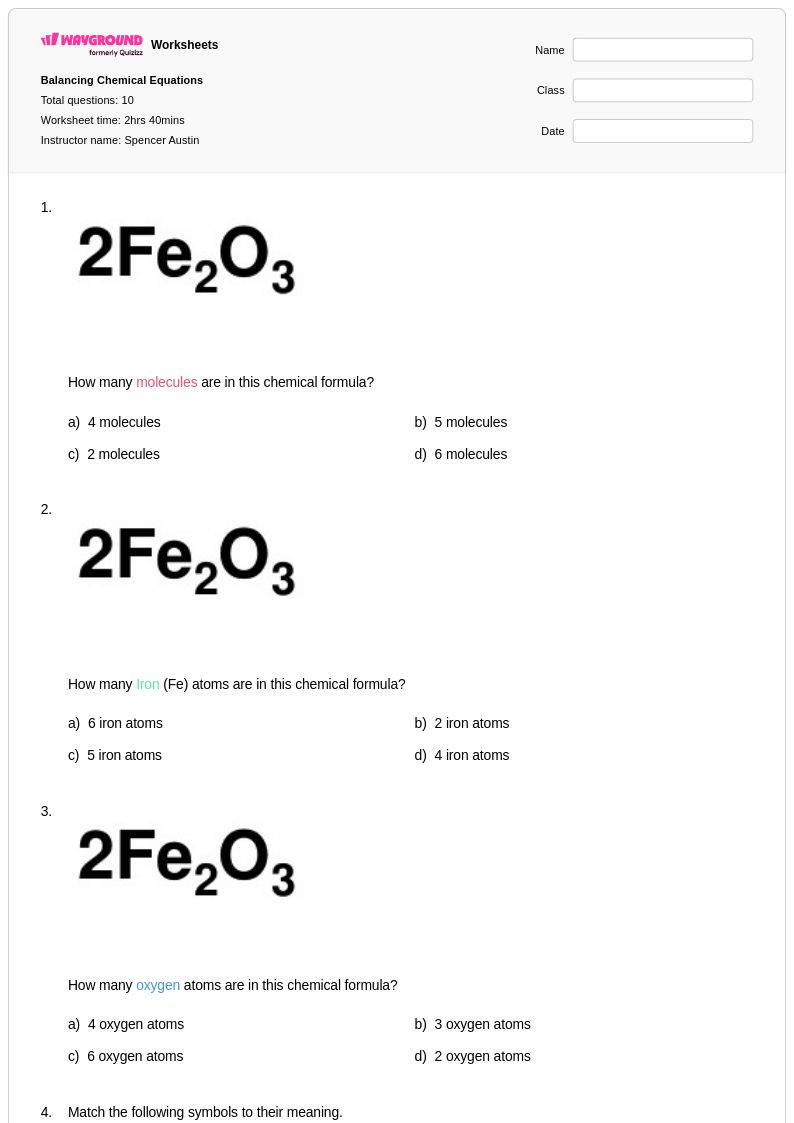
Nuclear equations worksheets for Year 12 students available through Wayground (formerly Quizizz) provide comprehensive practice with the fundamental principles of nuclear chemistry and radioactive decay processes. These expertly crafted worksheets strengthen essential skills including balancing nuclear equations, identifying decay modes such as alpha, beta, and gamma emission, calculating half-lives, and understanding nuclear stability patterns. Students work through practice problems that cover fission and fusion reactions, nuclear bombardment equations, and the application of conservation laws for mass number and atomic number. Each worksheet includes a detailed answer key to support independent learning, and the free printable pdf format ensures accessibility for both classroom instruction and homework assignments.
Wayground (formerly Quizizz) empowers educators with millions of teacher-created nuclear equations resources that streamline lesson planning and differentiated instruction for Year 12 chemistry courses. The platform's advanced search and filtering capabilities allow teachers to quickly locate worksheets aligned with specific curriculum standards, while customization tools enable modification of difficulty levels and problem types to meet diverse student needs. These comprehensive worksheet collections are available in both digital and printable pdf formats, facilitating seamless integration into various teaching environments and supporting effective remediation for struggling learners as well as enrichment opportunities for advanced students. The extensive database of nuclear chemistry resources ensures teachers have access to high-quality materials for skill practice, formative assessment, and comprehensive review of complex nuclear equation concepts.
FAQs
How do I teach students to balance nuclear equations?
Start by ensuring students understand that both mass numbers and atomic numbers must be conserved on both sides of a nuclear equation, just as charge is conserved in chemical equations. Introduce one decay type at a time — alpha, beta, and gamma — so students can recognize the particle emitted and predict its effect on the parent nucleus before attempting to balance. A systematic approach of writing known values, identifying unknowns, and applying conservation laws builds the procedural fluency students need before tackling multi-step or chain decay problems.
What types of problems should students practice when learning nuclear equations?
Students benefit most from a progression that starts with identifying decay type from a completed equation, then moves to finding a missing particle or isotope in a partially written reaction, and finally to writing full nuclear equations from a written description of the decay. Including half-life calculations and nuclear stability problems alongside balancing practice ensures students develop a well-rounded understanding of radioactive decay processes rather than procedural fluency alone.
What mistakes do students commonly make when balancing nuclear equations?
The most frequent error is confusing mass number and atomic number, either misidentifying which value changes during a specific decay type or incorrectly applying conservation rules to one but not both. Students also commonly mix up alpha and beta particles — writing an alpha particle with atomic number 2 but the wrong mass number, or forgetting that beta decay increases the atomic number by 1 while leaving the mass number unchanged. A targeted review of particle identity and properties before equation-balancing practice significantly reduces these errors.
How can I differentiate nuclear equations instruction for students at different levels?
For struggling learners, provide partially completed equations with the decay type labeled and ask students to identify only the missing particle. For on-level students, present incomplete equations without labeling the decay type so they must first determine what kind of emission occurred. Advanced students can work through chain decay sequences or connect balancing skills to half-life and mass-energy calculations. On Wayground, teachers can apply accommodations such as reduced answer choices or read-aloud settings to individual students, allowing the same digital activity to serve diverse needs simultaneously.
How do I use Wayground's nuclear equations worksheets in my classroom?
Wayground's nuclear equations worksheets are available as printable PDFs for traditional classroom use and in digital formats for technology-integrated learning environments, giving teachers flexibility regardless of their setup. Teachers can also host worksheets directly as a quiz on Wayground, which enables real-time progress tracking and immediate feedback for students. Each worksheet includes complete answer keys, making them practical for independent practice, guided review sessions, or targeted remediation without additional teacher preparation.
How do nuclear equations connect to broader chemistry and physics curricula?
Nuclear equations serve as the foundation for understanding radioactive decay series, nuclear fission, and nuclear fusion — all of which appear in both advanced chemistry and physics curricula. Mastery of balancing nuclear equations is a prerequisite for interpreting decay chains, calculating half-lives, and understanding mass-energy equivalence through Einstein's equation, making it a high-leverage skill for students continuing in STEM fields. Teachers often introduce nuclear equations after students are comfortable with isotope notation and atomic structure to ensure the necessary conceptual groundwork is in place.

![Form 3 - Bab 6.1 [Penjanaan Elektrik] - Printable Nuclear-equations Worksheets Year 12 - Quizizz](https://quizizz-static.s3.amazonaws.com/_media/worksheets-new/5e7e9b9801f63e001b648a1b-form-3-bab-61-penjanaan-elektrik)