Free Printable Rate Law Expression Worksheets for Year 12
Master Year 12 rate law expression concepts with Wayground's comprehensive collection of free chemistry worksheets, featuring printable PDFs, practice problems, and complete answer keys to strengthen your understanding.
Explore printable Rate Law Expression worksheets for Year 12
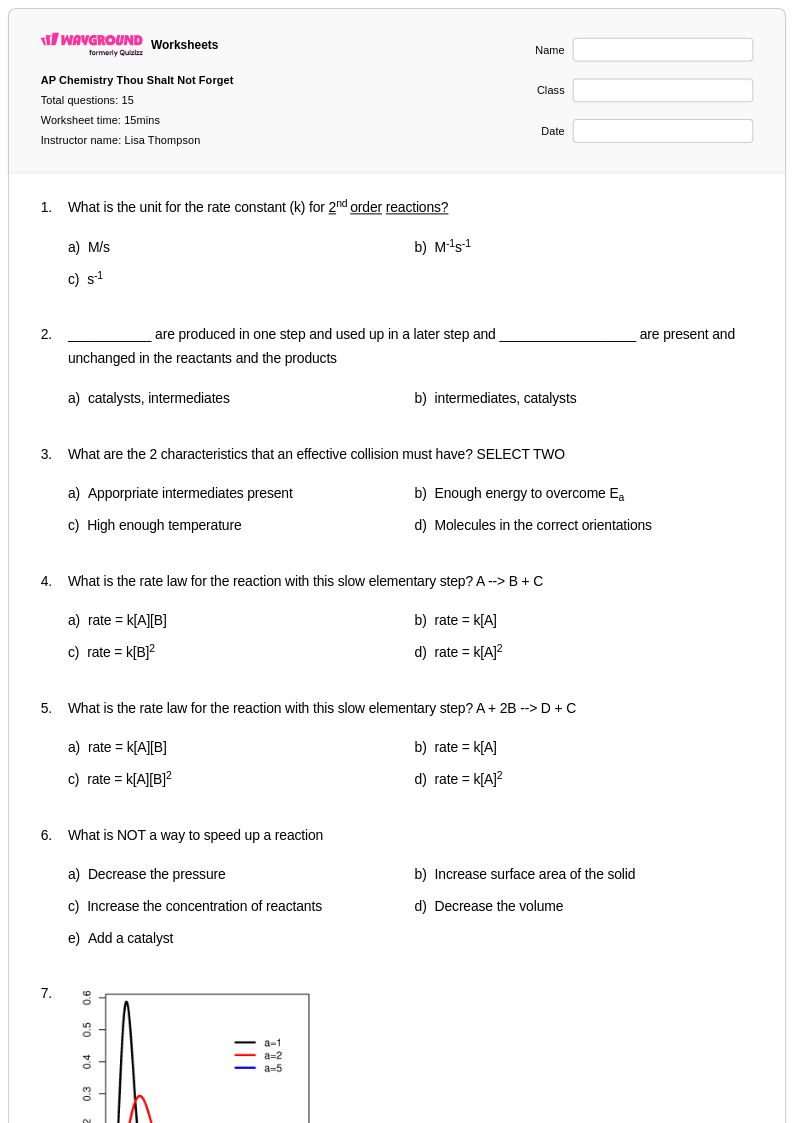
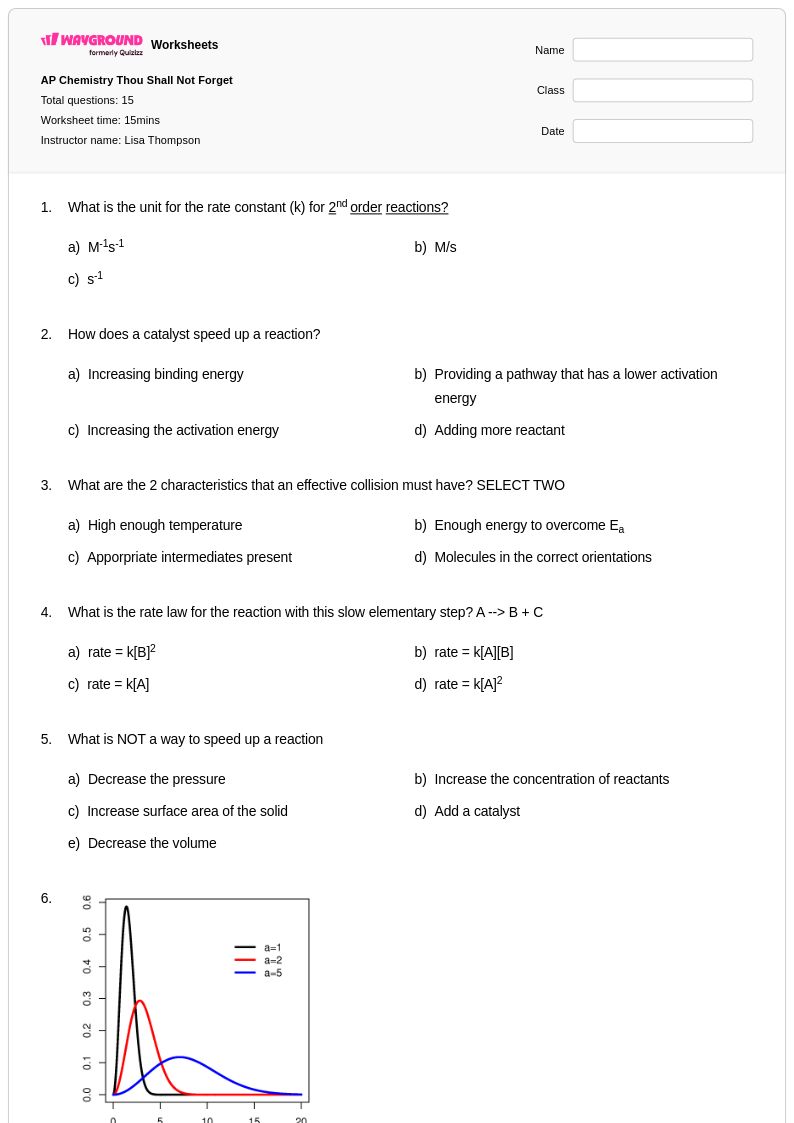
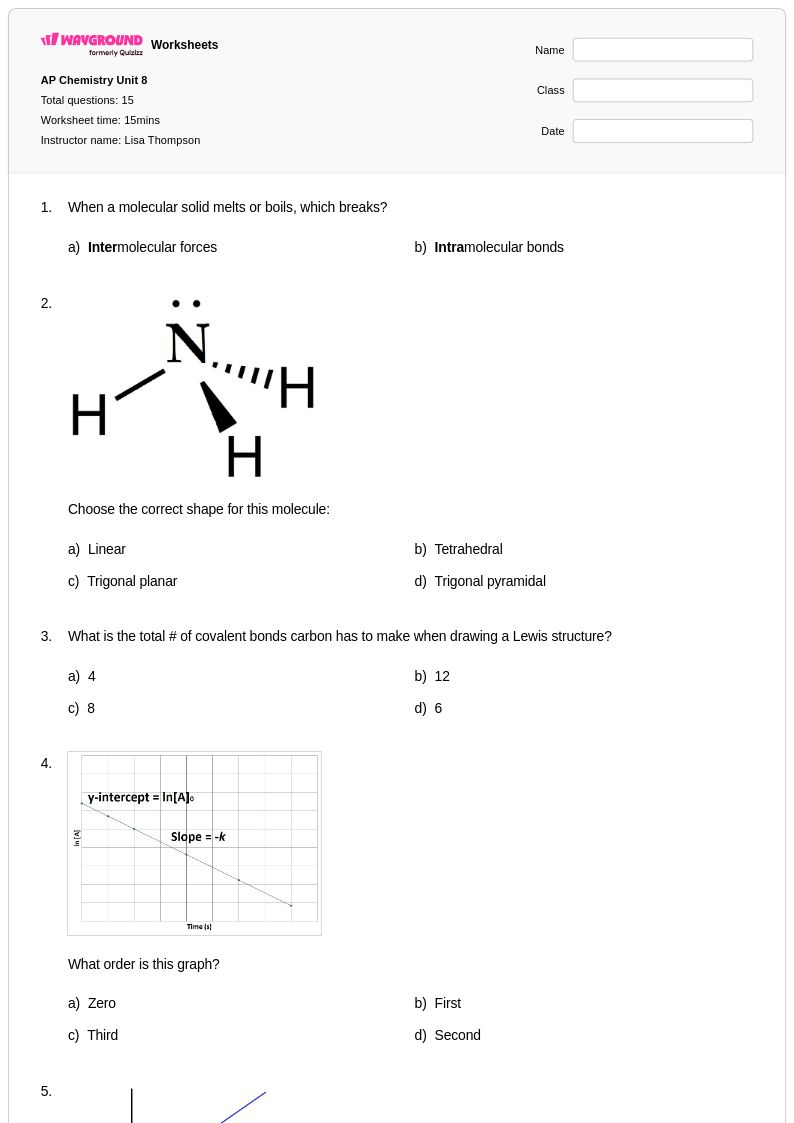
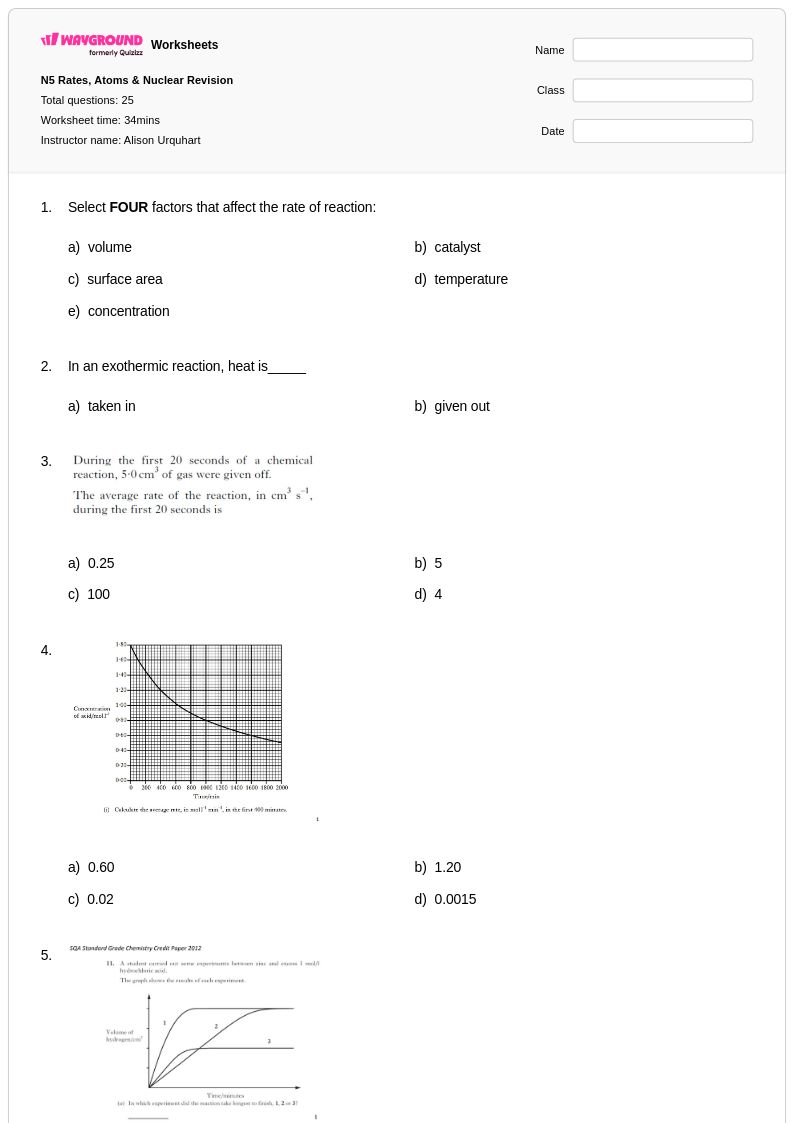
Rate law expression worksheets for Year 12 chemistry students available through Wayground (formerly Quizizz) provide comprehensive practice with one of the most challenging concepts in chemical kinetics. These expertly designed worksheets strengthen students' abilities to determine reaction orders, write rate law equations, calculate rate constants, and analyze experimental data to establish the mathematical relationship between reactant concentrations and reaction rates. Students work through systematic practice problems that build proficiency in interpreting kinetic data tables, applying the method of initial rates, and understanding how changes in concentration affect reaction velocity. Each worksheet includes detailed answer keys that guide students through complex calculations, and the free printable pdf format ensures accessibility for both classroom instruction and independent study sessions.
Wayground's extensive collection draws from millions of teacher-created resources specifically focused on rate law expressions and chemical kinetics, offering educators powerful search and filtering capabilities to locate worksheets that align with specific curriculum standards and learning objectives. The platform's differentiation tools enable teachers to customize problem sets based on individual student needs, whether for remediation of fundamental concepts or enrichment through advanced integrated rate law problems. Available in both printable and digital pdf formats, these worksheets support flexible lesson planning approaches, from traditional paper-based assignments to hybrid learning environments. Teachers can efficiently identify resources that target specific skills such as zero-order, first-order, and second-order reactions, making it simple to design targeted practice sessions that reinforce classroom instruction and prepare students for advanced chemistry assessments.
FAQs
How do I teach rate law expressions to chemistry students?
Start by grounding students in the concept that reaction rate depends on reactant concentration, then introduce the general form rate = k[A]^m[B]^n before working through experimental data to determine reaction orders. Use the initial rates method as a concrete entry point, having students compare trials where one concentration is held constant to isolate individual orders. Once students can determine orders from data, move into calculating the rate constant k with proper units, which reinforces dimensional analysis alongside kinetics concepts. Scaffolding from zero-order through second-order reactions in sequence helps students recognize patterns rather than memorizing disconnected formulas.
What practice problems should students work through to master rate law expressions?
Students need practice across three distinct skill areas: determining reaction order from experimental initial-rate data, writing the complete rate law expression, and calculating the rate constant k with correct units. Problems should progress from single-reactant systems to multi-reactant systems, and should include integrated rate law problems and half-life calculations to connect differential and integrated forms. Wayground's rate law expression worksheets cover zero-order, first-order, and second-order reactions with varied problem contexts, providing the repetition students need to build confidence manipulating these mathematical relationships.
What mistakes do students commonly make when writing rate law expressions?
The most frequent error is assuming reaction order matches the stoichiometric coefficients in the balanced equation rather than deriving order empirically from experimental data. Students also regularly confuse the units of the rate constant k, which change depending on overall reaction order, leading to incorrect answers even when the expression itself is correct. Another common misconception is conflating the rate law with the equilibrium expression, particularly for students who have recently covered equilibrium. Targeted practice with problems that explicitly require students to justify each reaction order from data helps address these errors before they become entrenched.
How can I use Wayground's rate law expression worksheets in my classroom?
Wayground's rate law expression worksheets are available as printable PDFs for traditional classroom use and in digital formats for technology-integrated environments, giving you flexibility to assign them as in-class practice, homework, or assessments. You can also host the worksheets as a live quiz on Wayground, which is useful for formative assessment or guided practice sessions where you want to monitor student progress in real time. All worksheets include detailed answer keys, supporting both teacher-led review and independent student self-assessment after practice.
How do I differentiate rate law expression instruction for students at different levels?
For students who are struggling, reduce cognitive load by starting with single-reactant rate laws and providing a structured template for comparing experimental trials before introducing multi-reactant systems. Advanced learners can be extended with problems that integrate rate law determination alongside half-life calculations and mechanistic reasoning about elementary steps. On Wayground, teachers can apply individual accommodations such as reduced answer choices or read-aloud support for students who need them, without affecting the experience of other students in the class.
How does the initial rates method connect to writing a rate law expression?
The initial rates method involves comparing two experimental trials in which only one reactant concentration is changed, allowing students to isolate and calculate the order with respect to that reactant by examining how the rate changes proportionally. Once individual orders are determined for each reactant, they are combined into the full rate law, and the rate constant k is then calculated by substituting any single trial's data into the completed expression. This process is foundational because it establishes that rate laws are experimentally derived, not theoretically predicted, a distinction students must internalize to apply kinetics correctly.