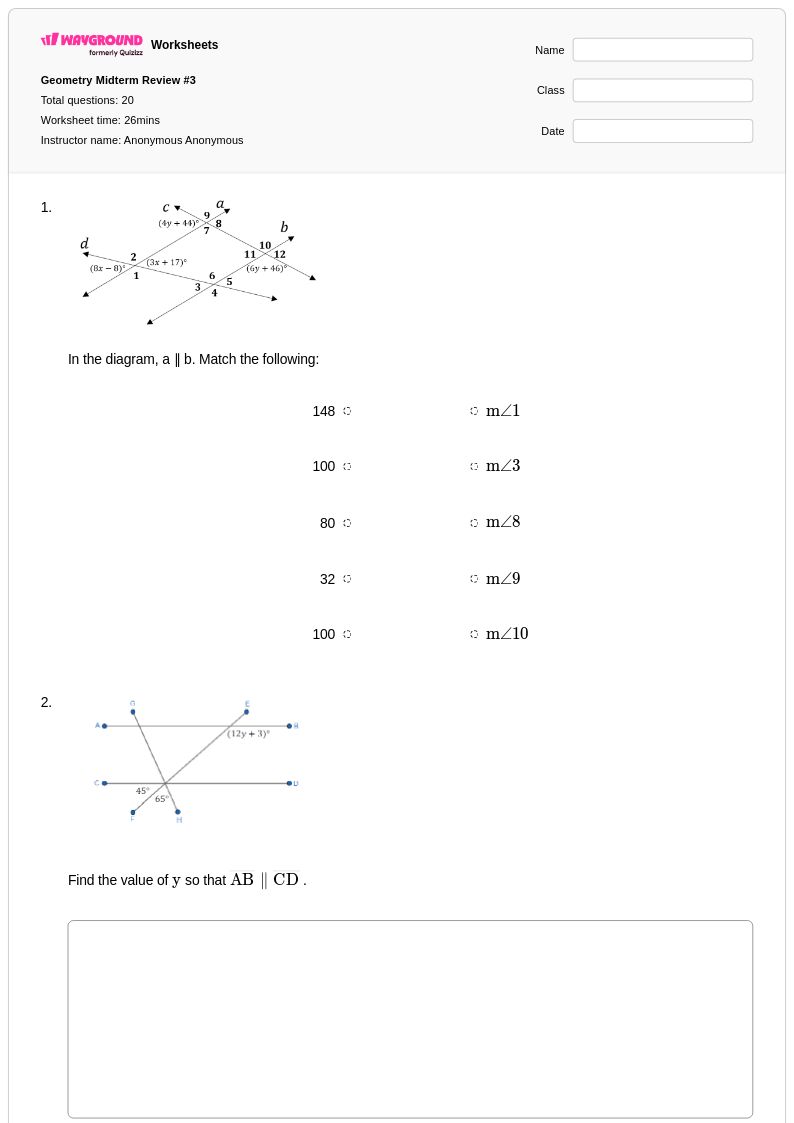
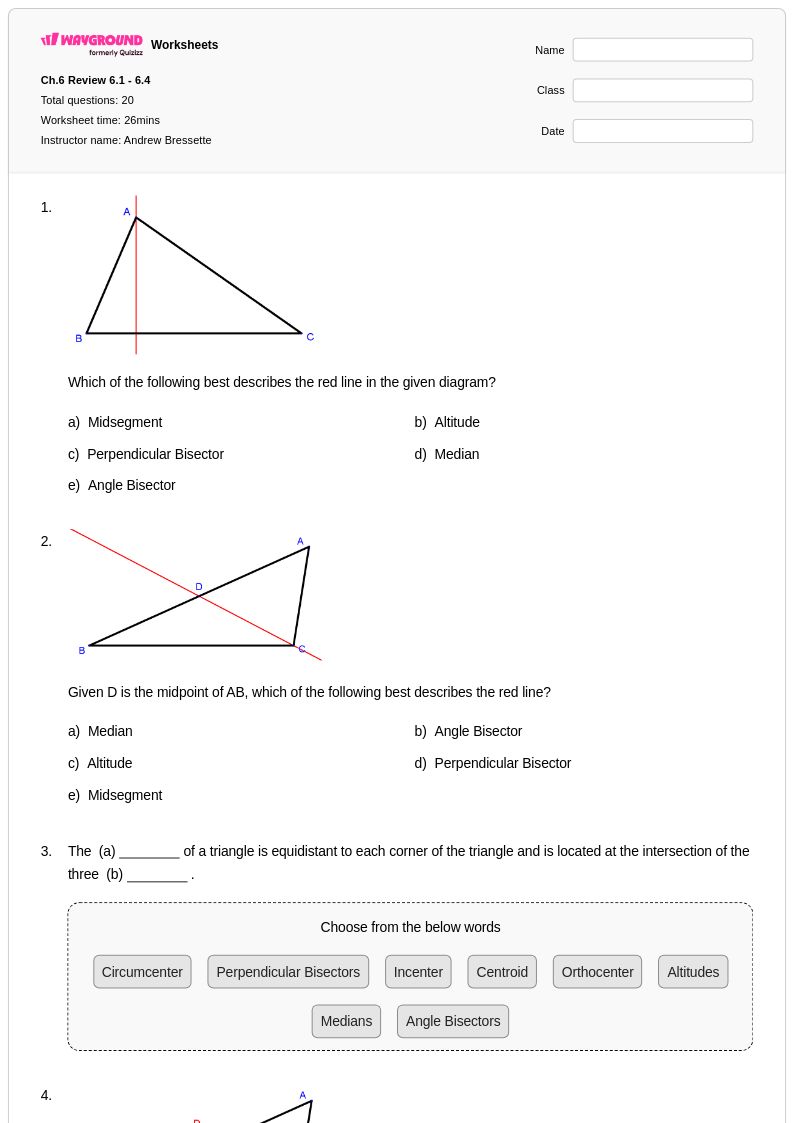
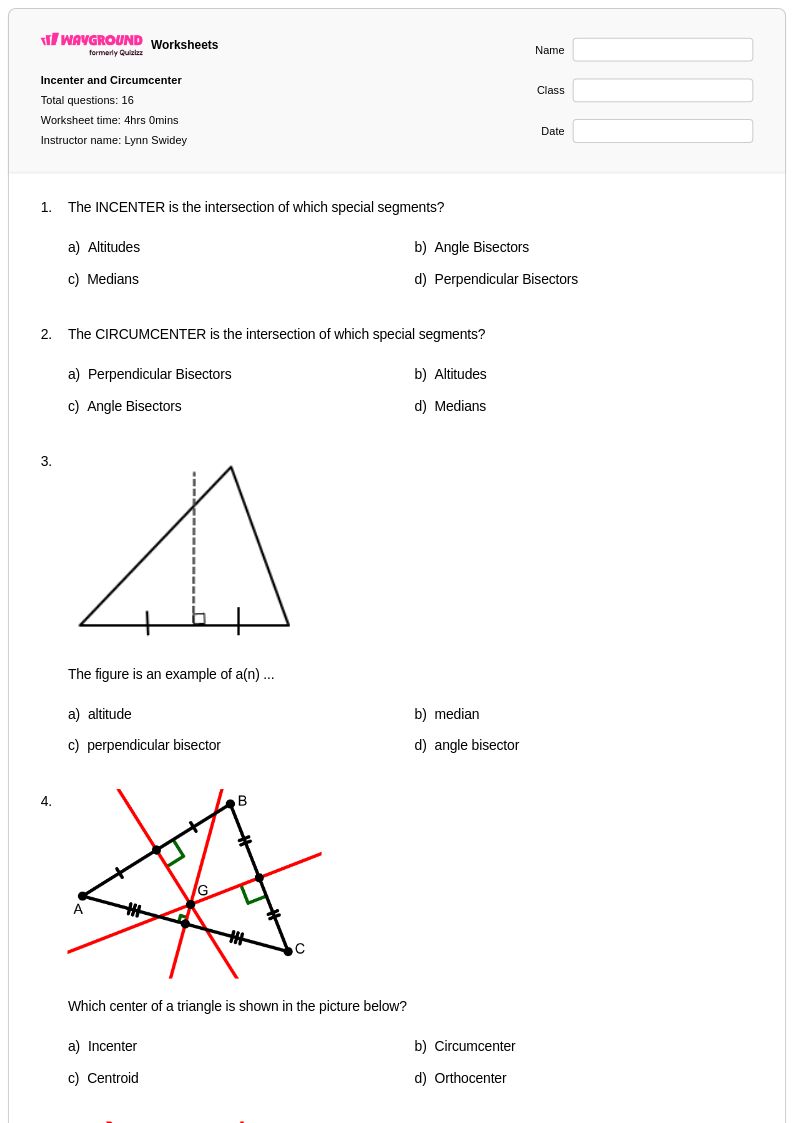
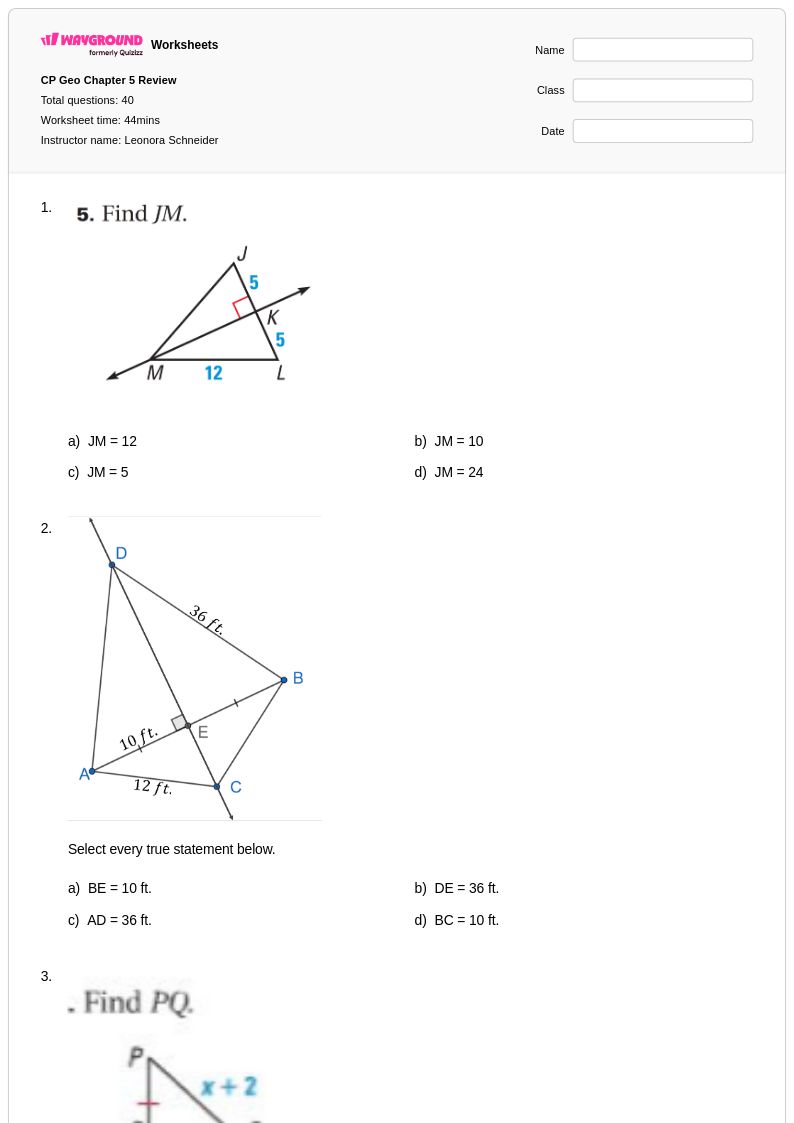
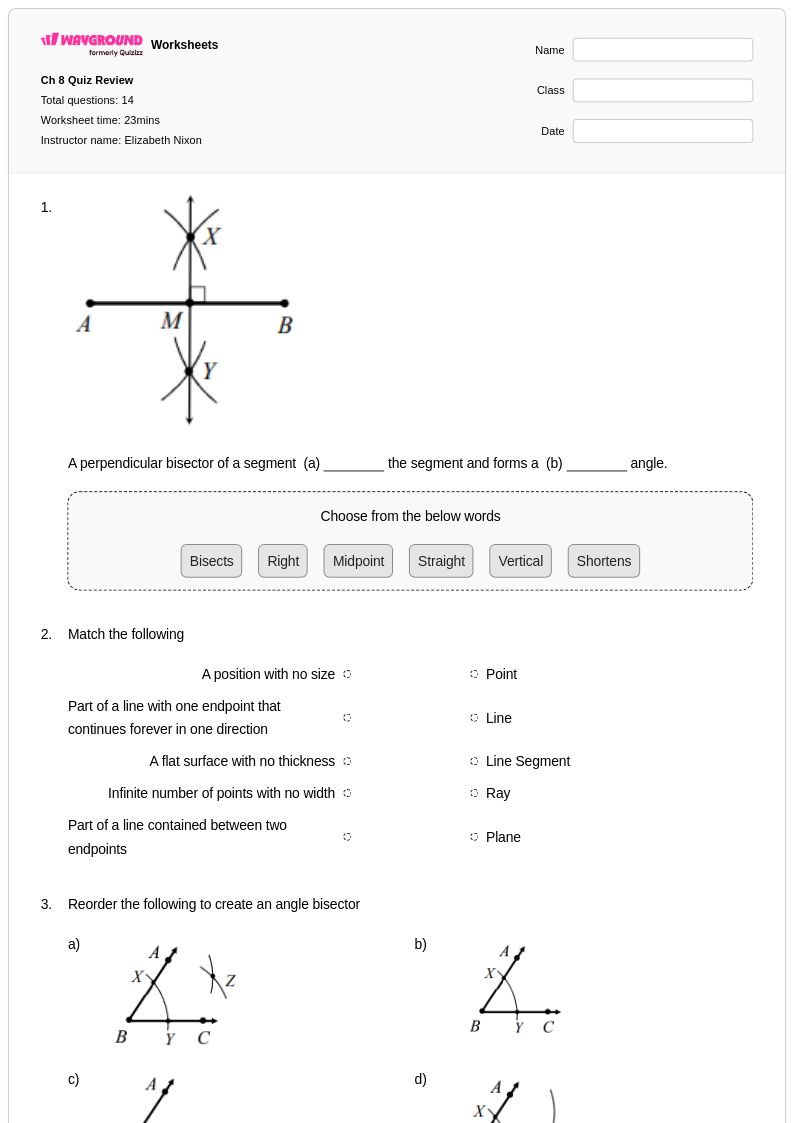
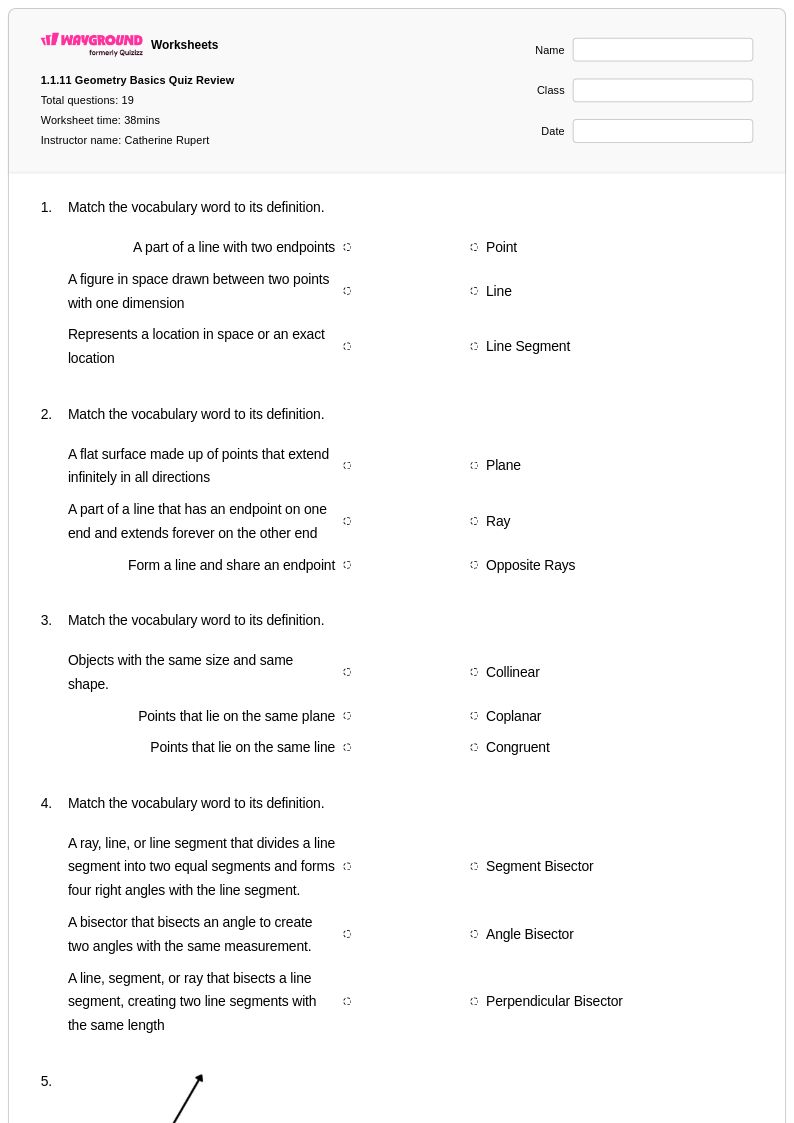
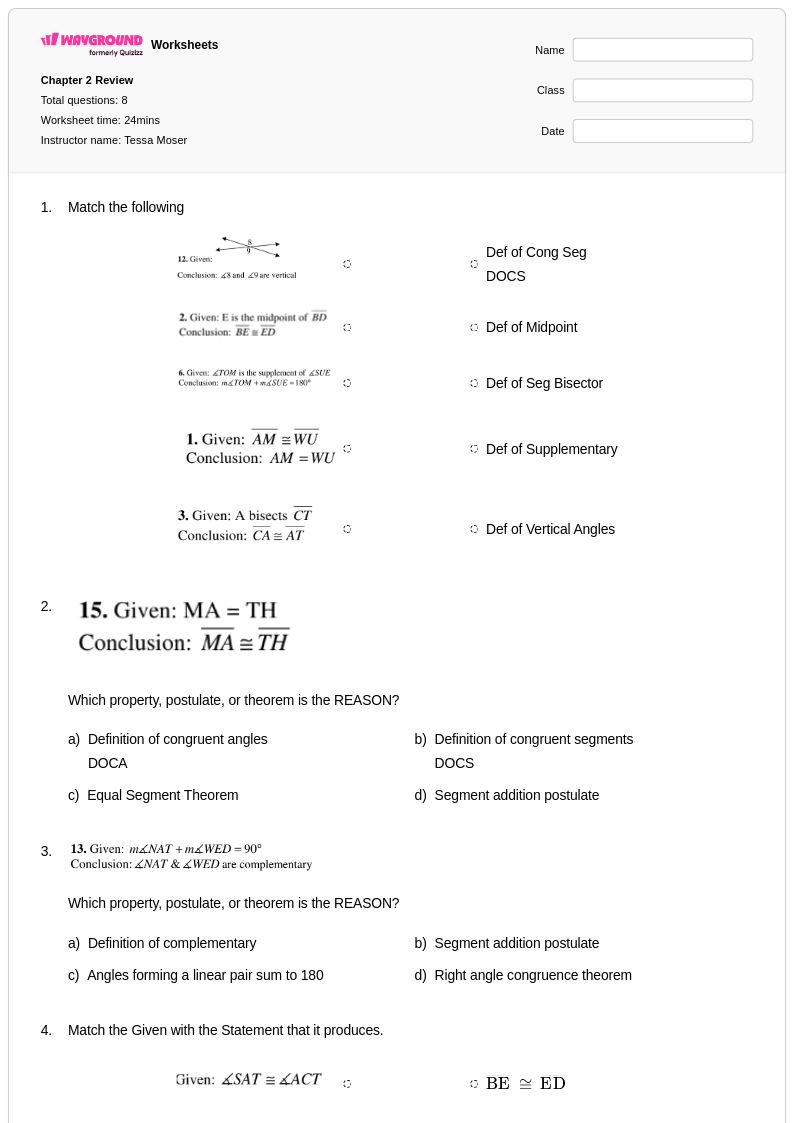
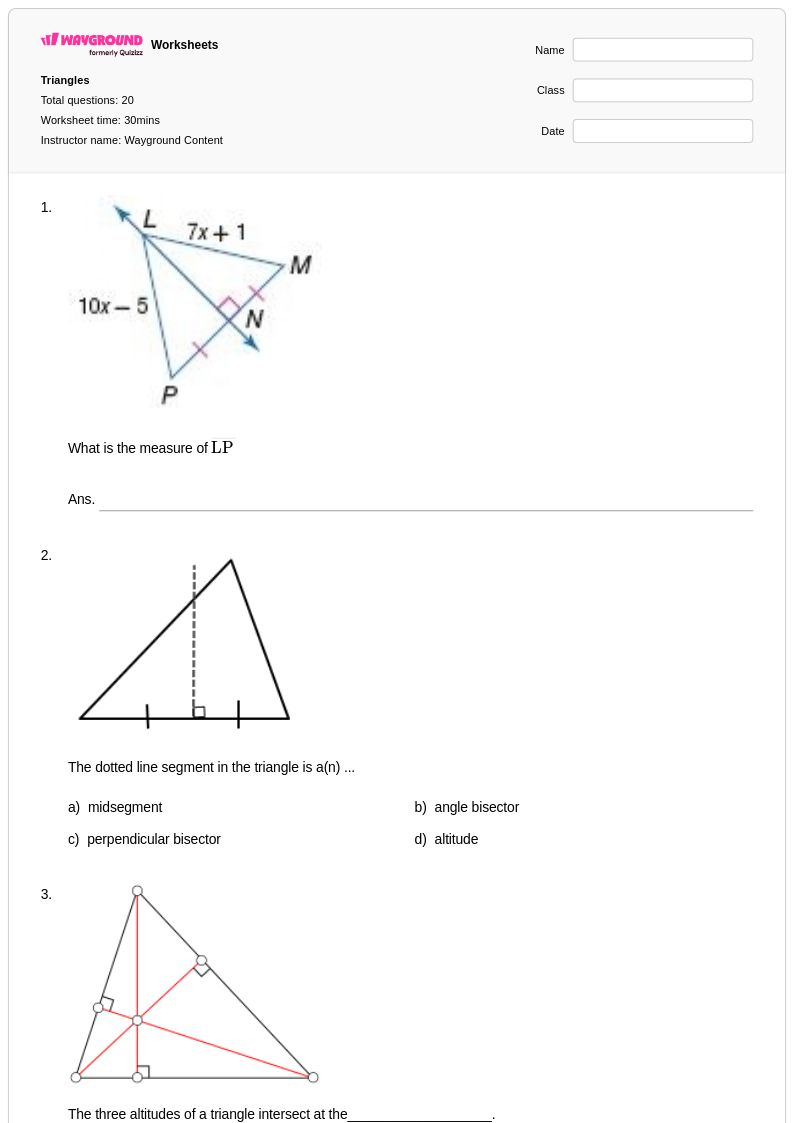
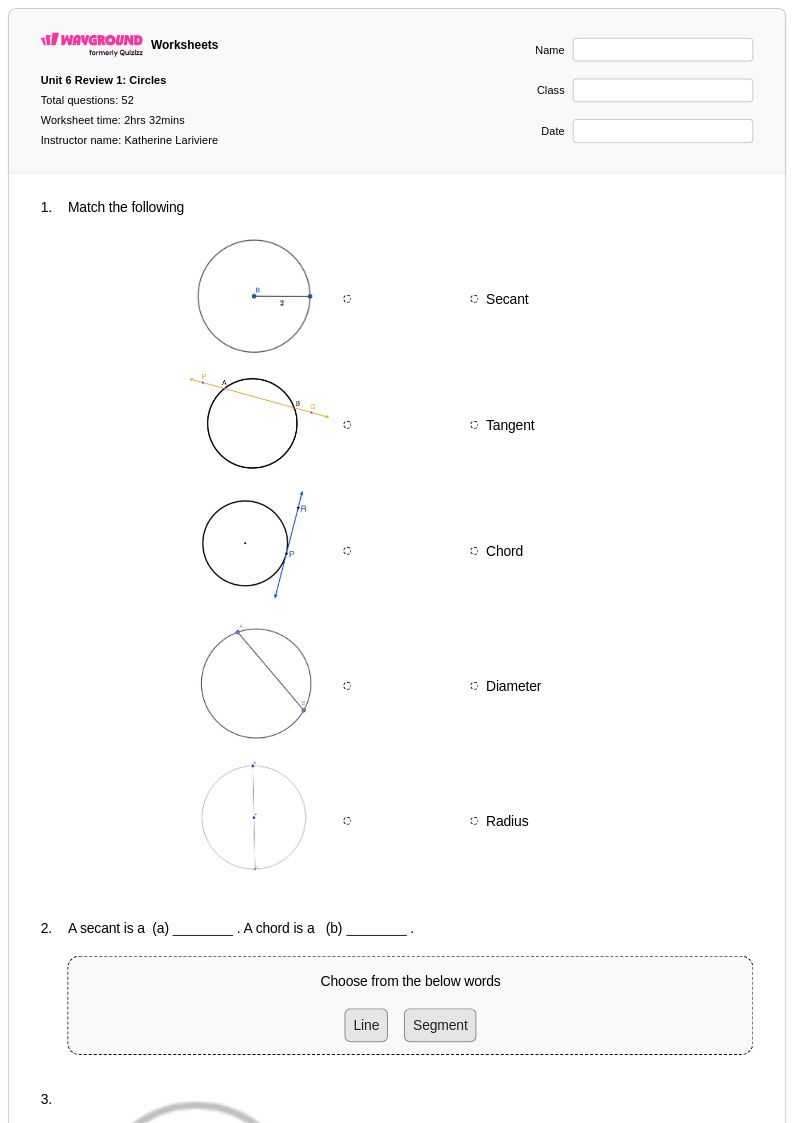
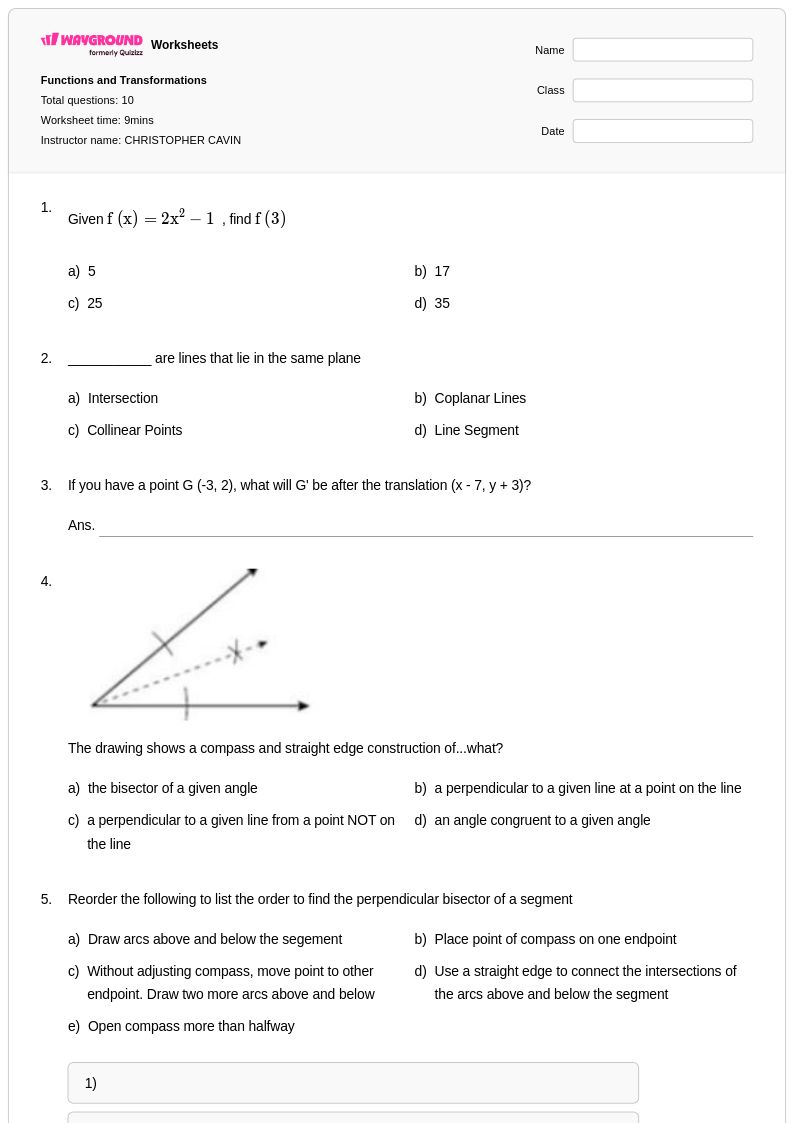
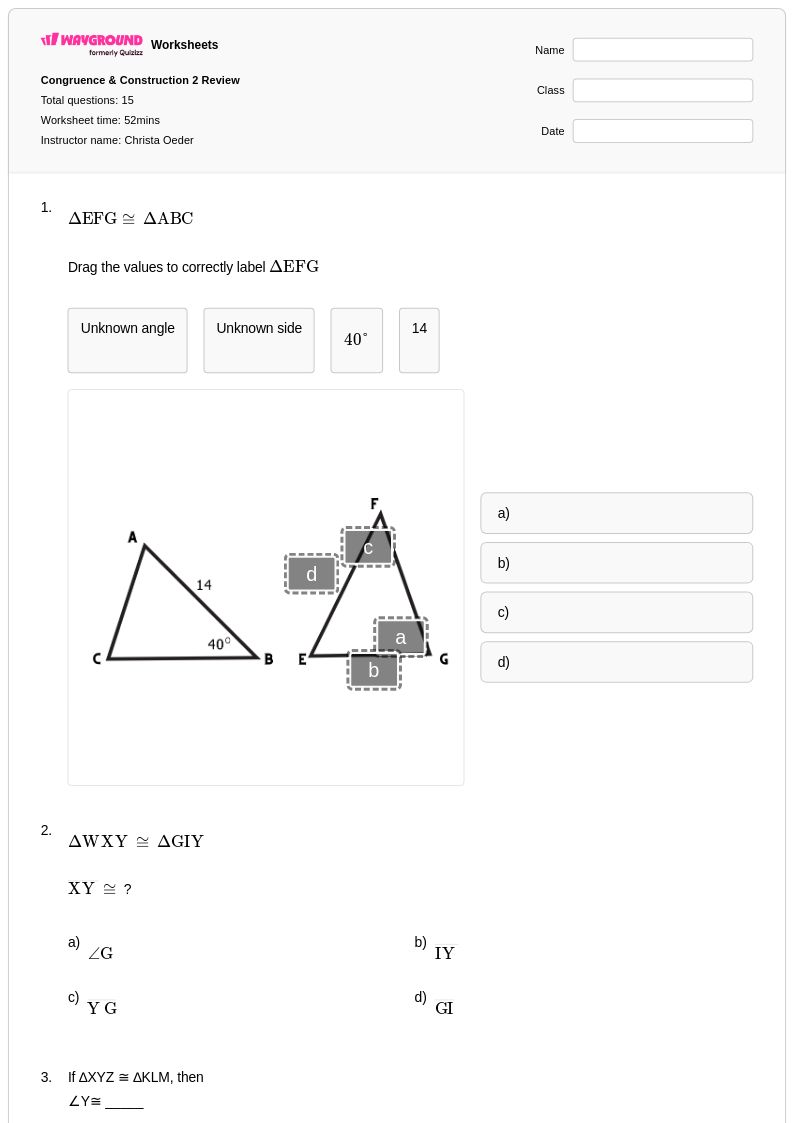
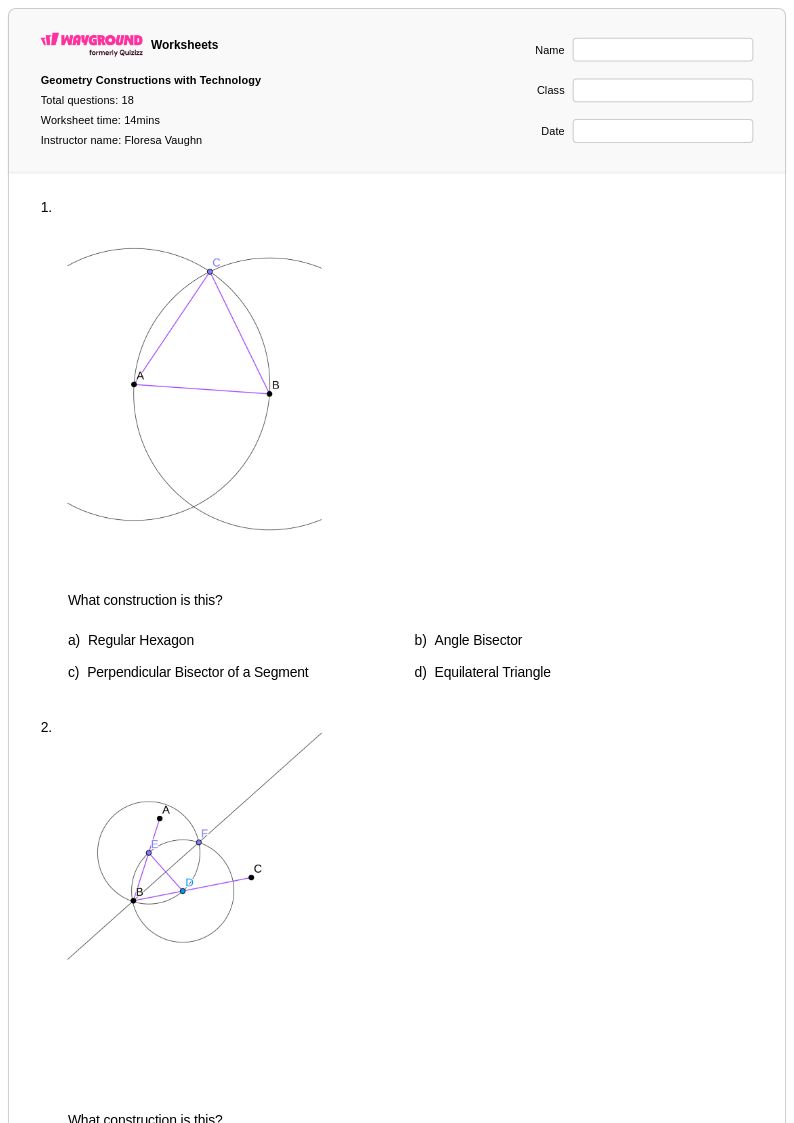
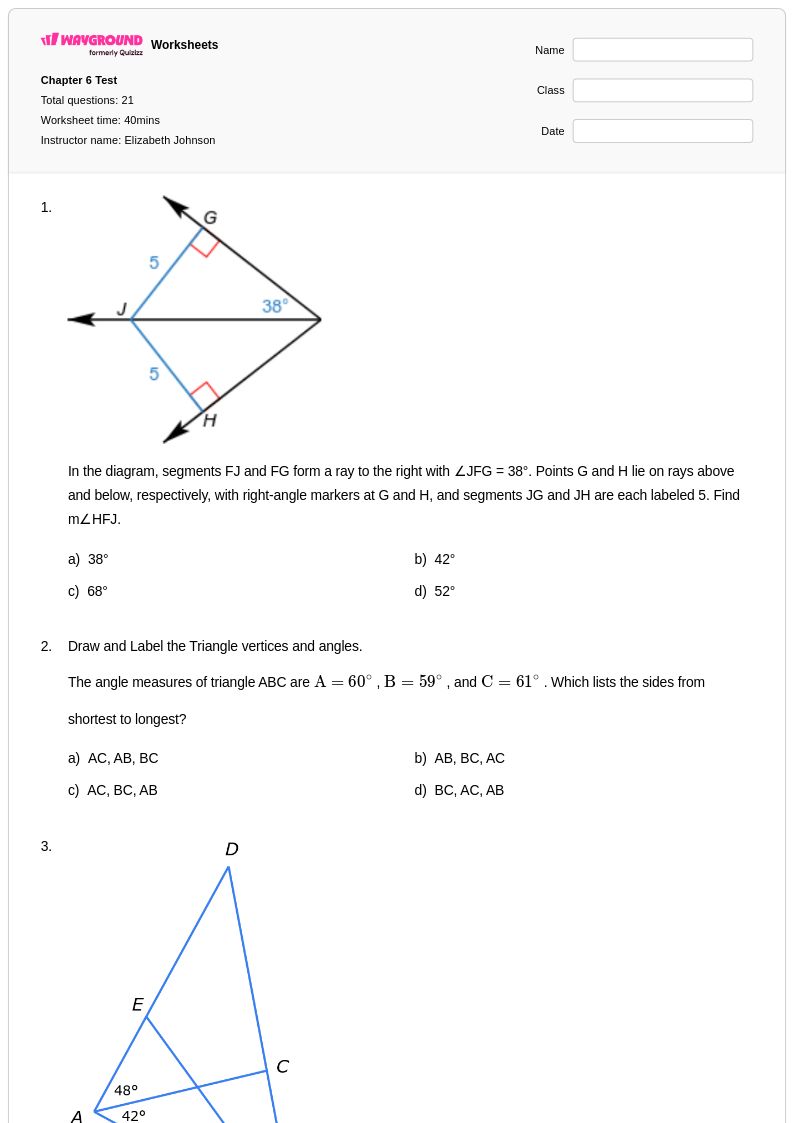
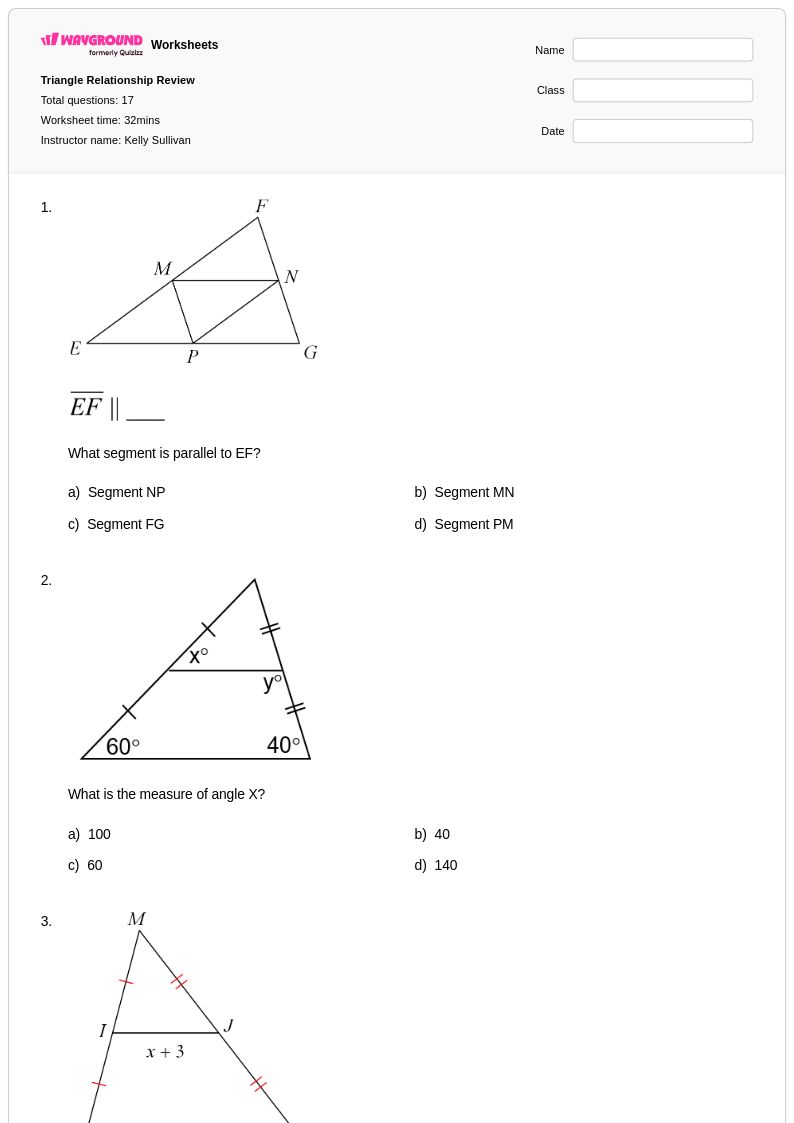
Explore Wayground's free segment bisector worksheets and printables that help students master identifying and constructing line segments that divide other segments into two equal parts through engaging practice problems with answer keys.
Segment bisector worksheets available through Wayground (formerly Quizizz) provide comprehensive practice opportunities for students to master this fundamental geometry concept. These carefully designed resources focus on developing critical skills including identifying segment bisectors, finding midpoints of line segments, applying the segment bisector theorem, and solving algebraic equations involving bisected segments. Students work through systematic practice problems that progress from basic midpoint identification to complex multi-step problems involving coordinate geometry and algebraic expressions. Each worksheet includes detailed answer keys that facilitate self-assessment and instructor review, while the printable pdf format ensures convenient access for both classroom instruction and independent study sessions.
Wayground (formerly Quizizz) empowers mathematics educators with an extensive collection of millions of teacher-created segment bisector resources that streamline lesson planning and enhance instructional effectiveness. The platform's robust search and filtering capabilities enable teachers to quickly locate worksheets aligned with specific curriculum standards and differentiated according to student ability levels. These customizable resources support diverse instructional needs, from targeted remediation for struggling learners to enrichment activities for advanced students, all available in both printable and interactive digital formats including downloadable pdfs. Teachers can seamlessly modify existing worksheets or combine multiple resources to create comprehensive practice sets that reinforce segment bisector concepts while building students' geometric reasoning and problem-solving proficiency across various mathematical contexts.
FAQs
How do I teach the concept of a segment bisector?
Start with a concrete definition: a segment bisector is a point, line, ray, or segment that intersects another segment at its midpoint, dividing it into two equal parts. Use physical demonstrations like folding a paper strip in half to find the midpoint. Then, transition to visual representations on a whiteboard, showing how a bisector creates two congruent segments, and introduce the notation (tick marks) to signify congruence.
What exercises help students practice segment bisectors?
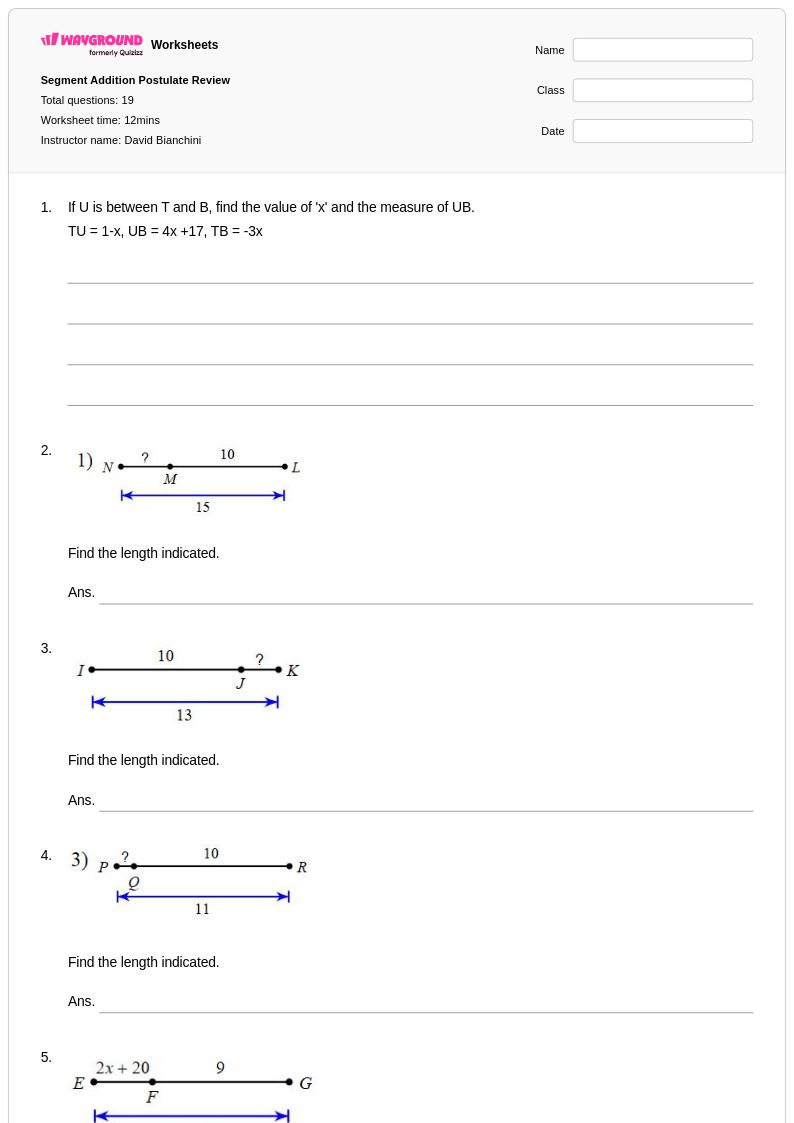
Effective practice moves from simple identification to complex application. Start with exercises asking students to identify bisectors and midpoints in given diagrams. Progress to problems where they must use the definition of a bisector to set up and solve algebraic equations (e.g., if AM = 2x + 1 and MB = 3x - 5, find x). Finally, incorporate coordinate geometry problems where students find the midpoint of a segment given the endpoints.
What are common mistakes students make with segment bisectors?
A frequent error is confusing a segment bisector with an angle bisector. Students may also misapply the concept algebraically; for instance, they might add the two smaller segment lengths to equal a third value instead of setting the two congruent parts equal to each other. In coordinate geometry, they often incorrectly average the x- and y-coordinates, such as by mixing x1 with y2 when applying the midpoint formula.
How can I use this segment bisector worksheet with my class?
This worksheet is available as a printable PDF for hands-on practice or as an interactive digital quiz you can assign directly on Wayground. Every worksheet includes a complete answer key for efficient grading. For paper assignments, you can use the Wayground for Teachers app to scan and grade student work quickly.
How do segment bisectors fit into the geometry curriculum?
Aligned with Common Core's approach to geometry, the concept of segment bisectors is a foundational building block. It typically follows lessons on points, lines, and segments. Understanding bisectors is prerequisite for more advanced topics like perpendicular bisectors, triangle congruence proofs (e.g., SAS, SSS), and geometric constructions with a compass and straightedge.
How can I differentiate practice for segment bisectors?
For students needing support, use Wayground's features to reduce the number of answer choices on multiple-choice questions or assign worksheets with simpler, non-algebraic problems. For advanced learners, provide worksheets that require multi-step algebraic solutions or ask them to write proofs involving segment bisectors in coordinate geometry.