Free Printable Cell Biology Worksheets for Class 11
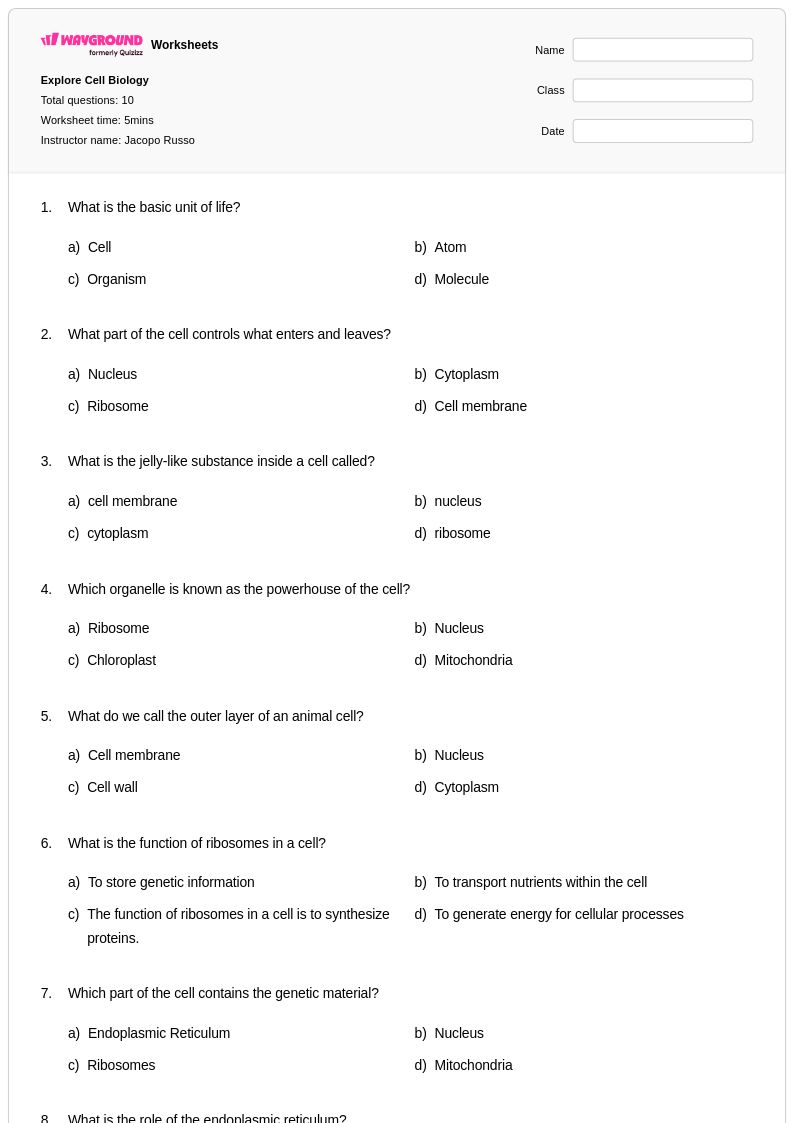
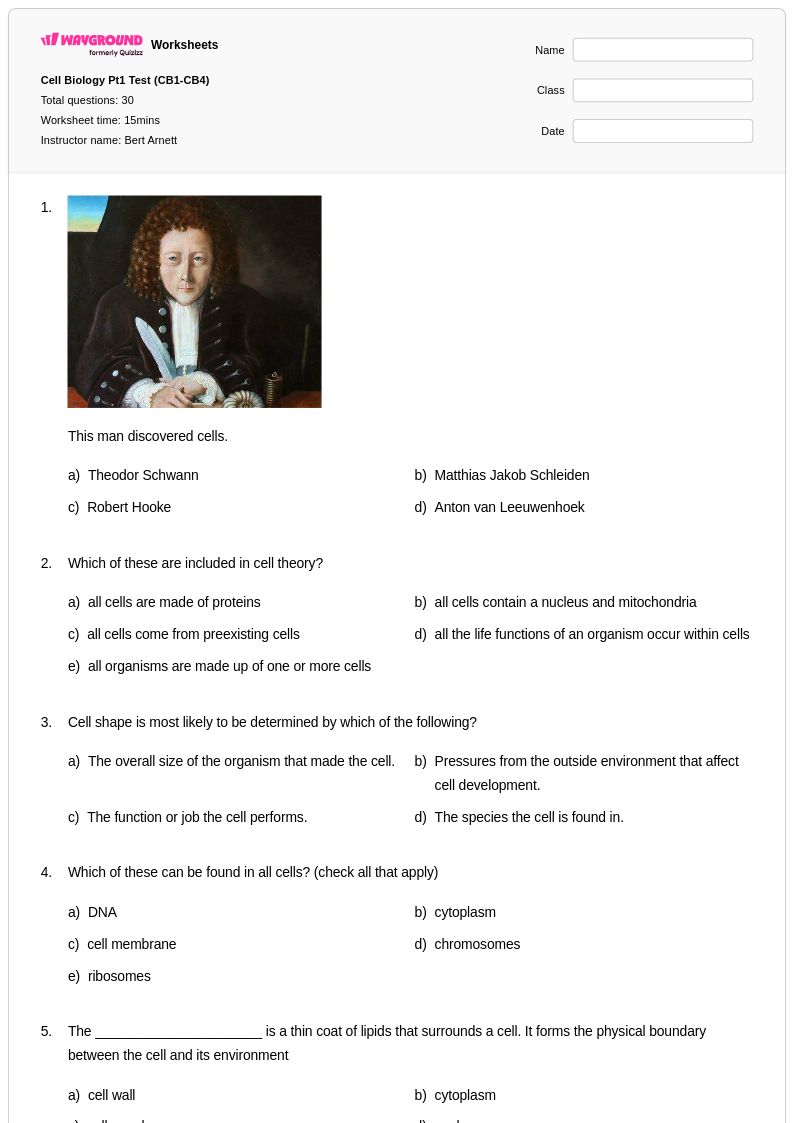
Class 11 Cell Biology worksheets from Wayground help students master cellular structures and processes through comprehensive printables, practice problems, and answer keys designed to reinforce essential biological concepts.
Explore printable Cell Biology worksheets for Class 11
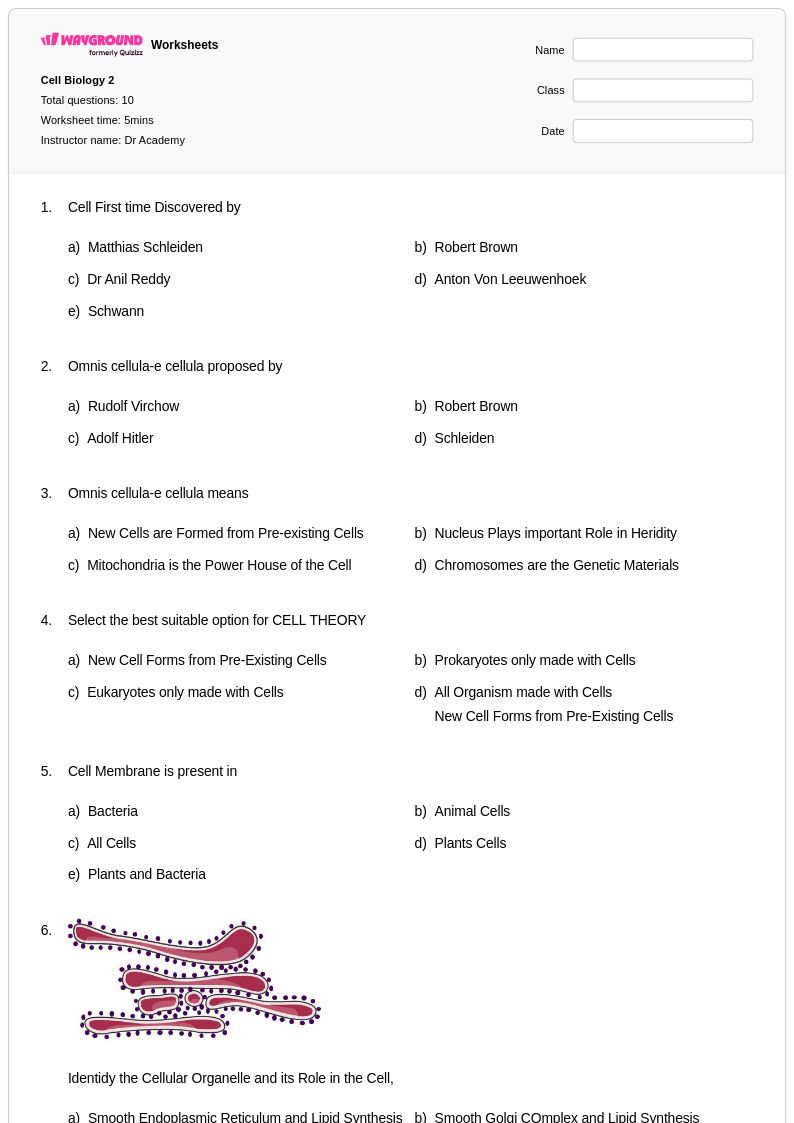
Class 11 cell biology worksheets available through Wayground (formerly Quizizz) provide comprehensive coverage of fundamental cellular processes and structures that form the foundation of advanced biological understanding. These expertly crafted resources strengthen critical thinking skills through detailed exploration of cell membrane dynamics, organelle functions, cellular respiration, photosynthesis, and cell division mechanisms including mitosis and meiosis. Students develop proficiency in analyzing cellular transport mechanisms, interpreting microscopic images, and understanding the molecular basis of cellular activities through engaging practice problems that challenge their comprehension of complex biological systems. Each worksheet includes a complete answer key and is available as a free printable pdf, enabling students to practice independently while reinforcing essential concepts covered in advanced high school biology curricula.
Wayground (formerly Quizizz) empowers educators with access to millions of teacher-created cell biology resources specifically designed for Class 11 students, featuring robust search and filtering capabilities that allow instructors to quickly locate materials aligned with state and national science standards. The platform's differentiation tools enable teachers to customize worksheet difficulty levels and content focus areas, accommodating diverse learning needs within the classroom while maintaining rigorous academic expectations. These versatile resources are available in both printable and digital formats, including downloadable pdf versions, facilitating seamless integration into lesson planning whether for in-person instruction, remote learning, or hybrid educational environments. Teachers utilize these comprehensive worksheet collections for targeted skill practice, remediation of challenging concepts like cellular energetics, and enrichment activities that deepen student understanding of cellular biology principles essential for success in advanced placement courses and college-level science programs.
FAQs
How do I teach cell biology to middle and high school students?
Teaching cell biology effectively starts with building a clear conceptual foundation around cell theory before introducing organelle structures and their functions. Use labeled diagrams to help students visualize the differences between prokaryotic and eukaryotic cells, and connect each organelle's structure to its specific role in the cell. Progressing from basic cell structure to dynamic processes like mitosis, meiosis, and membrane transport gives students a logical scaffolded pathway through the content.
What exercises help students practice identifying cell organelles and their functions?
Diagram labeling exercises are among the most effective tools for reinforcing organelle identification, as they require students to recall both location and function simultaneously. Matching activities that pair organelles with their roles, along with short-answer questions asking students to explain why a cell lacking a specific organelle would malfunction, push students toward deeper conceptual understanding. Practice problems that ask students to compare plant and animal cells or prokaryotic and eukaryotic cells also build critical analytical skills.
What mistakes do students commonly make when learning about cell processes like mitosis and meiosis?
One of the most persistent misconceptions is that students conflate mitosis and meiosis, often confusing the purpose of each process or misidentifying the stages. Students frequently struggle to distinguish between the two divisions in meiosis and often overlook the significance of crossing over in generating genetic diversity. Another common error is assuming that all cells undergo both processes, when in reality meiosis is restricted to reproductive cells. Explicitly contrasting the two processes side by side, using comparative charts or guided diagrams, helps students build accurate mental models.
How can I use cell biology worksheets to support students with different learning needs?
Cell biology content is highly visual, which means differentiation strategies should account for both reading demands and diagram complexity. On Wayground, teachers can enable accommodations such as Read Aloud for students who need audio support, Reduced answer choices to lower cognitive load for struggling learners, and Reading mode with adjustable font sizes for accessibility. These settings can be assigned to individual students while the rest of the class receives default settings, and they carry over across future sessions without requiring setup each time.
How do I use Wayground's cell biology worksheets in my classroom?
Wayground's cell biology worksheets are available as printable PDFs for traditional classroom use and in digital formats for technology-integrated environments, giving teachers flexibility regardless of their classroom setup. Teachers can also host worksheets as a quiz directly on Wayground, enabling real-time student responses and built-in assessment. All worksheets include complete answer keys, making them practical for independent practice, homework assignments, or structured remediation sessions.
How do I teach membrane transport and metabolic pathways in a way students can actually understand?
Membrane transport is best introduced by grounding students in the concept of concentration gradients before distinguishing between passive transport, facilitated diffusion, and active transport. Using analogies, such as comparing active transport to a pump moving water uphill, helps students internalize why energy is required in some cases but not others. For metabolic pathways like cellular respiration and photosynthesis, breaking each pathway into discrete stages and using flowcharts or step-by-step diagrams reduces cognitive overload and makes the sequence of reactions manageable.