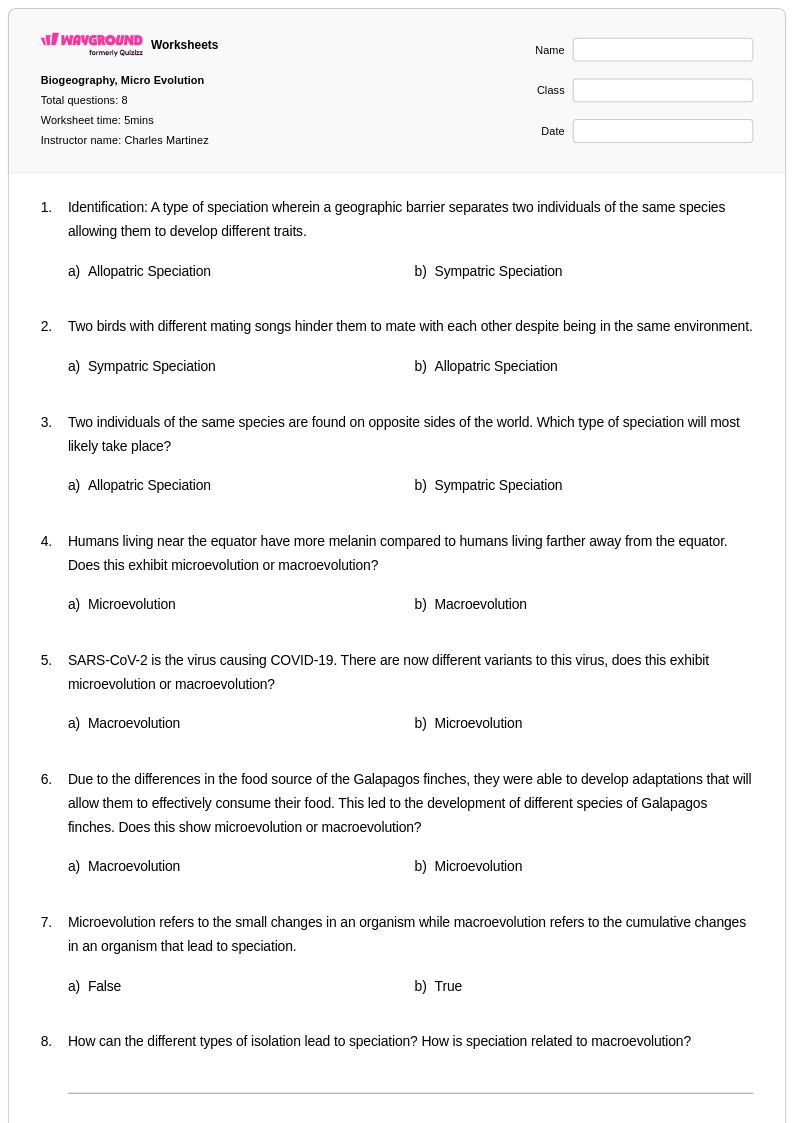
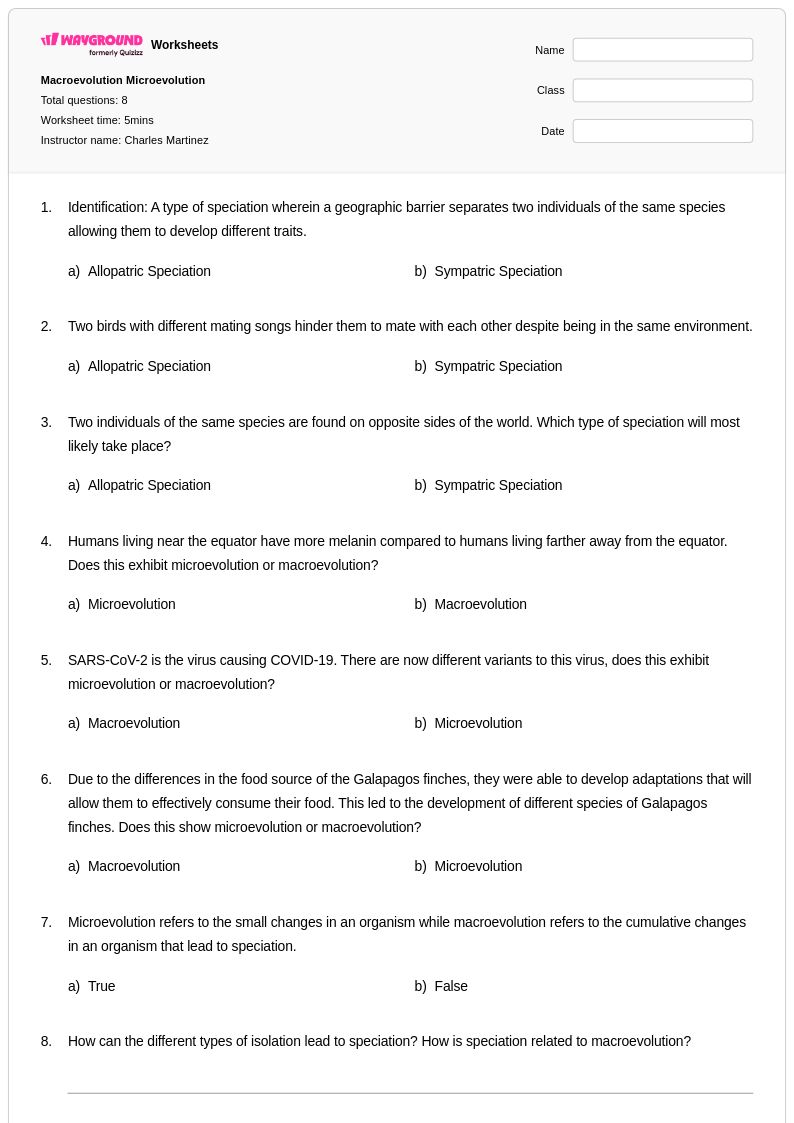
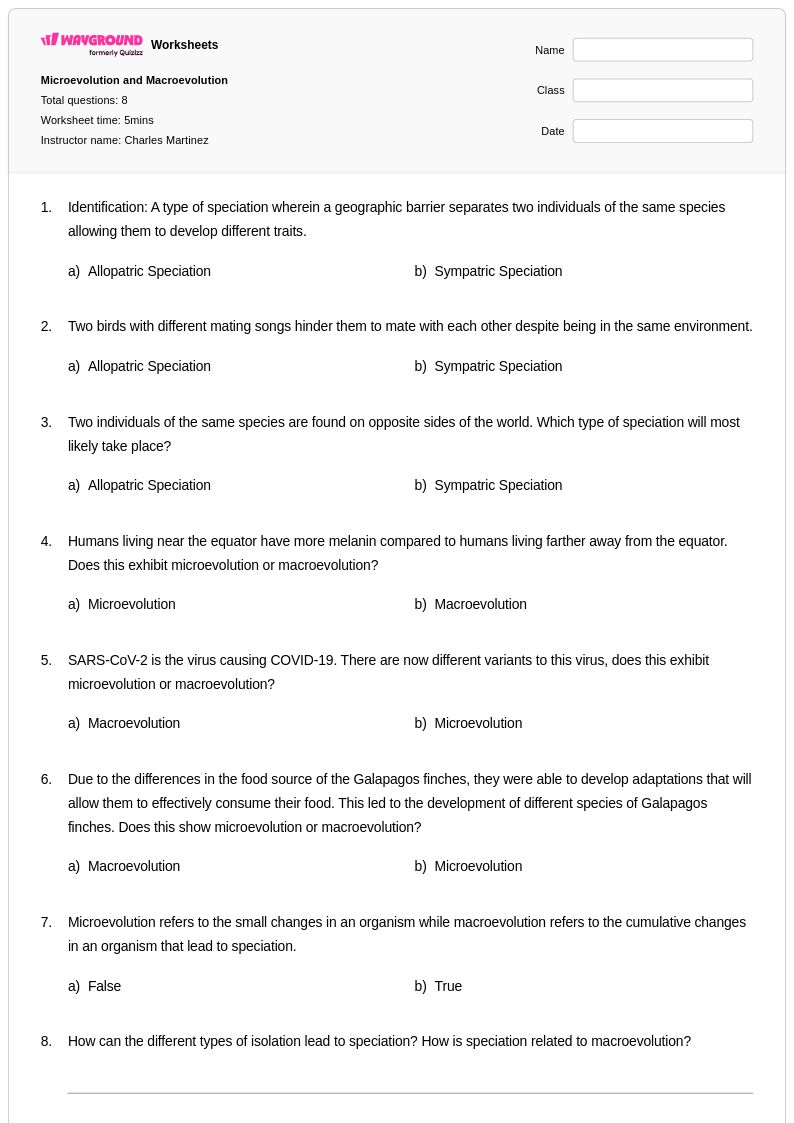
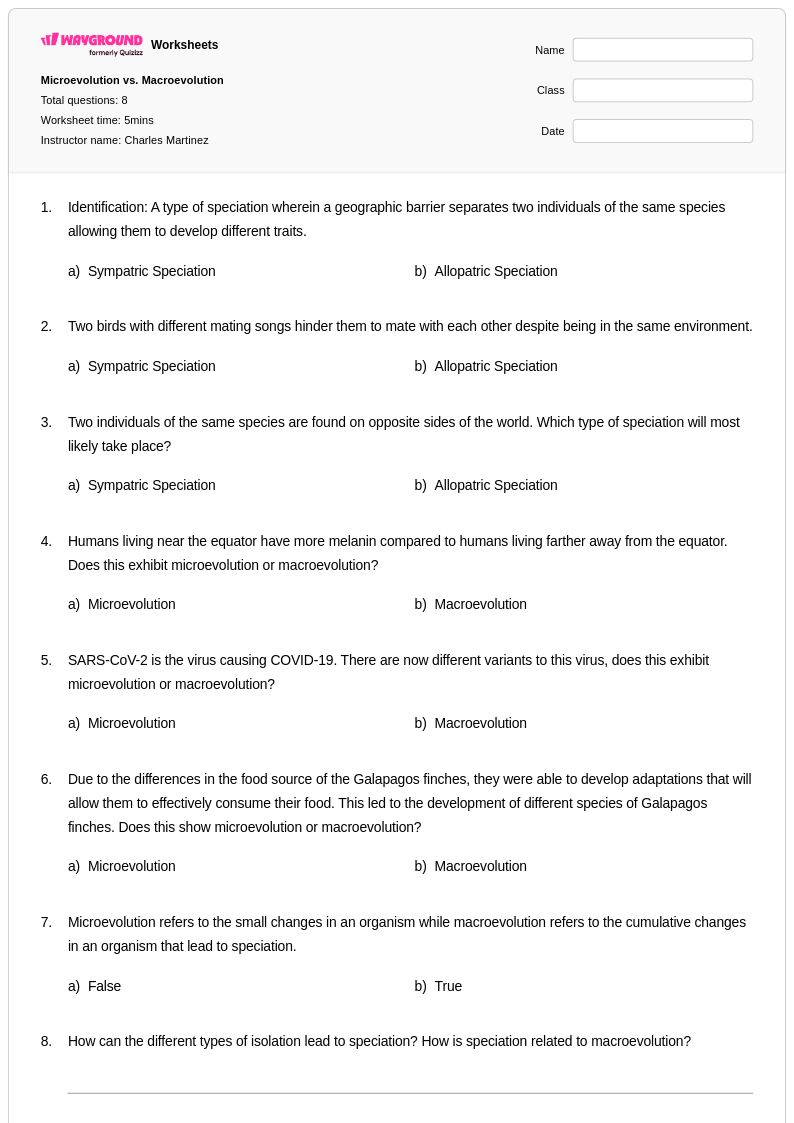
Explore Class 11 speciation worksheets and printables through Wayground that help students master evolutionary processes, species formation, and reproductive isolation with comprehensive practice problems, free PDFs, and detailed answer keys.
Explore printable Speciation worksheets for Class 11
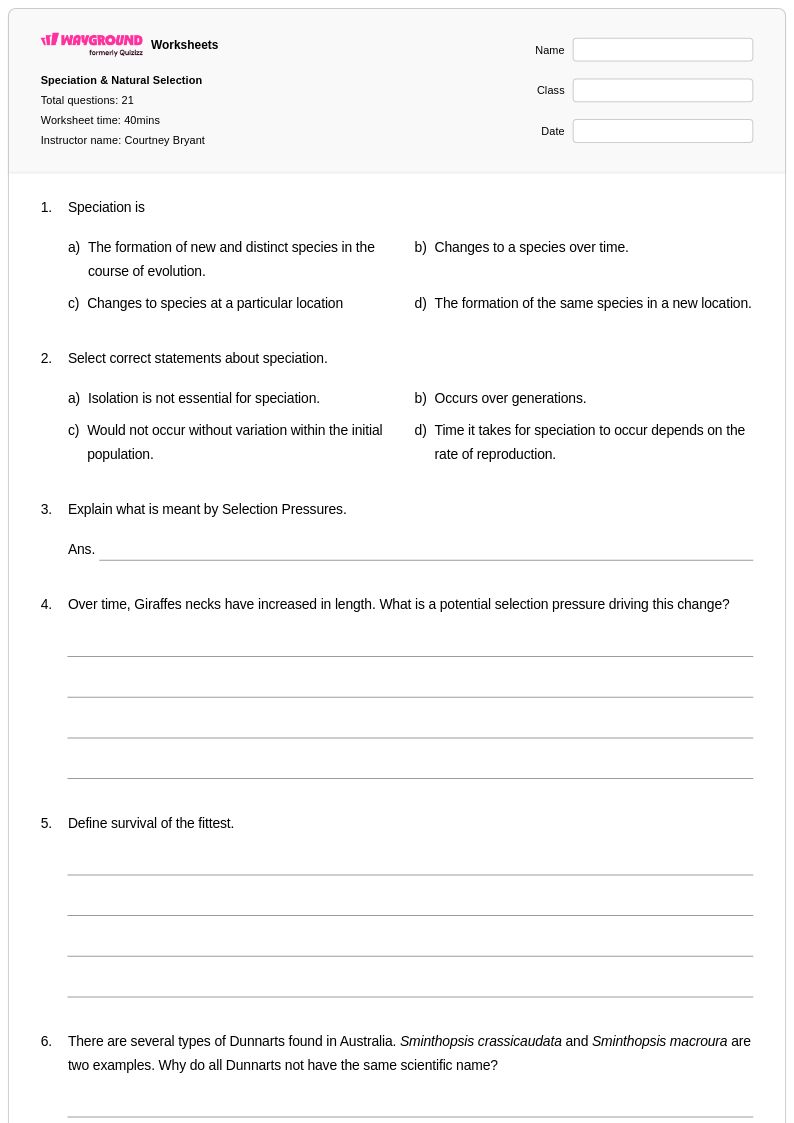
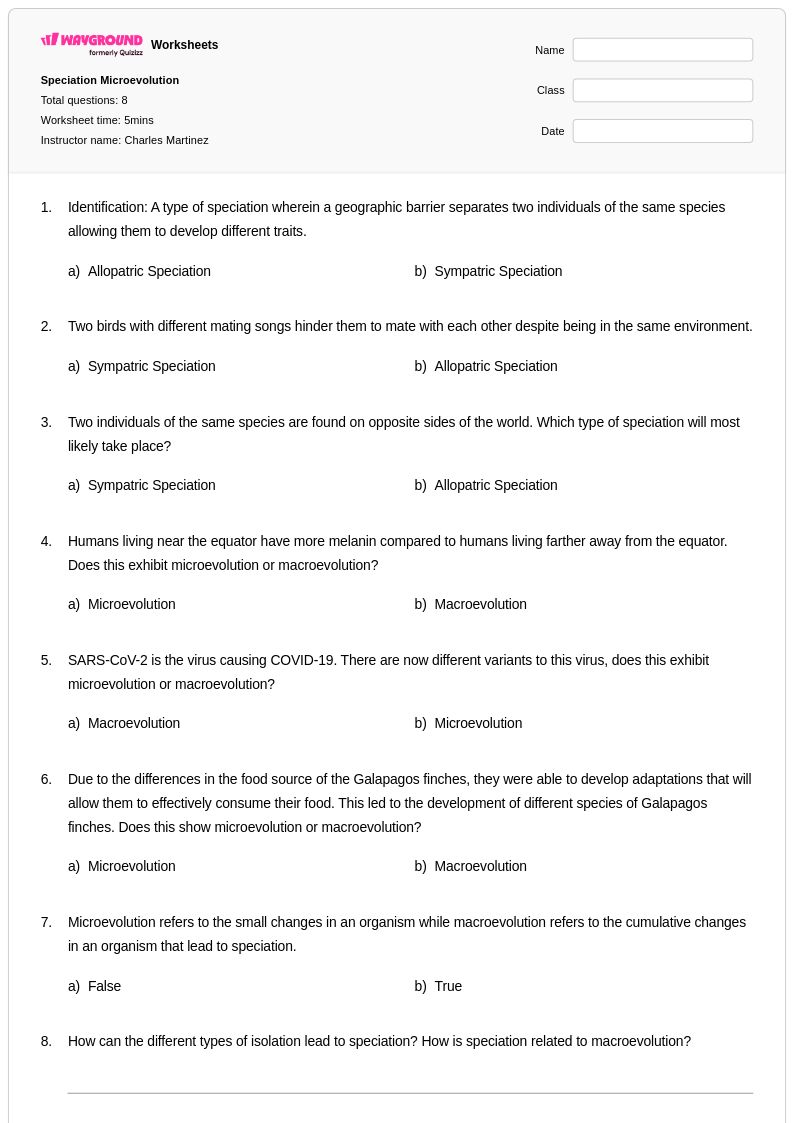
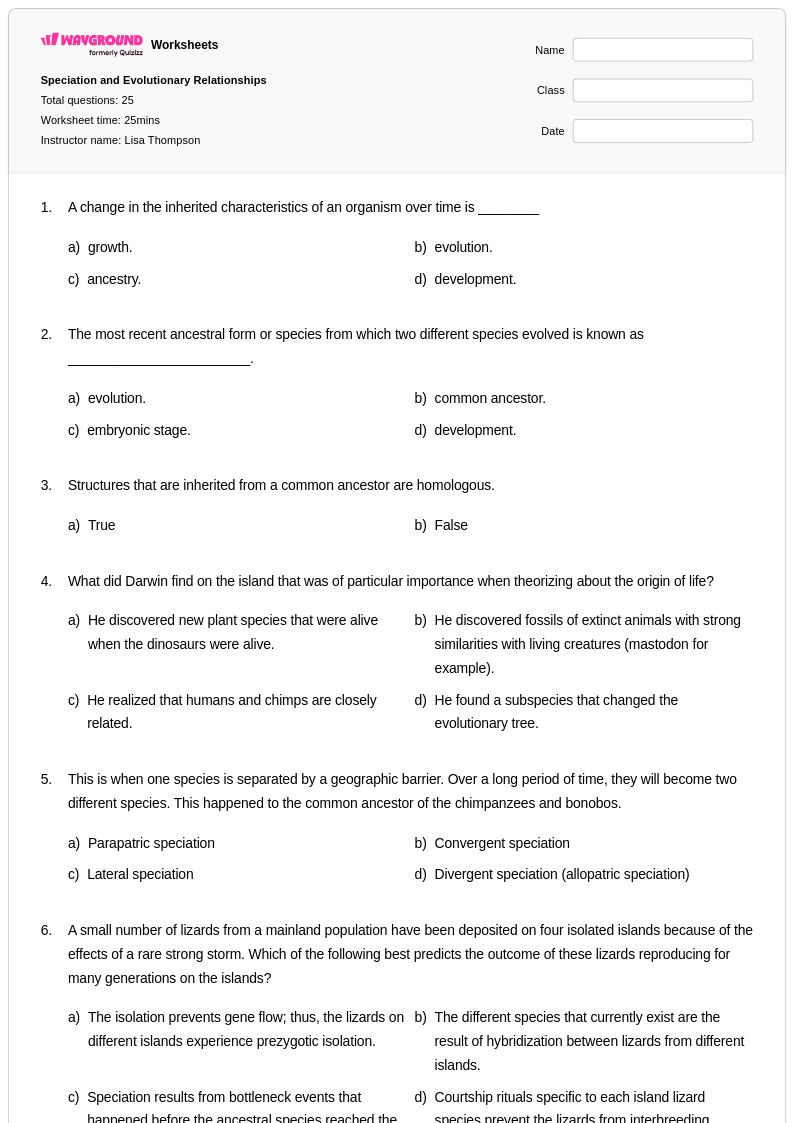
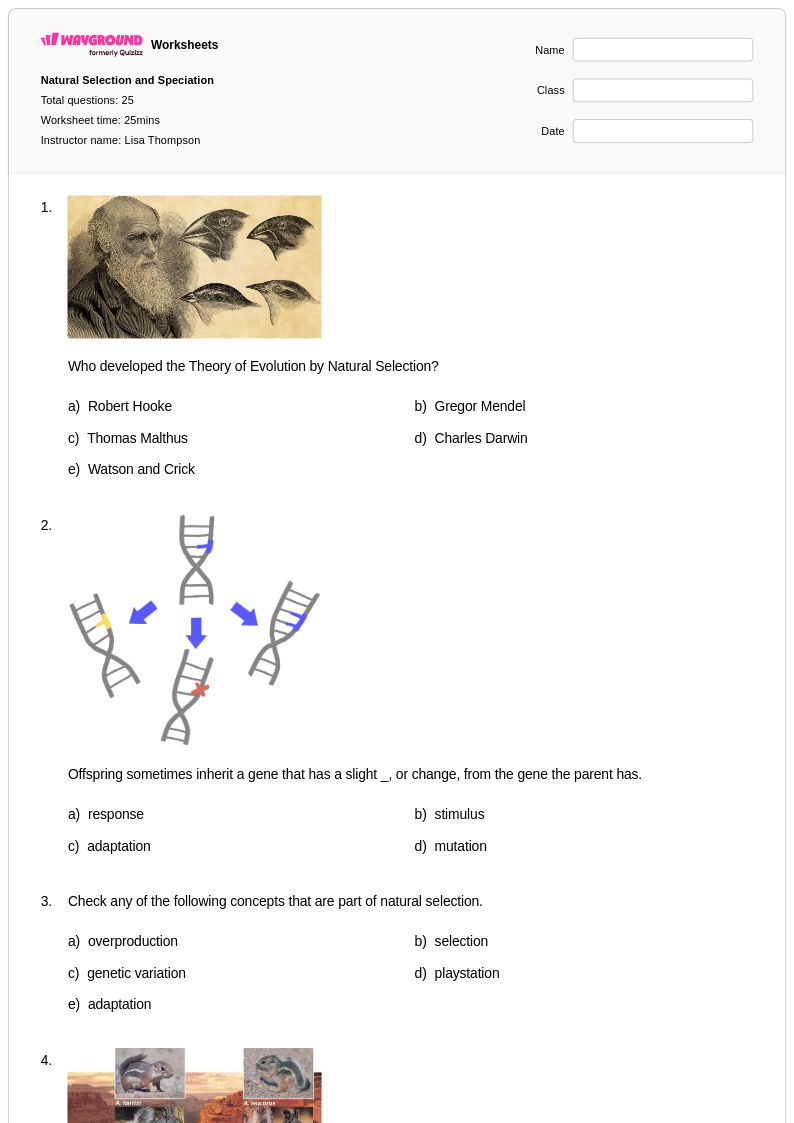
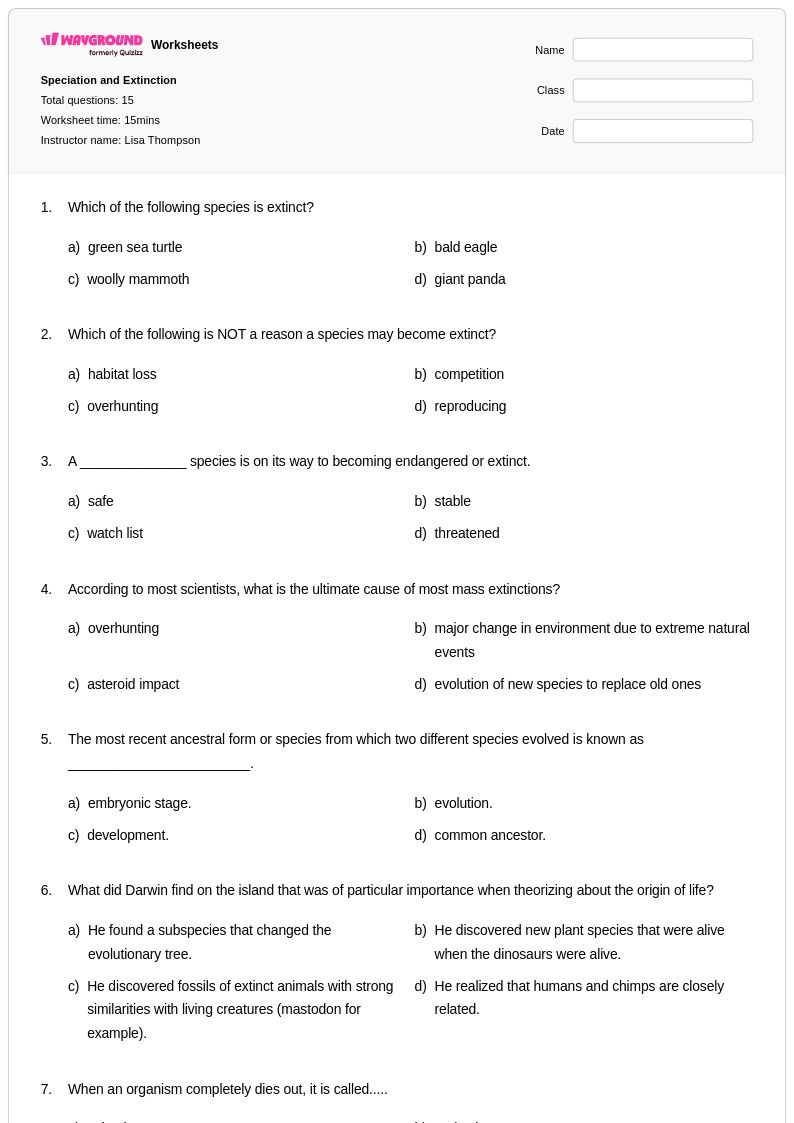
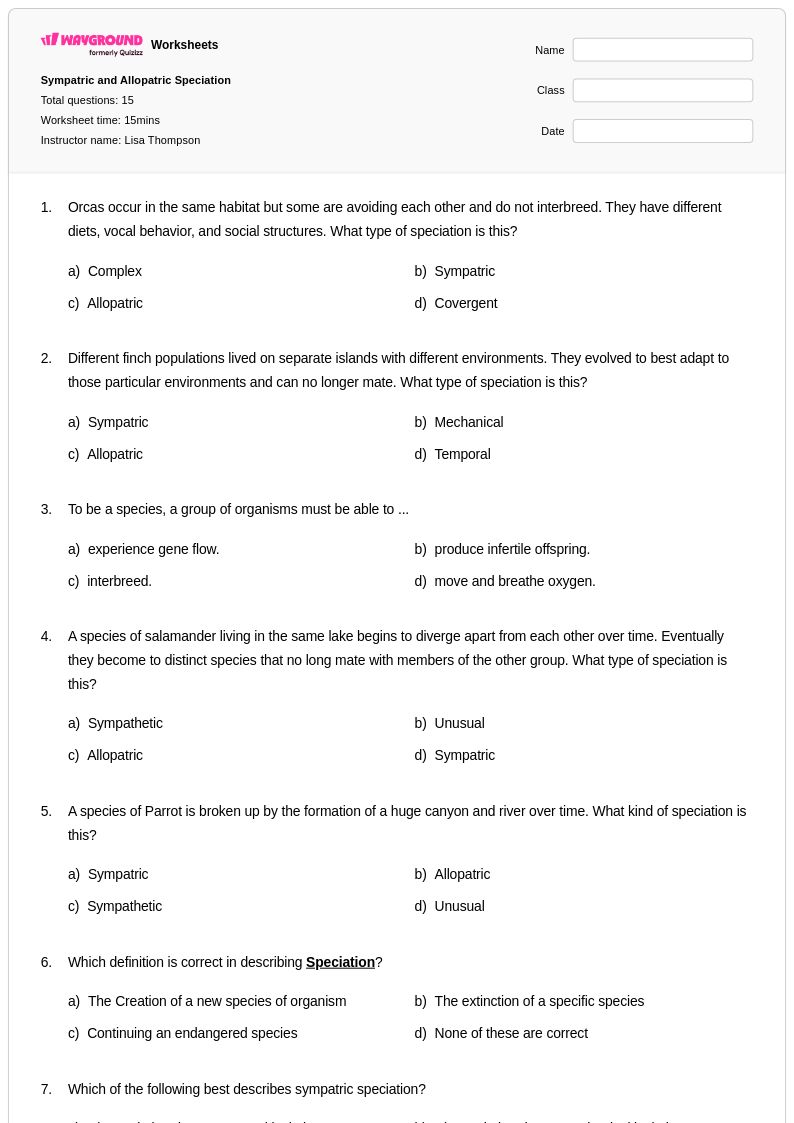
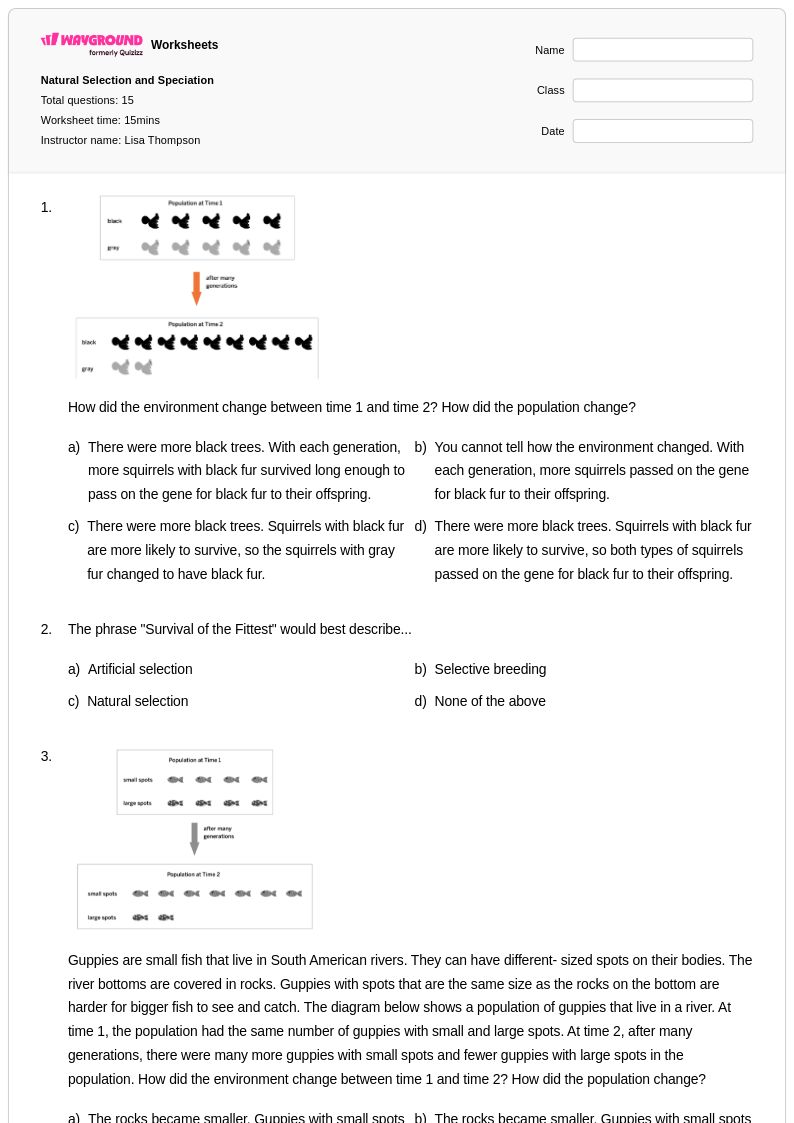
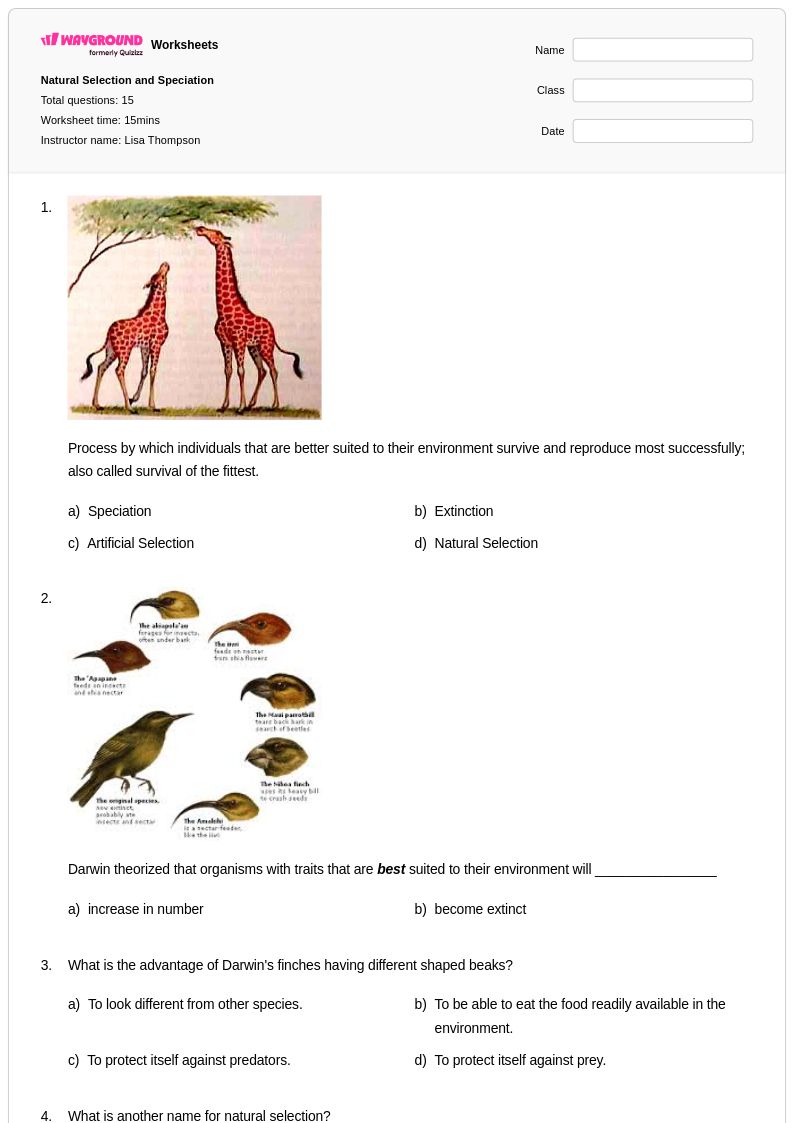
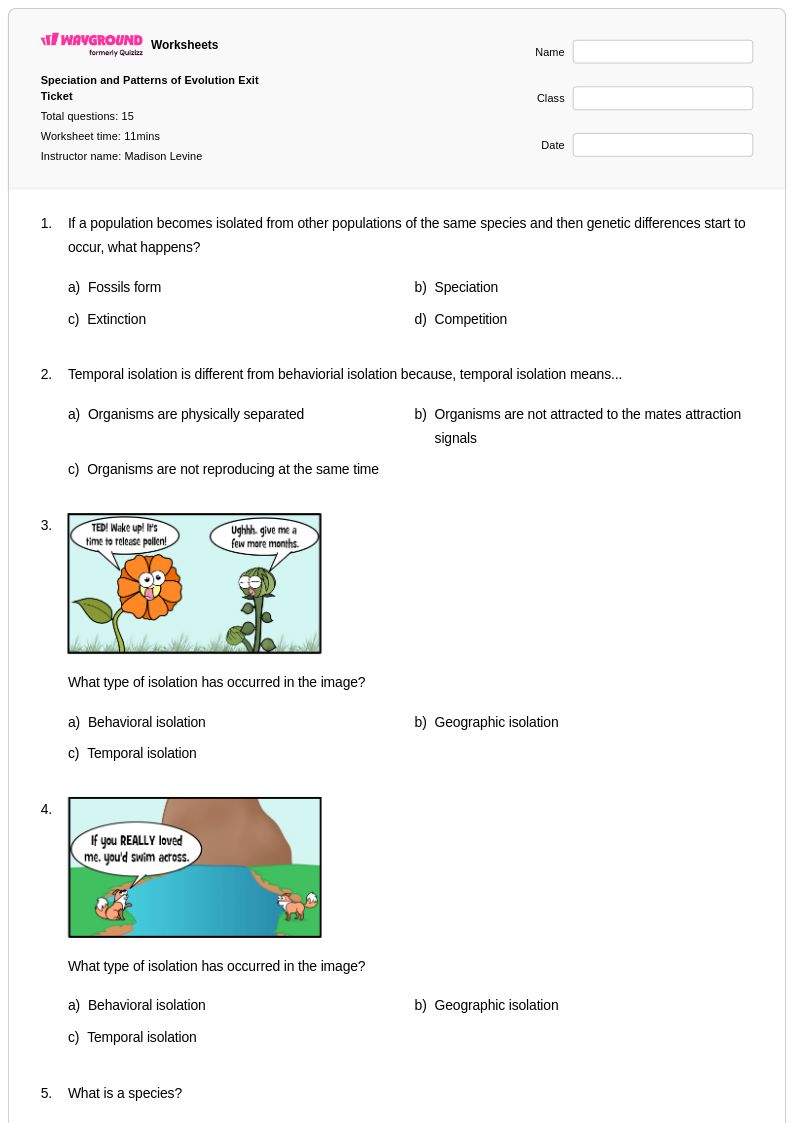
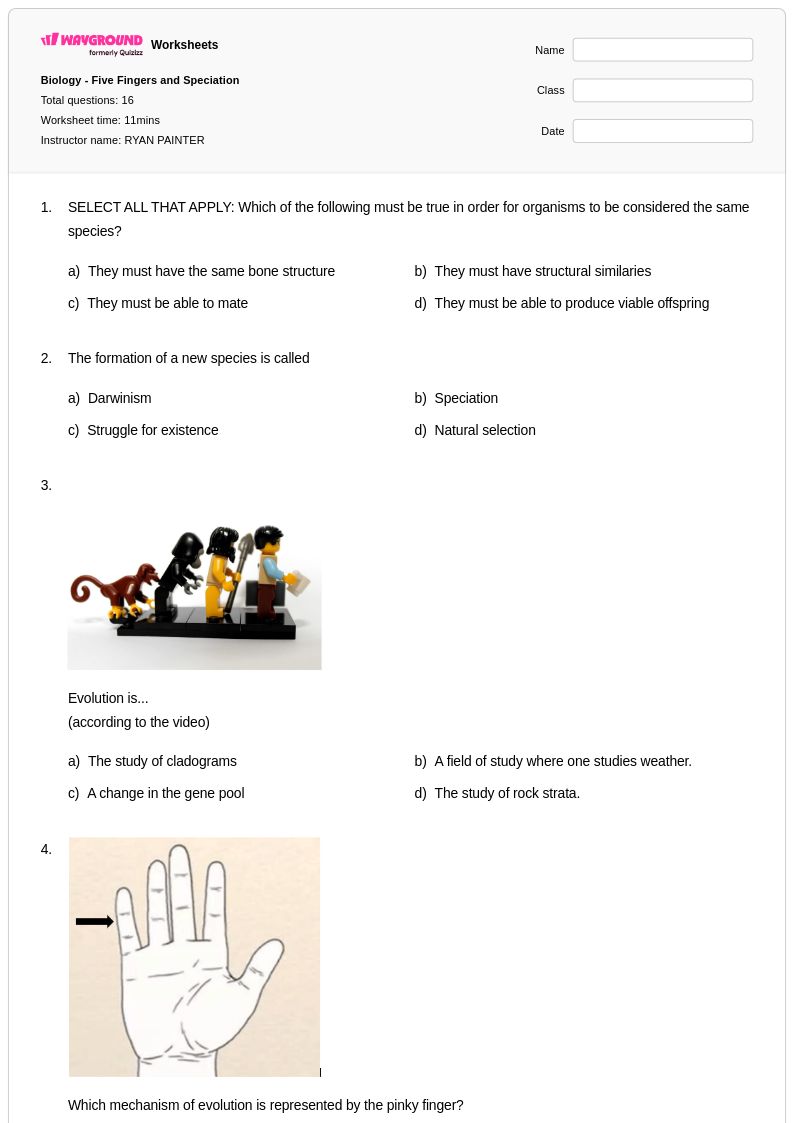
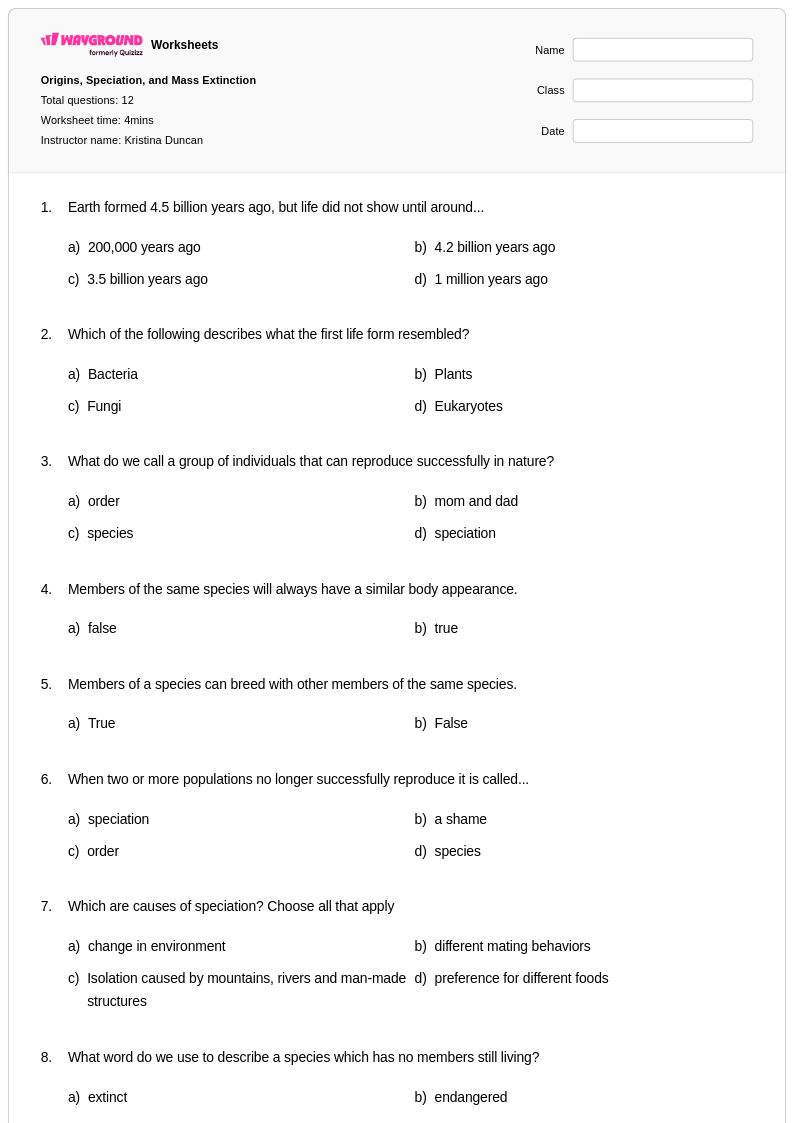
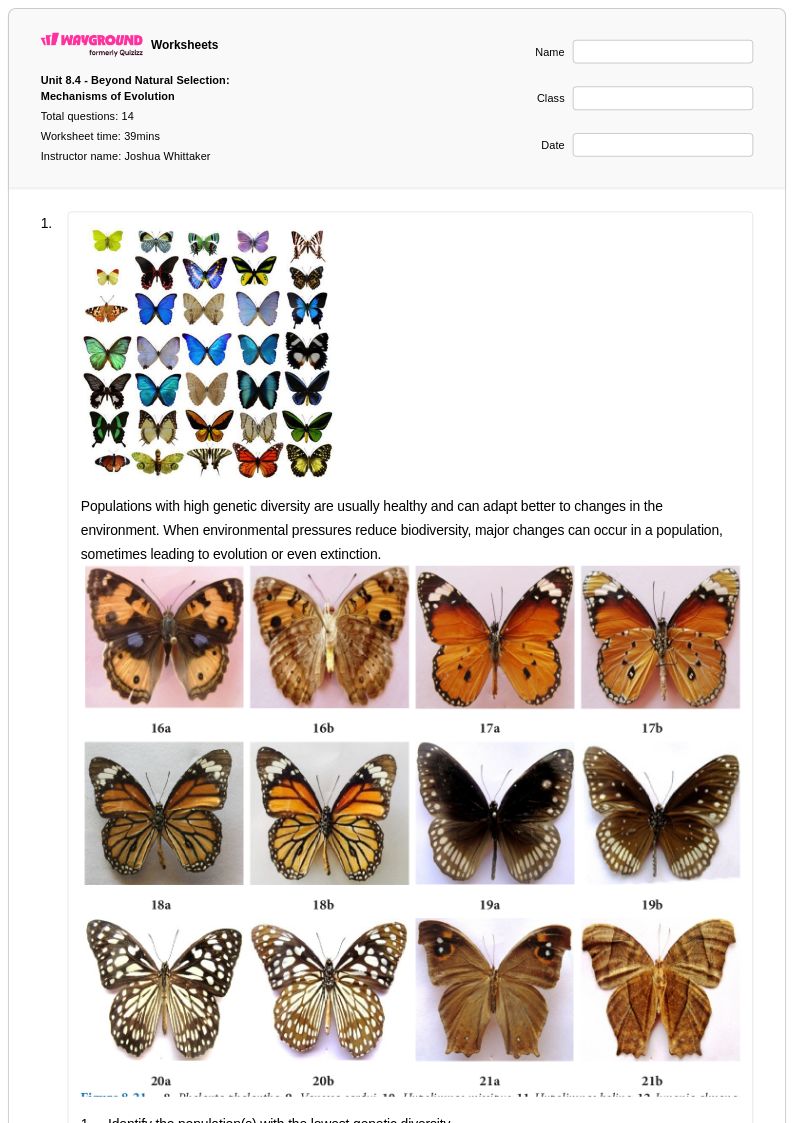
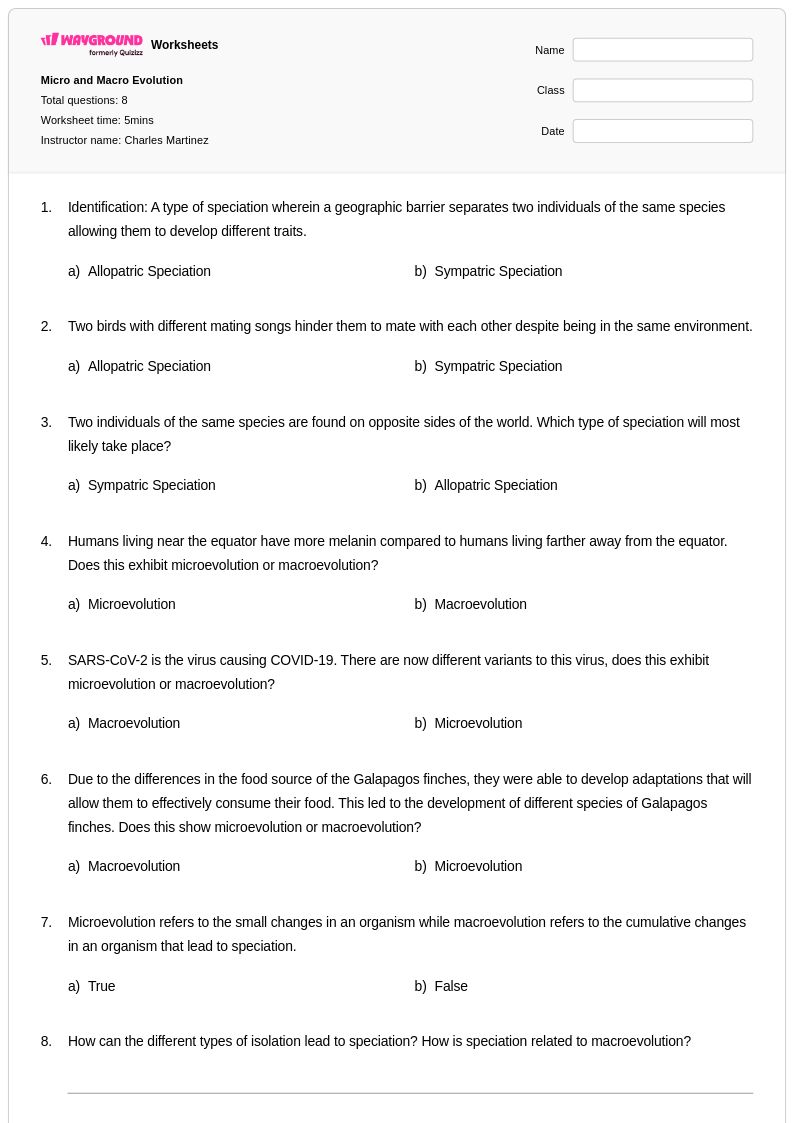
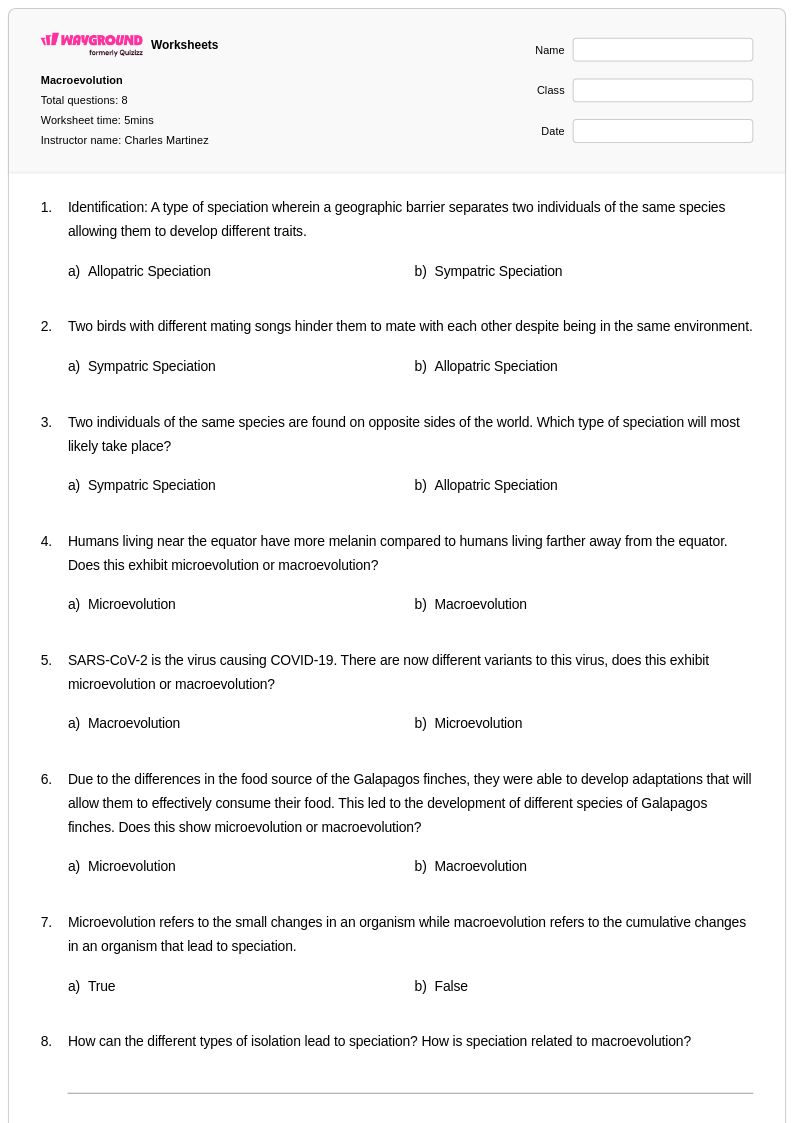
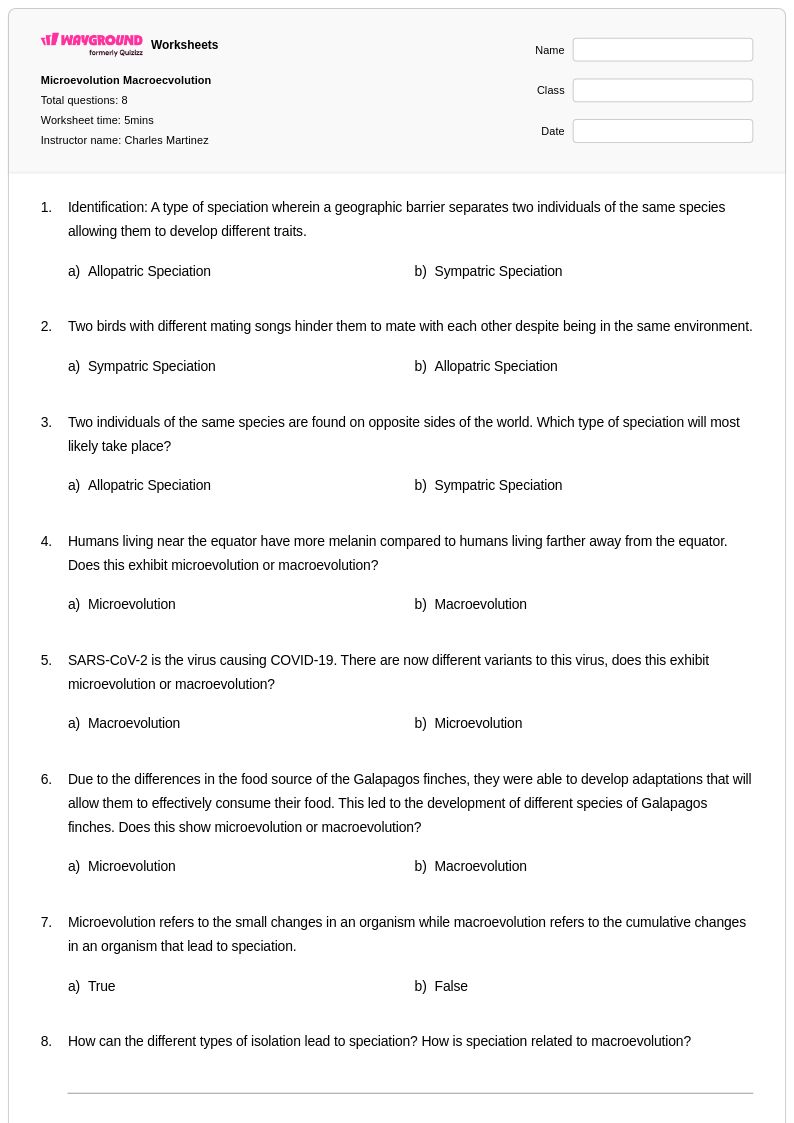
Speciation worksheets for Class 11 students available through Wayground (formerly Quizizz) provide comprehensive exploration of the evolutionary processes that lead to the formation of new species. These educational resources strengthen critical thinking skills by guiding students through complex concepts including allopatric and sympatric speciation, reproductive isolation mechanisms, and the role of genetic drift in population divergence. The carefully crafted practice problems challenge students to analyze real-world examples of species formation, from Darwin's finches to cichlid fish adaptive radiation, while answer key materials ensure accurate understanding of these fundamental evolutionary principles. Students benefit from free printable pdf worksheets that incorporate visual diagrams, data interpretation exercises, and scenario-based questions that reinforce their comprehension of how geographic barriers, polyploidy, and behavioral changes contribute to speciation events.
Wayground (formerly Quizizz) empowers educators with an extensive collection of millions of teacher-created speciation resources that streamline lesson planning and enhance classroom instruction for Class 11 biology courses. The platform's robust search and filtering capabilities allow teachers to quickly locate materials aligned with specific curriculum standards, while differentiation tools enable customization of worksheet difficulty levels to meet diverse student needs. These versatile resources are available in both printable and digital pdf formats, facilitating seamless integration into traditional classroom settings or remote learning environments. Teachers can effectively utilize these comprehensive worksheet collections for targeted skill practice, remediation of challenging evolutionary concepts, and enrichment activities that deepen student understanding of speciation mechanisms, making complex biological processes more accessible and engaging for advanced high school learners.
FAQs
How do I teach speciation to high school biology students?
Start by grounding students in the concept of reproductive isolation before introducing the two major pathways: allopatric speciation, driven by geographic barriers, and sympatric speciation, which occurs within a shared habitat. Use concrete case studies such as Darwin's finches or the cichlid fish of the African Great Lakes to make abstract mechanisms tangible. Once students can distinguish between these pathways, phylogenetic tree analysis and fossil evidence interpretation help deepen their understanding of how speciation unfolds over time.
What exercises help students practice understanding allopatric vs. sympatric speciation?
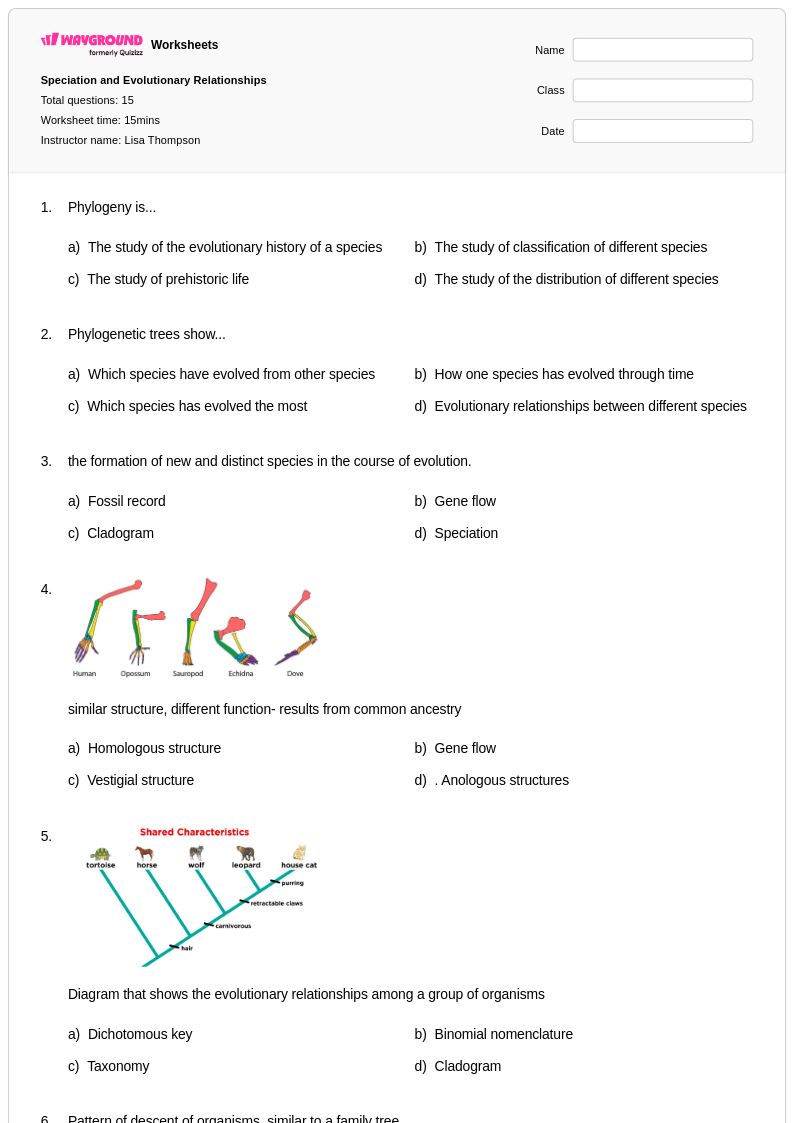
Scenario-based practice problems are highly effective — present students with a population that has been split by a geographic barrier and ask them to trace the steps leading to reproductive isolation and eventual speciation. For sympatric speciation, exercises involving resource partitioning or polyploidy in plants give students concrete contexts to apply the concept. Phylogenetic tree interpretation tasks are also valuable because they require students to identify divergence points and infer speciation events from visual data.
What mistakes do students commonly make when learning about speciation?
A frequent misconception is that speciation requires a physical barrier, which leads students to dismiss sympatric speciation as impossible or rare. Students also confuse reproductive isolation as a cause of speciation rather than recognizing it as both a mechanism and an outcome depending on context. Another common error is conflating microevolution with speciation — students may understand that allele frequencies shift over generations but struggle to connect that to the threshold at which two populations become distinct species.
How do I use Wayground's speciation worksheets in my classroom?
Wayground's speciation worksheets are available as free printable PDFs for traditional classroom use and in digital formats for technology-integrated learning environments, including the ability to host them as a quiz directly on Wayground. Teachers can use the printable versions for independent practice or formative assessment during class, while digital versions allow students to work asynchronously or in blended learning settings. Wayground also supports student-level accommodations such as read aloud, extended time, and reduced answer choices, making it straightforward to differentiate for learners with diverse needs.
How can I help students read and interpret phylogenetic trees in the context of speciation?
Begin by teaching students to identify nodes, branches, and the root of a phylogenetic tree before connecting those structural elements to speciation events. Emphasize that each node represents a common ancestor and a divergence point — this is where speciation occurred. Practice tasks should ask students to determine which species share the most recent common ancestor, estimate relative timing of speciation events, and identify clades, building from simpler trees before introducing ones that incorporate fossil data or molecular evidence.
How do I differentiate speciation instruction for students at different readiness levels?
For students who need foundational support, start with basic vocabulary and single-mechanism scenarios — for example, isolating on allopatric speciation with a clear geographic barrier before introducing reproductive isolation in detail. Advanced students can engage with hybrid zone case studies, evolutionary genetics, and adaptive radiation events that require synthesizing multiple mechanisms simultaneously. On Wayground, teachers can select worksheets that target specific aspects of speciation theory and apply individual accommodations such as read aloud or reduced answer choices to students who need additional scaffolding, without signaling those differences to the rest of the class.