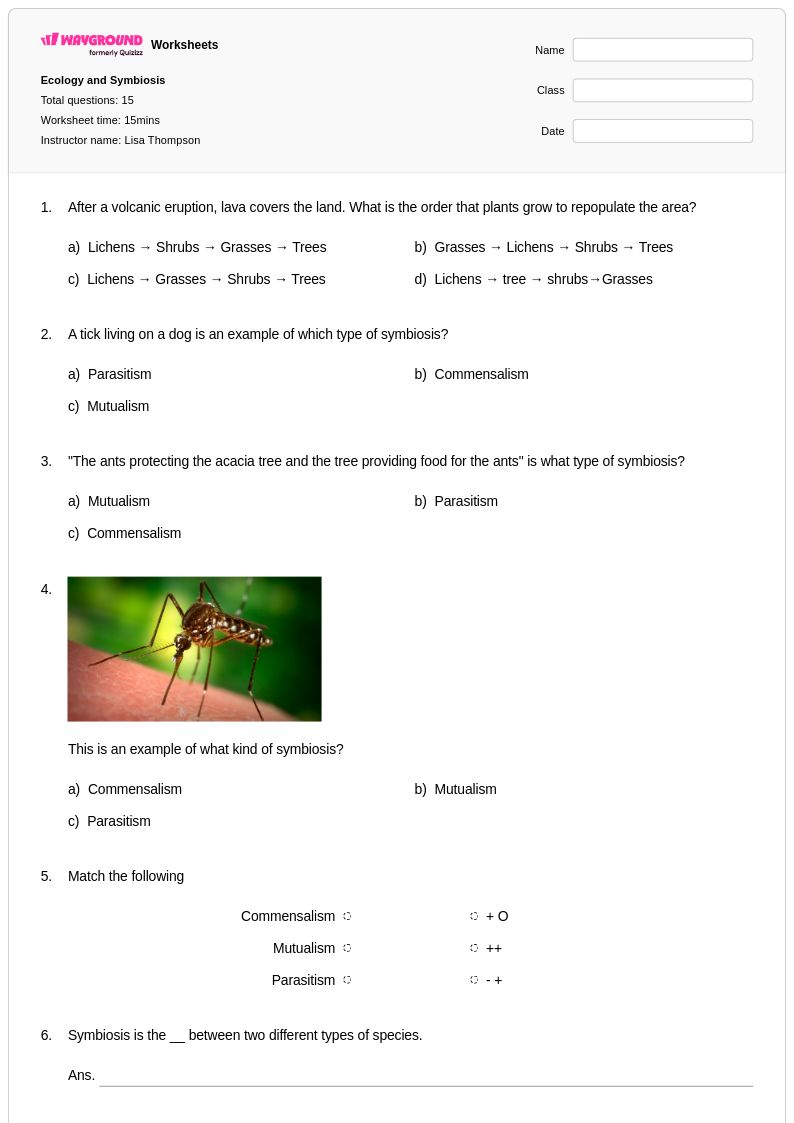
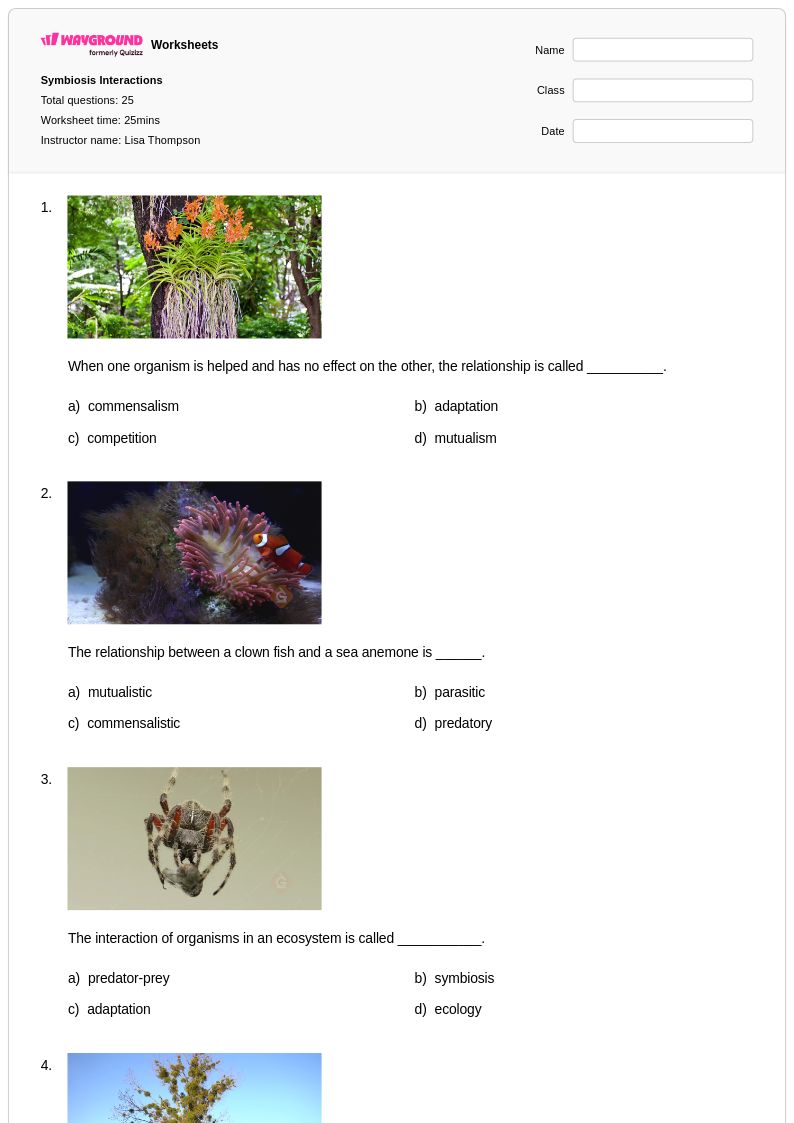
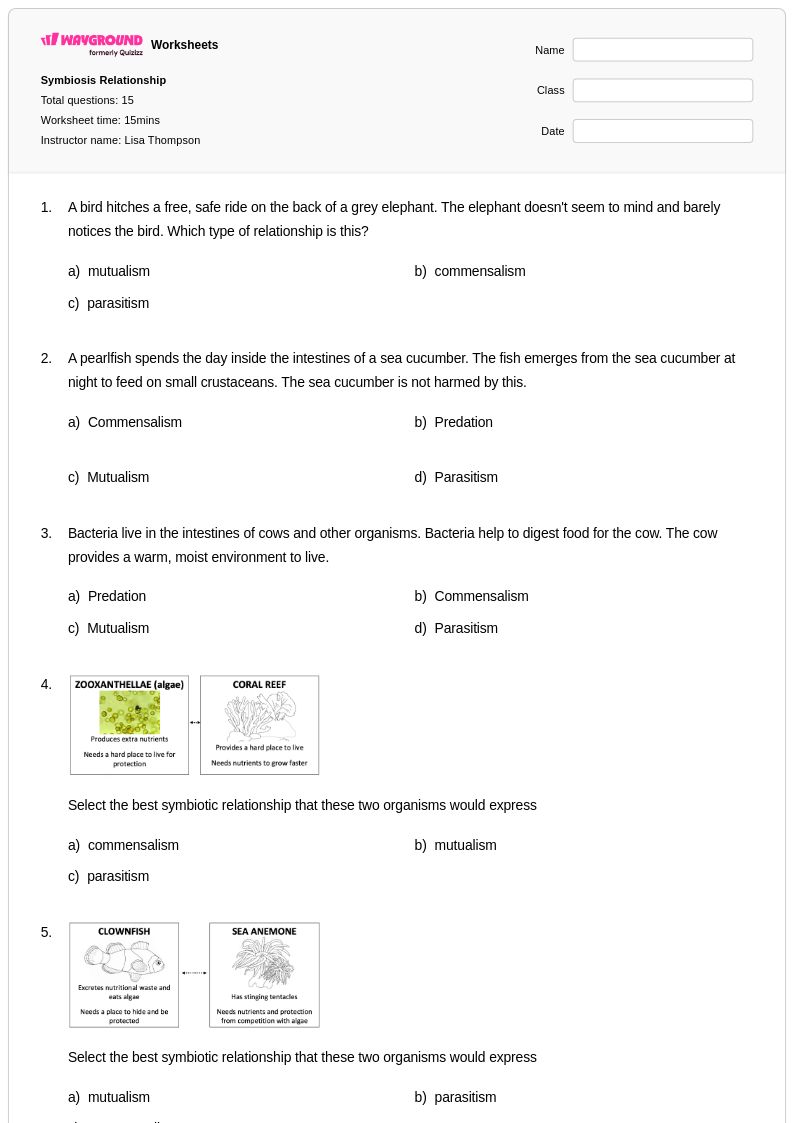
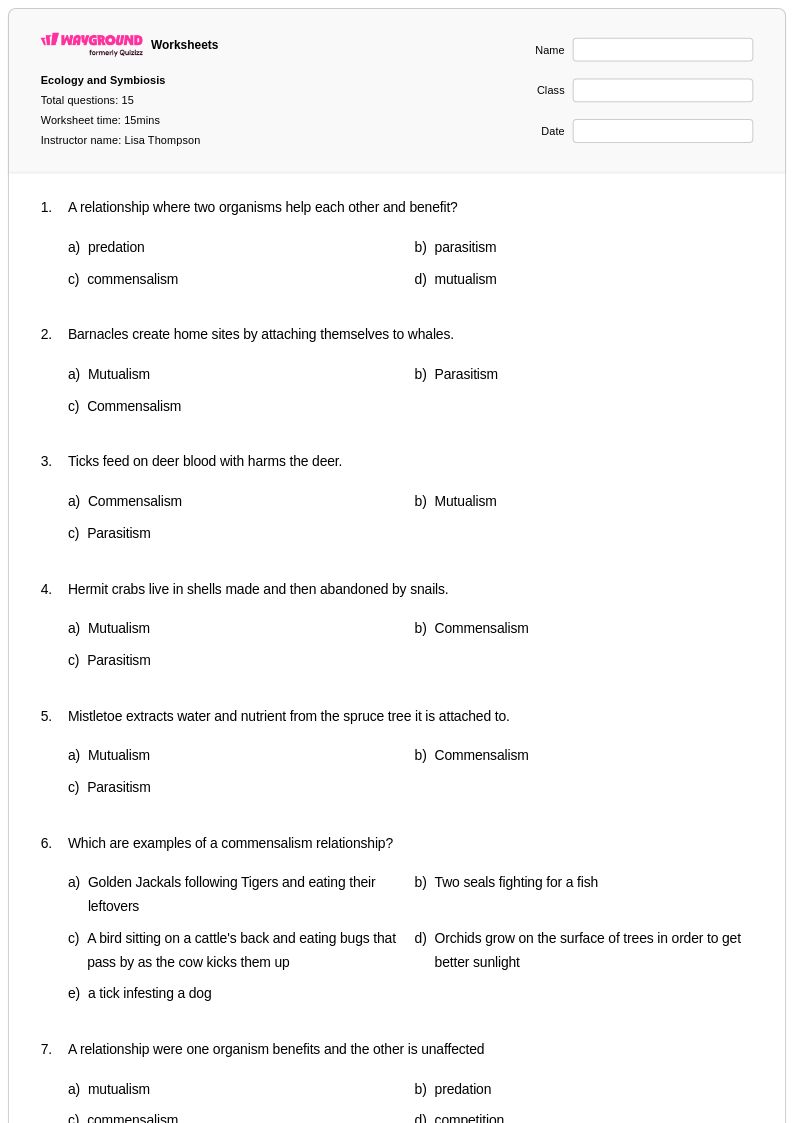
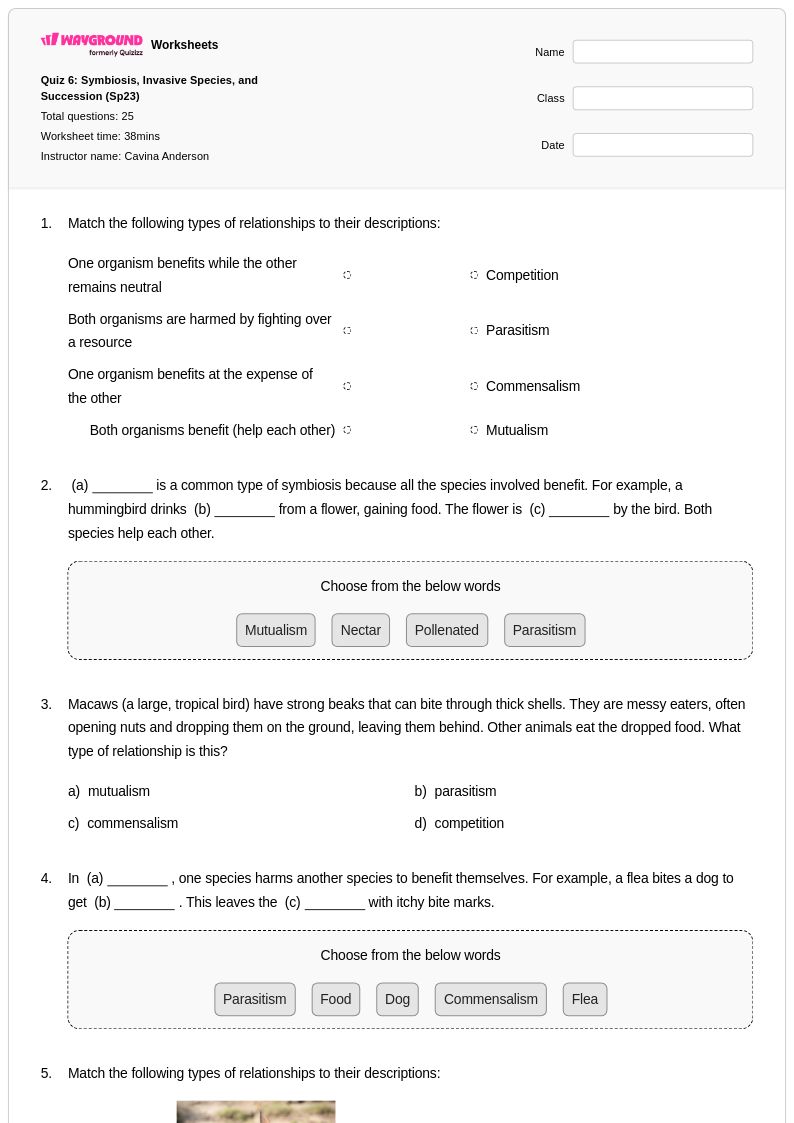
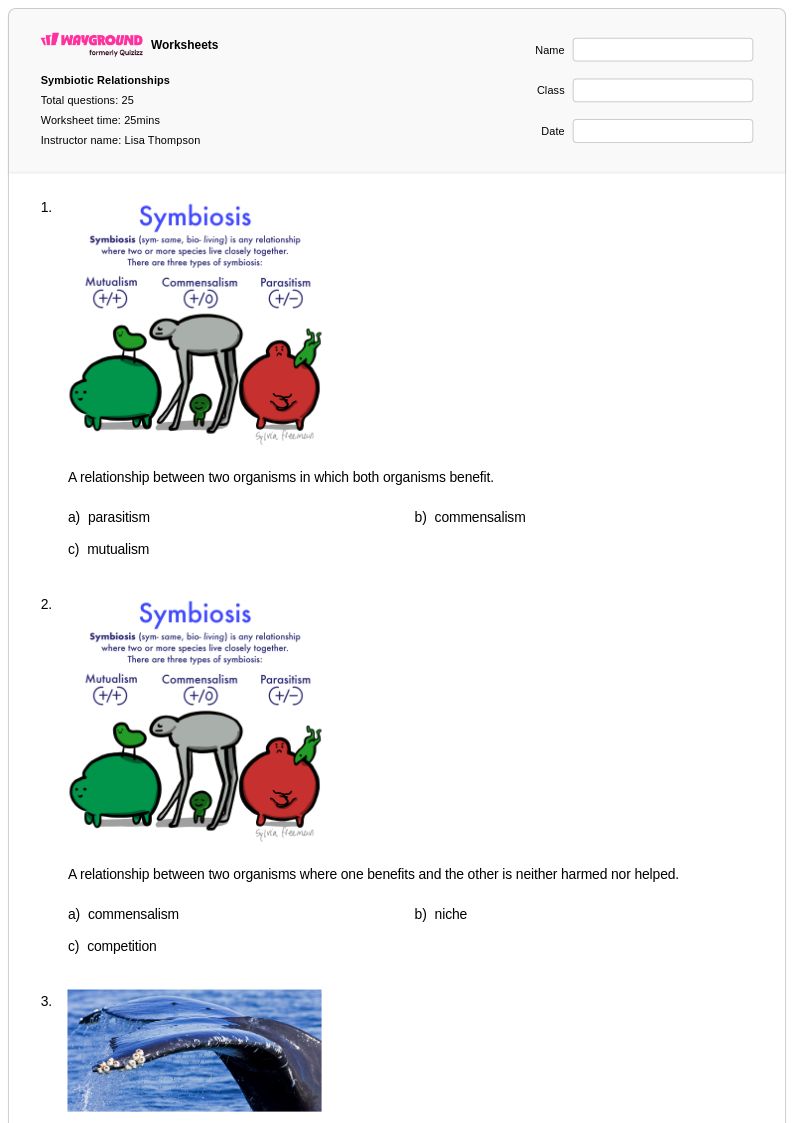
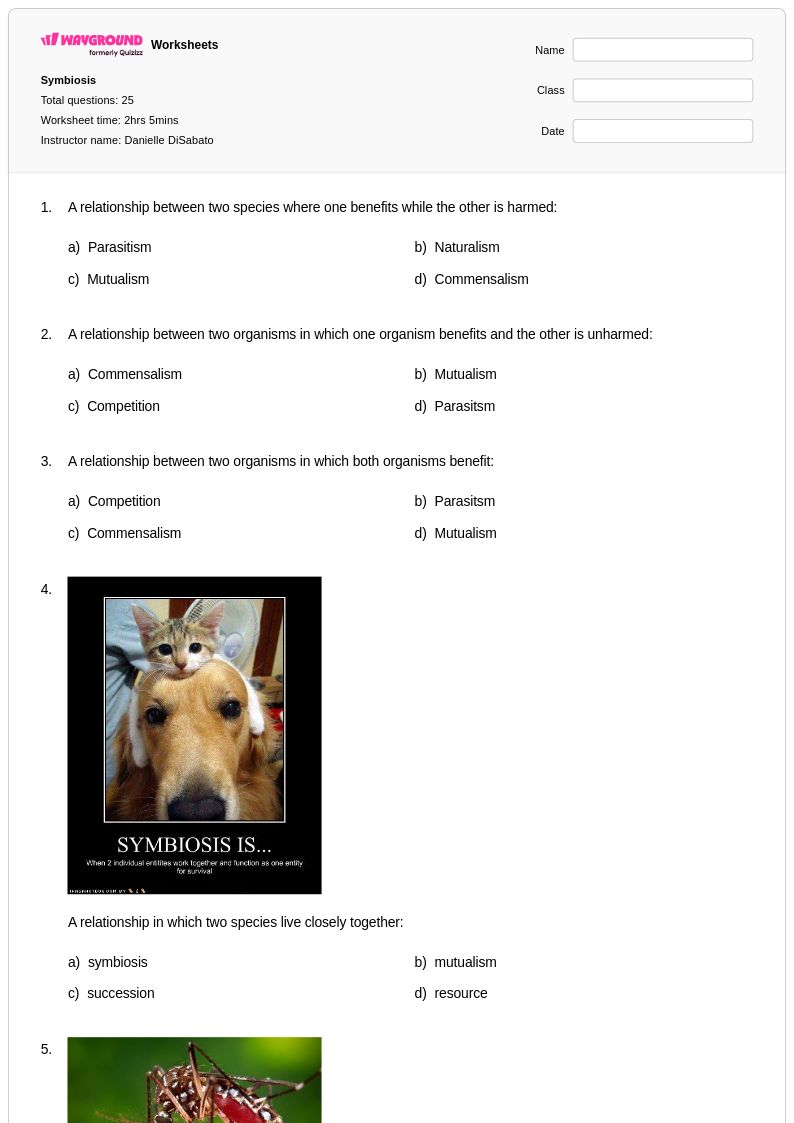
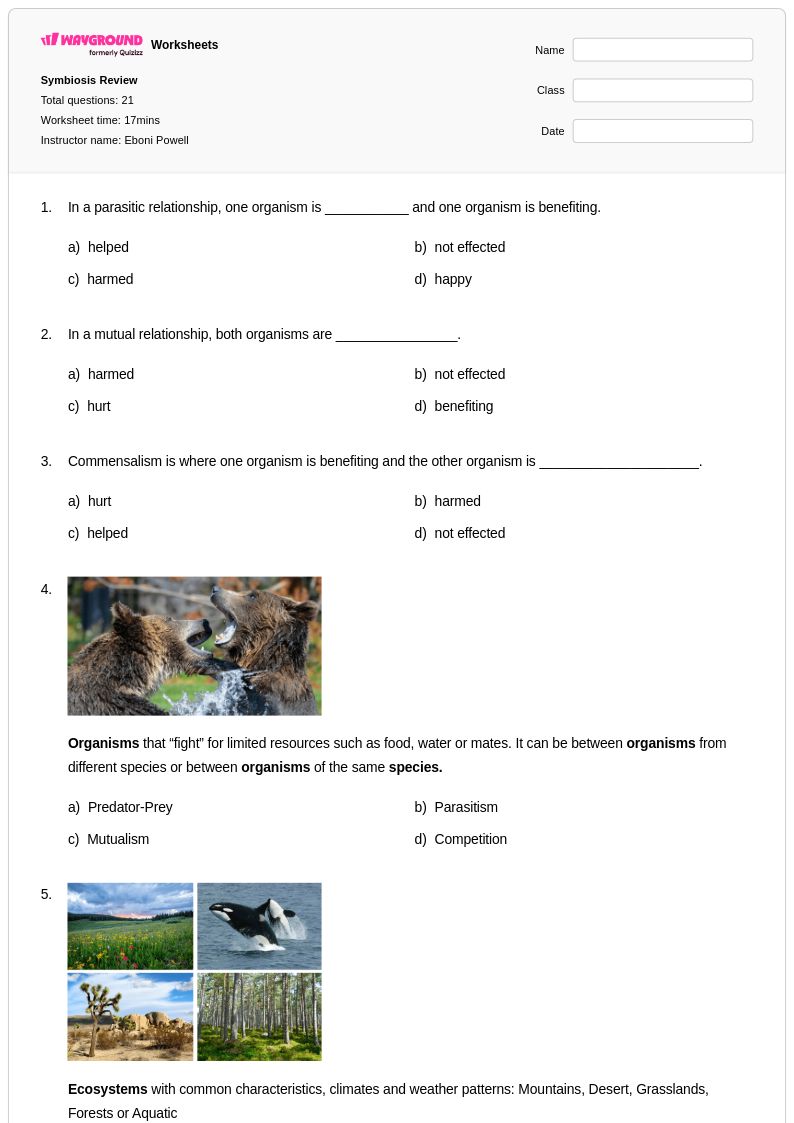
Class 11 biology students can master symbiosis concepts through Wayground's comprehensive collection of free worksheets, featuring detailed practice problems, printable PDFs, and complete answer keys for effective learning.
Explore printable Symbiosis worksheets for Class 11
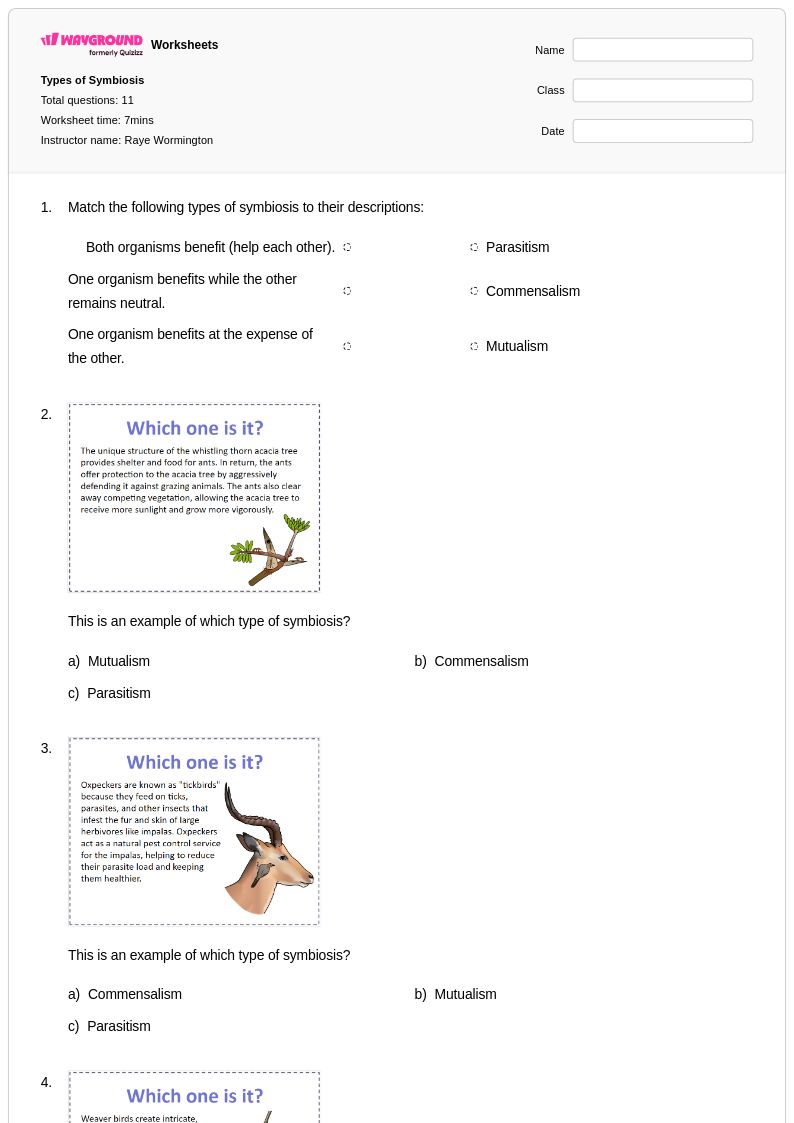
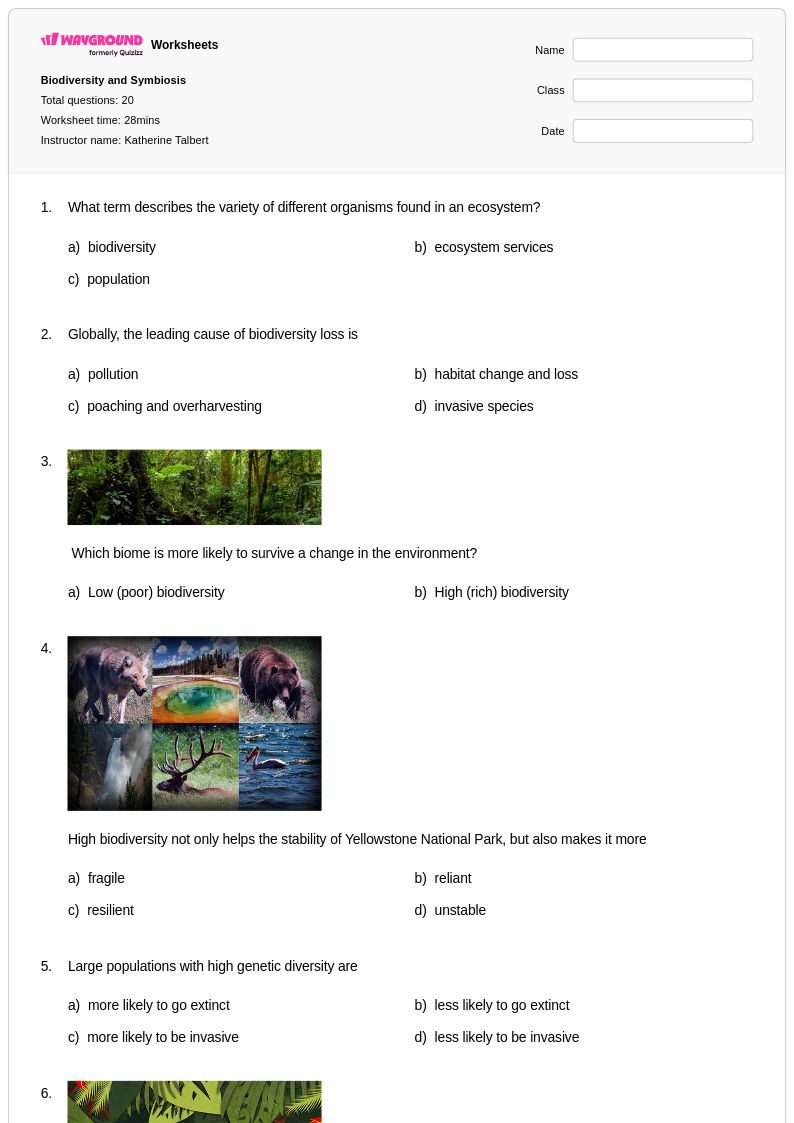
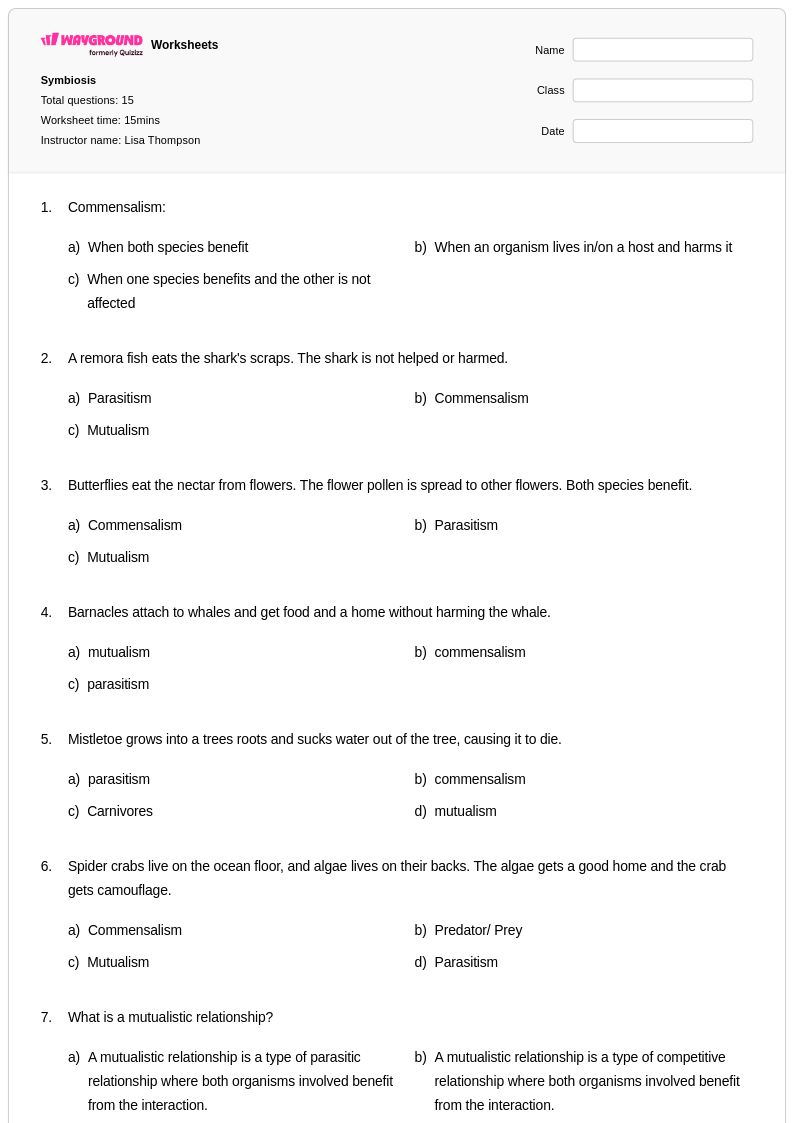
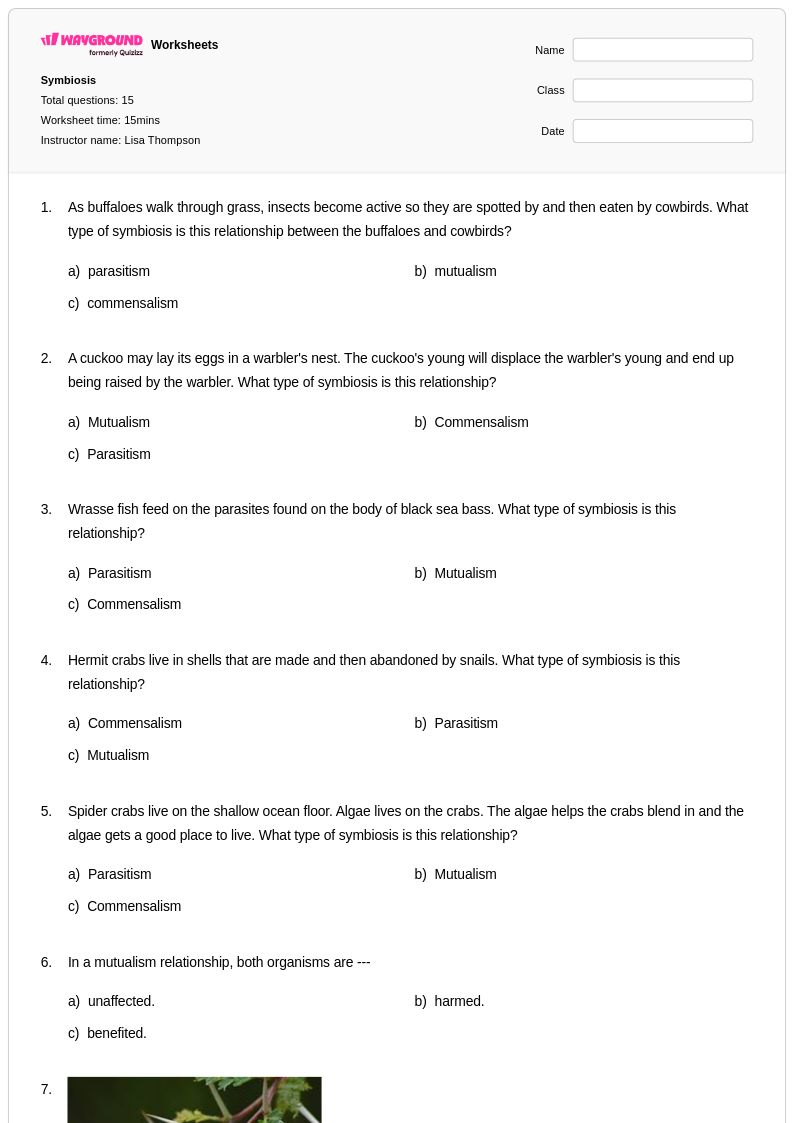
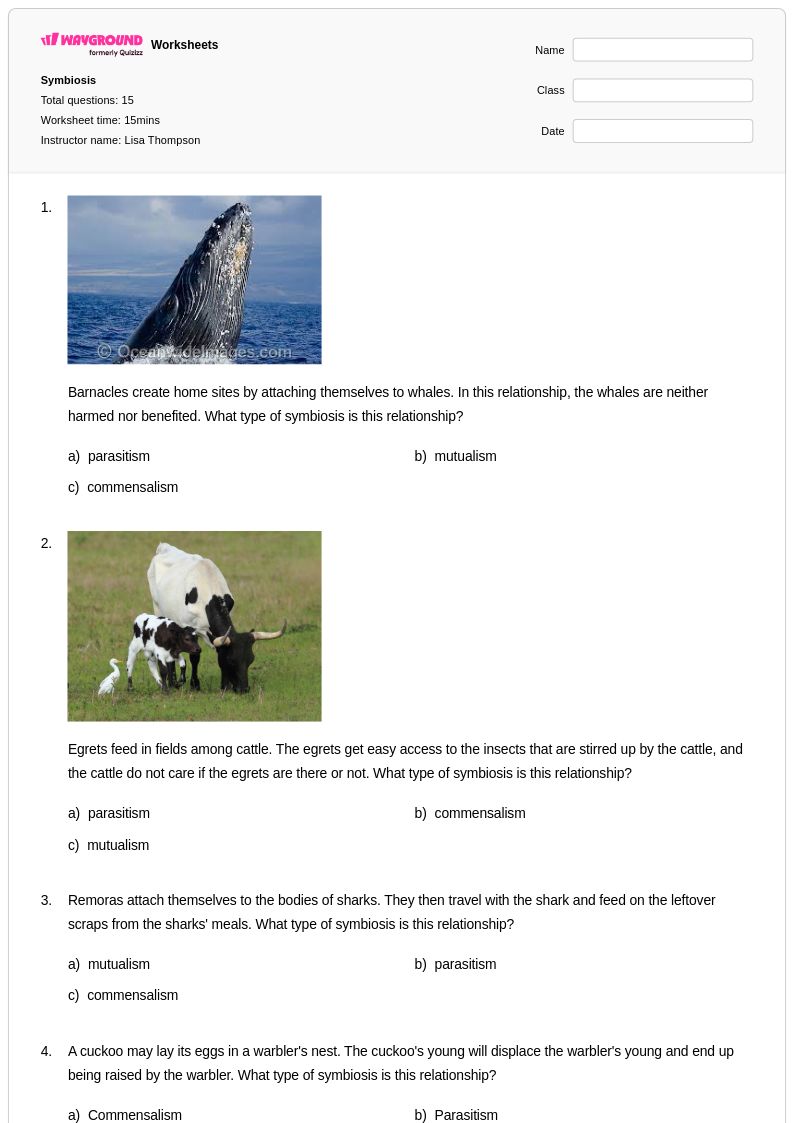
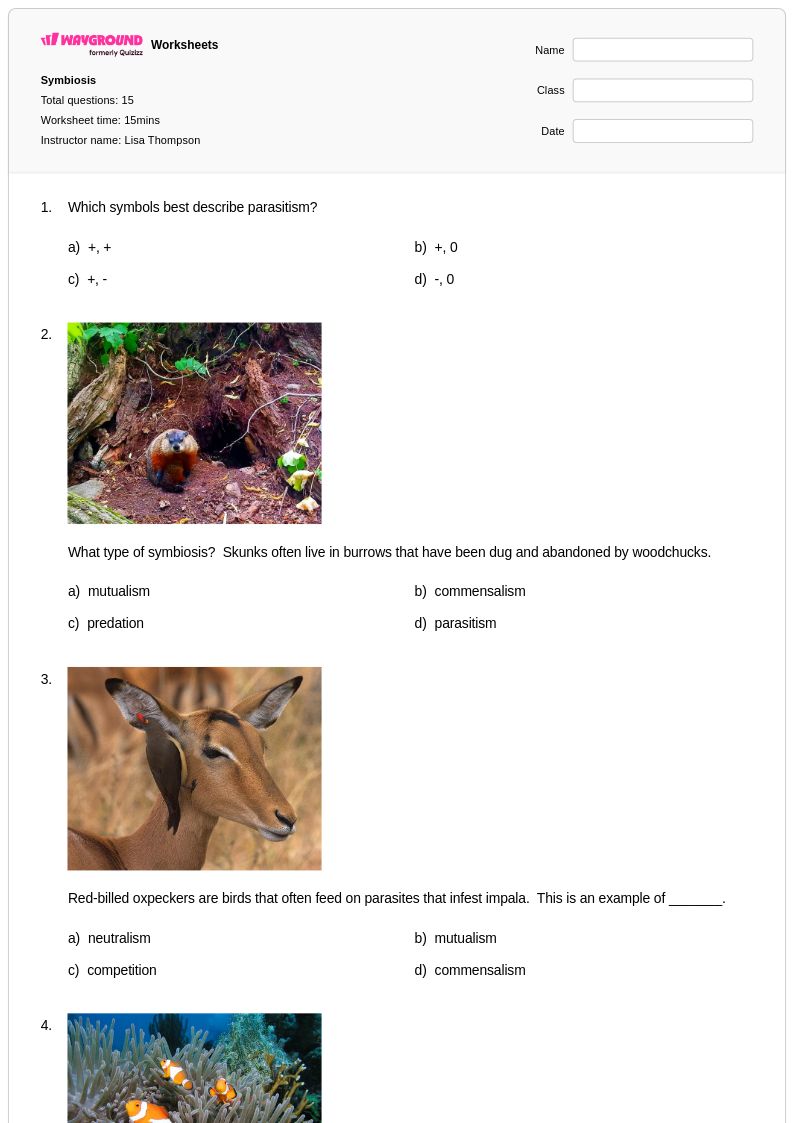
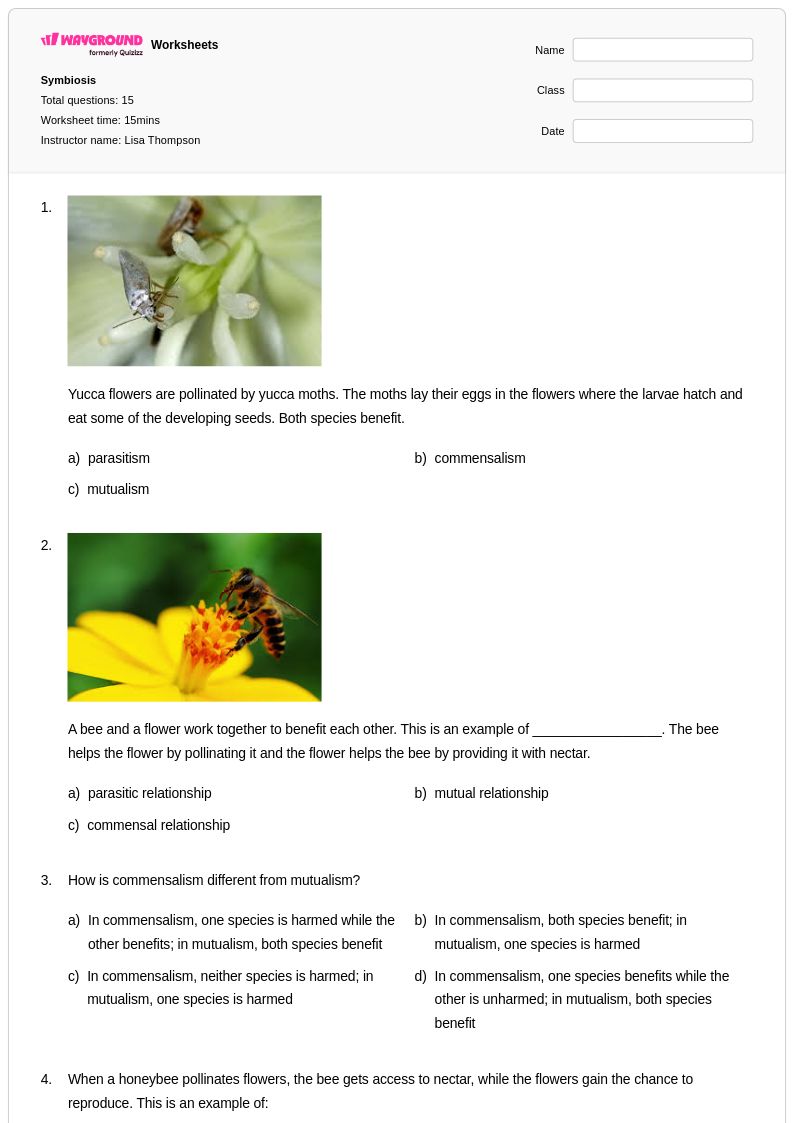
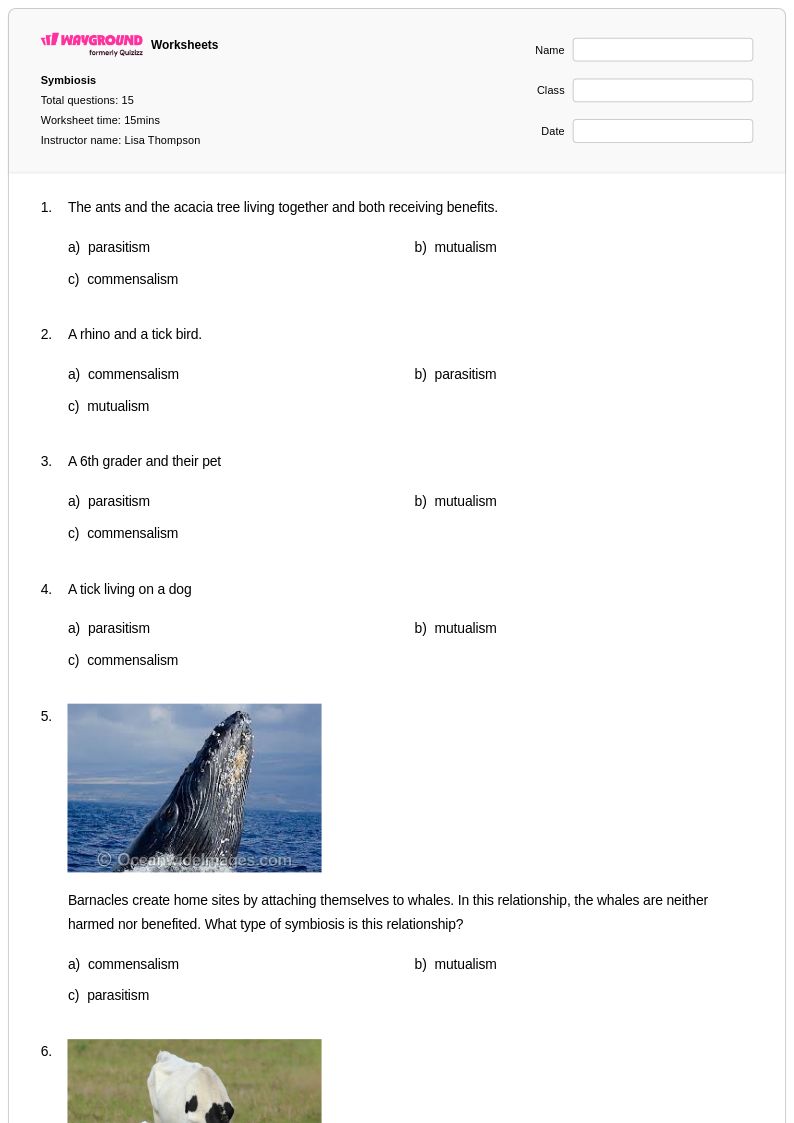
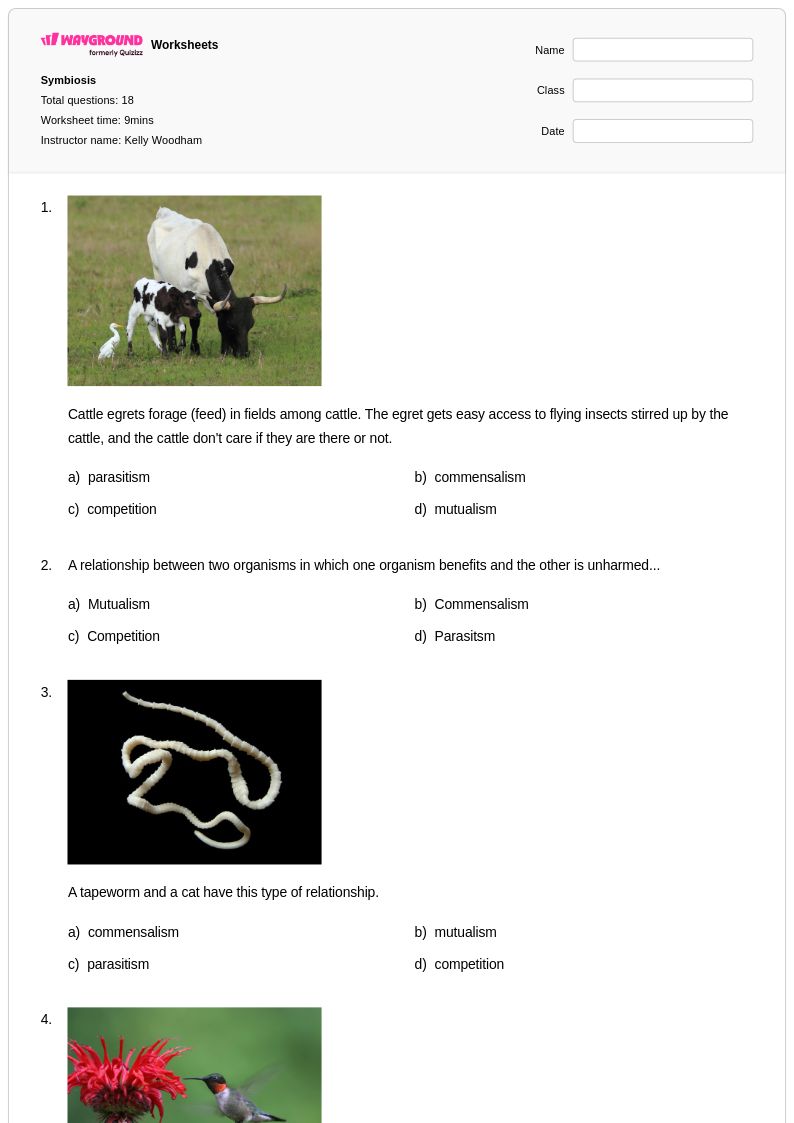
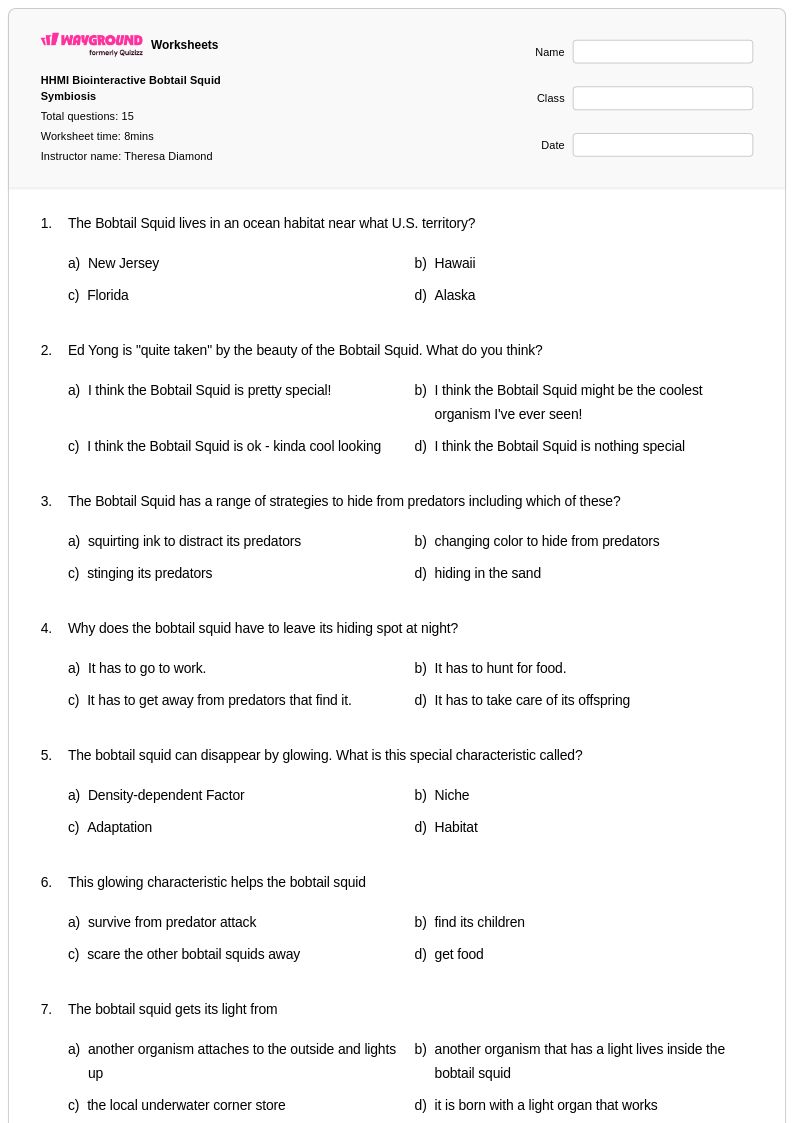
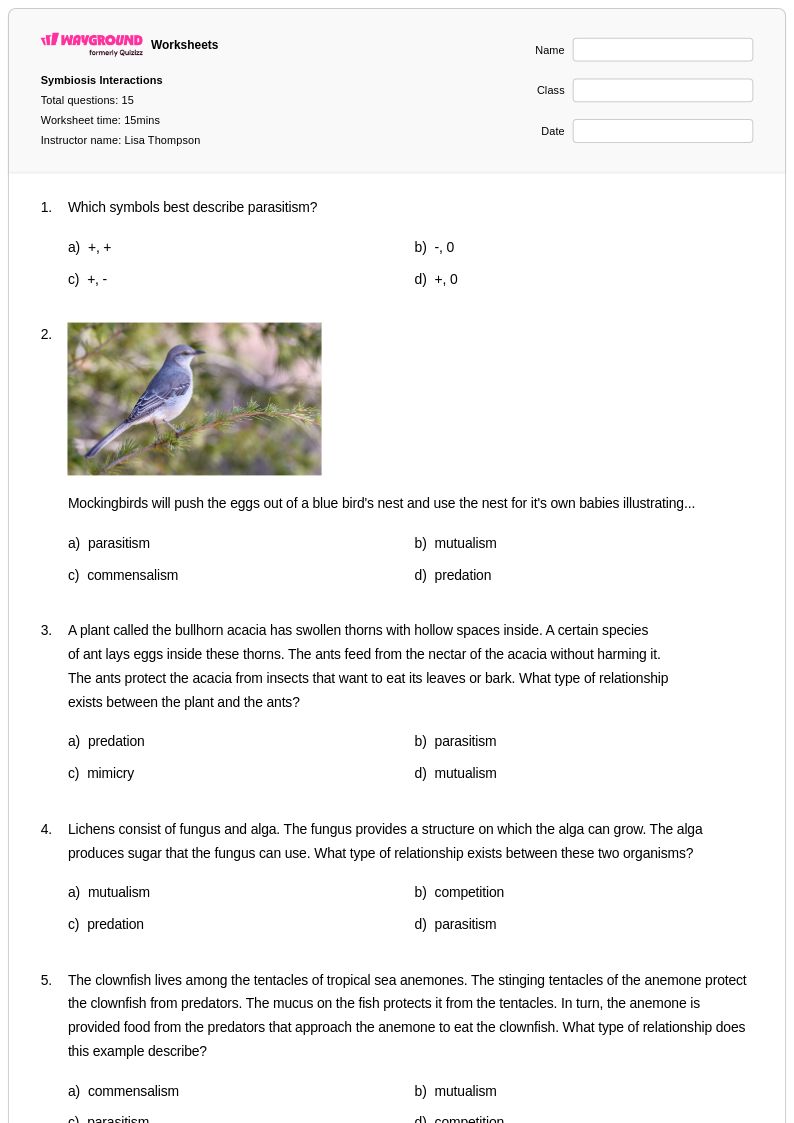
Class 11 symbiosis worksheets available through Wayground (formerly Quizizz) provide comprehensive coverage of the complex interspecies relationships that define ecological communities. These expertly designed resources strengthen students' analytical skills in identifying and categorizing mutualistic, commensalistic, and parasitic relationships while developing their understanding of coevolution and ecological interdependence. The collection includes practice problems that challenge students to examine real-world examples from various ecosystems, from mycorrhizal fungi partnerships with plant roots to cleaner fish relationships with larger marine species. Each worksheet comes with a detailed answer key to support independent learning and self-assessment, and the materials are available as free printables in convenient pdf format for seamless classroom integration.
Wayground (formerly Quizizz) empowers educators with millions of teacher-created symbiosis resources that can be easily discovered through robust search and filtering capabilities aligned with state and national biology standards. Teachers can differentiate instruction by selecting worksheets that match their students' varying skill levels, from basic identification exercises to complex analysis of symbiotic adaptations and their evolutionary significance. The platform's flexible customization tools allow educators to modify existing materials or create hybrid resources that address specific curriculum needs, whether for initial concept introduction, targeted remediation, or advanced enrichment activities. Both printable and digital formats, including downloadable pdf versions, ensure that these symbiosis worksheets can be seamlessly integrated into any learning environment while supporting diverse teaching approaches and student learning preferences.
FAQs
How do I teach the three types of symbiotic relationships to middle school students?
Start by grounding each relationship type in a familiar, concrete example: clownfish and sea anemones for mutualism, remoras and sharks for commensalism, and ticks on a dog for parasitism. Once students can categorize these anchor examples, move to less obvious scenarios that require them to reason about which organism benefits, which is harmed, and which is unaffected. Structured practice problems that ask students to justify their classifications help build the critical thinking needed to apply these concepts across diverse ecosystems.
What exercises help students practice identifying symbiotic relationships?
The most effective exercises present students with ecological scenarios and require them to label the relationship type and explain the effect on each organism involved. Worksheets that progress from straightforward identification tasks to complex, multi-organism scenarios are especially useful because they build confidence before introducing ambiguity. Answer-key-supported practice allows students to self-check their reasoning and correct misconceptions independently.
What mistakes do students commonly make when classifying symbiosis?
The most frequent error is confusing commensalism with mutualism — students often assume that if one organism benefits, the other must benefit too, and they overlook the possibility of a neutral effect. Students also struggle to distinguish parasitism from predation, since both involve one organism harming another; the key distinction is that a parasite depends on a living host for an extended period rather than killing it outright. Targeted practice with edge-case scenarios is the most reliable way to address these misconceptions.
How do I use symbiosis worksheets to differentiate instruction for mixed-ability biology classes?
For students who need additional support, begin with basic identification exercises that pair each scenario with a reference chart of the three relationship types before moving to independent classification. For advanced learners, use complex ecological scenarios involving multiple species interactions or food web contexts that require higher-order analysis. On Wayground, teachers can apply individual accommodations such as read aloud, reduced answer choices, and extended time to specific students, so the same worksheet session can serve diverse learners simultaneously without singling anyone out.
How do I use Wayground's symbiosis worksheets in my classroom?
Wayground's symbiosis worksheets are available as printable PDFs, making them straightforward to distribute for in-class work or take-home practice. They can also be assigned in digital format, and teachers have the option to host them as a live or self-paced quiz directly on the Wayground platform. Each worksheet includes a complete answer key, so they function equally well for teacher-led instruction, independent student practice, or formative assessment.
How can I assess whether my students truly understand symbiosis versus just memorizing definitions?
Memorization typically breaks down when students encounter unfamiliar organism pairs or ecosystem contexts. Effective assessment uses novel scenarios — relationships students have not seen before — and asks them to identify the relationship type, name the effect on each organism, and provide a brief justification. Worksheets that include both basic identification and extended ecological scenarios in the same set allow teachers to see exactly where a student's understanding stops being generative and starts being recall-based.