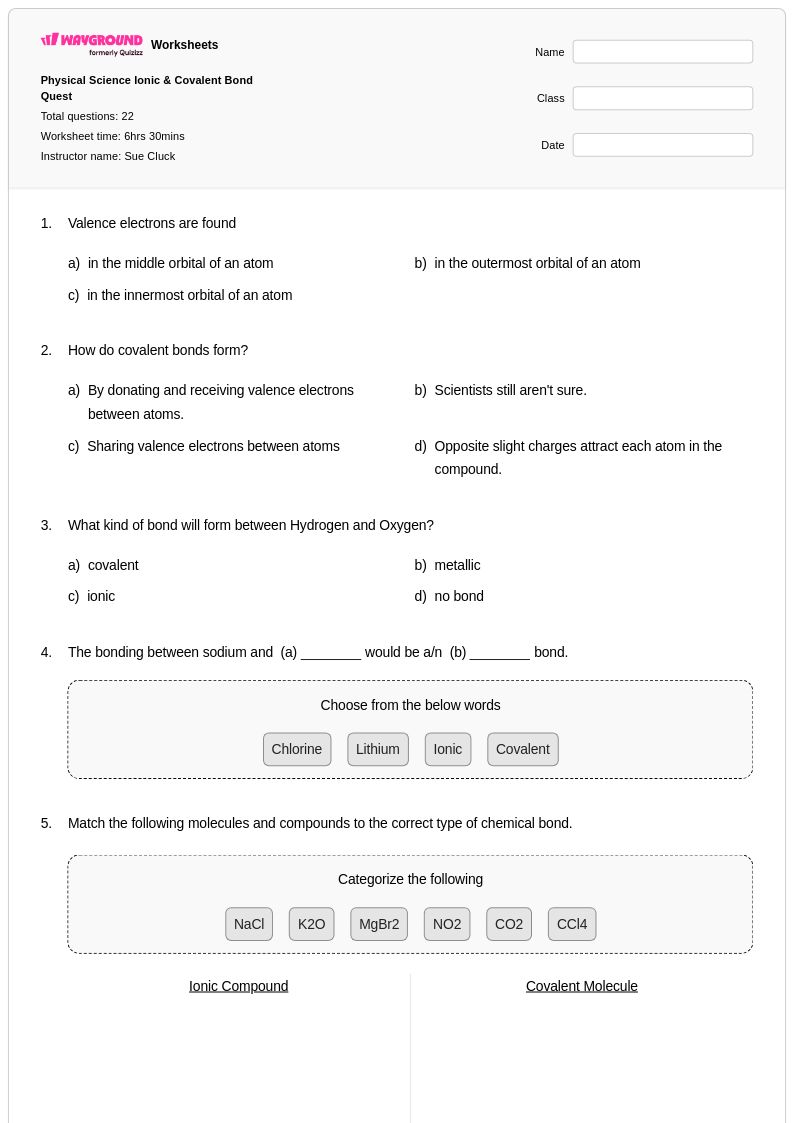
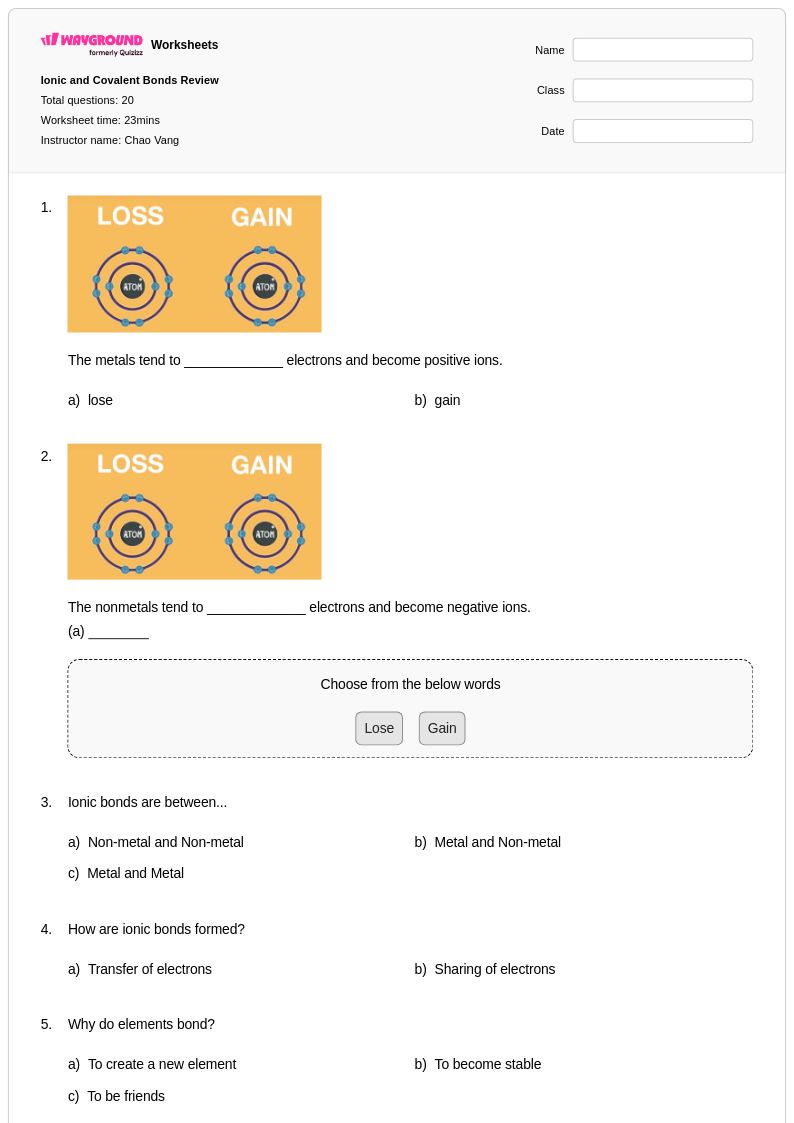
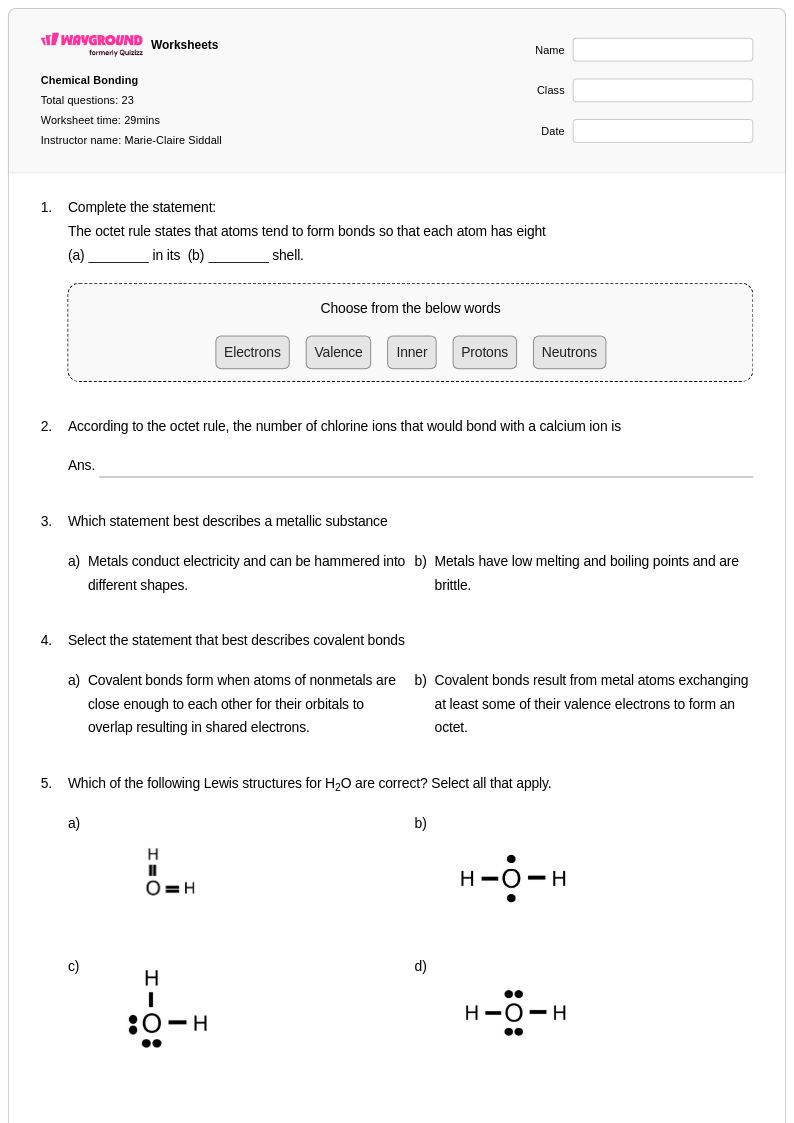
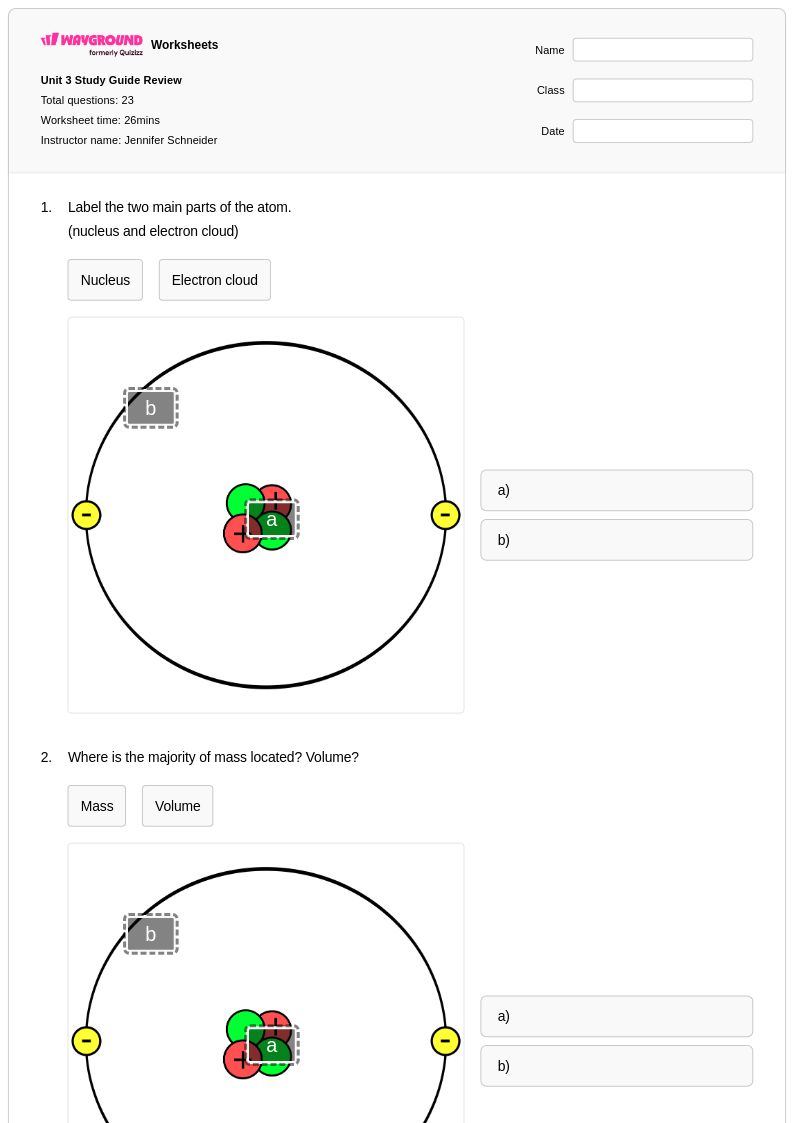
Explore Year 12 electrons worksheets and printables through Wayground that help students master electron configuration, orbital theory, and quantum mechanics with comprehensive practice problems and answer keys.
Explore printable Electrons worksheets for Year 12
Year 12 electron worksheets available through Wayground (formerly Quizizz) provide comprehensive coverage of advanced electron behavior, quantum mechanics, and atomic structure concepts essential for college-level chemistry preparation. These expertly designed resources strengthen students' understanding of electron configuration, orbital theory, quantum numbers, and electron-electron interactions through carefully scaffolded practice problems that progress from fundamental concepts to complex applications. Each worksheet collection includes detailed answer keys that support independent learning and self-assessment, while the free printable format ensures accessibility for all classroom environments. Students develop critical analytical skills by working through problems involving electron spin, magnetic quantum numbers, Hund's rule applications, and the relationship between electron arrangement and chemical properties.
Wayground (formerly Quizizz) empowers chemistry teachers with millions of teacher-created electron worksheet resources that feature robust search and filtering capabilities, enabling educators to quickly locate materials aligned with specific learning standards and student needs. The platform's differentiation tools allow teachers to customize worksheets for varying skill levels, while flexible formatting options provide both digital and printable pdf versions to accommodate diverse classroom technologies and teaching preferences. These comprehensive collections support effective lesson planning by offering ready-to-use materials for initial instruction, targeted remediation for struggling students, and enrichment activities for advanced learners. Teachers can seamlessly integrate these electron-focused worksheets into their curriculum to reinforce quantum mechanical concepts, provide additional skill practice opportunities, and assess student mastery of complex Year 12 chemistry topics through formative and summative evaluation methods.
FAQs
How do I teach electron configuration to high school chemistry students?
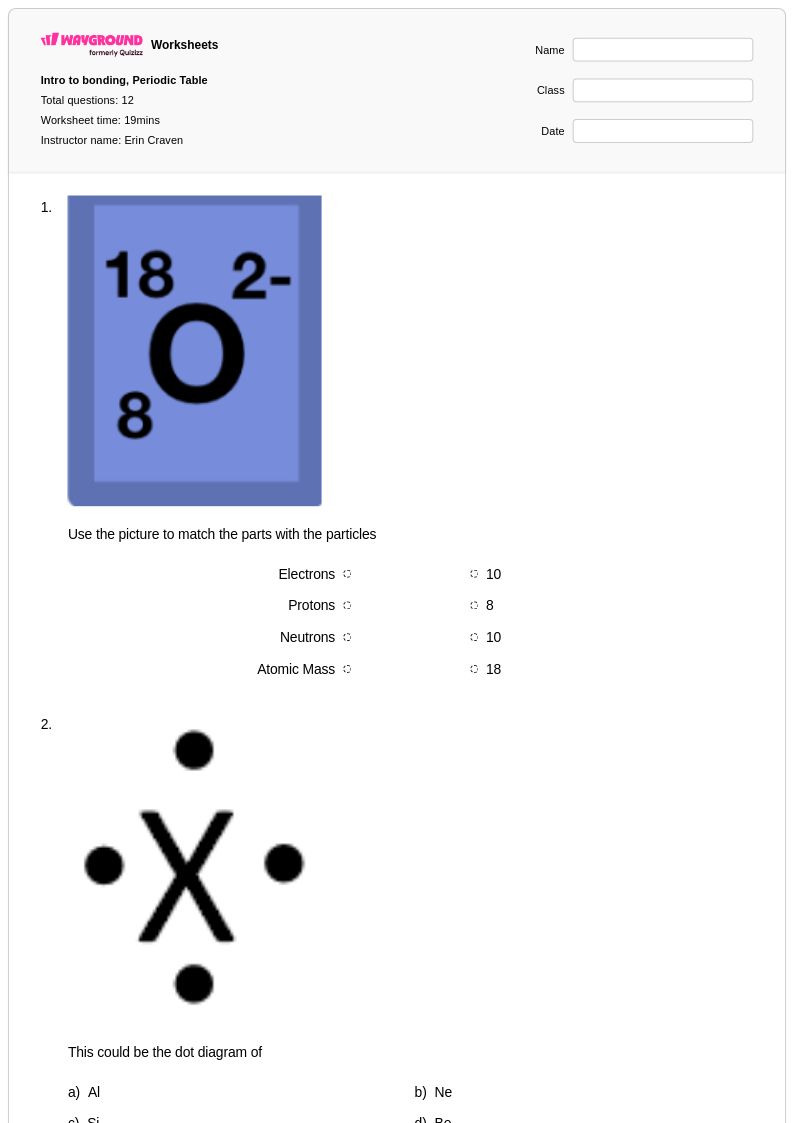
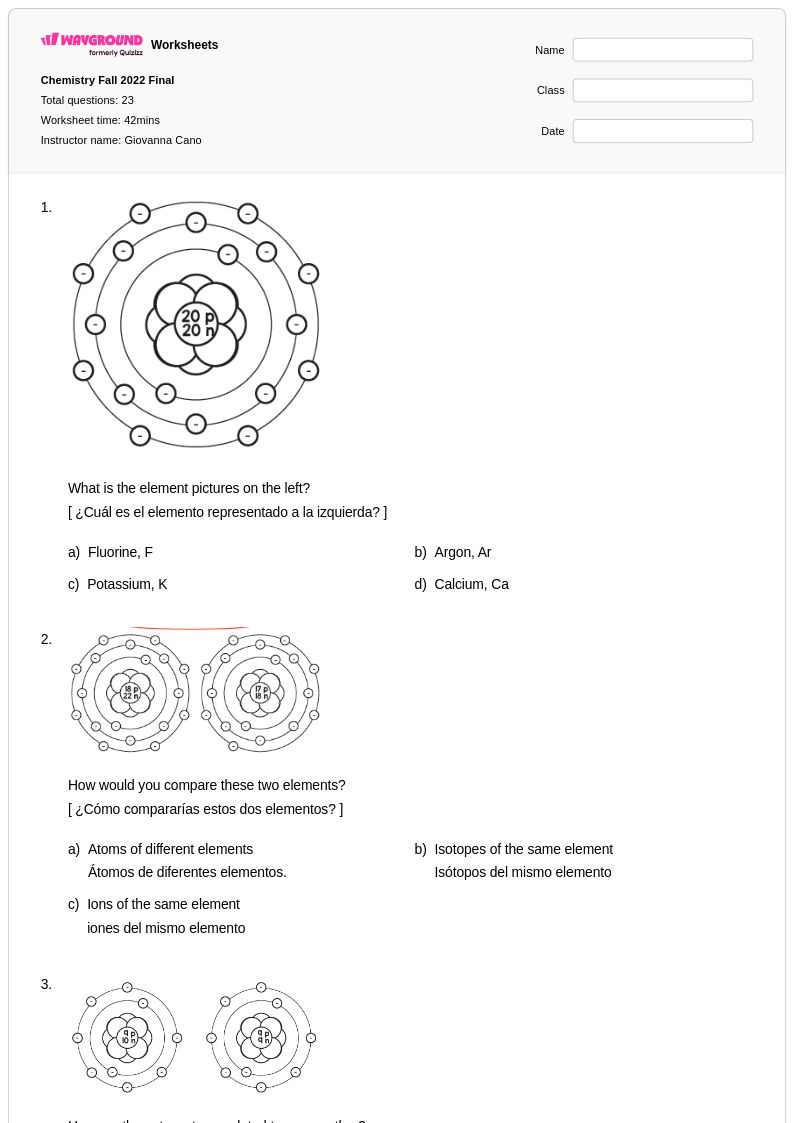
Electron configuration is best taught by building from atomic number to orbital filling using the Aufbau principle, Hund's rule, and the Pauli exclusion principle in sequence. Start with period 1 and 2 elements before moving to transition metals, where exceptions like chromium and copper often cause confusion. Visual tools like orbital diagrams and electron dot diagrams help students connect abstract notation to actual electron placement. Reinforcing each rule with immediate practice problems before introducing the next rule reduces cognitive overload and builds procedural fluency.
What exercises help students practice electron configuration and orbital theory?
Effective practice for electron configuration includes writing full and abbreviated electron configurations, completing orbital diagrams with arrows to show spin, and identifying valence electrons from the configuration. Lewis dot structure exercises bridge orbital theory to chemical bonding by requiring students to apply their understanding of valence electrons in a new context. Practice problems that ask students to predict ionization energy trends or electron affinity from configurations push higher-order thinking beyond rote notation.
What mistakes do students commonly make with electron configuration?
The most common errors include incorrectly filling the 4s orbital before 3d when writing configurations for transition metals, and forgetting to apply Hund's rule by pairing electrons before all orbitals in a sublevel are singly occupied. Students also frequently confuse the principal quantum number with the energy level ordering, especially after the 3rd period where the 4s fills before 3d. Another persistent error is writing electron dot diagrams with more than 8 dots for main-group elements that do not expand their octet.
How do I help students who struggle to visualize electron arrangements and orbital theory?
Students who struggle with electron arrangements benefit from color-coded orbital diagrams that make sublevel distinctions concrete and from using periodic table sections as a visual guide to filling order. Breaking electron configuration into a stepwise process, one sublevel at a time, with immediate feedback at each step significantly reduces errors. On Wayground, teachers can enable the Read Aloud accommodation so that question text is read to students who have reading barriers, and Reduced Answer Choices can lower cognitive load for students overwhelmed by complex multi-step problems.
How do I use Wayground's electron worksheets in my chemistry class?
Wayground's electron worksheets are available as printable PDFs for traditional classroom use and in digital formats for technology-integrated environments, making them flexible for both in-person and remote instruction. Teachers can also host worksheets as a live or self-paced quiz directly on Wayground, allowing for real-time progress monitoring. The worksheets cover electron configuration, orbital theory, valence electrons, Lewis structures, electron affinity, ionization energy, and quantum numbers, so a single collection can support initial instruction, targeted remediation, and enrichment within the same unit.
How do electron configuration worksheets connect to chemical bonding topics?
Electron configuration worksheets build the foundational knowledge students need to understand chemical bonding by making valence electron counts explicit and visual. When students can reliably write electron dot diagrams and identify valence electrons, they are better prepared to predict bond formation, draw Lewis structures for molecules, and explain why certain elements are more reactive than others. Worksheets that sequence from configuration to Lewis structures and then to bonding predictions create a coherent conceptual pathway rather than treating each topic in isolation.