Free Printable Equilibrium Constant and Reaction Quotient Worksheets for Year 11
Year 11 Chemistry students can master equilibrium constant and reaction quotient concepts with Wayground's comprehensive collection of free worksheets, printables, and practice problems featuring detailed answer keys in convenient PDF format.
Explore printable Equilibrium Constant and Reaction Quotient worksheets for Year 11
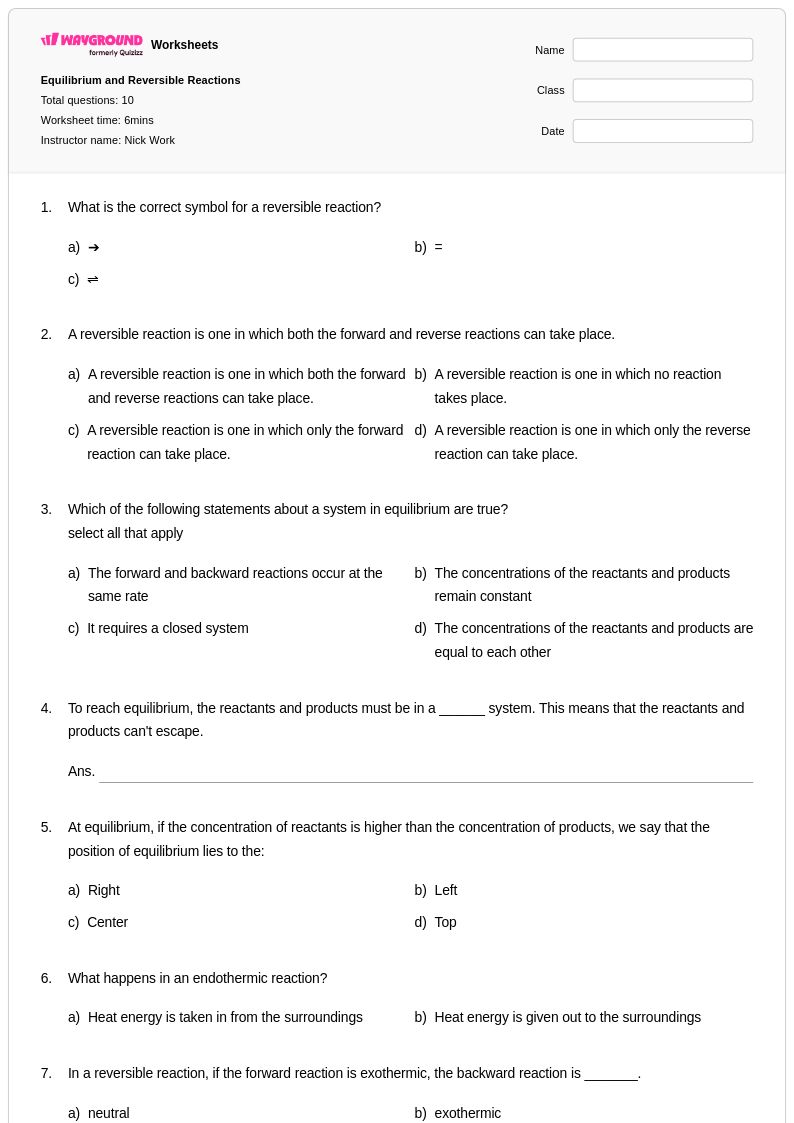
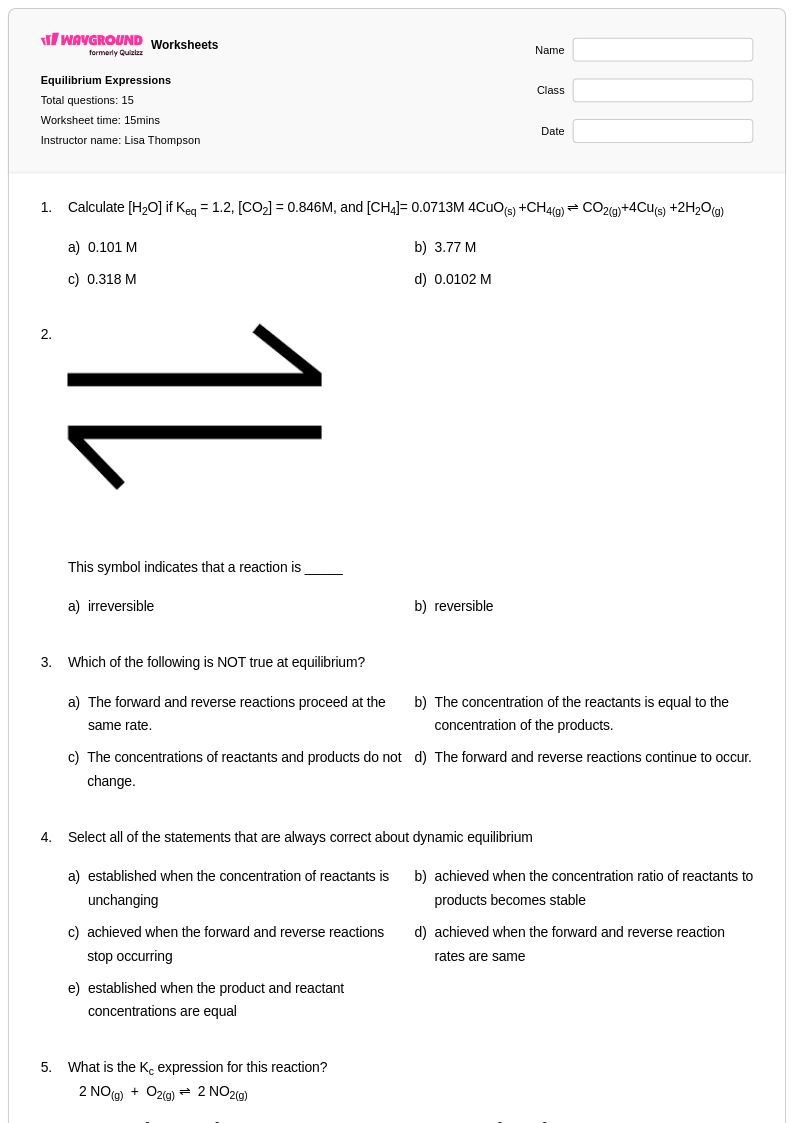
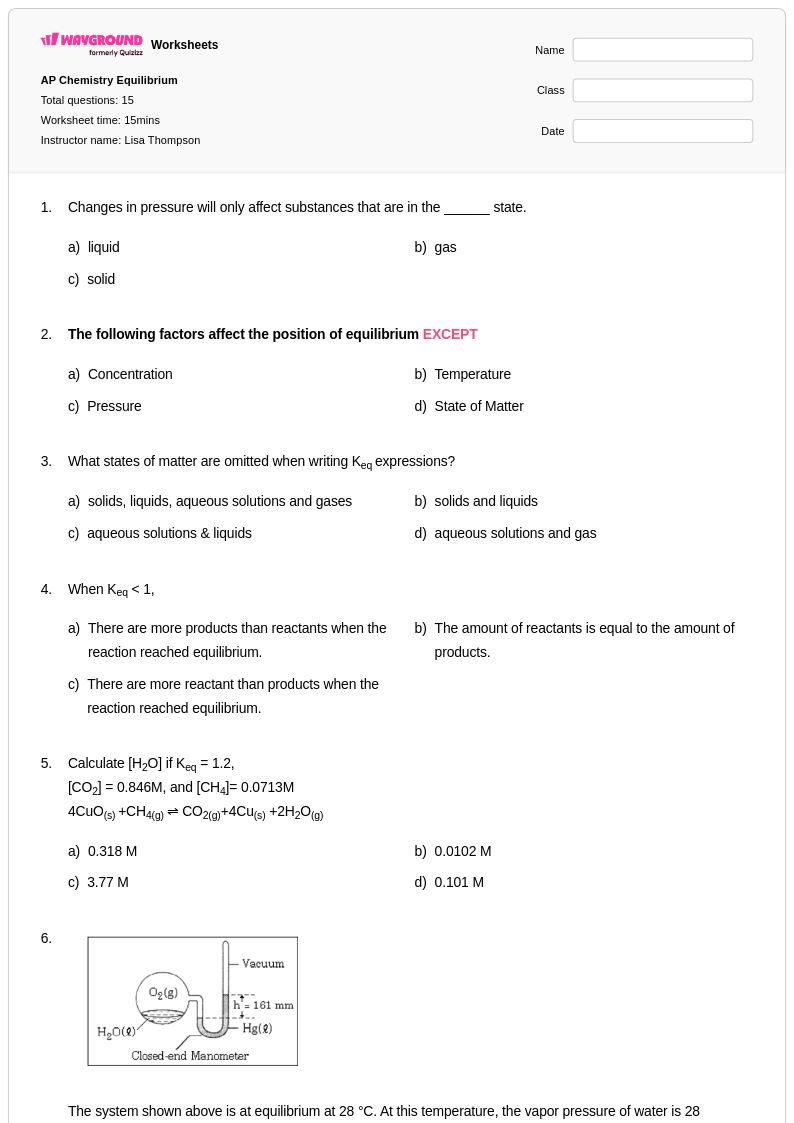
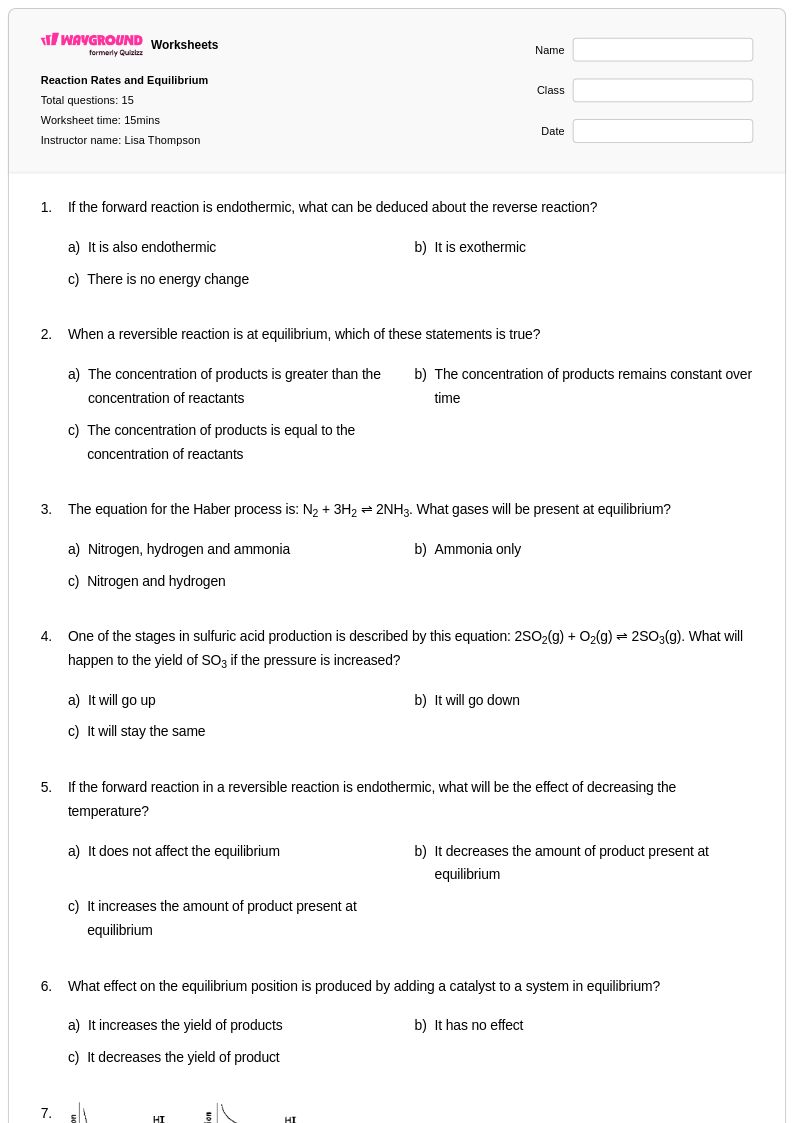
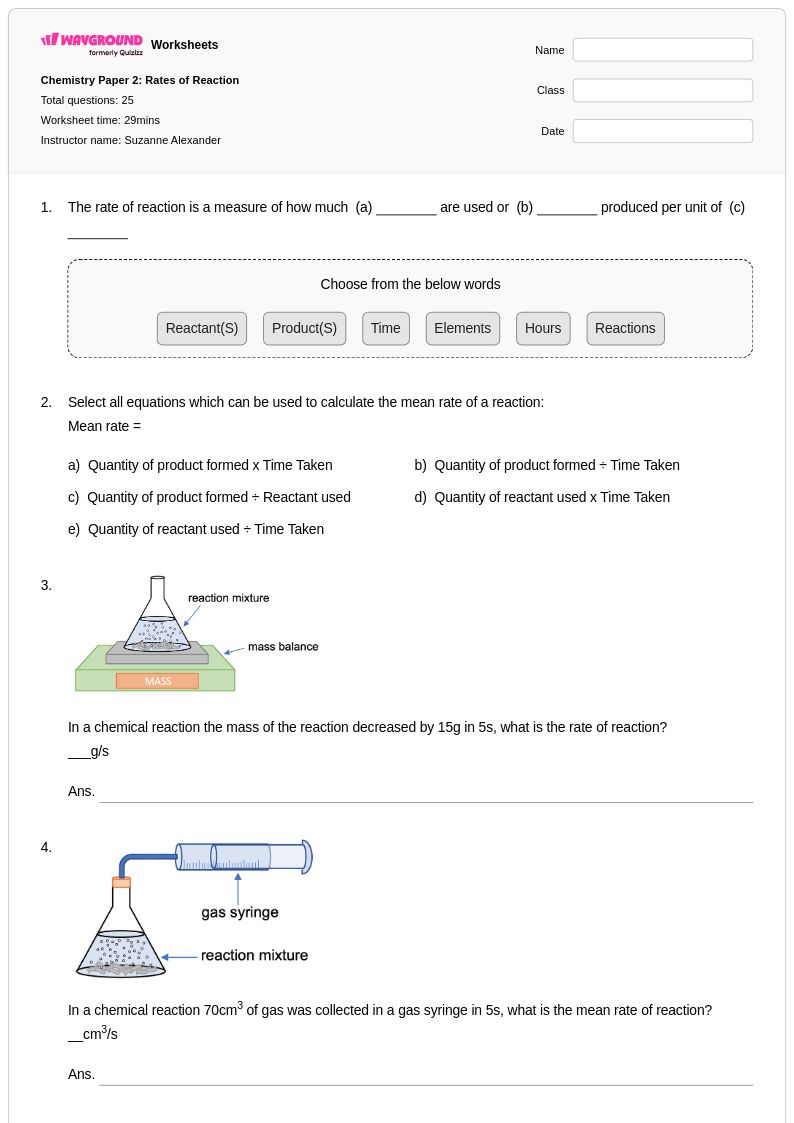
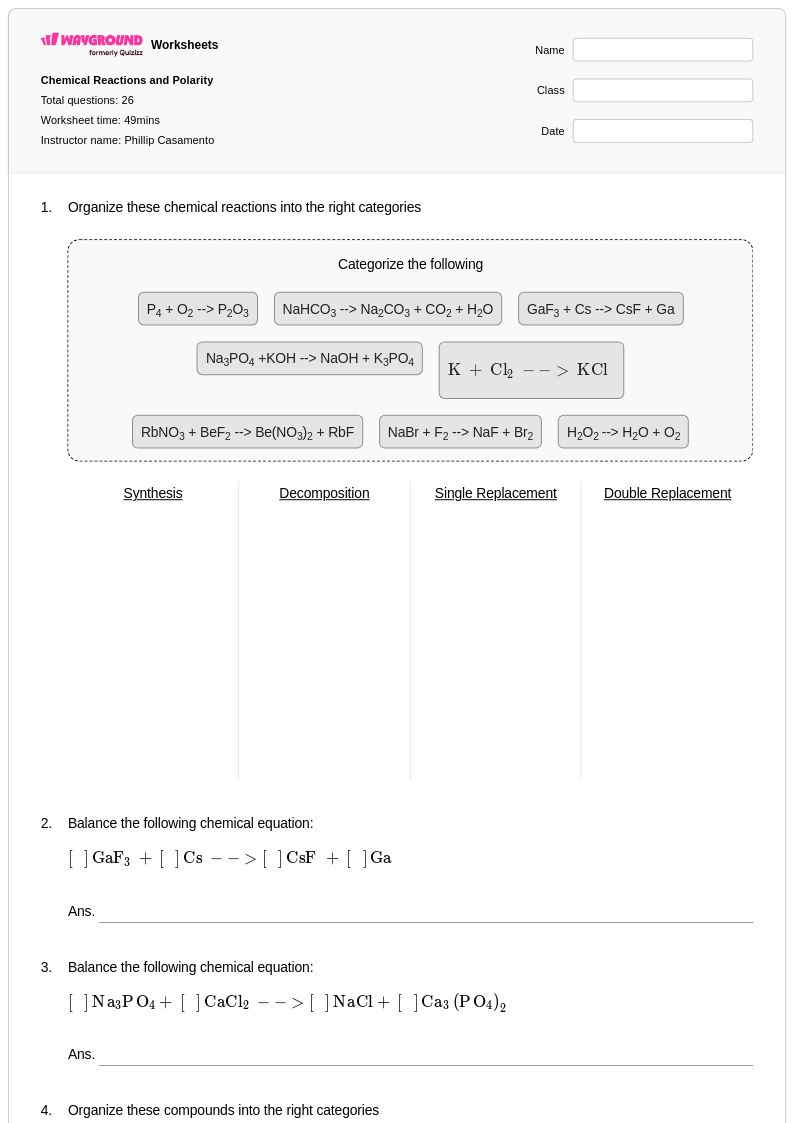
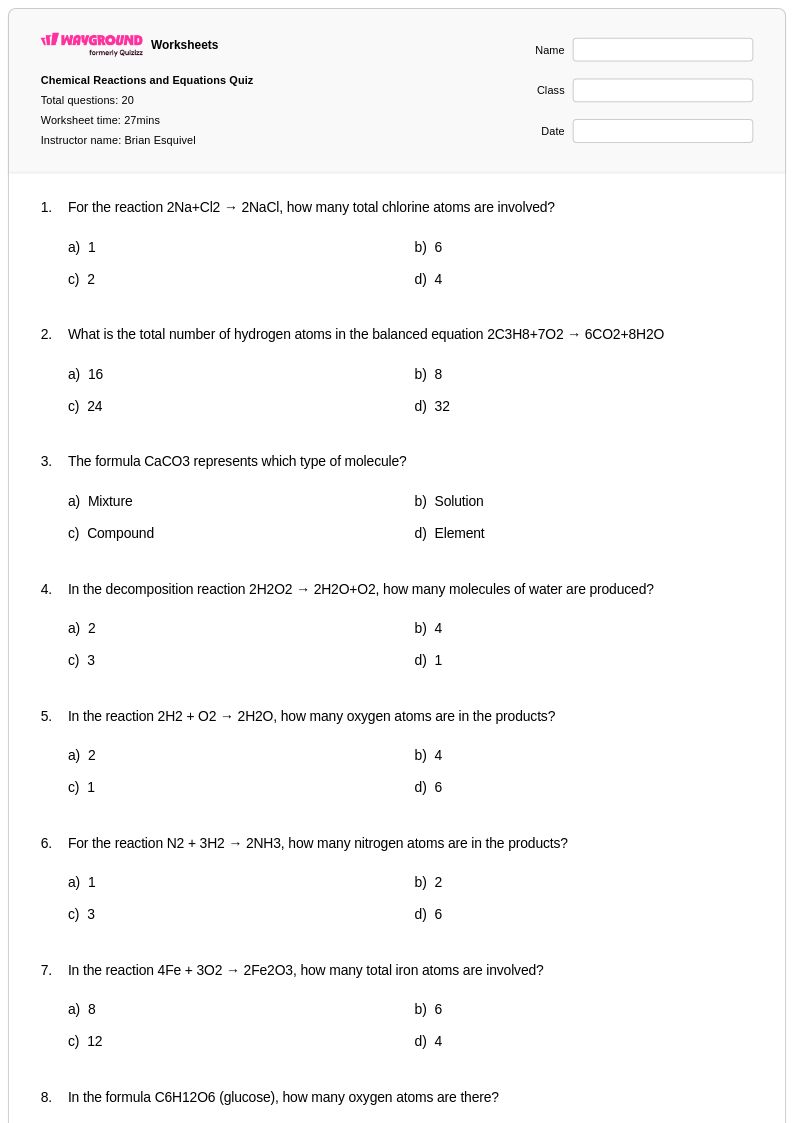
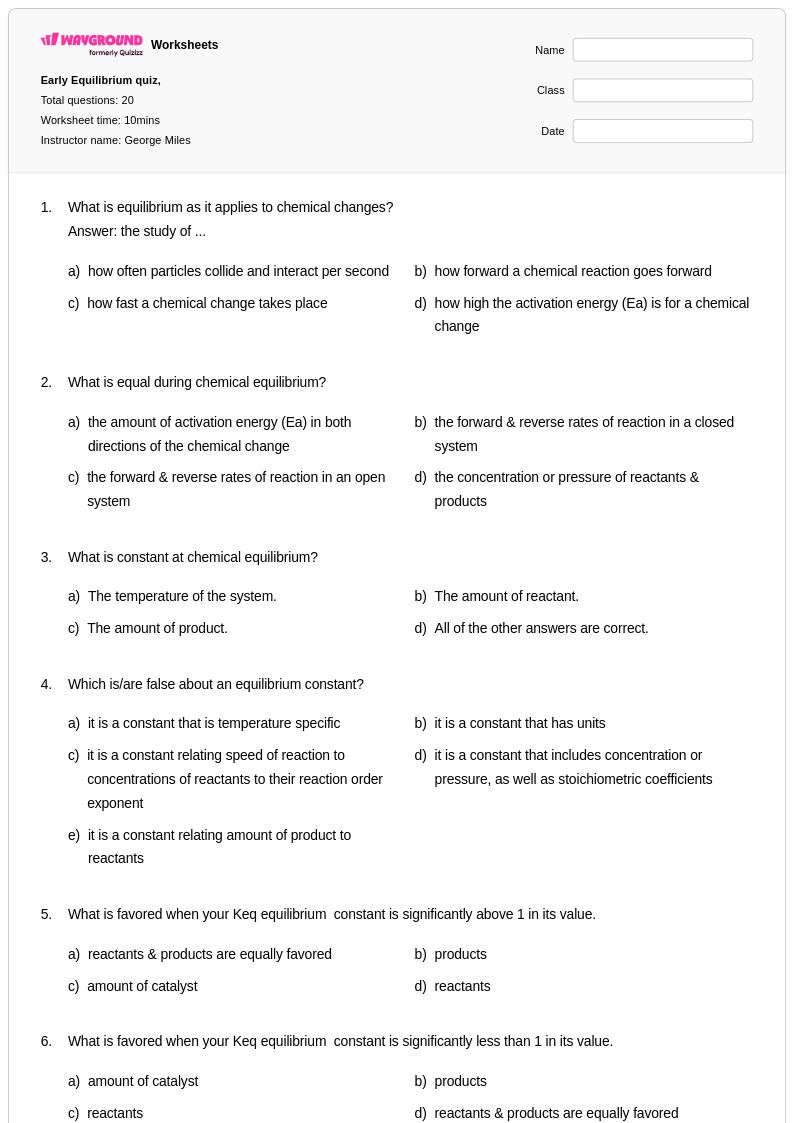
Equilibrium constant and reaction quotient worksheets for Year 11 chemistry students available through Wayground provide comprehensive practice with these fundamental thermodynamic concepts that govern chemical reactions. These educational resources strengthen students' abilities to calculate equilibrium constants from concentration data, determine reaction quotients at any point during a chemical process, and predict the direction of reaction shifts using Le Chatelier's principle. The worksheet collections include detailed answer keys that guide students through complex problem-solving steps, while printable pdf formats ensure easy classroom distribution and homework assignments. Students engage with practice problems ranging from basic Kc and Kp calculations to advanced scenarios involving temperature effects on equilibrium positions, helping them master the quantitative relationships that describe chemical equilibrium states.
Wayground's extensive library supports chemistry educators with millions of teacher-created resources specifically designed for Year 11 equilibrium constant and reaction quotient instruction. The platform's advanced search and filtering capabilities allow teachers to quickly locate worksheets aligned with specific chemistry standards, while built-in differentiation tools enable customization for varying student ability levels within the same classroom. Teachers can access these materials in both digital and printable pdf formats, facilitating seamless integration into lesson planning whether for in-person instruction, remote learning, or hybrid educational environments. These versatile worksheet collections serve multiple pedagogical purposes, from initial concept introduction and guided practice to targeted remediation for struggling students and enrichment activities for advanced learners seeking deeper exploration of equilibrium dynamics and thermochemical principles.
FAQs
How do I teach students the difference between the equilibrium constant and the reaction quotient?
The most effective approach is to first establish a firm conceptual distinction: the equilibrium constant (K) is a fixed value at a given temperature, while the reaction quotient (Q) is calculated using current concentrations at any point in the reaction. Have students calculate Q for a set of initial concentrations, compare it to a given K value, and then predict whether the reaction will proceed forward, reverse, or is already at equilibrium. This comparison exercise reinforces the idea that Q and K share the same mathematical form but carry different interpretive weight. Anchoring the lesson in real chemical scenarios, such as gas-phase reactions or dissolution equilibria, helps students move beyond rote calculation toward genuine conceptual understanding.
What practice problems best prepare students for equilibrium constant calculations on exams?
Students need layered practice that begins with straightforward Kc and Kp calculations using ICE tables, then progresses to problems involving Ksp for sparingly soluble salts and multiple simultaneous equilibria. Problems that require students to convert between Kc and Kp using the relationship Kp = Kc(RT)^Δn are particularly high-value because they integrate algebra with conceptual chemistry. Including problems where students must first write a balanced equilibrium expression before calculating K prevents the common shortcut of plugging numbers in without understanding the stoichiometric structure of the expression.
What mistakes do students commonly make when working with equilibrium constants and reaction quotients?
The most frequent error is writing the equilibrium expression with reactants in the numerator instead of products, a mistake that stems from confusing the rate law format with the equilibrium expression. Students also commonly include pure solids and liquids in their Kc or Ksp expressions, which is incorrect because their concentrations are constant and are absorbed into the equilibrium constant by convention. A third widespread error is treating K as concentration-dependent rather than temperature-dependent, leading students to assume K changes when concentrations are altered. Targeted practice problems that deliberately present these misconception traps, followed by immediate feedback through answer keys, are the most efficient way to correct these patterns.
How can I use Q vs. K comparison problems to help students predict reaction direction?
Structure the practice so students first calculate Q from a given set of non-equilibrium concentrations, then compare it numerically to the provided K value. When Q is less than K, the reaction must shift right to produce more products; when Q is greater than K, the reaction shifts left. Having students articulate this reasoning in writing, not just circle an answer, significantly deepens retention. Follow-up problems that then ask students to calculate the new equilibrium concentrations using ICE tables reinforce the connection between qualitative prediction and quantitative resolution.
How do I use Wayground's equilibrium constant and reaction quotient worksheets in my classroom?
Wayground's equilibrium constant and reaction quotient worksheets are available as free printable PDF downloads for traditional classroom use and in digital formats for technology-integrated environments, including the option to host them as a quiz directly on Wayground. Teachers can use printable versions for in-class problem sets or homework, while digital formats work well for self-paced practice or formative assessment. Each worksheet includes a comprehensive answer key, so students can check their work independently and teachers can use them efficiently without additional preparation time. For students who need additional support, Wayground's platform also offers accommodations such as read aloud and extended time, which can be configured per student from the Students or Classes tab.
How do I differentiate equilibrium constant instruction for students at different skill levels?
For students who are new to the concept, start with problems that provide pre-written equilibrium expressions and ask only for substitution and arithmetic, removing the barrier of expression-writing until the calculation routine is secure. Intermediate students should practice writing expressions from scratch and working full ICE tables with approximations. Advanced students benefit from multi-step problems involving Ksp and common ion effects, or problems that integrate Le Chatelier's principle with quantitative equilibrium calculations. Wayground's filtering tools allow teachers to locate worksheets matched to each of these skill tiers, and the platform's accommodation settings, including reduced answer choices and adjustable reading modes, can be applied to individual students without disrupting the rest of the class.