Free Printable Heat of Formation Worksheets for Year 11
Discover comprehensive Year 11 heat of formation worksheets and printables through Wayground that help students master enthalpy calculations, thermochemical equations, and formation reactions with practice problems, free PDF resources, and detailed answer keys.
Explore printable Heat of Formation worksheets for Year 11
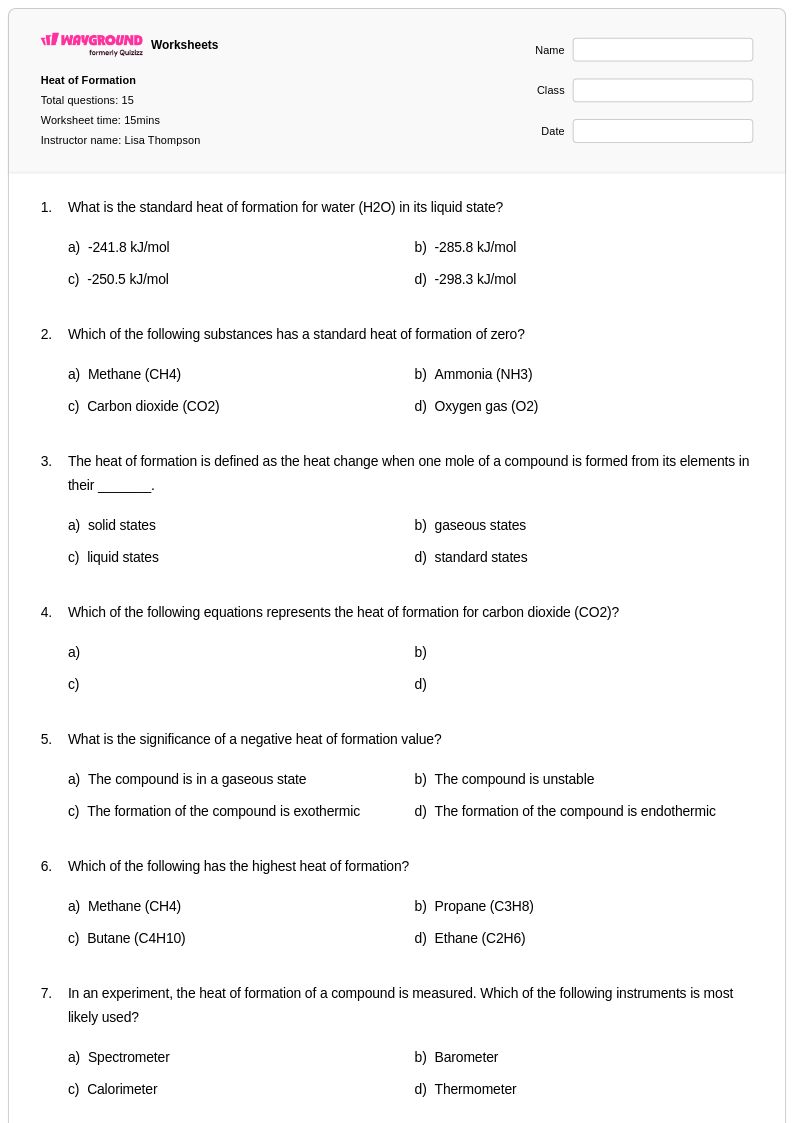
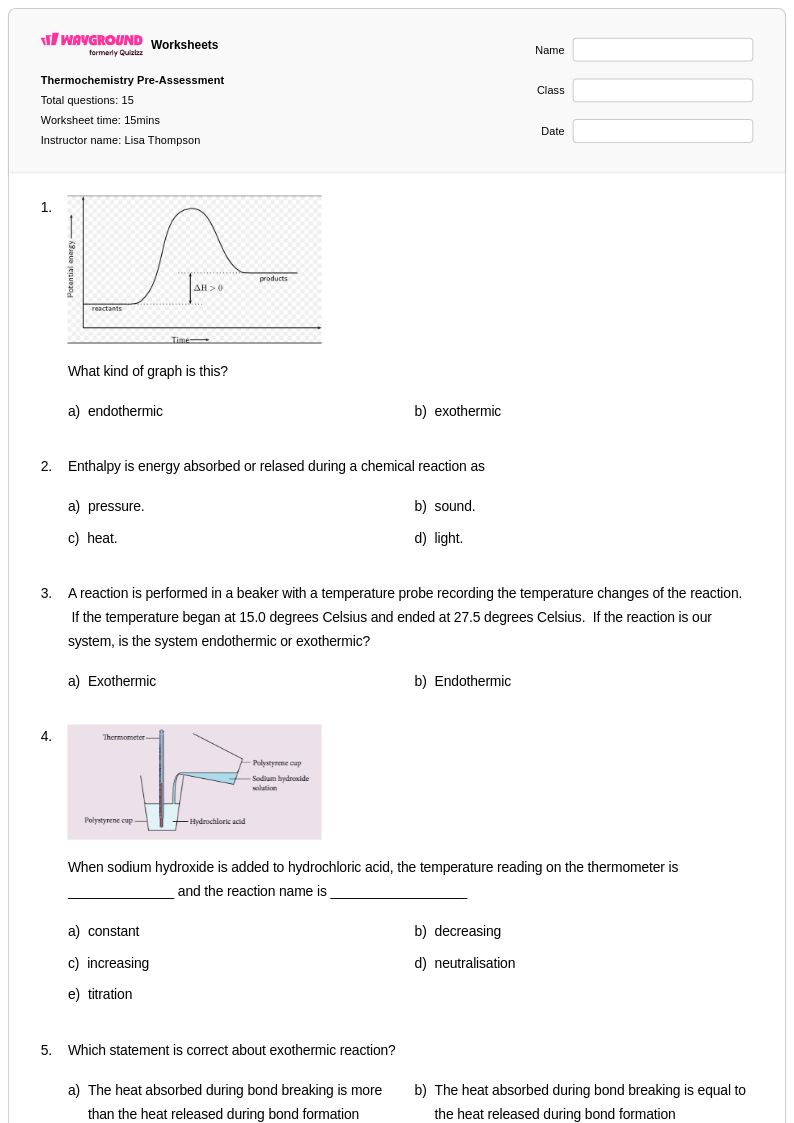
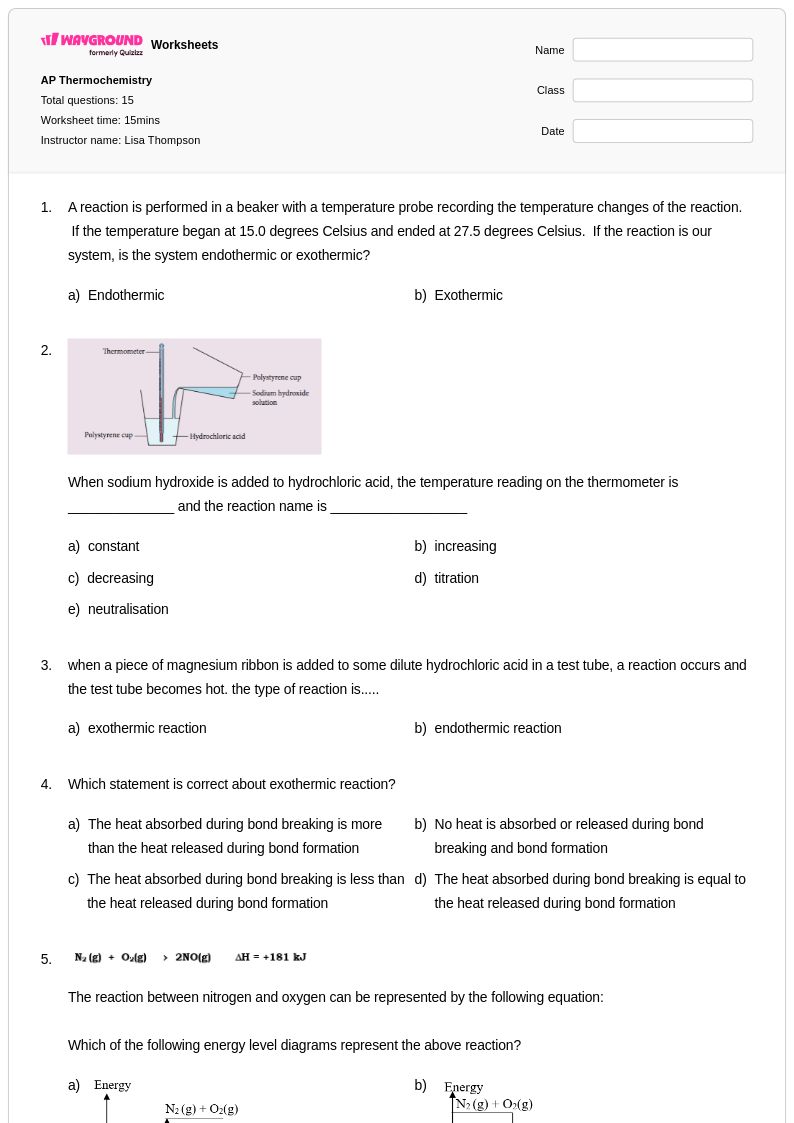
Heat of formation worksheets for Year 11 chemistry students available through Wayground (formerly Quizizz) provide comprehensive practice with one of thermochemistry's most fundamental concepts. These educational resources help students master the calculation and interpretation of standard enthalpies of formation, strengthening their ability to predict reaction energies and understand chemical stability. The worksheets feature diverse practice problems that guide students through determining heat of formation values using Hess's law, bond energies, and calorimetry data, while accompanying answer keys enable self-assessment and targeted skill development. These free printables cover essential topics including standard state conditions, formation equations for compounds, and the relationship between molecular structure and thermodynamic stability, ensuring students develop both computational proficiency and conceptual understanding of this critical chemistry principle.
Wayground (formerly Quizizz) empowers chemistry educators with millions of teacher-created heat of formation resources that can be seamlessly integrated into Year 11 curriculum planning and instruction. The platform's robust search and filtering capabilities allow teachers to quickly locate worksheets aligned with specific learning standards and student proficiency levels, while built-in differentiation tools enable customization for diverse classroom needs. These versatile materials are available in both printable pdf format and interactive digital versions, supporting flexible implementation whether for homework assignments, lab follow-up activities, or test preparation. Teachers can efficiently address individual learning gaps through targeted remediation, provide enrichment opportunities for advanced students, and systematically build thermochemistry skills through carefully sequenced practice problems that progress from basic formation calculations to complex multi-step applications.
FAQs
How do I teach heat of formation to chemistry students?
Start by establishing what a standard state is and why it matters as a reference point, then introduce the concept that the heat of formation (ΔHf°) for any element in its standard state is zero. From there, use simple formation reactions to show how compounds are built from elements, and progress to applying Hess's law to calculate overall reaction enthalpies from tabulated ΔHf° values. Connecting each calculation back to a physical or chemical change — such as combustion or dissolution — helps students see why thermochemistry is practically meaningful.
What practice problems are most effective for mastering heat of formation calculations?
The most effective practice moves students through a progression: first identifying correctly written formation reactions, then using tabulated ΔHf° values to calculate the enthalpy of a single reaction, and finally applying Hess's law across multi-step problems. Problems that require students to manipulate and reverse equations — rather than just plug values into a formula — build the deeper procedural fluency needed for assessments. Including problems where ΔHf° = 0 for elemental reactants reinforces a concept students frequently overlook.
What mistakes do students commonly make when calculating heat of formation?
The most common error is forgetting that the standard heat of formation for an element in its standard state is zero, which leads students to either omit it from calculations or assign it a nonzero value. Students also frequently confuse formation reactions with combustion reactions, and they struggle to correctly reverse and scale equations when applying Hess's law. A third persistent error is misreading units — mixing kJ/mol with kJ — which produces answers that are off by a factor of the stoichiometric coefficient.
How do I differentiate heat of formation worksheets for students at different levels?
For students who are still building fluency, start with problems that provide a partially completed Hess's law setup so they focus on the arithmetic rather than the algebraic manipulation. Advanced students benefit from problems where they must derive formation enthalpies from combustion data or multi-step Hess's law chains without a provided scaffold. On Wayground, teachers can apply accommodations such as reduced answer choices or read-aloud support to individual students, allowing the same worksheet to serve the full range of learners simultaneously.
How do I use heat of formation worksheets on Wayground in my classroom?
Wayground heat of formation worksheets are available as printable PDFs for traditional classroom use and in digital formats for technology-integrated environments, including the option to host them as a live quiz on Wayground. The digital format allows you to assign worksheets as homework or in-class practice and track student responses in real time. Printable versions work well for structured problem sets, lab follow-ups, or test review sessions where students benefit from working through multi-step calculations by hand.
How does Hess's law connect to heat of formation worksheets?
Hess's law is the mathematical backbone of heat of formation calculations: because enthalpy is a state function, you can combine formation reactions algebraically to find the enthalpy change of any target reaction. Heat of formation worksheets that incorporate Hess's law ask students to reverse reactions, multiply them by stoichiometric coefficients, and sum the resulting ΔHf° values. Practicing this process repeatedly with varied compounds builds the algebraic fluency students need to handle unfamiliar reactions on assessments.