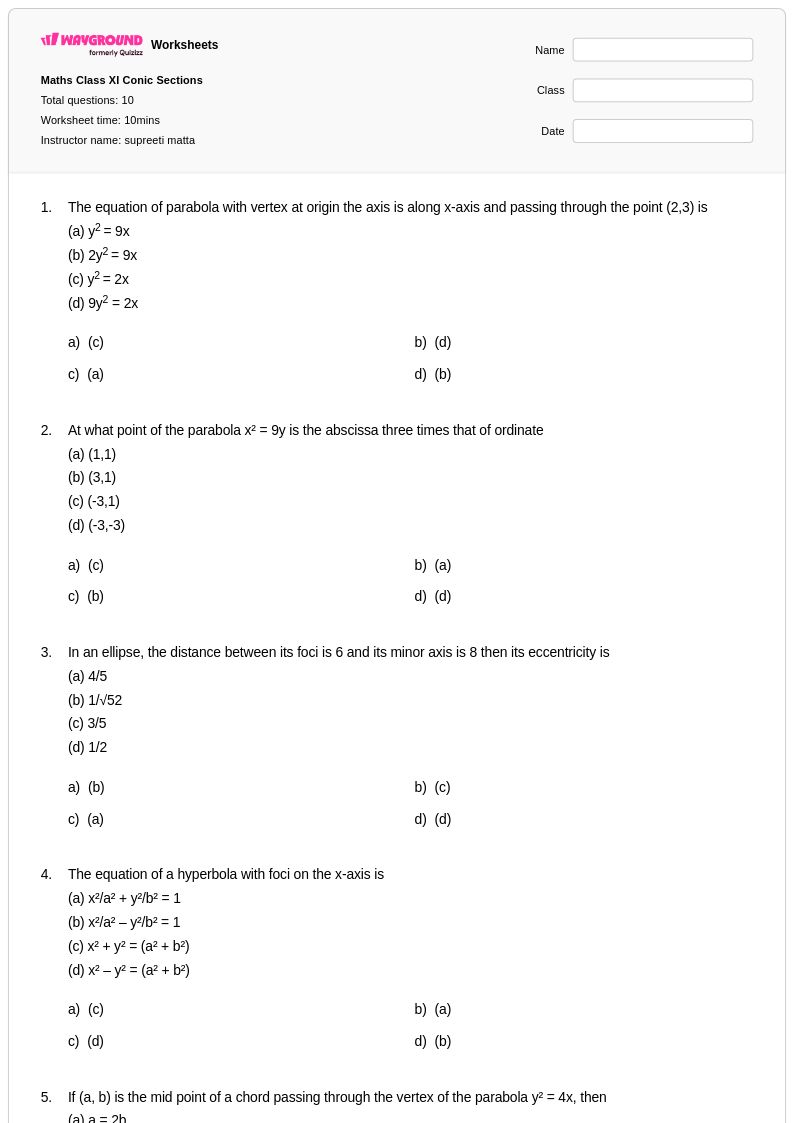
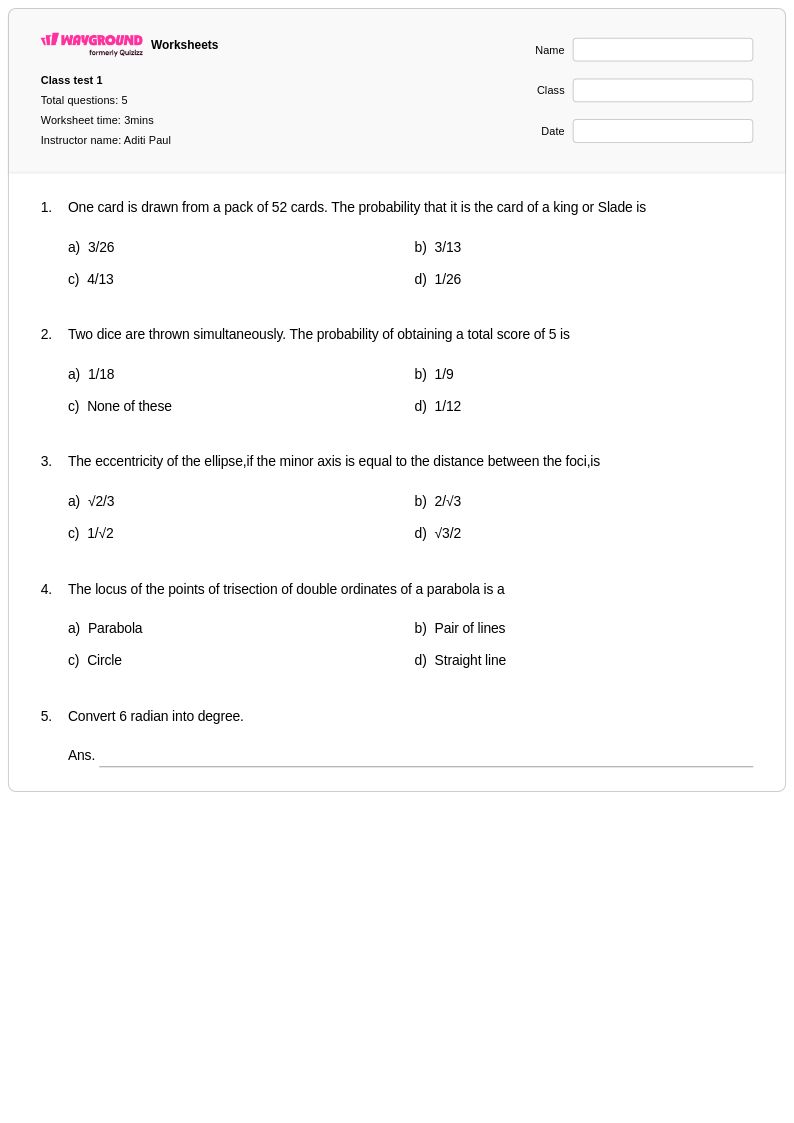
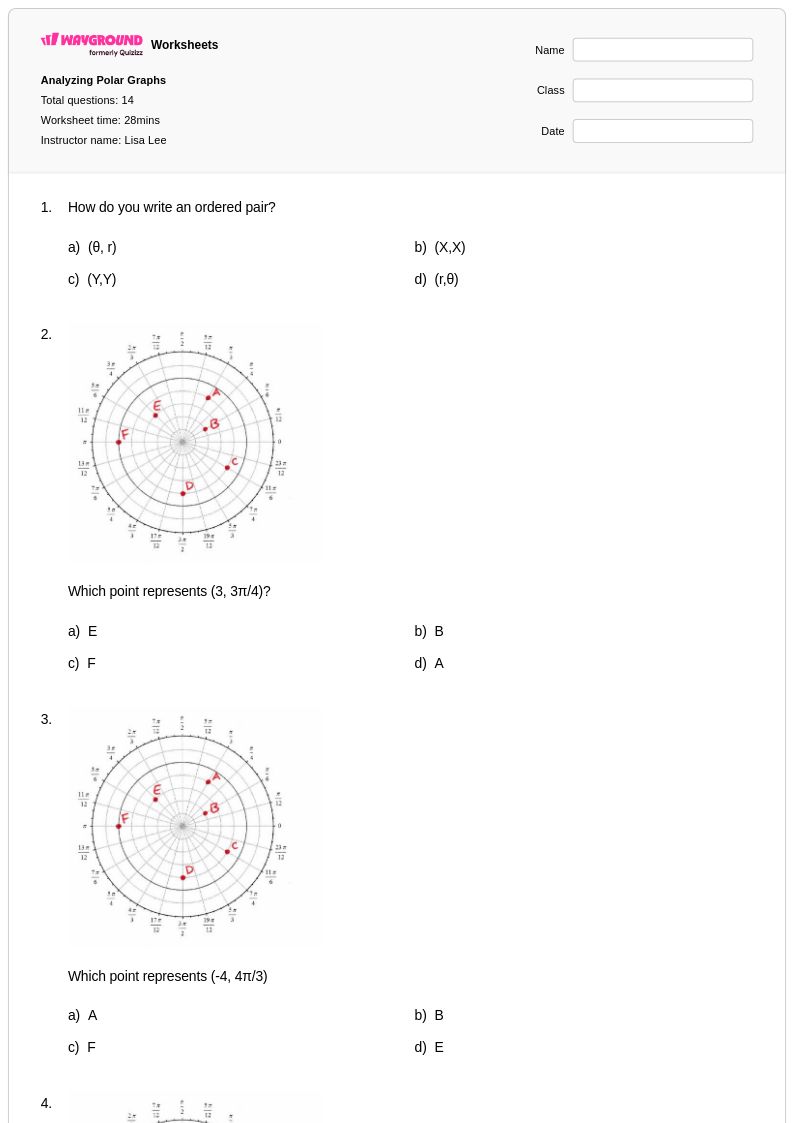
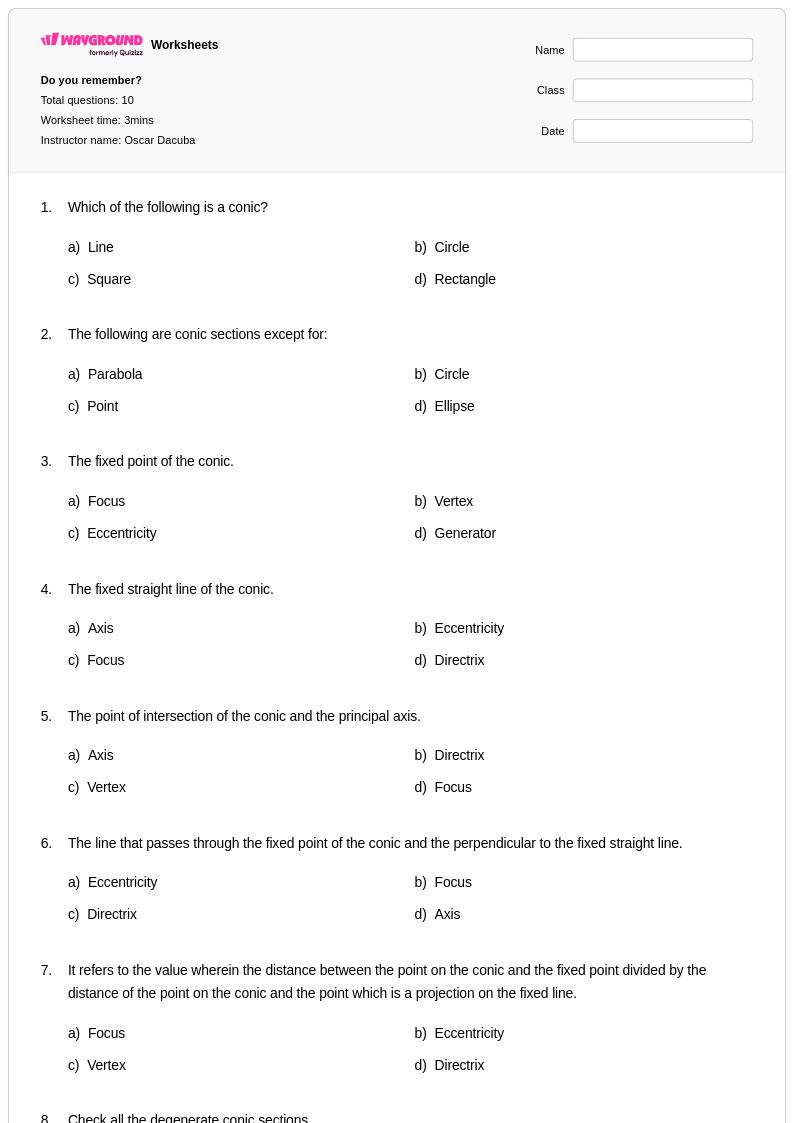
Explore Wayground's comprehensive collection of free eccentricity worksheets and printables that help students master this essential geometry concept through engaging practice problems and detailed answer keys.
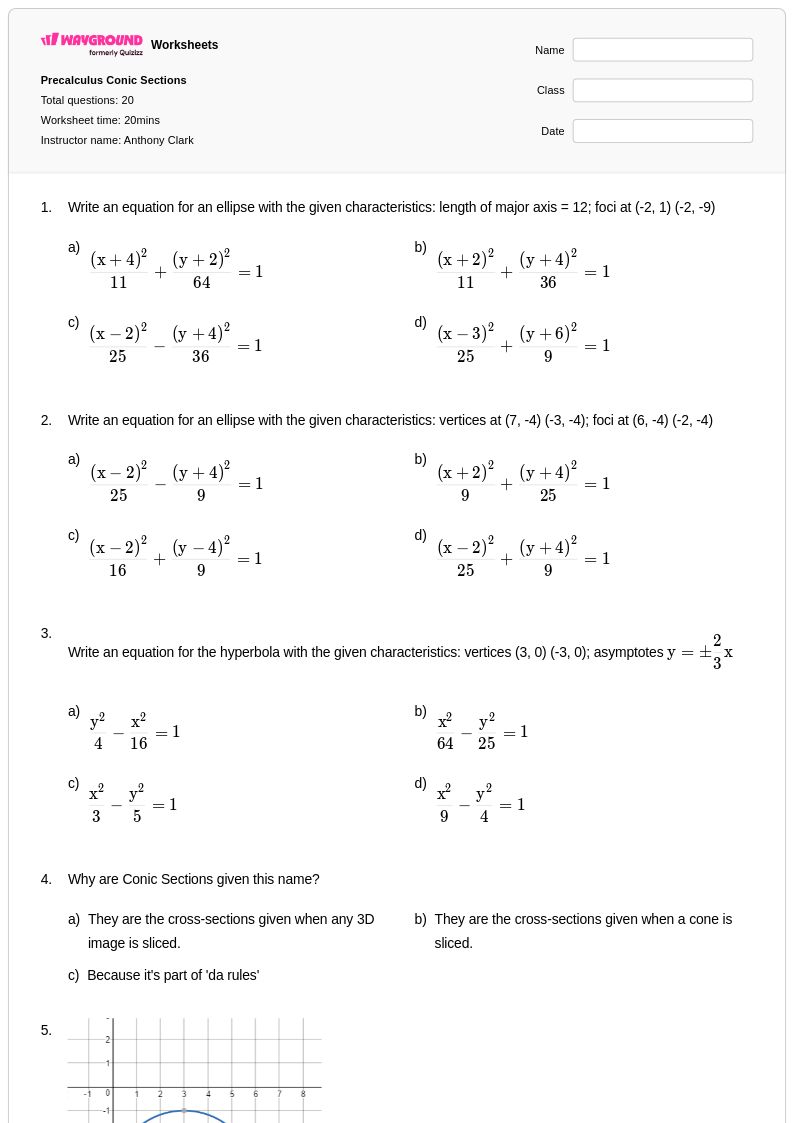
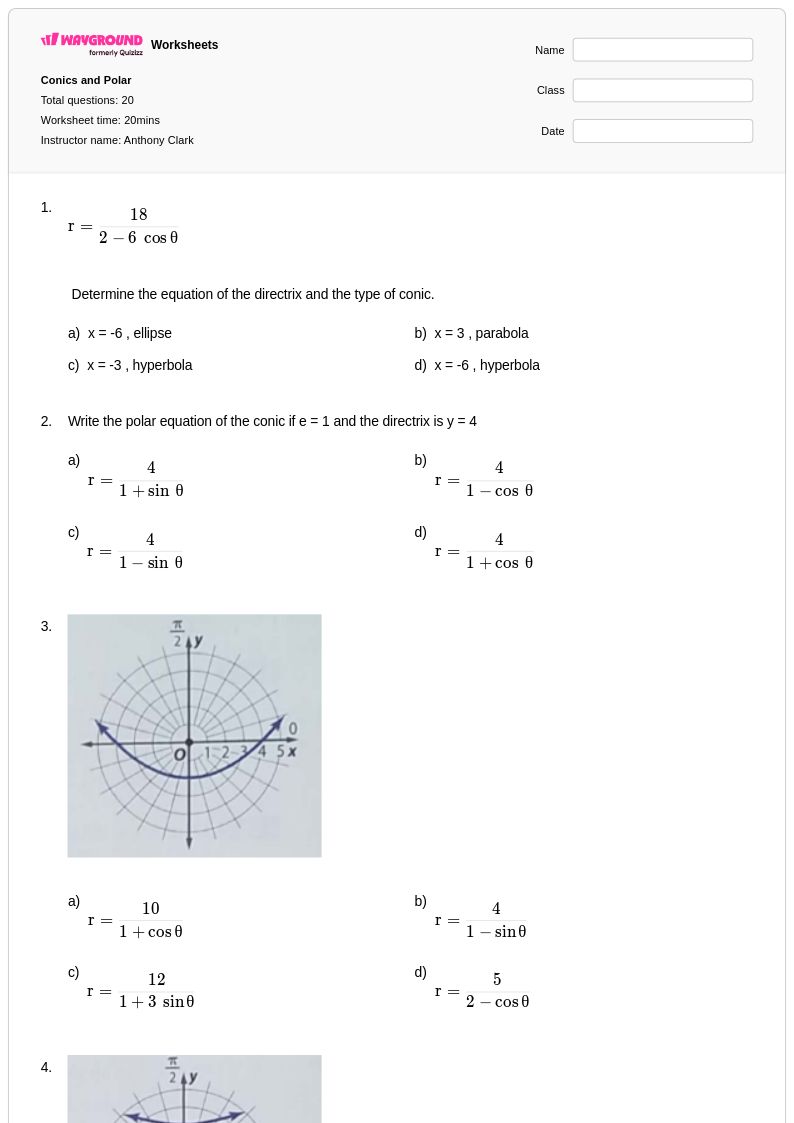
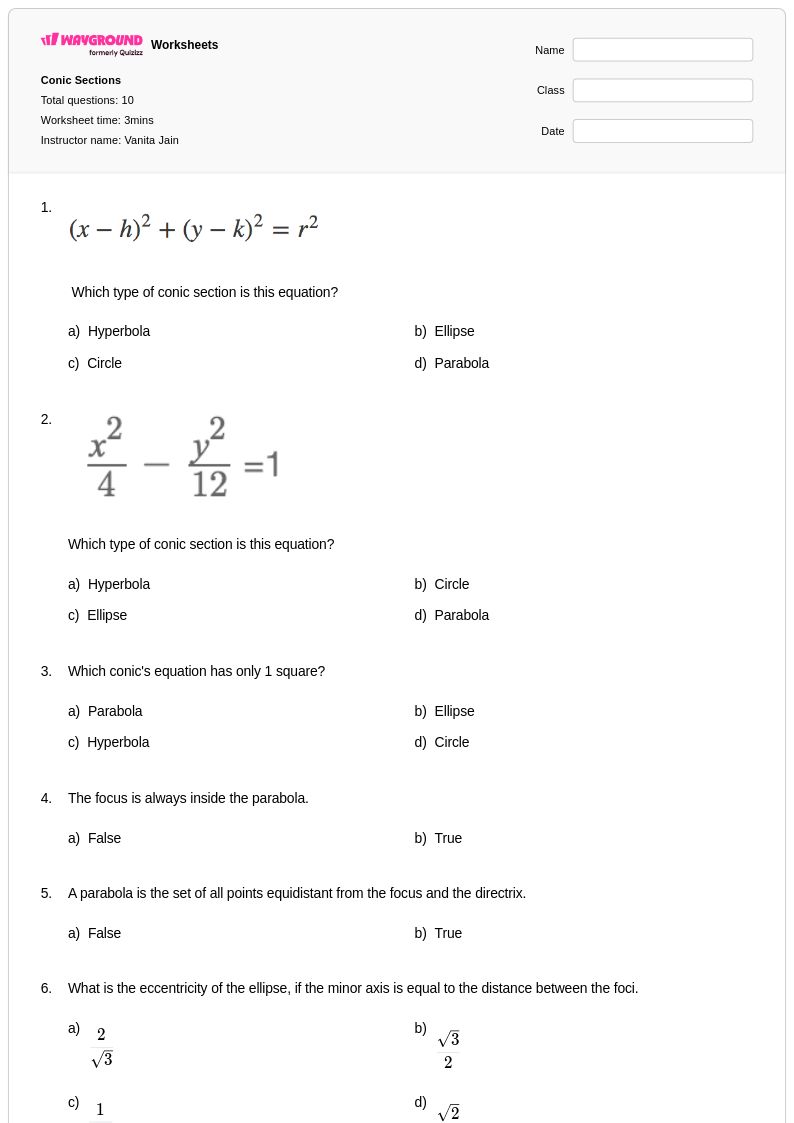
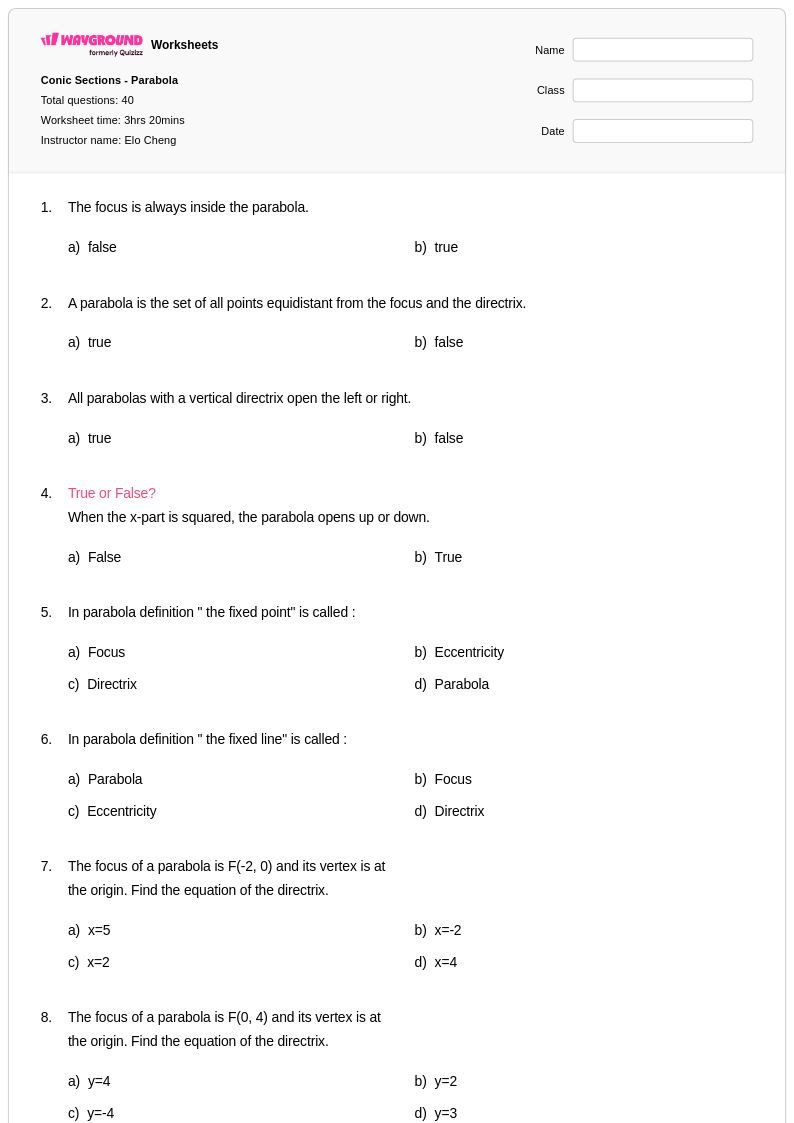
Eccentricity worksheets available through Wayground (formerly Quizizz) provide comprehensive practice with this fundamental concept in conic sections, helping students master the mathematical relationship that defines the shape characteristics of ellipses, parabolas, and hyperbolas. These expertly designed worksheets strengthen critical analytical skills by guiding students through calculations of eccentricity values, interpretation of how eccentricity determines conic shape, and application of eccentricity formulas across various geometric contexts. Each worksheet collection includes detailed answer keys and step-by-step solutions, making them valuable resources for independent study and classroom instruction. Available as free printables and downloadable pdf files, these practice problems range from basic eccentricity calculations to complex applications involving focal points, directrix relationships, and real-world modeling scenarios.
Wayground (formerly Quizizz) empowers educators with millions of teacher-created eccentricity worksheet resources, featuring robust search and filtering capabilities that allow instructors to quickly locate materials aligned with specific learning objectives and mathematical standards. The platform's differentiation tools enable teachers to customize worksheet difficulty levels and problem types, ensuring appropriate challenge levels for diverse learners while maintaining focus on essential eccentricity concepts. These flexible resources support comprehensive lesson planning by offering both printable and digital formats, including interactive pdf worksheets that can be easily distributed for homework assignments, in-class practice, or assessment preparation. Teachers can efficiently address individual student needs through targeted remediation worksheets for struggling learners and advanced enrichment materials for students ready to explore complex applications of eccentricity in analytical geometry and mathematical modeling.
FAQs
How do I teach eccentricity in conic sections?
Start with the definition: eccentricity is the ratio of the distance from any point on the conic to the focus versus its distance to the directrix. Build intuition before formulas — show students how a circle (e = 0) gradually flattens into an ellipse as e approaches 1, then opens into a parabola at exactly e = 1, and becomes a hyperbola beyond that. Once students can predict the shape from the value, the calculations feel purposeful rather than arbitrary.
What exercises help students practice eccentricity?
The most effective practice moves through three stages: calculating e from given focal and axis measurements, working backward from an eccentricity value to sketch or classify the conic, and applying the concept to real contexts like planetary orbits. Mixing all three types in a single worksheet session forces students to think about what eccentricity means, not just how to compute it.
What mistakes do students commonly make when calculating eccentricity?
Two errors come up constantly. First, students confuse which measurements go in the numerator and denominator — particularly for ellipses, where e = c/a and students frequently invert the ratio or substitute b for a. Second, they treat eccentricity as just another number to compute rather than a classifier, so they'll calculate e = 1.3 and not recognize that result identifies a hyperbola. Building in a classification step after every calculation catches both errors early.
How do I use Wayground's eccentricity worksheets in my class?
Each worksheet includes a complete answer key, so it works well for independent practice or homework without extra prep on your end. You can run it as a digital quiz hosted on Wayground — useful for getting instant results — or download the PDF and print it for paper-based practice. If you go the print route, the Wayground for Teachers app lets you scan or capture student work to grade it without manual re-entry.
How does eccentricity fit into the high school math curriculum?
Common Core's approach to geometry and algebra builds toward conic sections by first establishing students' fluency with the distance formula and the standard forms of quadratic equations. Eccentricity sits near the top of that progression: students need to understand focal points and directrices before eccentricity makes sense, and mastering it then unlocks the ability to move fluidly between a conic's equation, its graph, and its geometric classification — a skill that carries directly into precalculus and calculus work with polar forms of conics.
Can I differentiate eccentricity practice for mixed-ability classes?
Yes. For students who struggle with the ratio setup, Wayground's reduced answer choices accommodation lowers the cognitive load on multiple-choice problems while they build confidence. For students with reading difficulties, the Read Aloud feature handles question text so the barrier is the math, not the language. At the worksheet level, you can also apply a dyslexia-friendly font or adjust font size — small changes that make a real difference when students are already wrestling with an abstract concept.
Is eccentricity a difficult concept for students?
It tends to be — not because the formula is complicated, but because students have to hold three things together at once: the numeric value, what shape it implies, and why. Students who memorize e = c/a without understanding what c and a represent will stall as soon as a problem changes the presentation. Grounding every lesson in the geometric meaning of the ratio, not just the calculation, is what separates students who can apply eccentricity flexibly from those who can only reproduce it on familiar problem types.