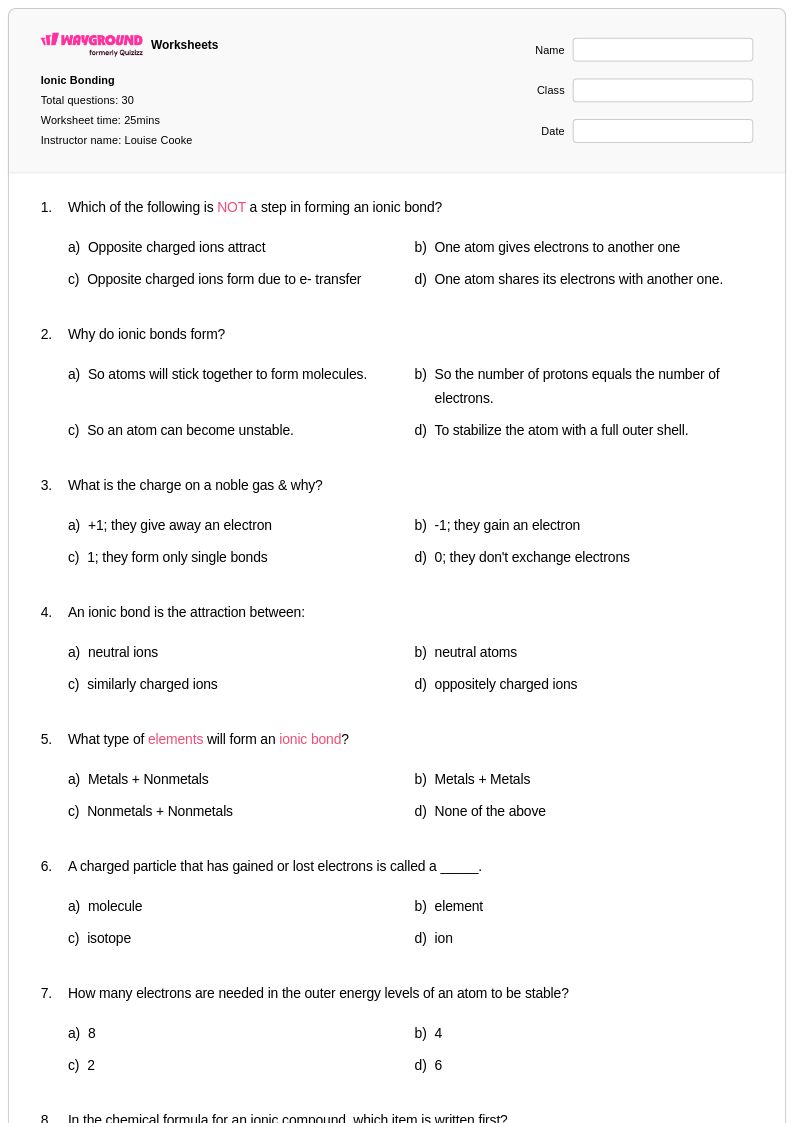
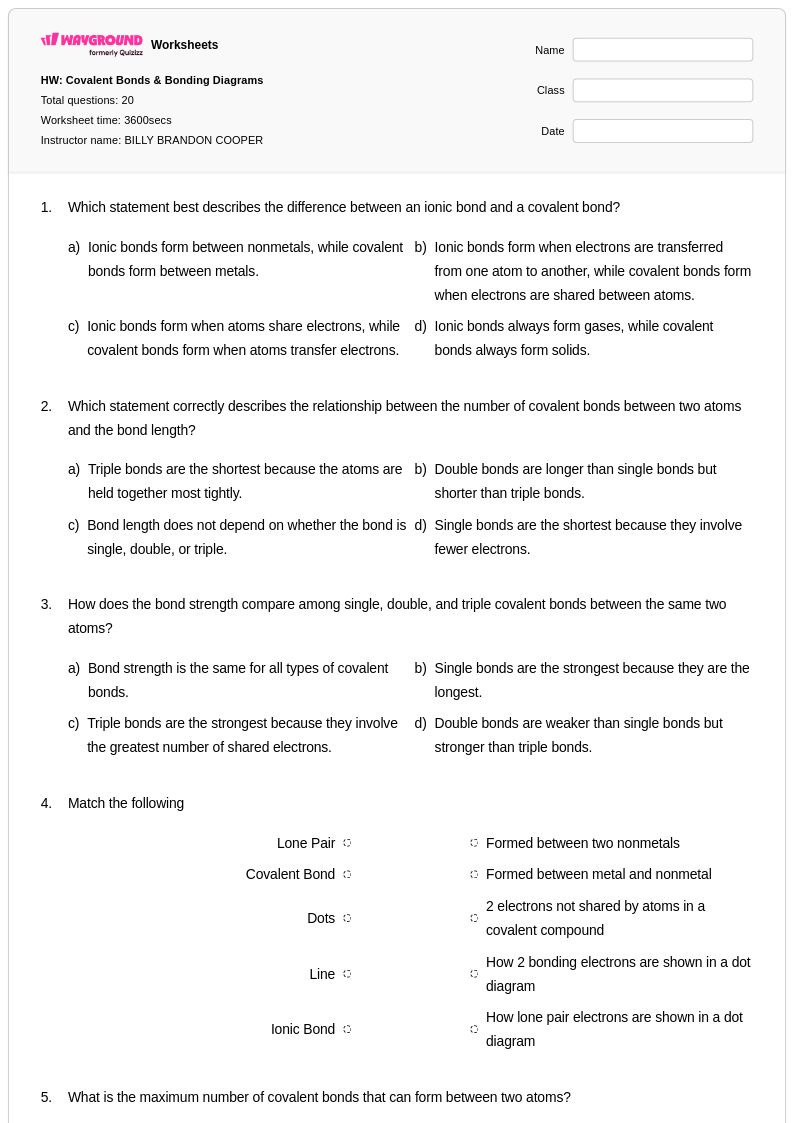
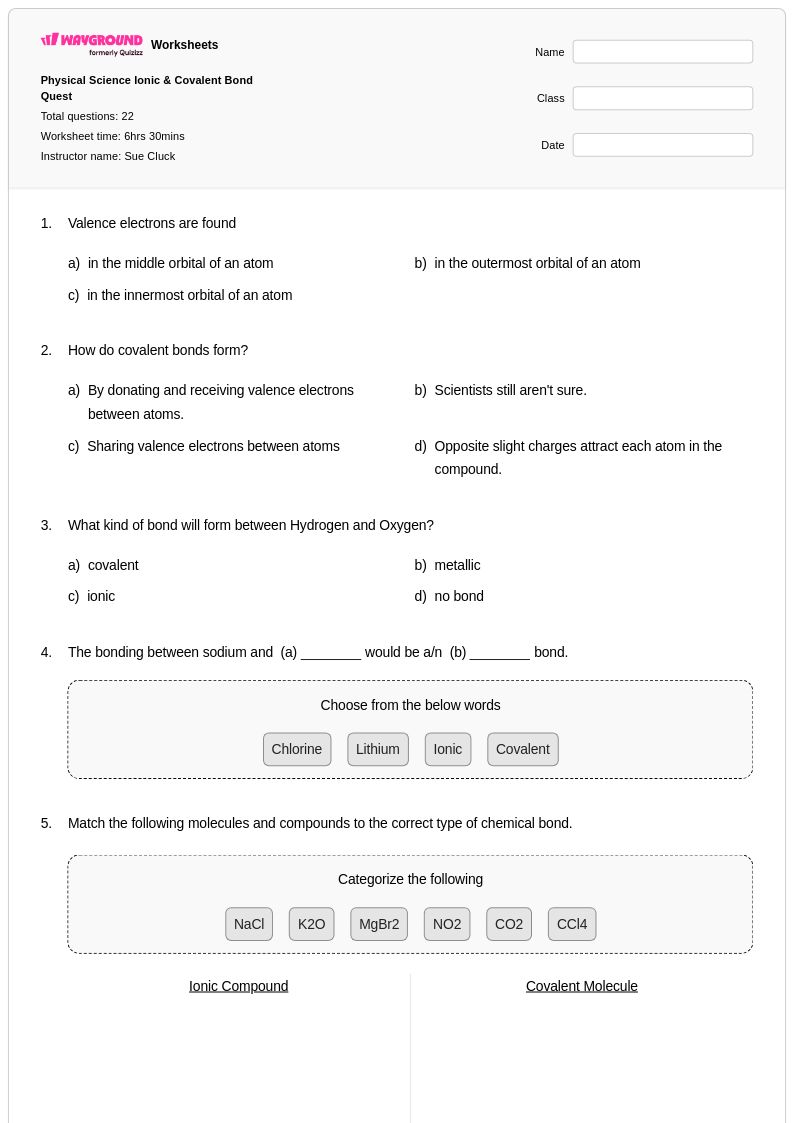
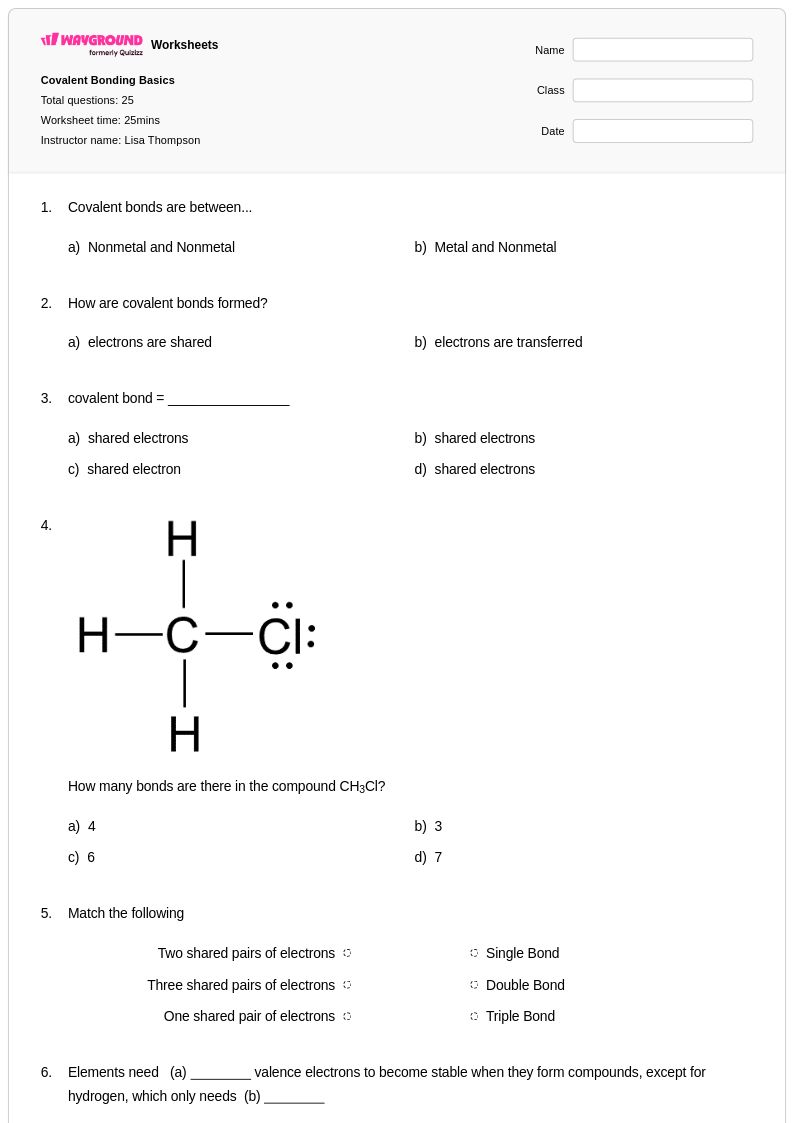
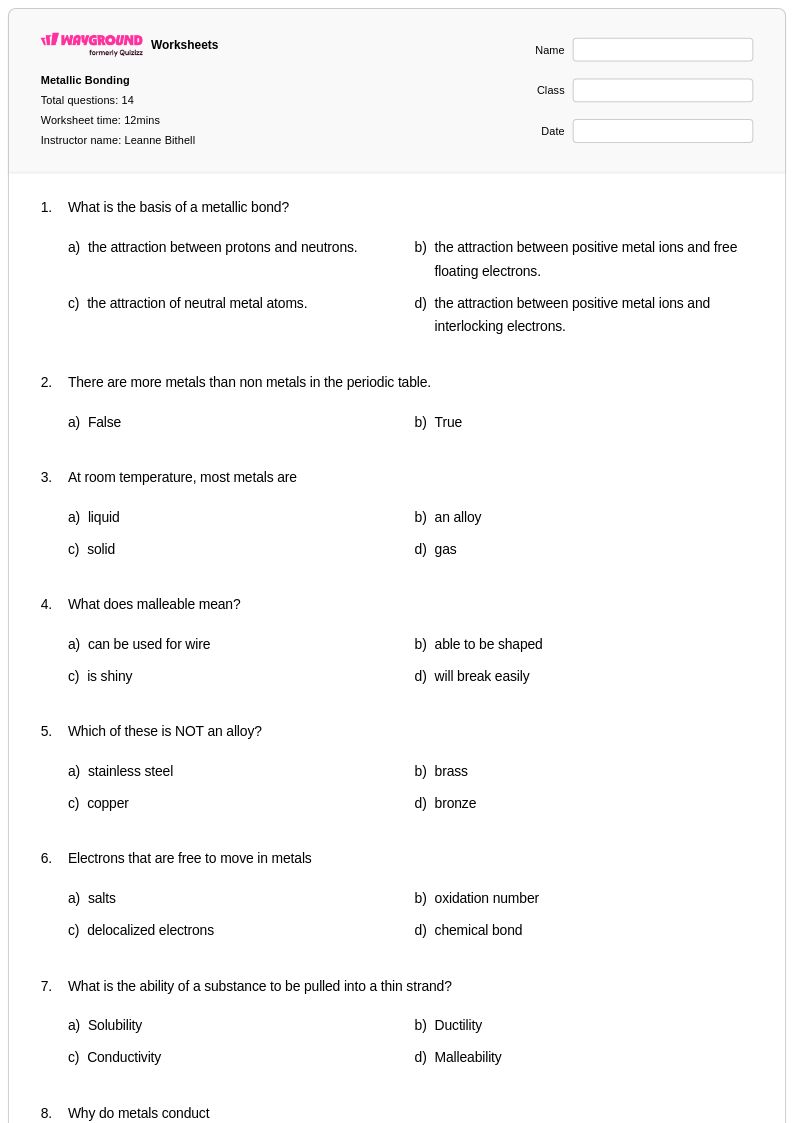
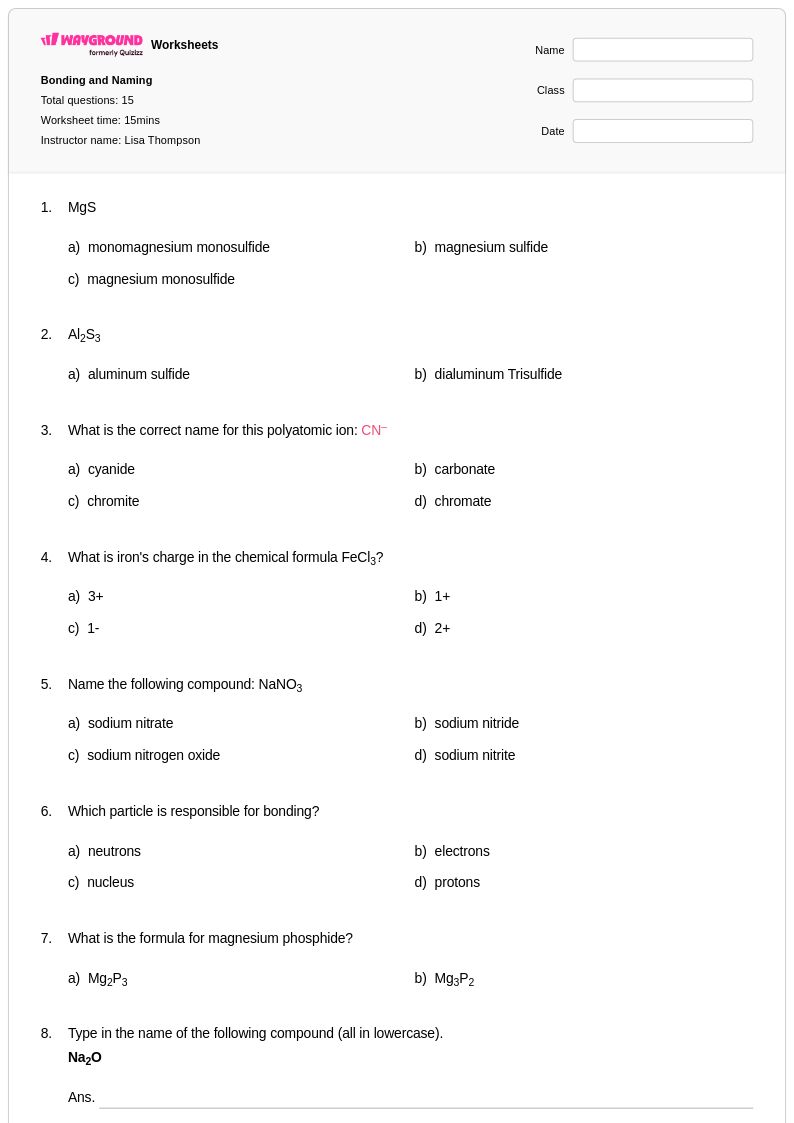
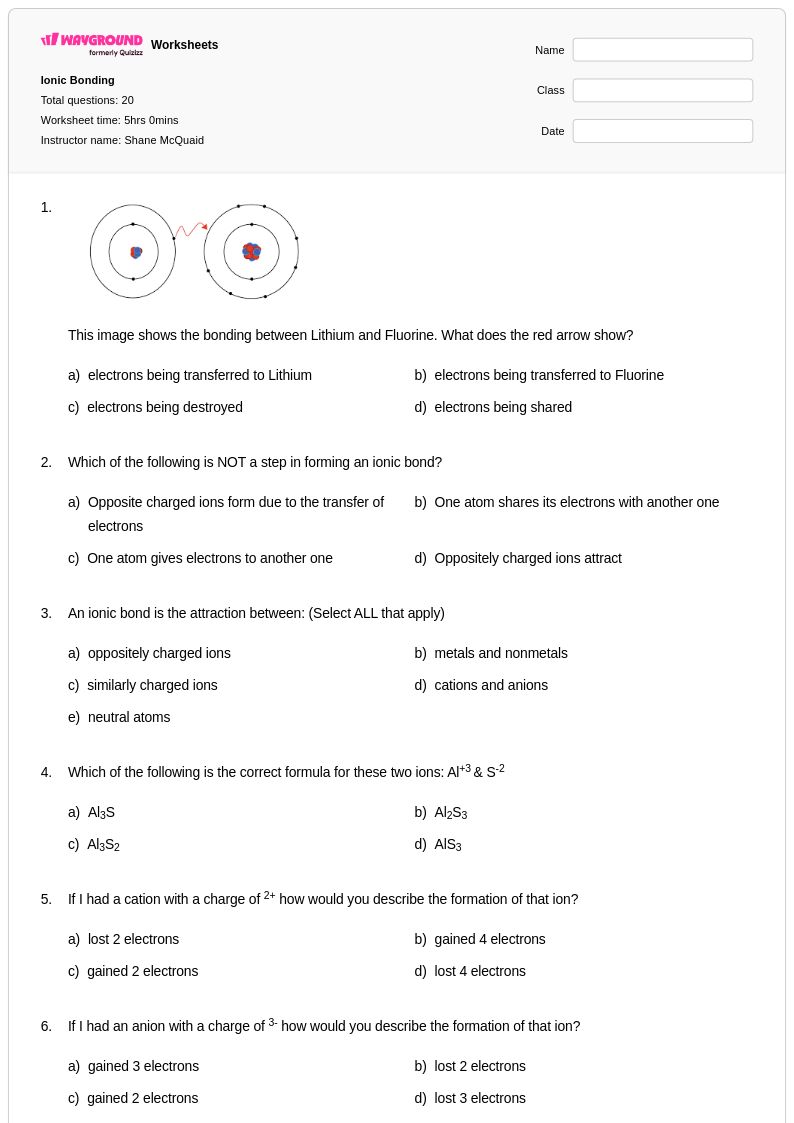
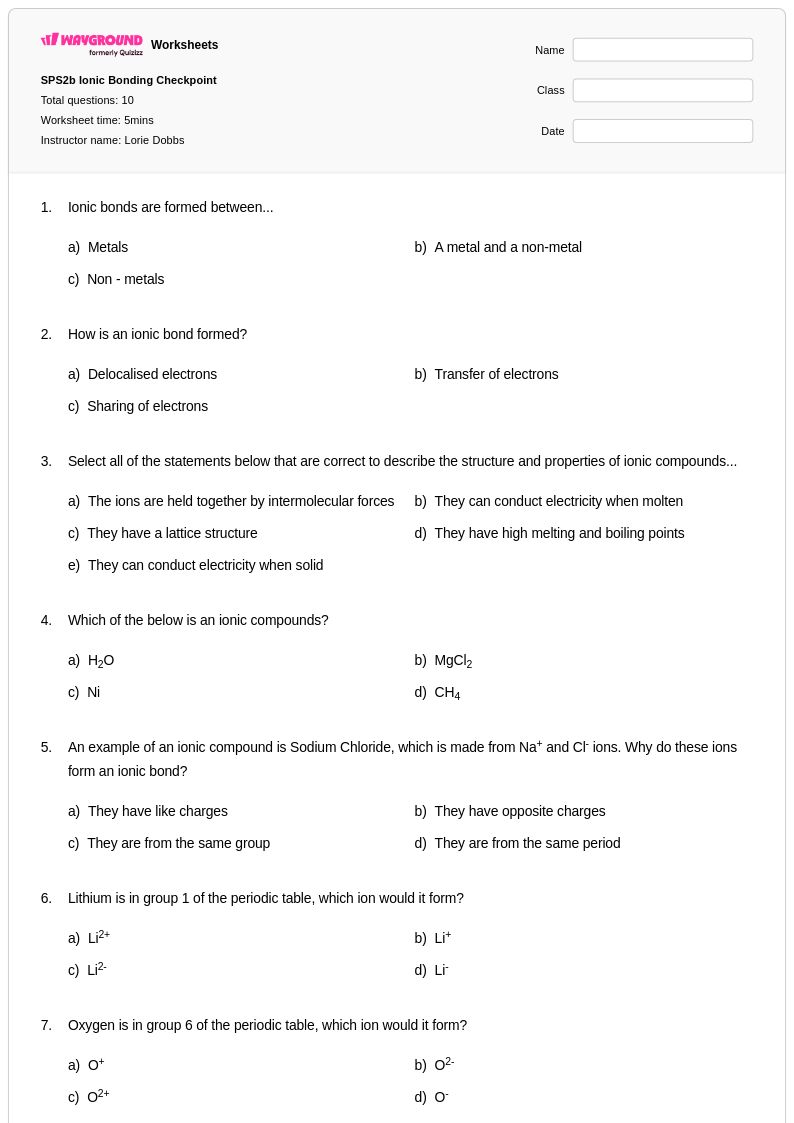
Year 11 Chemistry bonding worksheets from Wayground provide comprehensive printables and practice problems with answer keys to help students master ionic, covalent, and metallic bonding concepts through free PDF resources.
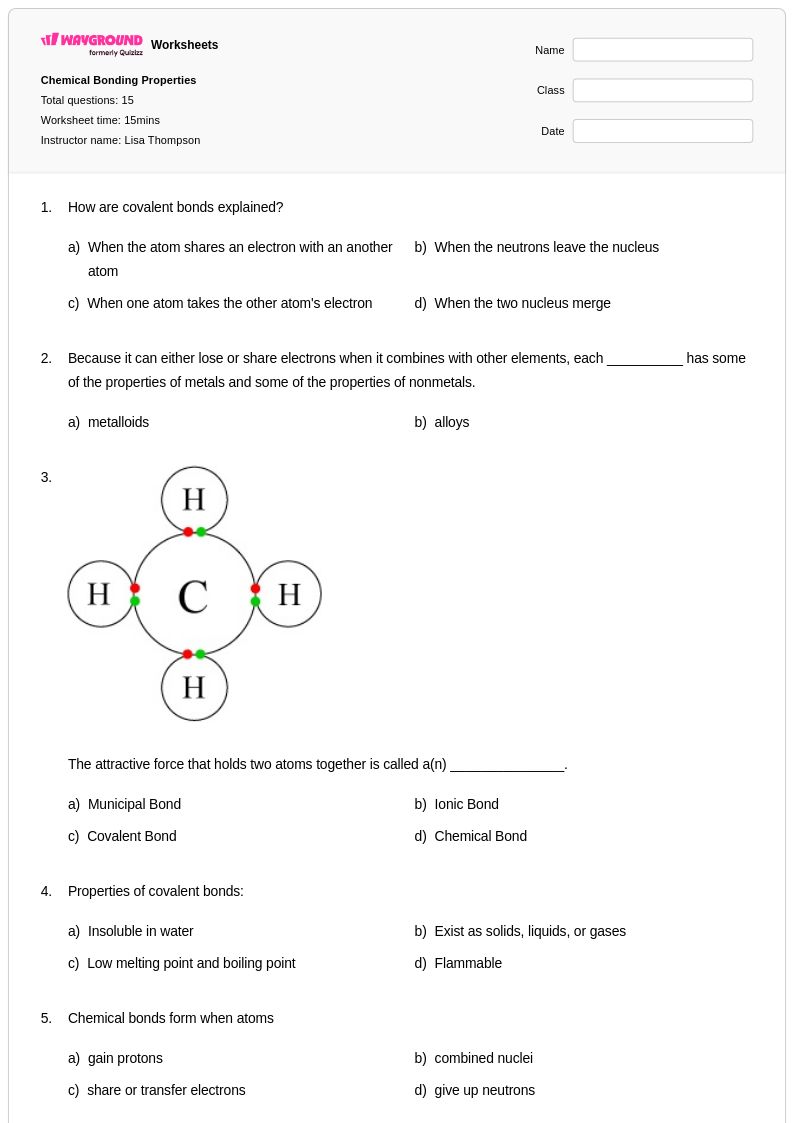
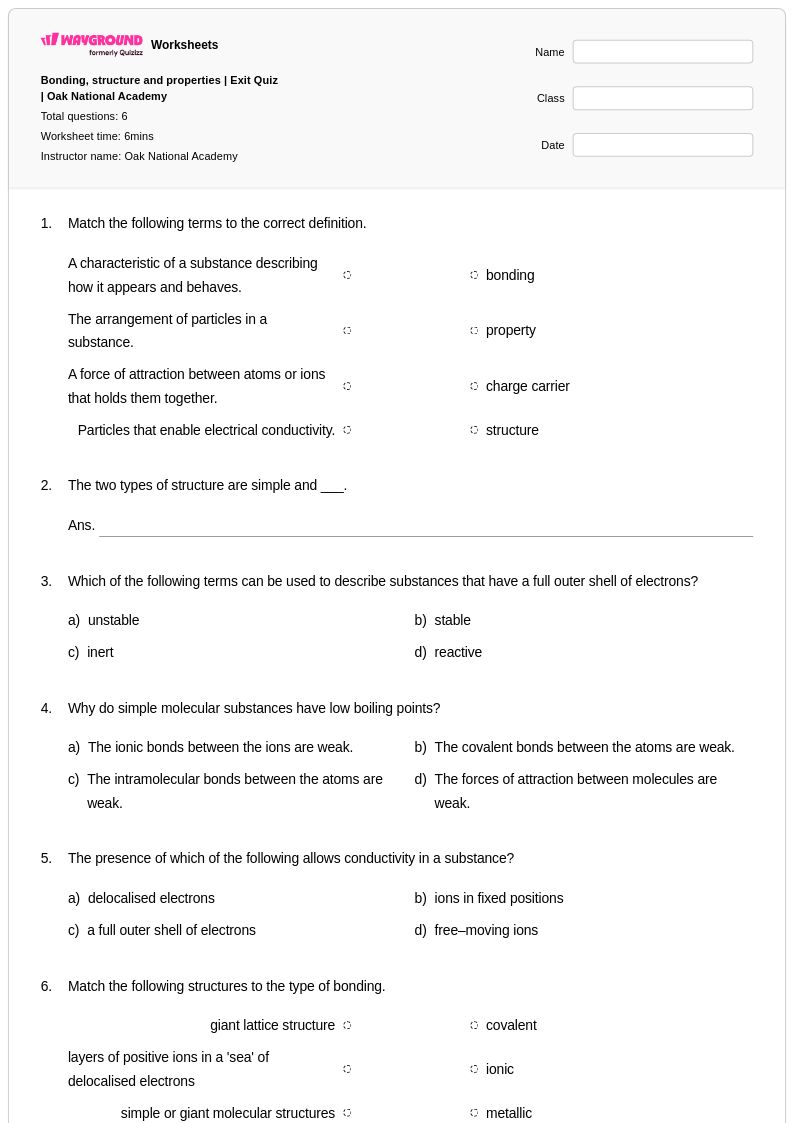
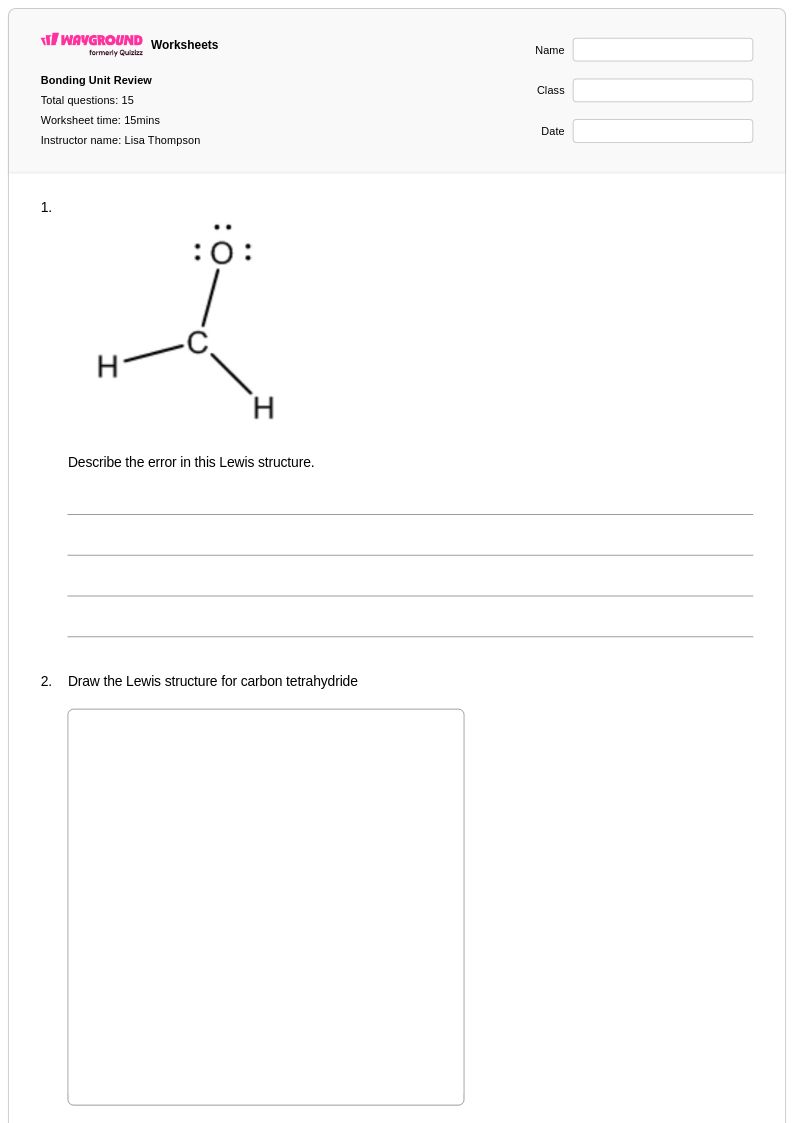
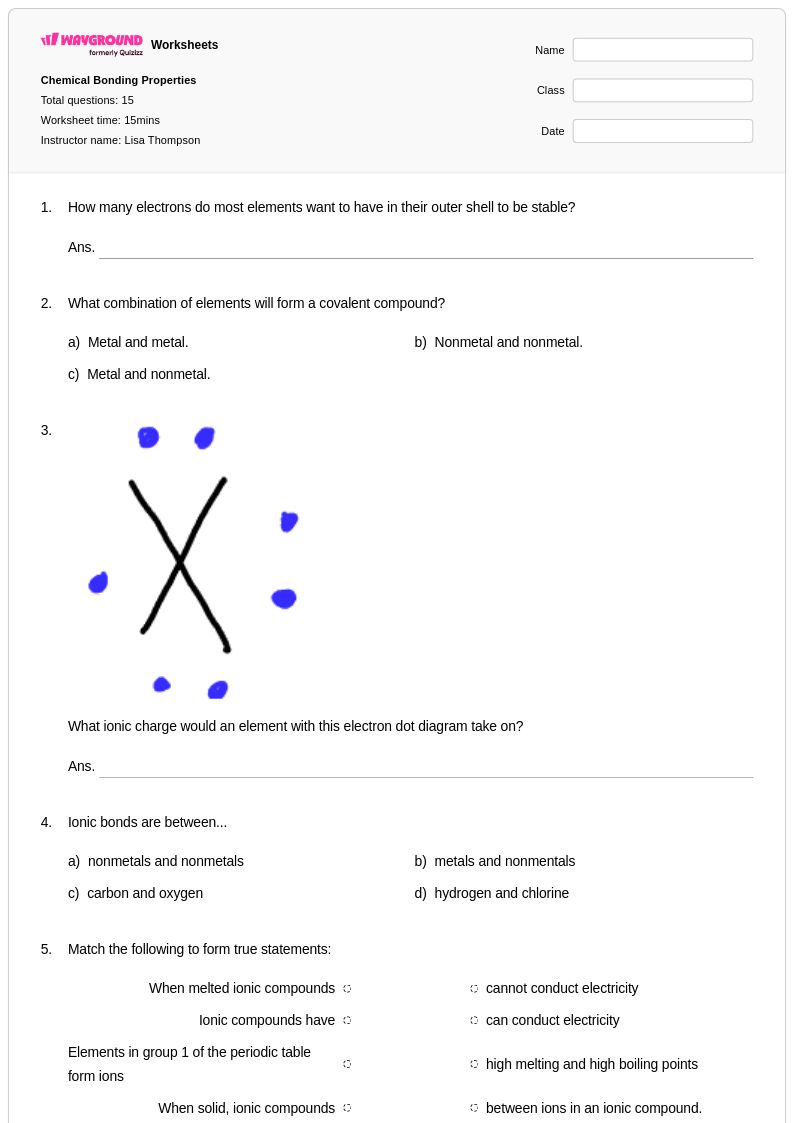
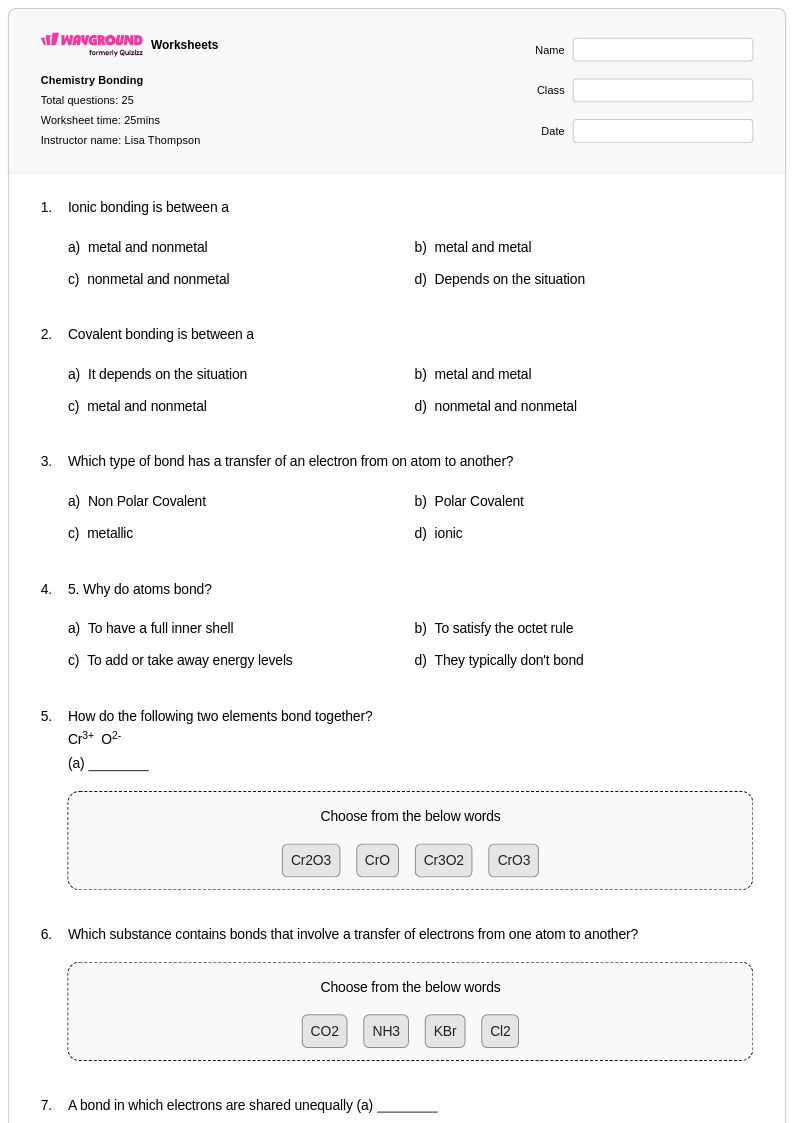
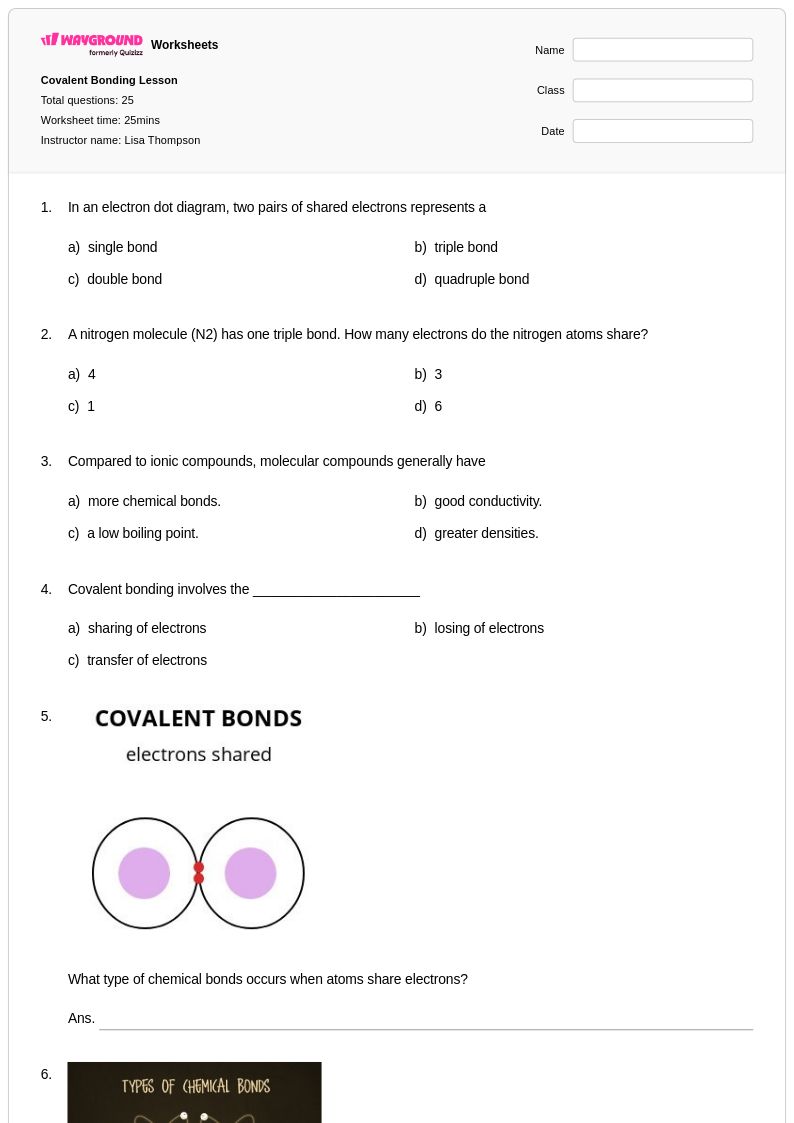
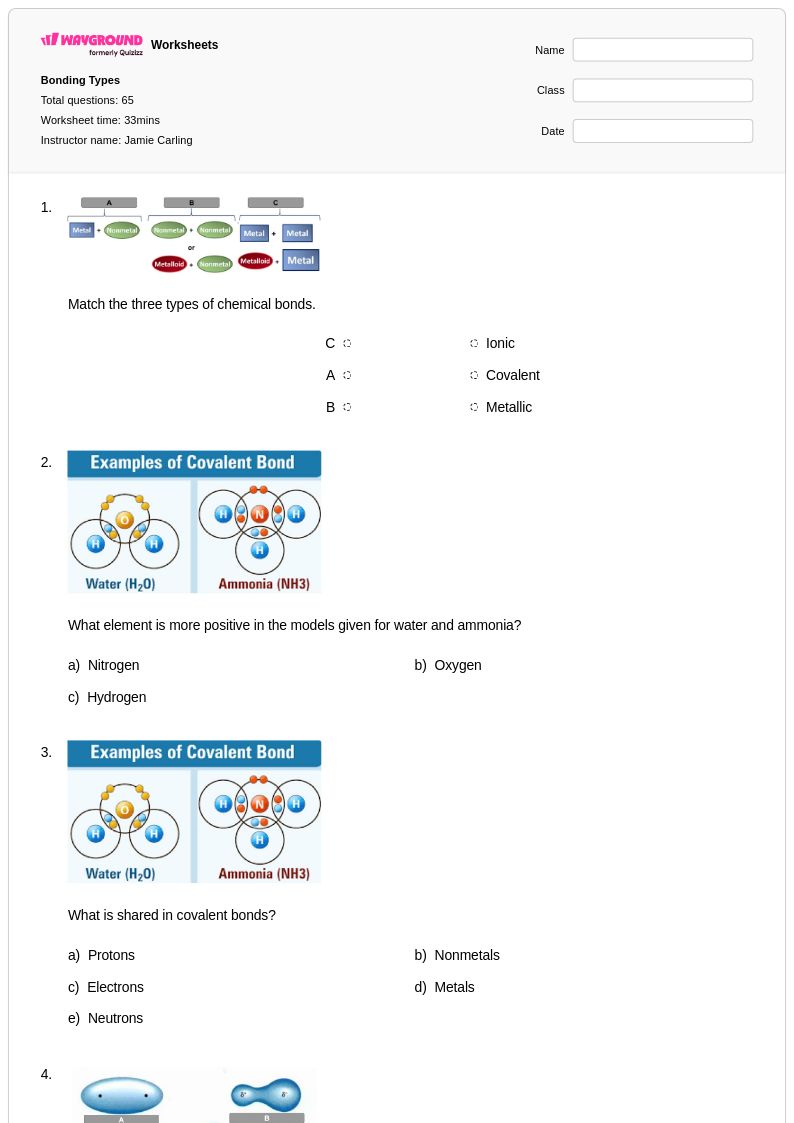
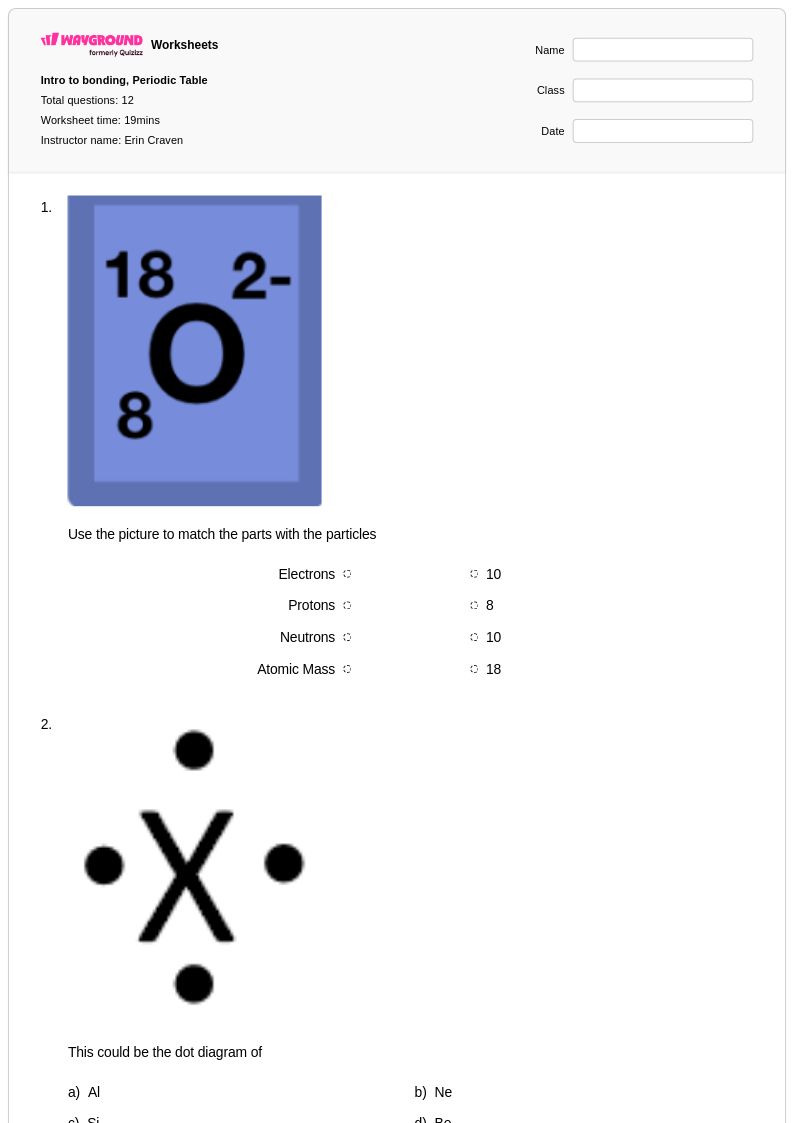
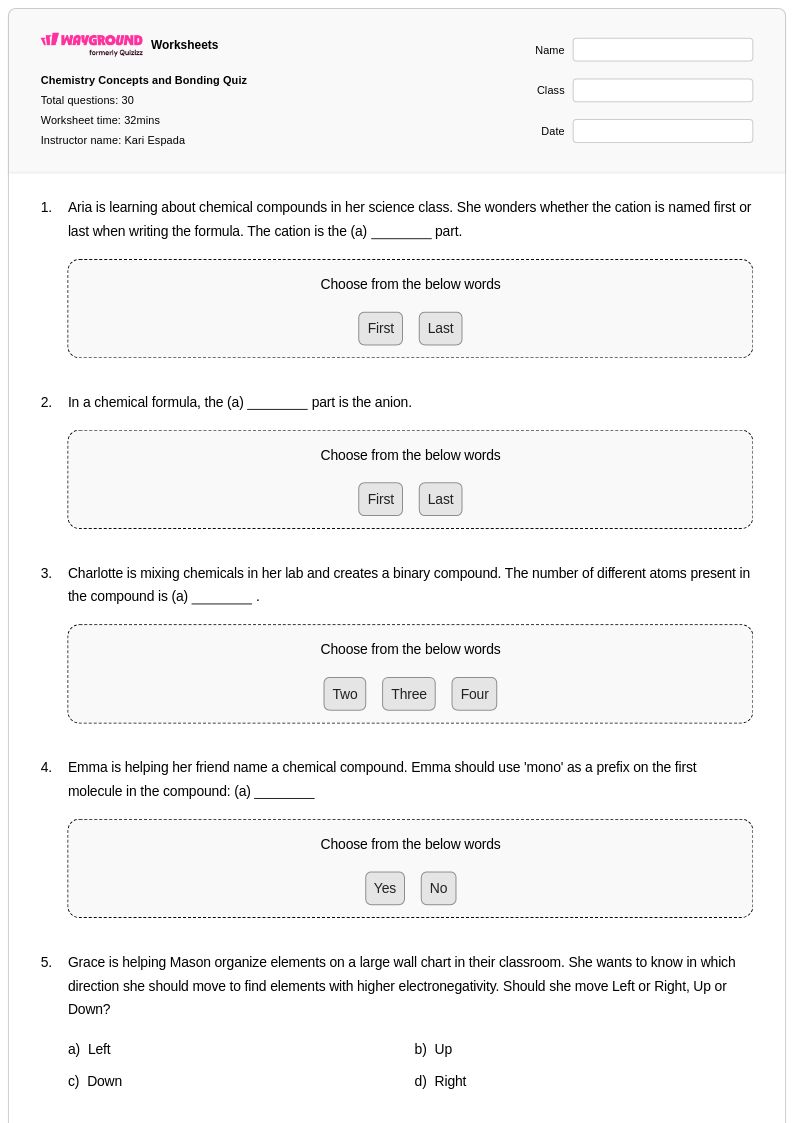
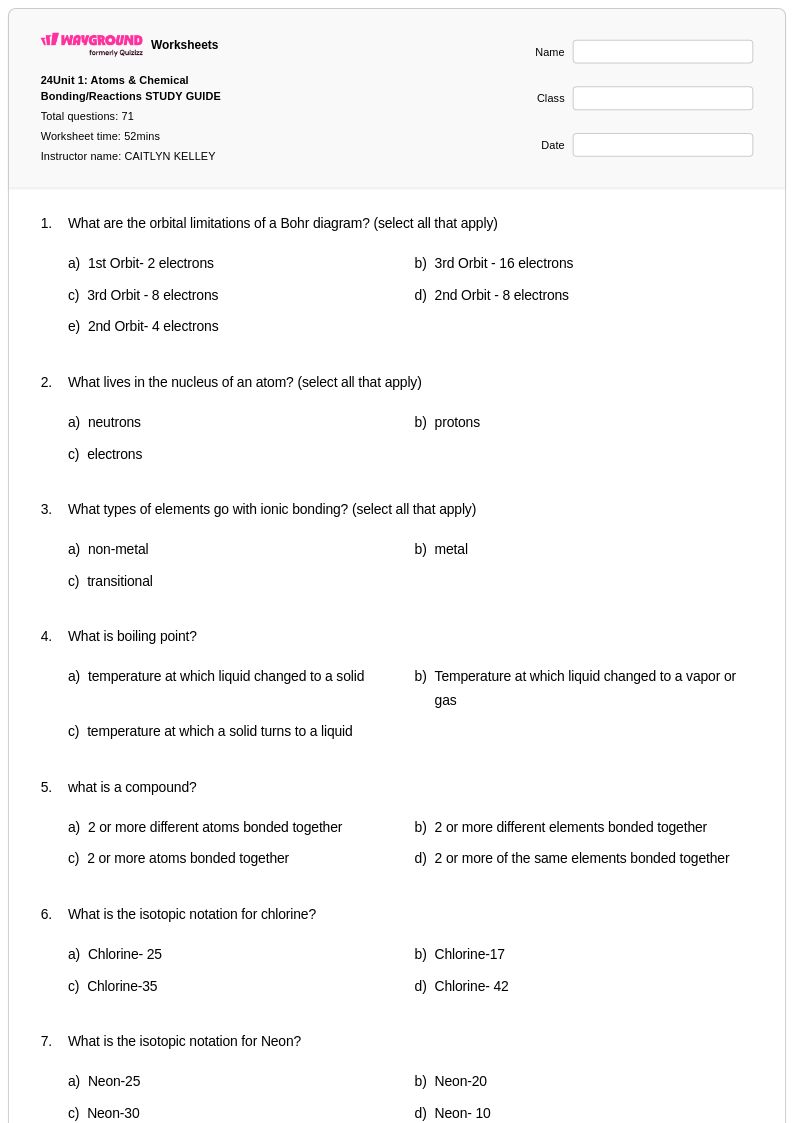
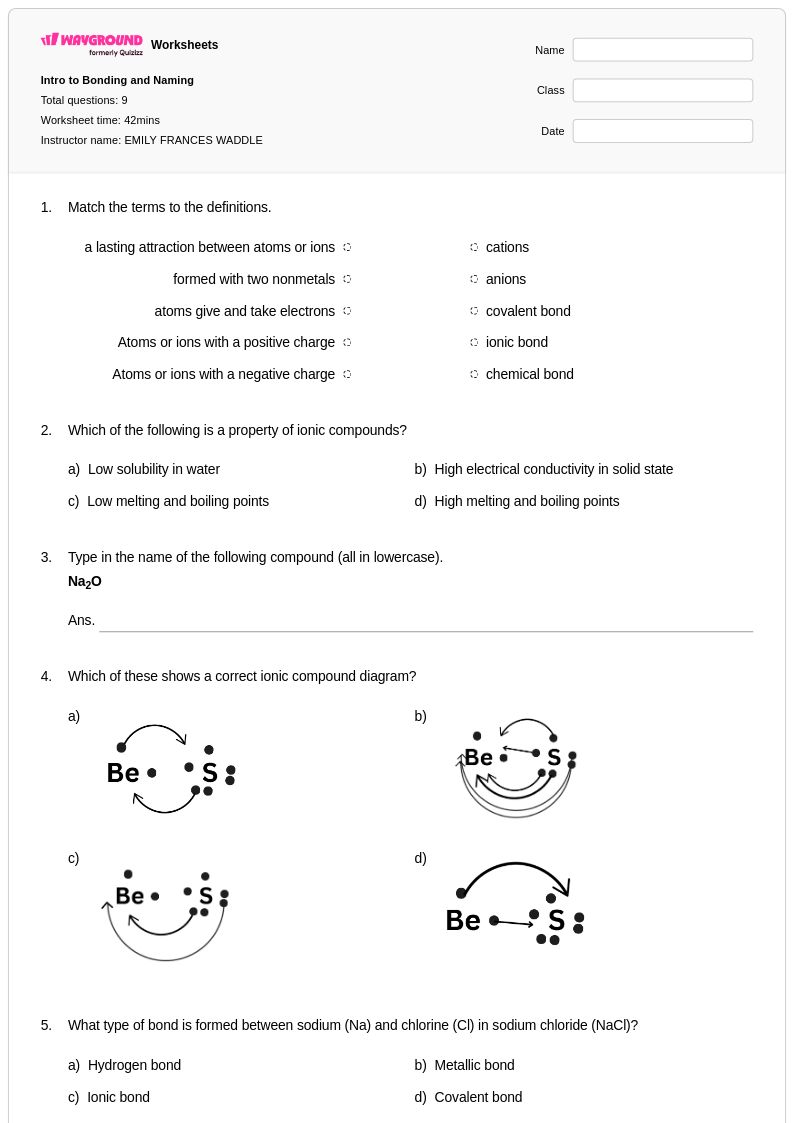
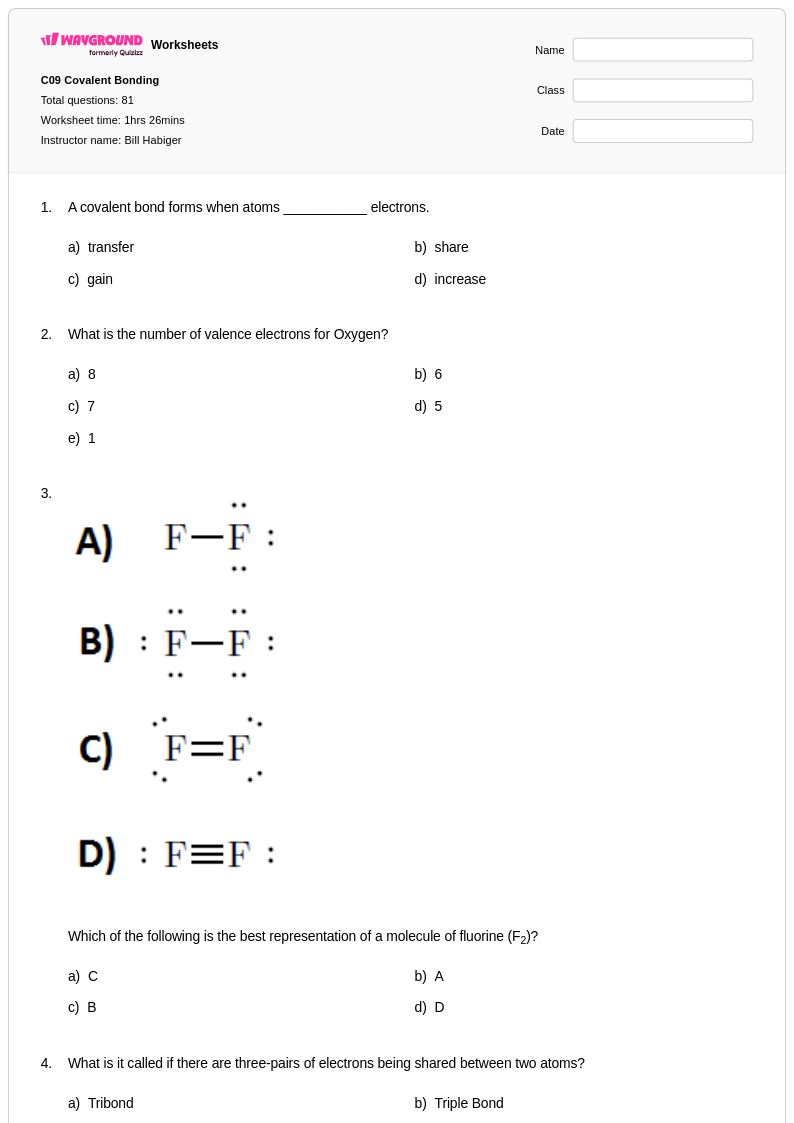
Bonding worksheets for Year 11 students through Wayground (formerly Quizizz) provide comprehensive coverage of chemical bonding principles that form the foundation of advanced chemistry understanding. These expertly designed resources focus on ionic, covalent, and metallic bonding mechanisms, helping students master electron transfer and sharing concepts, Lewis structures, molecular geometry, and bond polarity. Each worksheet collection includes detailed practice problems that guide students through predicting bond types, drawing electron dot diagrams, and analyzing molecular properties based on bonding characteristics. The materials come complete with answer keys and are available as free printables in convenient pdf format, enabling students to work through complex bonding scenarios systematically while building confidence in their ability to predict and explain chemical behavior at the molecular level.
Wayground's extensive library contains millions of teacher-created bonding resources specifically curated for Year 11 chemistry instruction, offering educators powerful search and filtering capabilities to locate materials aligned with specific curriculum standards and learning objectives. Teachers can easily differentiate instruction by selecting worksheets that match individual student needs, from foundational ionic bonding concepts to advanced topics like hybridization and molecular orbital theory. The platform's flexible customization tools allow educators to modify existing worksheets or combine multiple resources to create targeted practice sessions for remediation or enrichment purposes. Available in both printable and digital formats including downloadable pdfs, these bonding worksheets seamlessly integrate into lesson planning workflows, providing reliable resources for homework assignments, formative assessments, and comprehensive skill practice that reinforces critical chemistry concepts throughout the academic year.
FAQs
How do I teach ionic vs. covalent bonding to high school students?
Start by grounding students in electronegativity differences: ionic bonds form when the difference is large (typically above 1.7), while covalent bonds form between atoms with similar electronegativities. Use visual models to show electron transfer in ionic bonding versus electron sharing in covalent bonding. Connecting bond type to observable properties, such as melting point, conductivity, and solubility, helps students move beyond memorization toward conceptual understanding.
What practice exercises help students get better at identifying bond types?
Bond identification exercises that ask students to classify compounds using electronegativity values are highly effective, as they build the reasoning skill rather than relying on rote recall. Lewis structure drawing problems reinforce covalent bonding by requiring students to account for all valence electrons. Pairing these with molecular geometry challenges, such as applying VSEPR theory, extends practice from basic identification to structural prediction.
What are the most common mistakes students make when learning chemical bonding?
One of the most frequent errors is confusing ionic and polar covalent bonds, with students often assuming any bond between a metal and nonmetal is purely ionic without checking electronegativity values. Students also commonly miscount valence electrons when drawing Lewis structures, leading to incorrect bond orders and formal charges. A third persistent misconception is treating metallic bonding as identical to ionic bonding rather than understanding the delocalized electron sea model.
How do I support struggling students when teaching electron configuration and bonding?
Students who struggle with bonding often have gaps in their understanding of valence electrons, so targeted remediation should revisit electron configuration before introducing bond formation. Breaking Lewis structure drawing into a step-by-step checklist, such as counting valence electrons, placing bonds, and distributing lone pairs, reduces cognitive overload. On Wayground, teachers can assign accommodations such as reduced answer choices and read aloud support to individual students, making bonding practice more accessible without singling anyone out.
How can I use Wayground's bonding worksheets in my chemistry class?
Wayground's bonding worksheets are available as printable PDFs for traditional classroom use and in digital formats for technology-integrated environments, including the option to host them as a quiz directly on Wayground. Teachers can use them for guided practice, homework assignments, or assessment preparation across topics ranging from basic bond identification to molecular geometry and intermolecular forces. Each worksheet includes a detailed answer key, which supports independent student review and reduces grading time.
How do intermolecular forces connect to what students learn about covalent bonding?
Intermolecular forces are a direct extension of covalent bonding concepts: once students understand bond polarity, they can predict whether a molecule will exhibit dipole-dipole interactions, hydrogen bonding, or only London dispersion forces. This connection is critical because intermolecular forces explain physical properties like boiling point, viscosity, and solubility that ionic and covalent bond type alone cannot account for. Worksheets that sequence from Lewis structures to polarity to intermolecular forces help students build this understanding as a coherent arc rather than isolated topics.