Free Printable Covalent Compounds Worksheets for Year 11
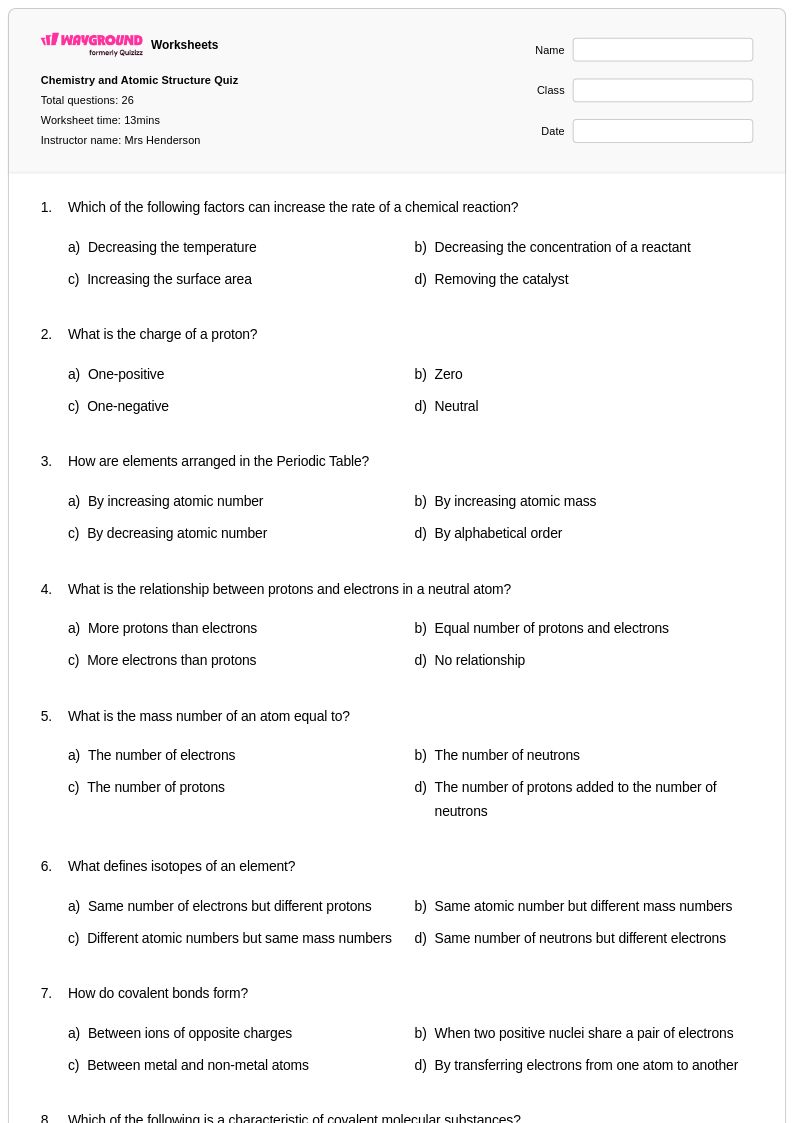
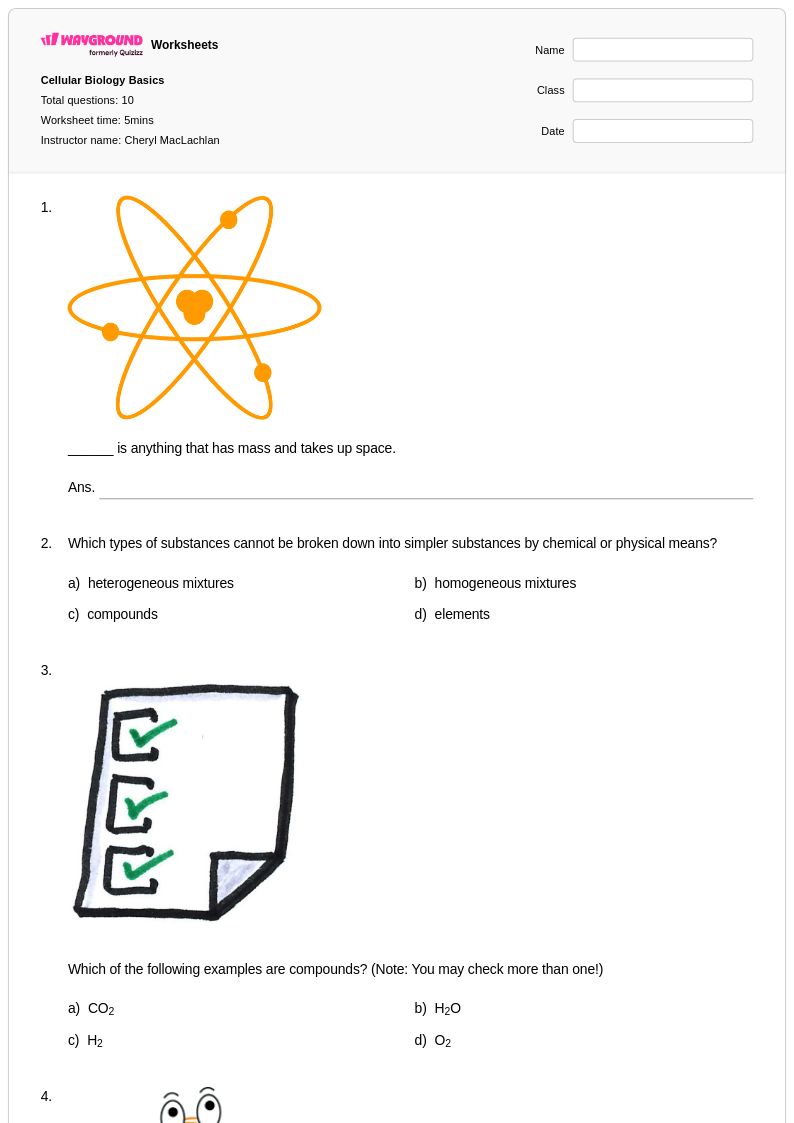
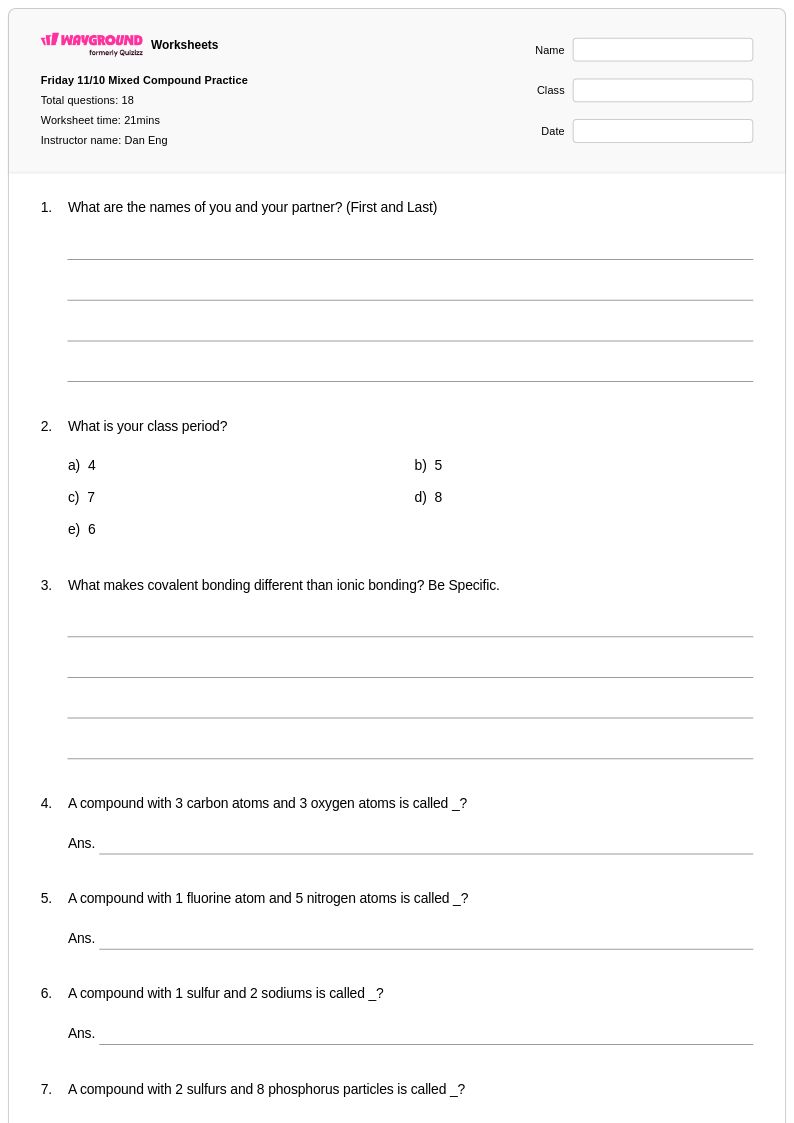
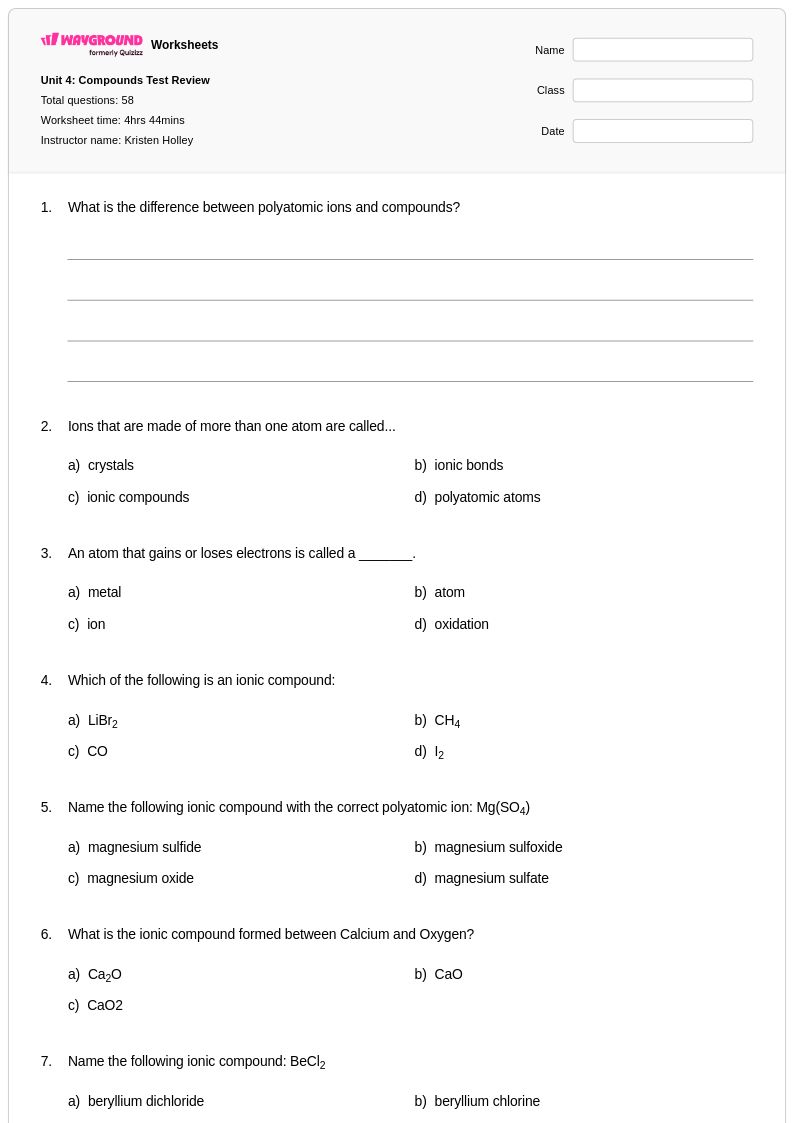
Year 11 covalent compounds worksheets from Wayground provide comprehensive printables and practice problems with answer keys to help students master molecular bonding, Lewis structures, and chemical formulas through engaging free PDF resources.
Explore printable Covalent Compounds worksheets for Year 11
Covalent compounds represent a fundamental concept in Year 11 chemistry, requiring students to master the intricate relationships between atomic structure, electron sharing, and molecular properties. Wayground's comprehensive collection of covalent compounds worksheets provides students with structured practice problems that develop critical skills in molecular geometry, polarity determination, intermolecular forces, and compound naming conventions. These expertly designed printables guide learners through complex topics such as VSEPR theory, hybridization, and the relationship between molecular structure and physical properties. Each worksheet includes detailed answer keys that support independent learning and self-assessment, while the free pdf format ensures accessibility for both classroom instruction and home study. Students engage with authentic chemistry scenarios that strengthen their ability to predict molecular behavior, draw Lewis structures, and analyze bonding patterns in organic and inorganic compounds.
Wayground's extensive library of millions of teacher-created resources transforms how educators approach covalent compound instruction through powerful search and filtering capabilities that locate precisely targeted materials for specific learning objectives. The platform's standards alignment ensures worksheets meet rigorous academic requirements while differentiation tools enable teachers to customize content for diverse learning needs and ability levels. Whether planning comprehensive unit lessons, designing targeted remediation activities, or creating enrichment opportunities for advanced students, educators can seamlessly access both printable and digital formats including downloadable pdf versions. The flexible customization features allow teachers to modify existing worksheets or combine multiple resources to create comprehensive practice sets that address specific misconceptions or reinforce particular skills, making Wayground an invaluable tool for effective chemistry instruction and student skill development.
FAQs
How do I teach covalent bonding to high school chemistry students?
Start by building on students' prior knowledge of electron configuration and valence electrons before introducing the concept of electron sharing between nonmetals. Use Lewis dot structures as a visual entry point — they make the abstract idea of shared electrons concrete and give students a systematic method to model bond formation. Progressing from simple diatomic molecules to polyatomic structures and then to molecular geometry helps scaffold the concept effectively before introducing polarity and naming conventions.
What practice exercises help students get better at naming covalent compounds?
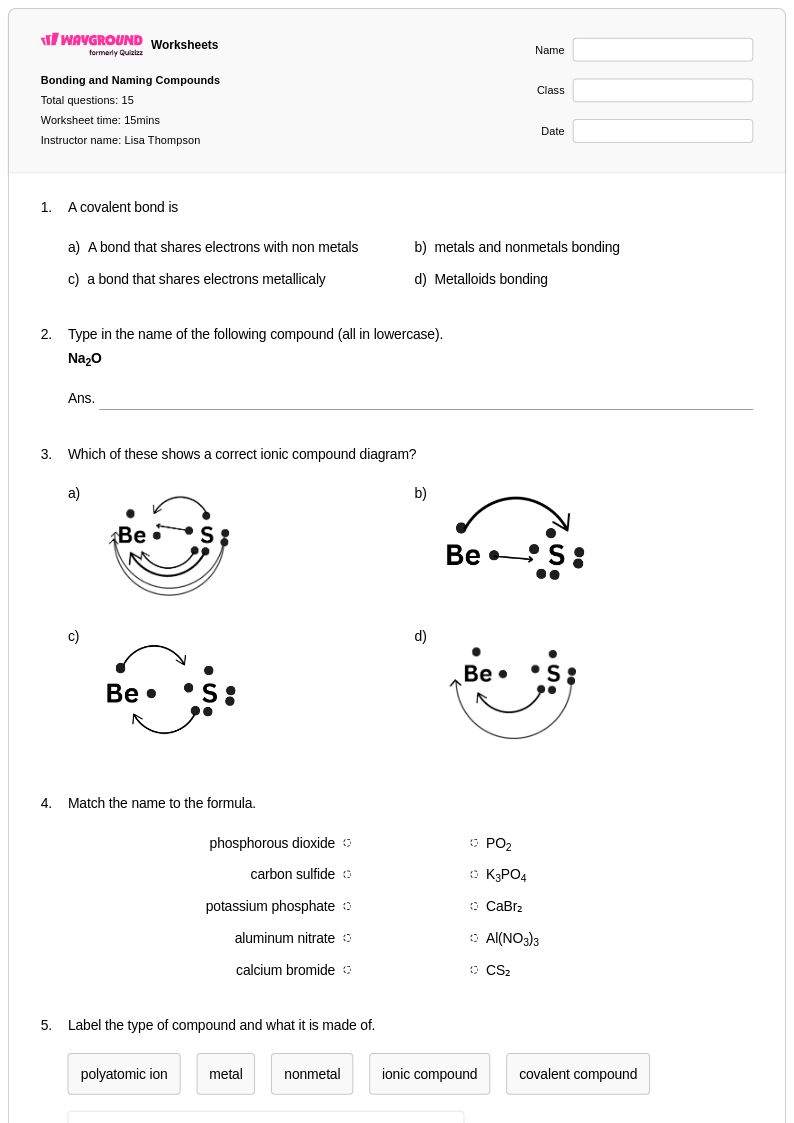
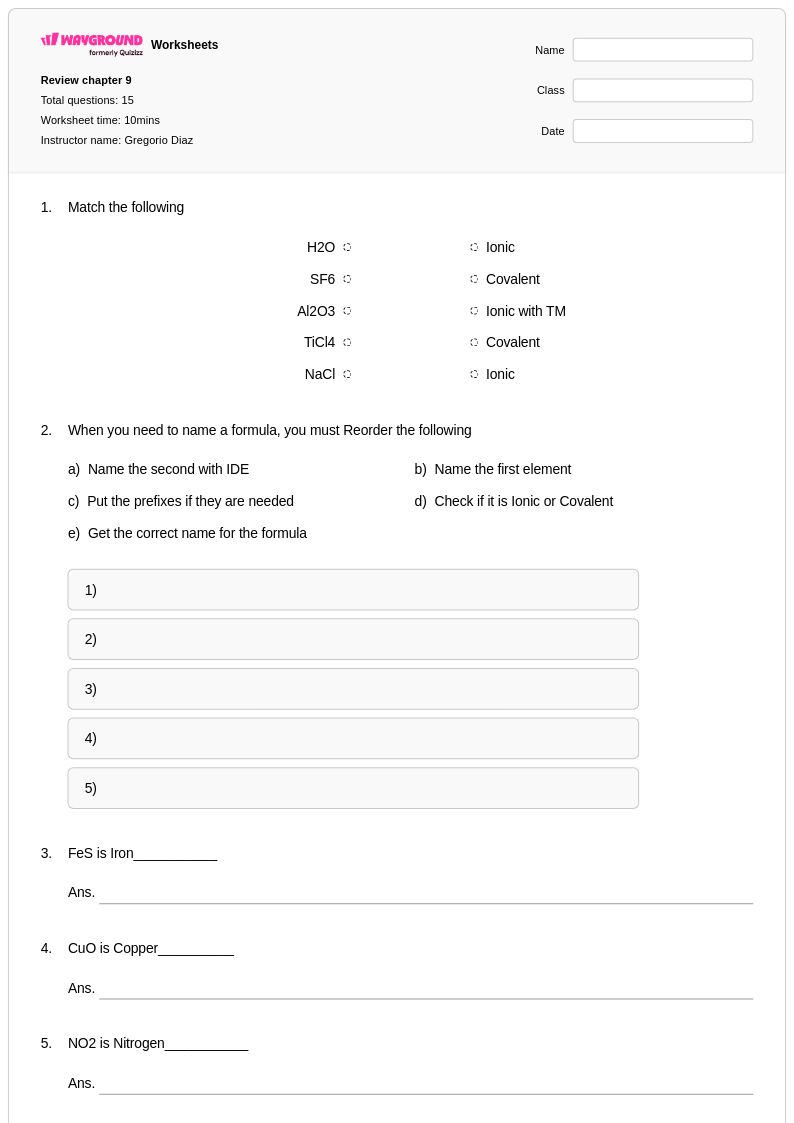
Naming exercises should move from recognition to production — first having students identify prefixes (mono-, di-, tri-) in given names, then requiring them to write names from formulas independently. Mixed practice problems that interleave binary covalent compounds with polyatomic examples reinforce the distinction between naming systems. Requiring students to also write the formula from a given name closes the loop and prevents one-directional memorization.
What are the most common mistakes students make when learning about covalent compounds?
The most persistent misconception is confusing ionic and covalent bonding — students frequently apply ionic naming rules (using charge-based names) to covalent compounds, especially when metal-nonmetal pairs appear similar to nonmetal-nonmetal pairs. A second common error is drawing Lewis structures with incorrect electron counts, often by forgetting to account for all valence electrons or by misplacing lone pairs. Students also frequently struggle to connect molecular geometry to polarity, incorrectly assuming that any molecule with polar bonds must be polar overall.
How do I help students distinguish between ionic and covalent compounds?
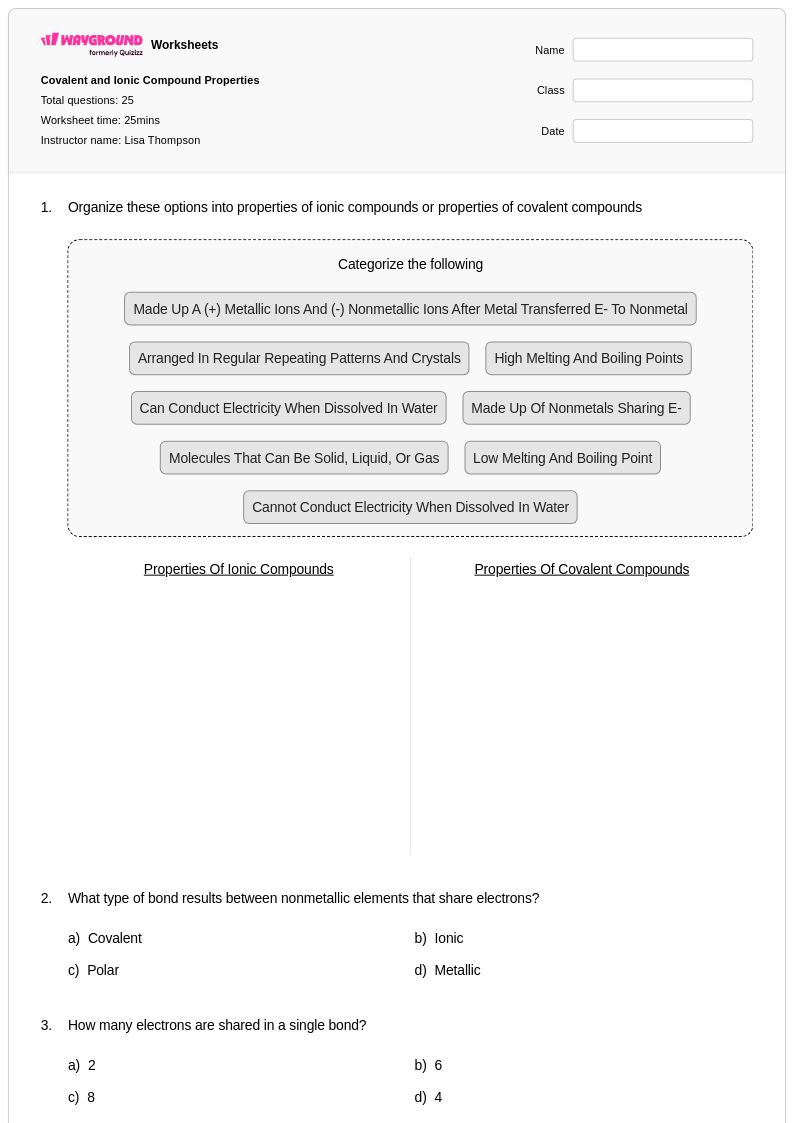
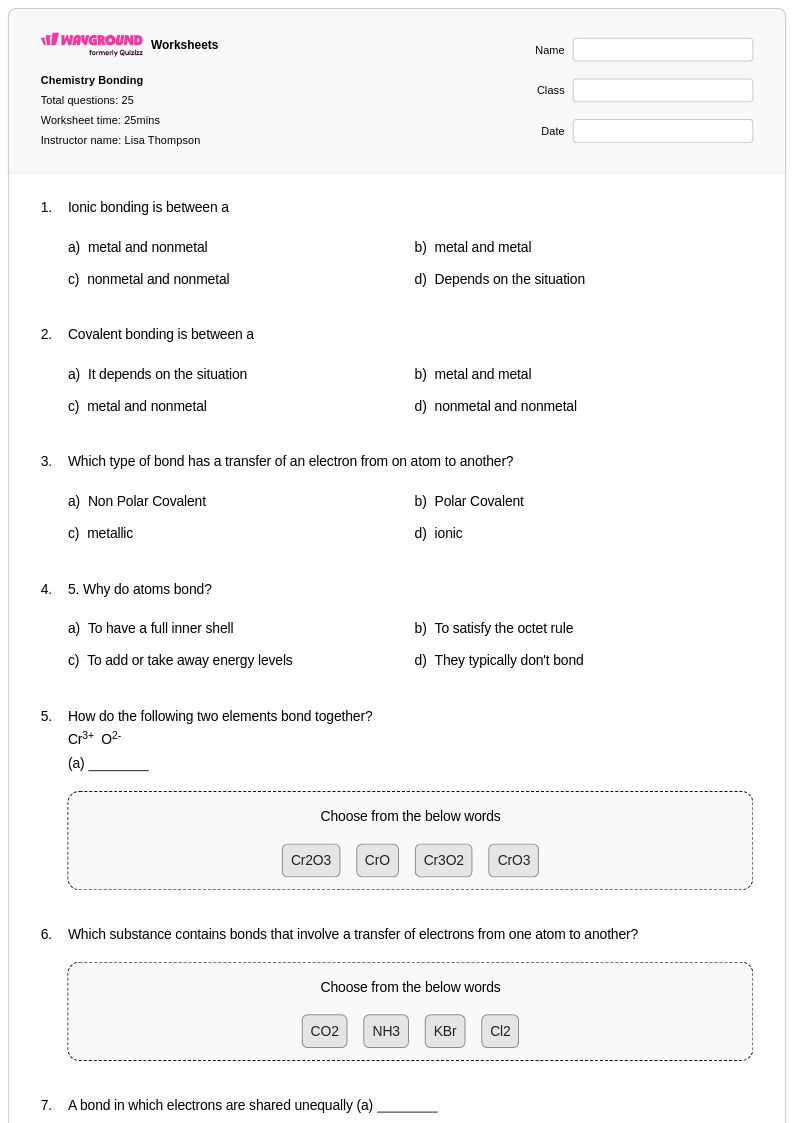
Emphasize the compositional rule first: covalent compounds form between two nonmetals, while ionic compounds involve a metal and a nonmetal. From there, connect composition to behavior — covalent compounds generally have lower melting points, do not conduct electricity in solution, and exist as discrete molecules rather than lattice structures. Side-by-side comparison activities, where students classify and justify their reasoning for a set of compounds, are especially effective at solidifying this distinction.
How do I use Wayground's covalent compounds worksheets in my classroom?
Wayground's covalent compounds worksheets are available as printable PDFs for traditional classroom distribution — useful for homework, lab preparation, or test review — and in digital formats for technology-integrated environments. Teachers can also host the worksheets as a live quiz on Wayground, enabling real-time student responses and immediate feedback. For students who need additional support, Wayground's accommodation tools allow teachers to enable features like read aloud, extended time, or reduced answer choices on a per-student basis without affecting the rest of the class.
How can I differentiate covalent compounds instruction for students at different skill levels?
For students who are struggling, focus practice on one concept at a time — Lewis structures before geometry, geometry before polarity — and use reduced-complexity problems that isolate the skill. For advanced students, introduce exceptions like expanded octets and resonance structures to deepen understanding beyond the standard curriculum. On Wayground, teachers can assign individual accommodations such as reduced answer choices or extended time to specific students, allowing differentiated support to run quietly in the background during a shared digital assignment.