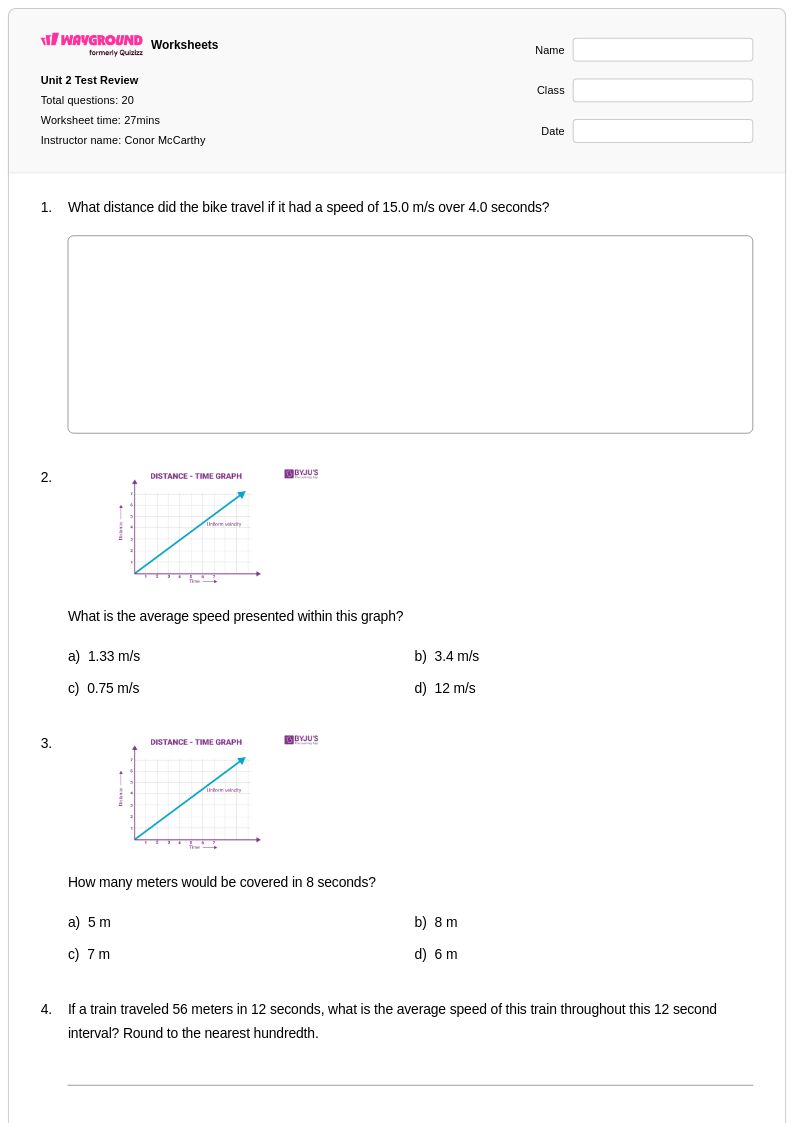
Free Printable Electrolysis and Faraday's Law Worksheets for Year 11
Year 11 electrolysis and Faraday's Law worksheets from Wayground provide comprehensive printables and practice problems with answer keys to help students master electrochemical reactions and quantitative relationships in chemistry.
Explore printable Electrolysis and Faraday's Law worksheets for Year 11
Year 11 electrolysis and Faraday's Law worksheets available through Wayground provide comprehensive practice with electrochemical processes and quantitative calculations that form the foundation of advanced chemistry study. These expertly designed resources strengthen students' understanding of oxidation-reduction reactions at electrodes, the relationship between electric current and chemical change, and the mathematical principles governing electrolytic cells. Students work through practice problems that cover calculating the amount of substance produced or consumed during electrolysis, determining current efficiency, and applying Faraday's constants to real-world scenarios. Each worksheet includes detailed answer keys that guide learners through step-by-step solutions, while free printable pdf formats ensure accessibility for both classroom instruction and independent study sessions.
Wayground's extensive collection of teacher-created electrolysis and Faraday's Law resources draws from millions of educational materials specifically curated for Year 11 chemistry instruction. The platform's advanced search and filtering capabilities allow educators to quickly locate worksheets aligned with curriculum standards and differentiate instruction based on individual student needs. Teachers can customize existing materials or create entirely new practice sets, with flexible options for both digital delivery and printable pdf distribution. These comprehensive tools support lesson planning by providing ready-to-use assessments and practice materials, while also serving as valuable resources for targeted remediation when students struggle with electrochemical calculations and enrichment opportunities for advanced learners seeking additional challenge in quantitative chemistry applications.
FAQs
How do I teach Faraday's Law of electrolysis to chemistry students?
Start by grounding students in the relationship between electric charge, current, and time (Q = It) before introducing Faraday's constants and molar mass calculations. Use concrete examples like copper electroplating or the electrolysis of water so students can visualize what is physically happening at each electrode. Once students understand the conceptual setup, move into quantitative problem-solving where they calculate mass deposited or gas evolved. Building this progression from concept to calculation prevents students from treating Faraday's Law as a formula to memorize without understanding.
What practice problems best help students apply Faraday's Law?
The most effective practice problems require students to calculate the mass of a substance deposited or dissolved at an electrode given current, time, and molar mass, then work backward from a target mass to find the required charge or time. Problems involving multi-electron transfers, such as the reduction of Cu²⁺ or Al³⁺, are especially valuable because they force students to account for the number of moles of electrons per mole of product. Including problems set in real-world contexts, such as industrial electrolysis or electroplating, helps students connect stoichiometric calculations to practical applications.
What mistakes do students commonly make when solving Faraday's Law problems?
The most frequent error is failing to account for the number of electrons transferred per ion, leading students to use the wrong mole ratio between charge and substance. Students also regularly confuse Faraday's constant (96,485 C/mol) with the number of moles of electrons rather than treating it as a conversion factor. A third common mistake is using inconsistent units, particularly mixing milliamps with amperes or seconds with minutes when calculating total charge. Requiring students to show unit analysis at every step catches most of these errors before they compound.
How can I differentiate electrolysis and Faraday's Law instruction for students at different skill levels?
For students who are struggling, reduce cognitive load by providing scaffolded problems that isolate one variable at a time and include a reference sheet with Faraday's constant and the core equation. Advanced students benefit from multi-step problems that chain electrode reactions with stoichiometric calculations or compare the efficiency of different electrolytic cells. On Wayground, teachers can assign digital worksheets with accommodations such as reduced answer choices or read-aloud support for individual students, while the rest of the class works under standard settings without disruption.
How do I use Wayground's electrolysis and Faraday's Law worksheets in my classroom?
Wayground's electrolysis and Faraday's Law worksheets are available as printable PDFs for traditional classroom use and in digital formats for technology-integrated environments, including the option to host them as a quiz directly on Wayground. Teachers can use the printable versions for in-class problem sets or homework and switch to digital mode for immediate feedback during review sessions. Each worksheet includes a detailed answer key, so teachers can use them for self-paced practice, peer checking, or guided worked examples.
How do I assess whether students truly understand Faraday's Law versus just plugging numbers into a formula?
Conceptual understanding is best assessed by asking students to explain why doubling the current halves the time needed to deposit the same mass, or by presenting an electrode reaction they have not seen before and asking them to predict the product and calculate the yield. Students who only know the formula will struggle to set up novel problems or interpret what their numerical answer physically means. Including short written justification prompts alongside calculation problems is an effective way to surface gaps between procedural fluency and genuine understanding.