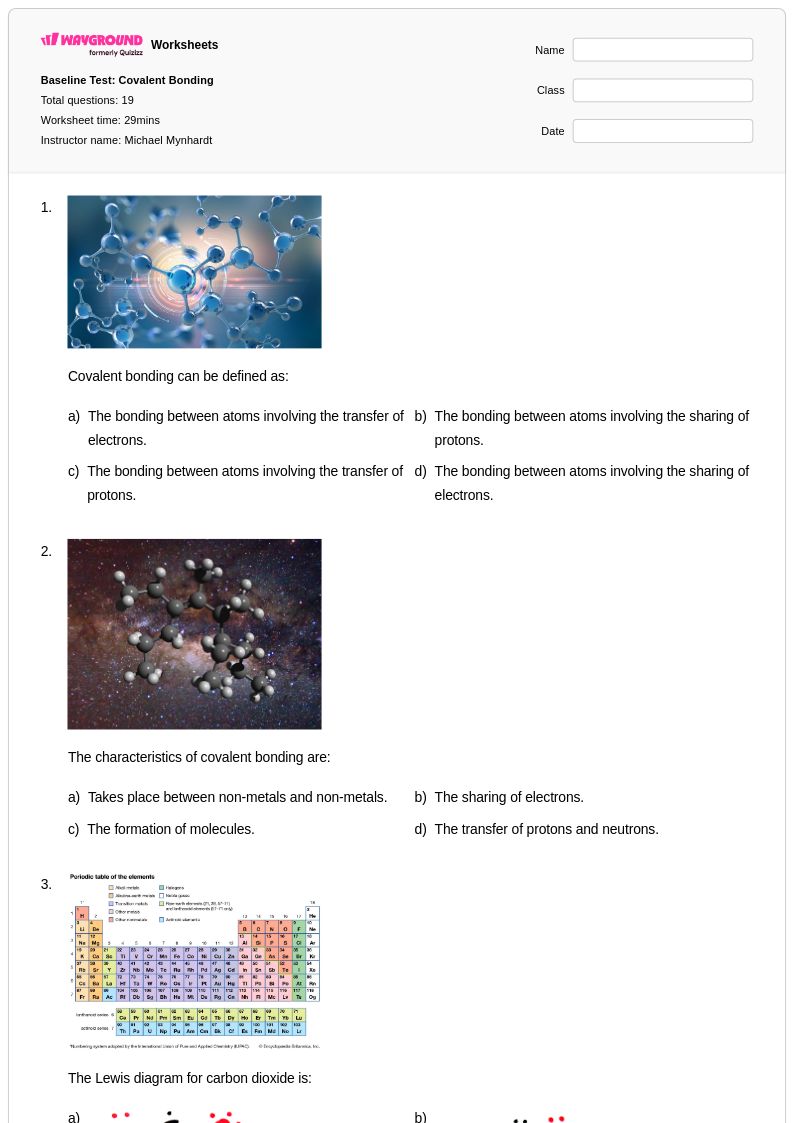
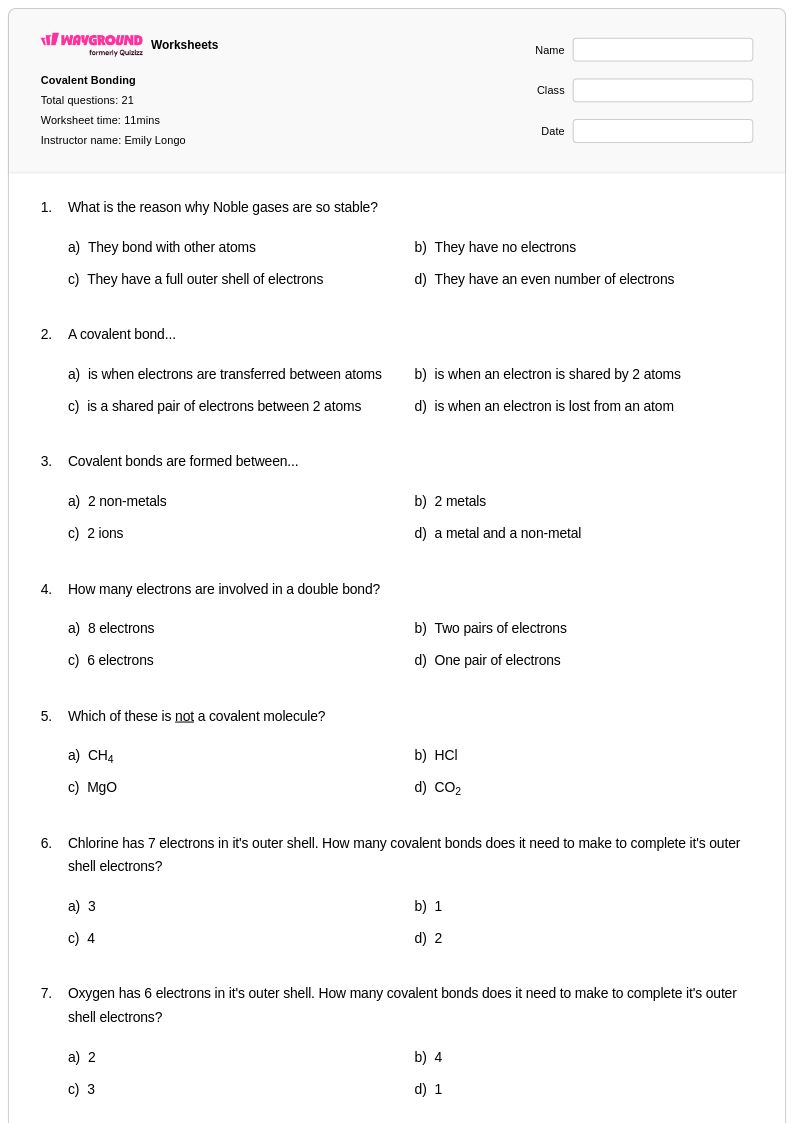
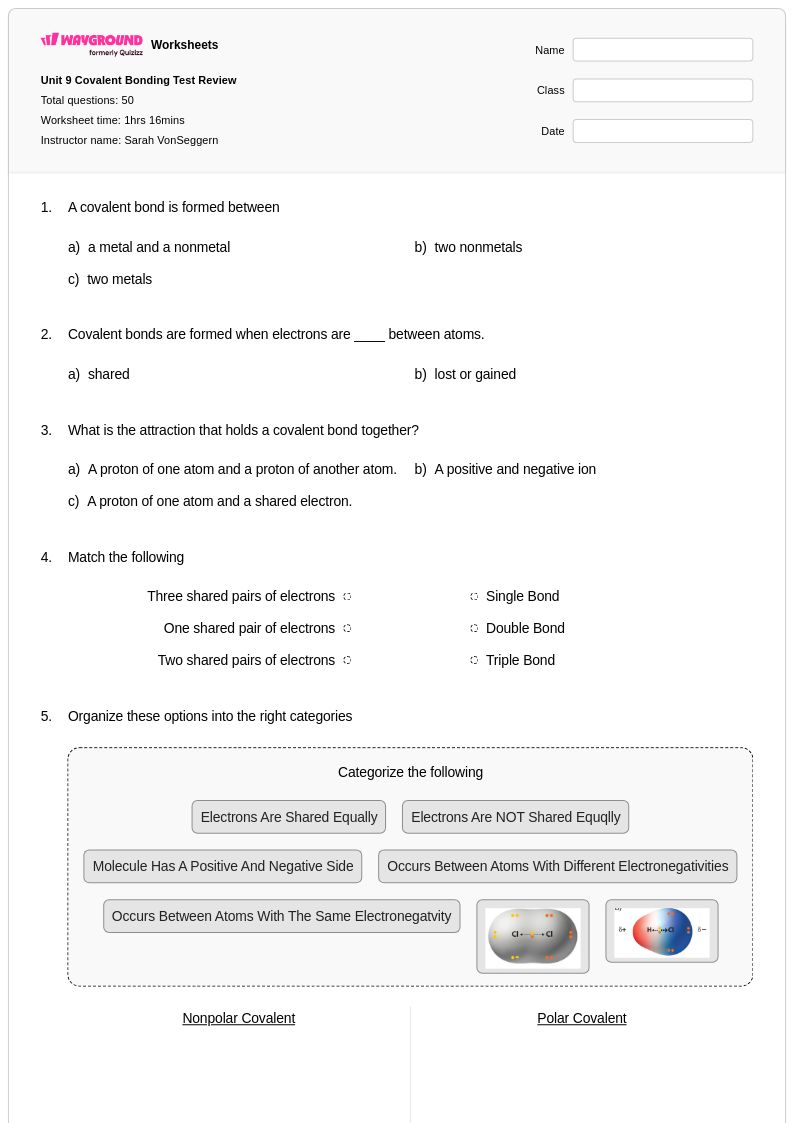
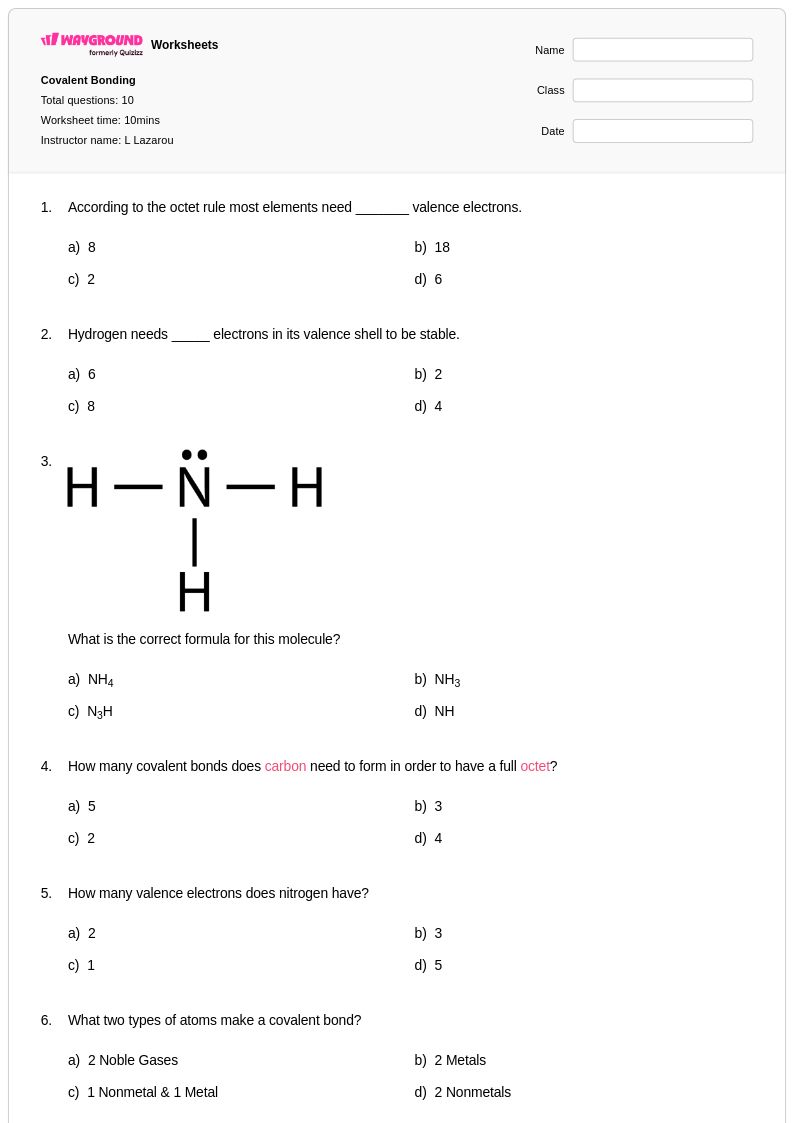
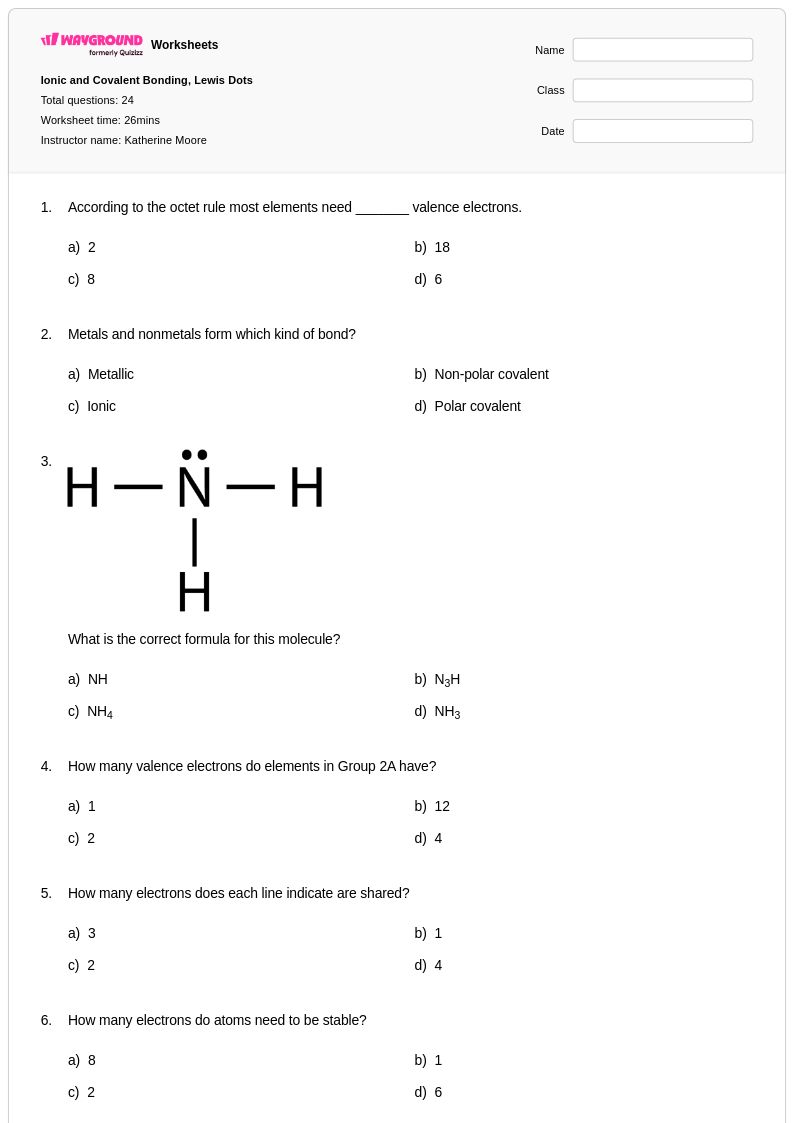
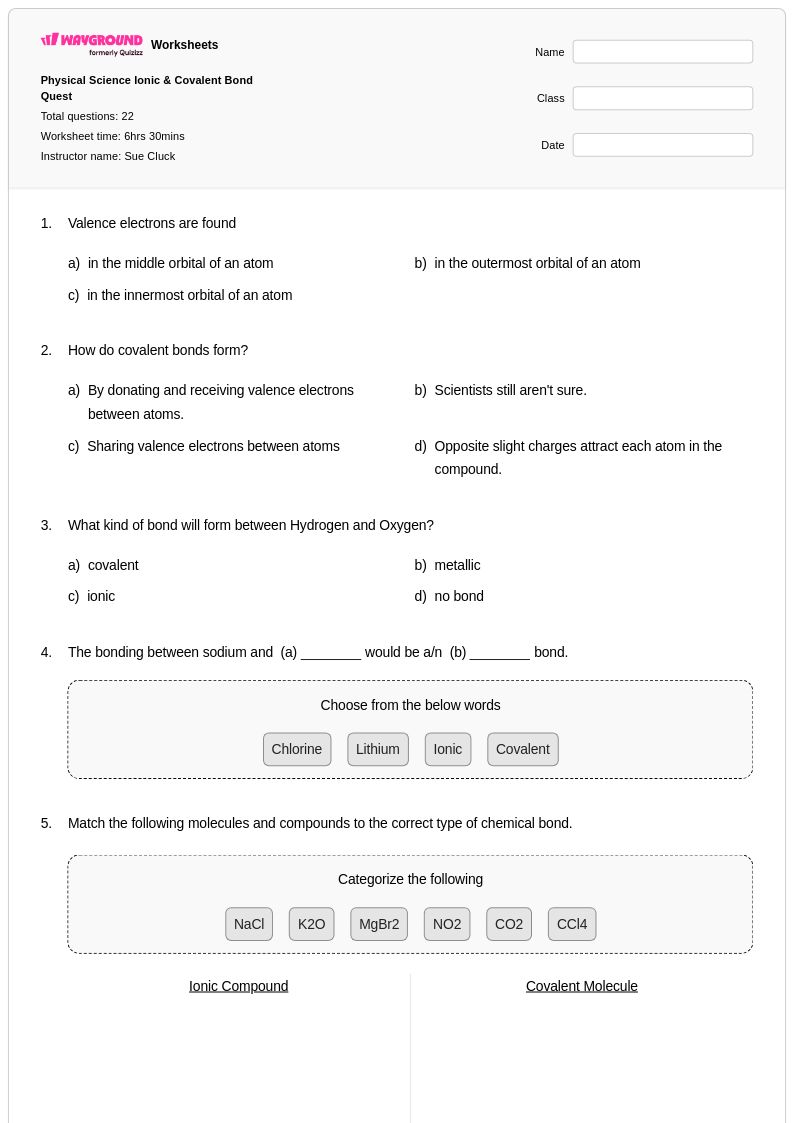
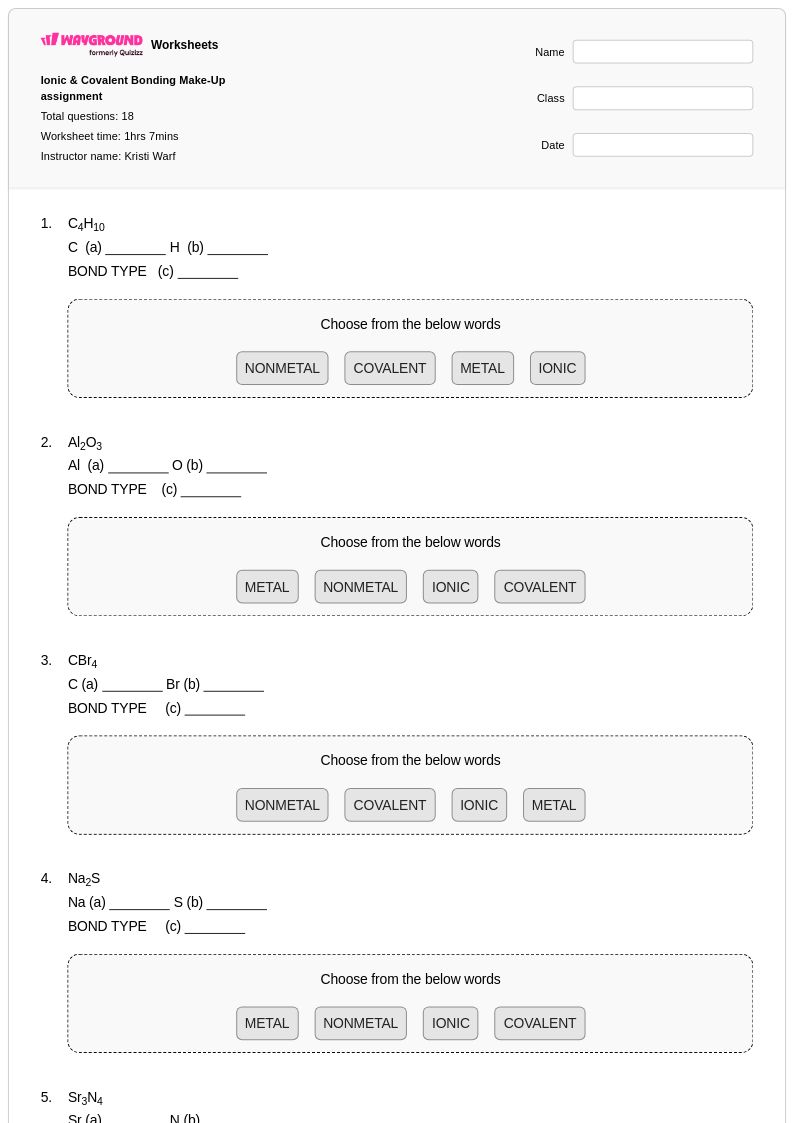
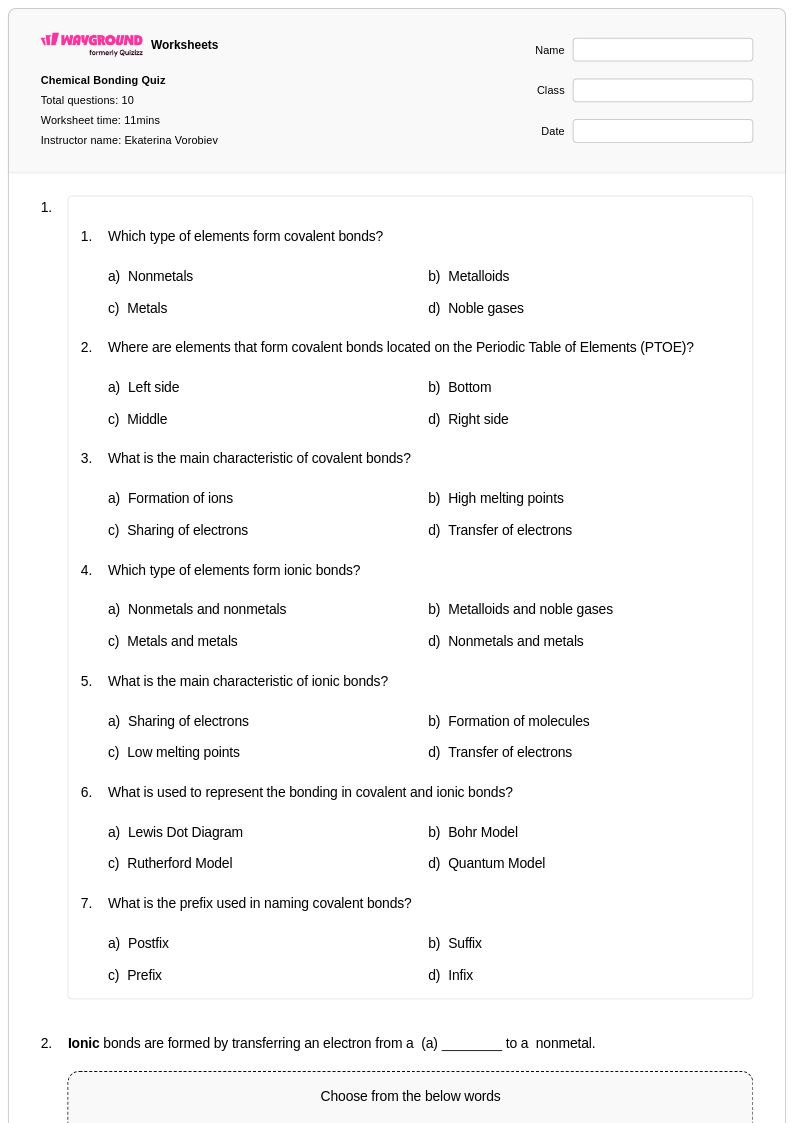
Discover comprehensive covalent bonding worksheets from Wayground featuring free printables, practice problems, and answer keys to help students master molecular structures, electron sharing, and chemical bond formation in chemistry.
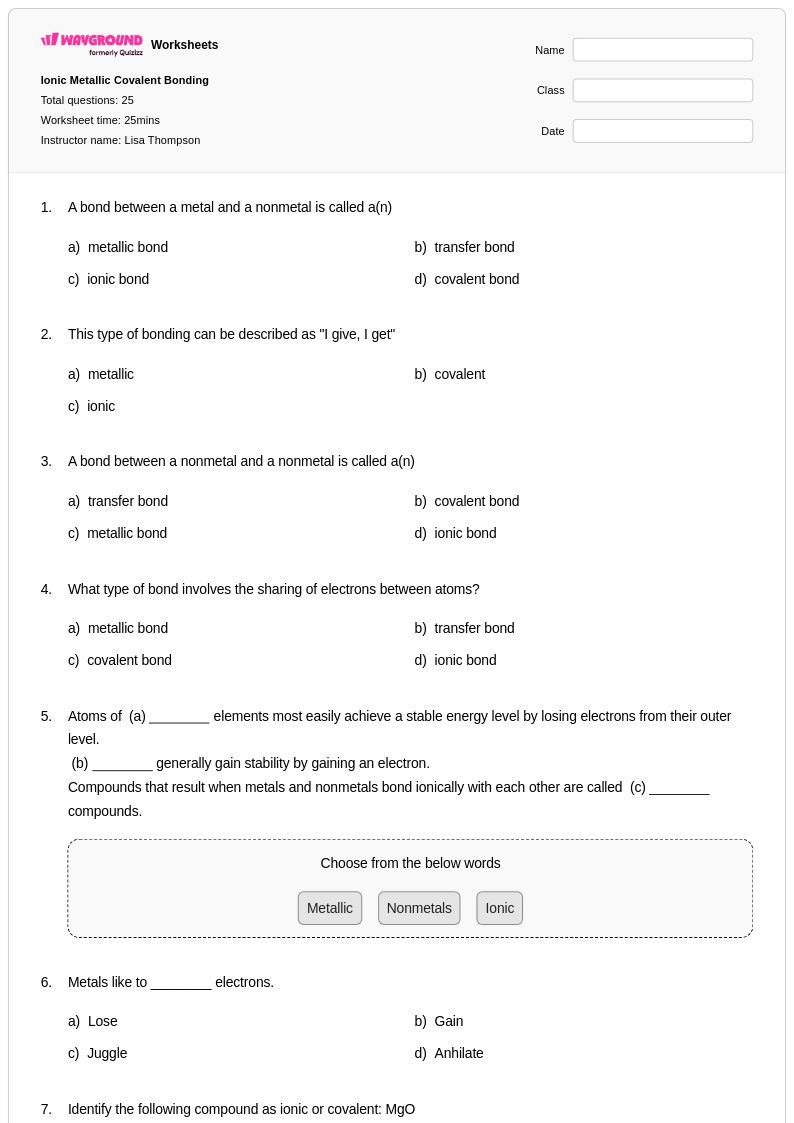
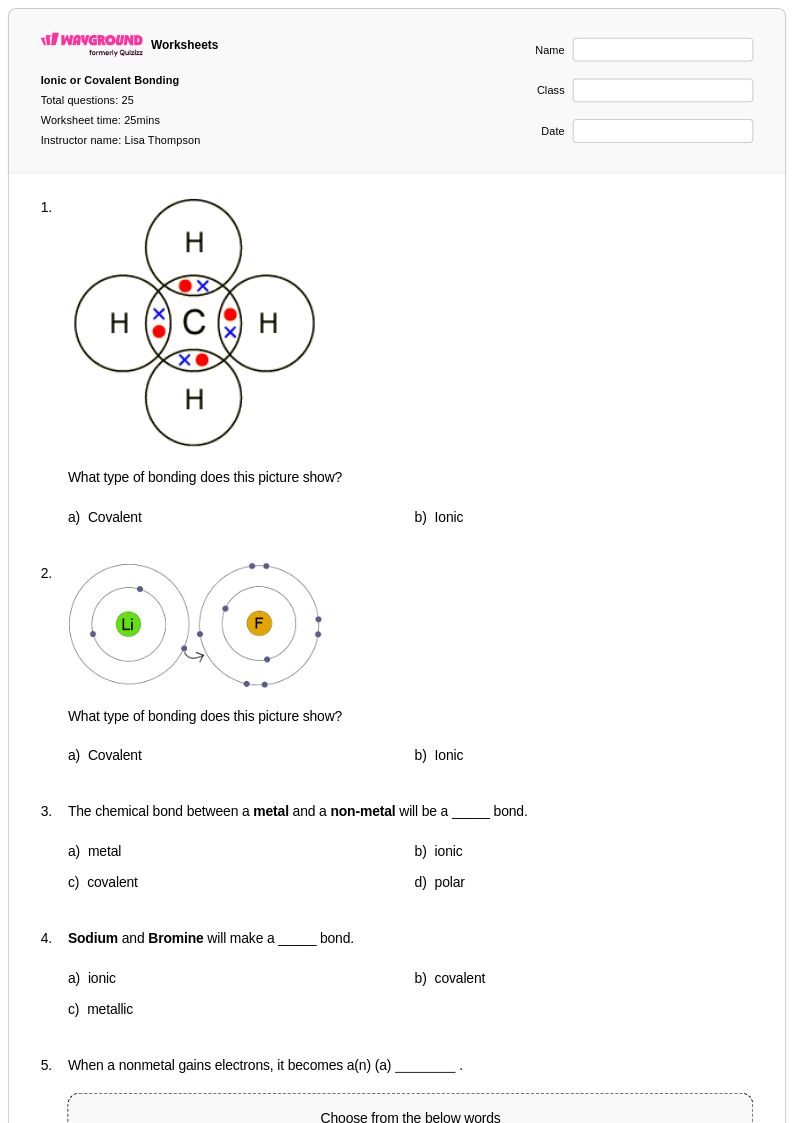
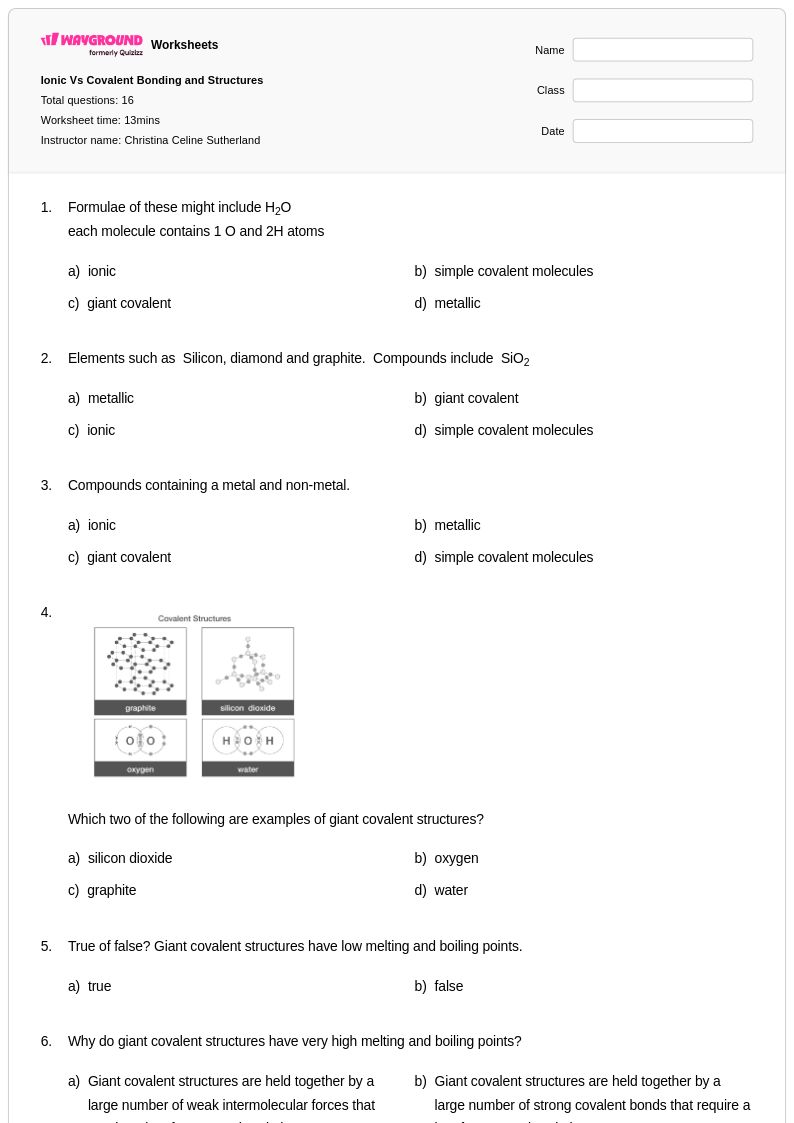
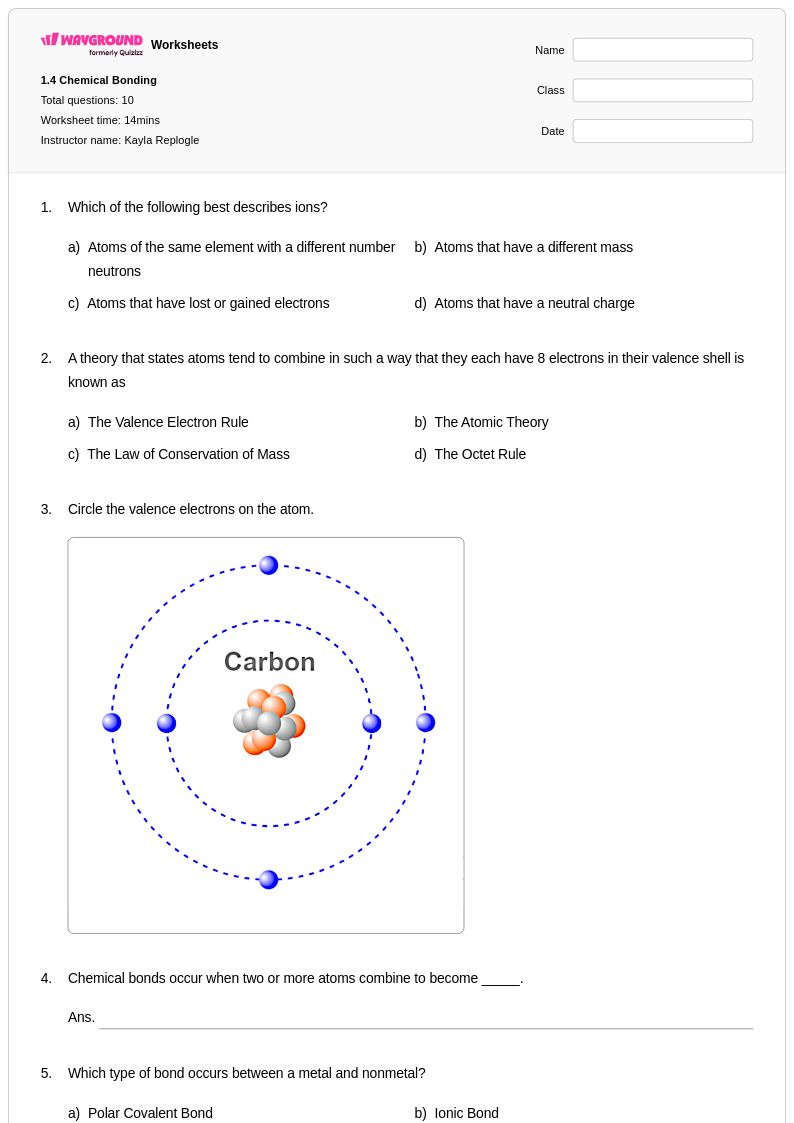
Covalent bonding worksheets available through Wayground (formerly Quizizz) provide comprehensive coverage of molecular bond formation, electron sharing mechanisms, and molecular geometry concepts essential for mastering chemical bonding theory. These expertly designed resources strengthen students' understanding of how atoms share electrons to achieve stable electron configurations, including single, double, and triple bond formations, Lewis dot structures, and VSEPR theory applications. The worksheet collections include detailed practice problems that guide learners through predicting molecular shapes, determining bond polarity, and analyzing intermolecular forces, with comprehensive answer keys that support both independent study and classroom instruction. Teachers can access these materials as free printables in convenient pdf formats, making them ideal for homework assignments, laboratory preparations, and assessment practice.
Wayground's extensive platform supports chemistry educators with millions of teacher-created covalent bonding resources that can be easily discovered through robust search and filtering capabilities aligned with national and state chemistry standards. The platform's differentiation tools enable teachers to customize worksheet difficulty levels and problem types to meet diverse learning needs, from introductory electron sharing concepts to advanced molecular orbital theory applications. These versatile materials are available in both printable pdf formats for traditional classroom use and interactive digital versions for online learning environments, providing flexibility for lesson planning, targeted remediation of bonding misconceptions, enrichment activities for advanced students, and systematic skill practice that builds conceptual understanding progressively. The comprehensive collection ensures teachers have access to high-quality resources that support effective instruction across all aspects of covalent bonding theory and application.
FAQs
How do I teach covalent bonding to high school chemistry students?
Start by grounding students in the concept of electron sharing as a strategy atoms use to achieve stable, full outer electron shells, contrasting this with ionic bonding where electrons are transferred. Build from single bonds to double and triple bonds using Lewis dot structures, then layer in polarity and molecular geometry using VSEPR theory. Connecting bond type to real molecular properties, such as why water is polar and CO2 is not, helps students see the conceptual payoff and retain the material more reliably.
What are common mistakes students make when drawing Lewis dot structures?
The most frequent errors include placing all electrons around the central atom before distributing them to terminal atoms, forgetting to check that each atom satisfies the octet rule (or duet rule for hydrogen), and failing to recognize when a double or triple bond is needed to resolve an electron deficiency. Students also commonly miscalculate the total number of valence electrons by not accounting for charge in polyatomic ions. Targeted practice problems that require students to show their electron-counting steps before drawing the structure help expose and correct these procedural gaps.
How can I help students understand the difference between polar and nonpolar covalent bonds?
Teach electronegativity as the key variable: when two atoms share electrons unequally because of a significant electronegativity difference, the bond is polar; when sharing is equal or nearly equal, the bond is nonpolar. Reinforce this by having students calculate electronegativity differences using Pauling values and classify bonds on a spectrum rather than as a binary. A common misconception is that a polar molecule must have polar bonds, but students must also analyze molecular geometry to determine whether bond dipoles cancel, which is why practicing both steps together on the same worksheet is effective.
What practice exercises build student fluency with VSEPR theory and molecular geometry?
Effective practice starts with identifying the number of bonding pairs and lone pairs around a central atom, then mapping that electron geometry to the corresponding molecular shape. Graduated exercises work best: begin with simple two- and three-atom molecules like H2O and NH3, then move to molecules with expanded octets. Having students predict bond angles before confirming them, and then explaining why lone pairs compress those angles, builds the reasoning habit rather than mere shape memorization.
How do I use covalent bonding worksheets effectively in my chemistry class?
Covalent bonding worksheets on Wayground are available as printable PDFs for use as homework, lab preparation, or in-class practice, and in digital formats that allow students to complete them on a device, which is useful for blended or fully online instruction. Teachers can also host the worksheets as an interactive quiz directly on Wayground, enabling real-time visibility into student responses. Because answer keys are included, the materials also work well for self-paced review or station rotations where students check their own work.
How can I differentiate covalent bonding instruction for students at different levels?
For students still developing fluency, focus practice on single-bond Lewis structures with straightforward molecules before introducing resonance or formal charge. More advanced students can work through expanded-octet molecules, molecular orbital theory concepts, and intermolecular force analysis. Wayground's platform allows teachers to assign accommodations at the individual student level, including read-aloud support for students who struggle with written chemistry vocabulary, reduced answer choices to lower cognitive load, and extended time settings, all without signaling differences to the rest of the class.