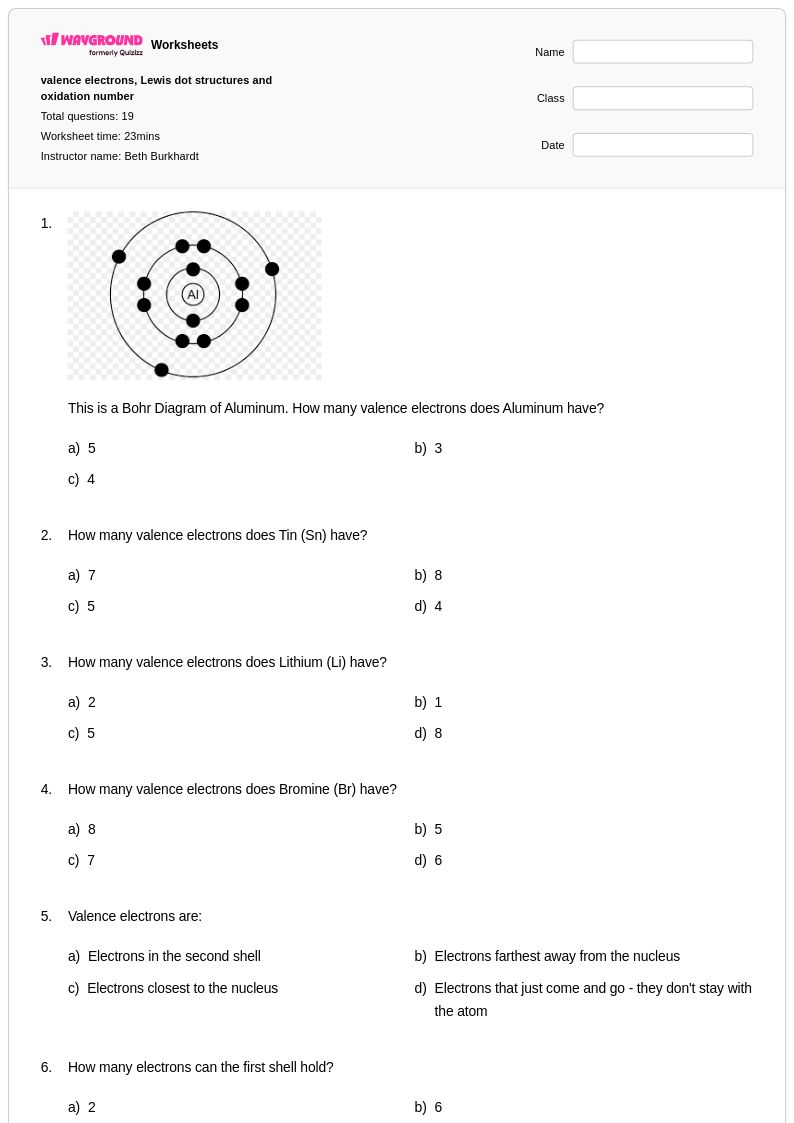
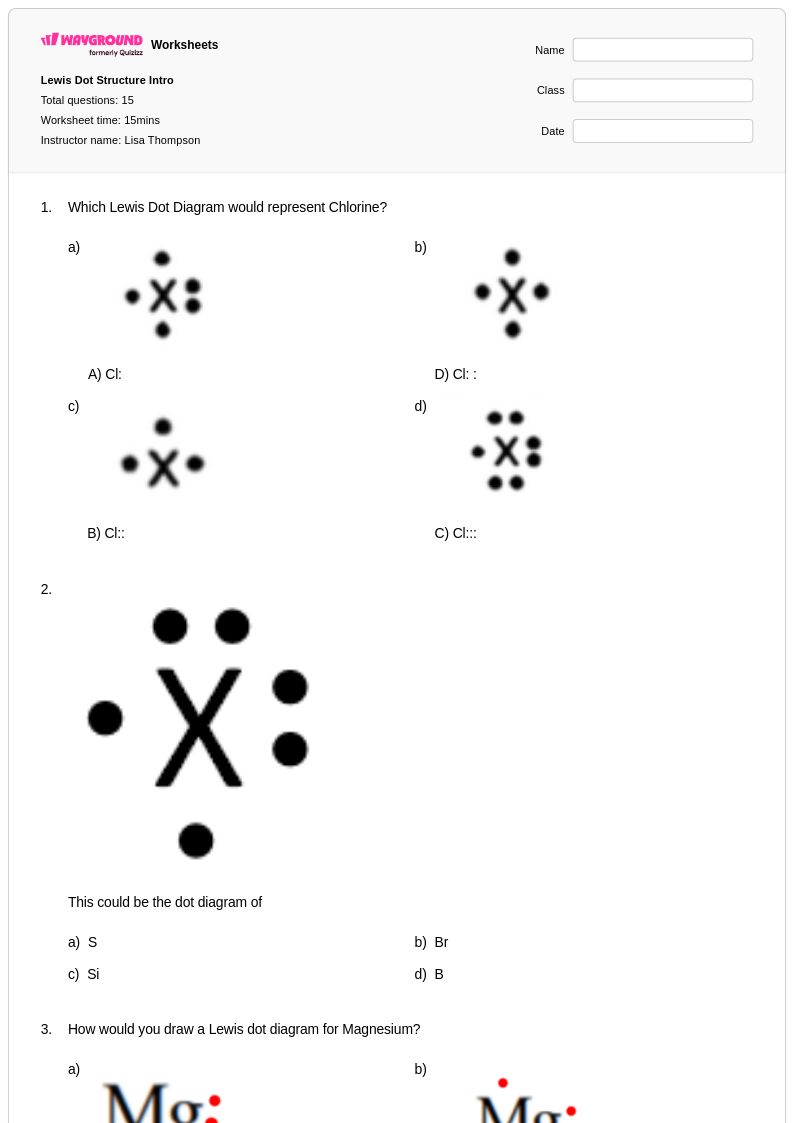
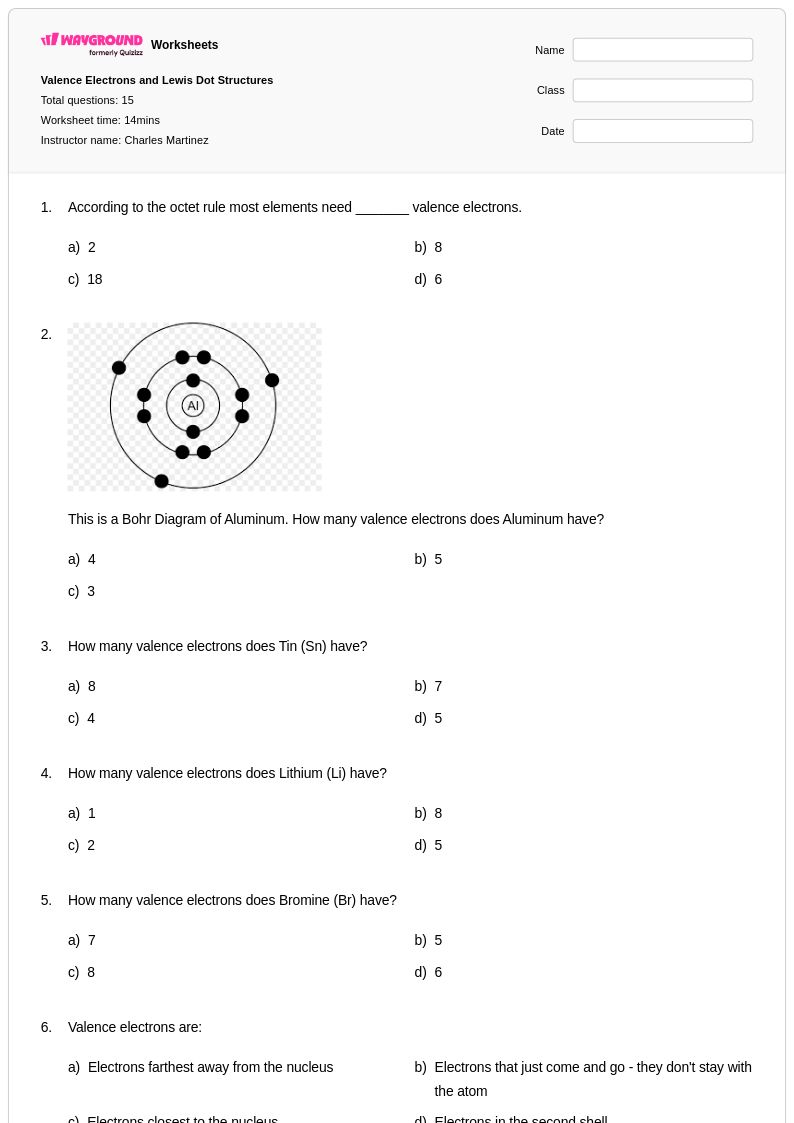
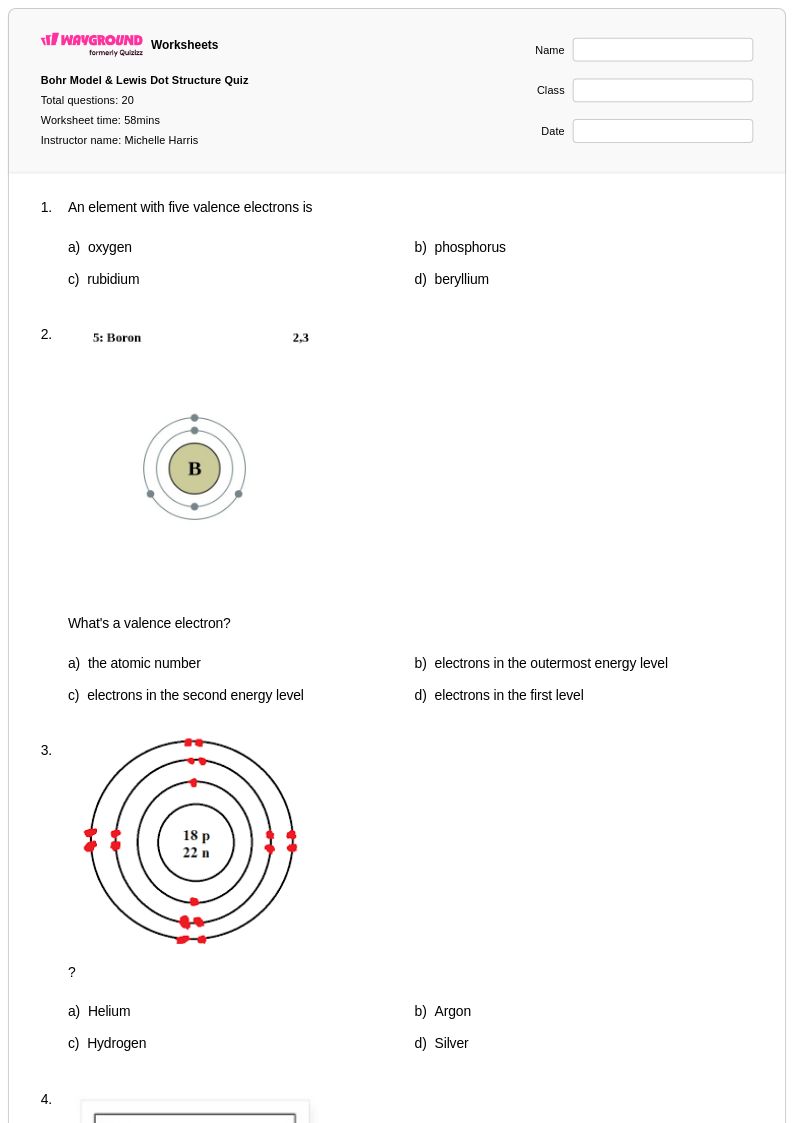
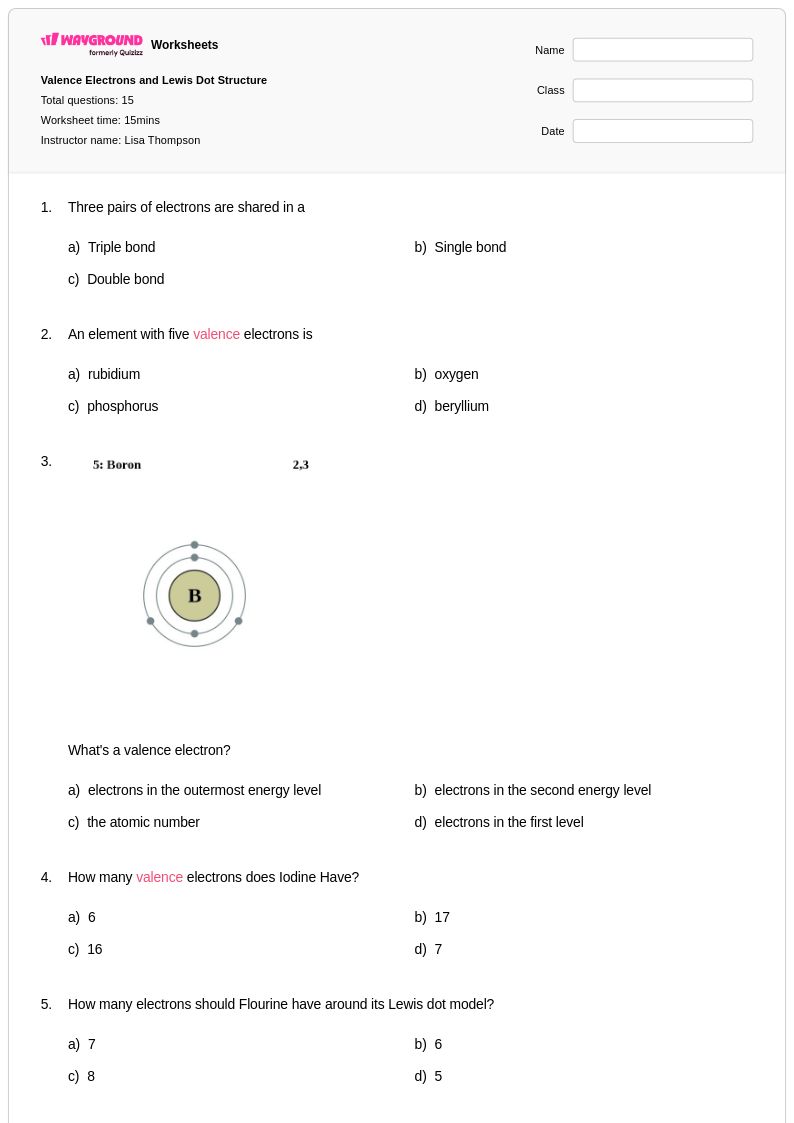
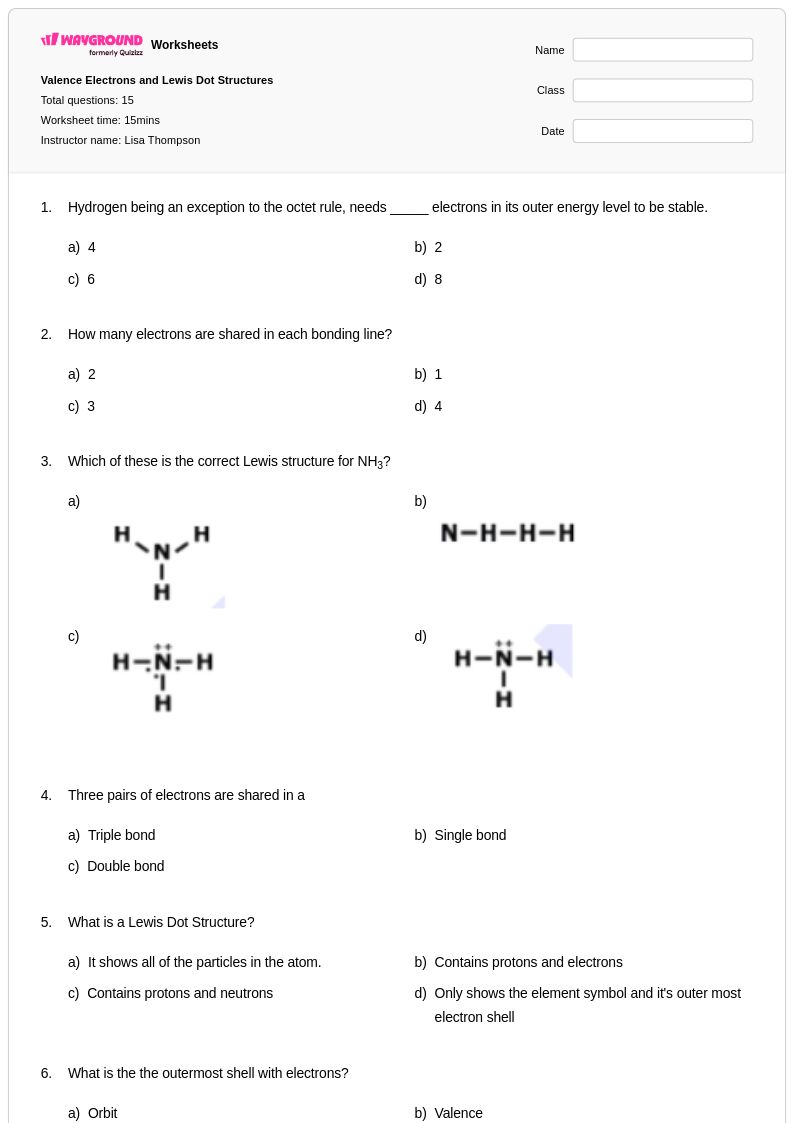
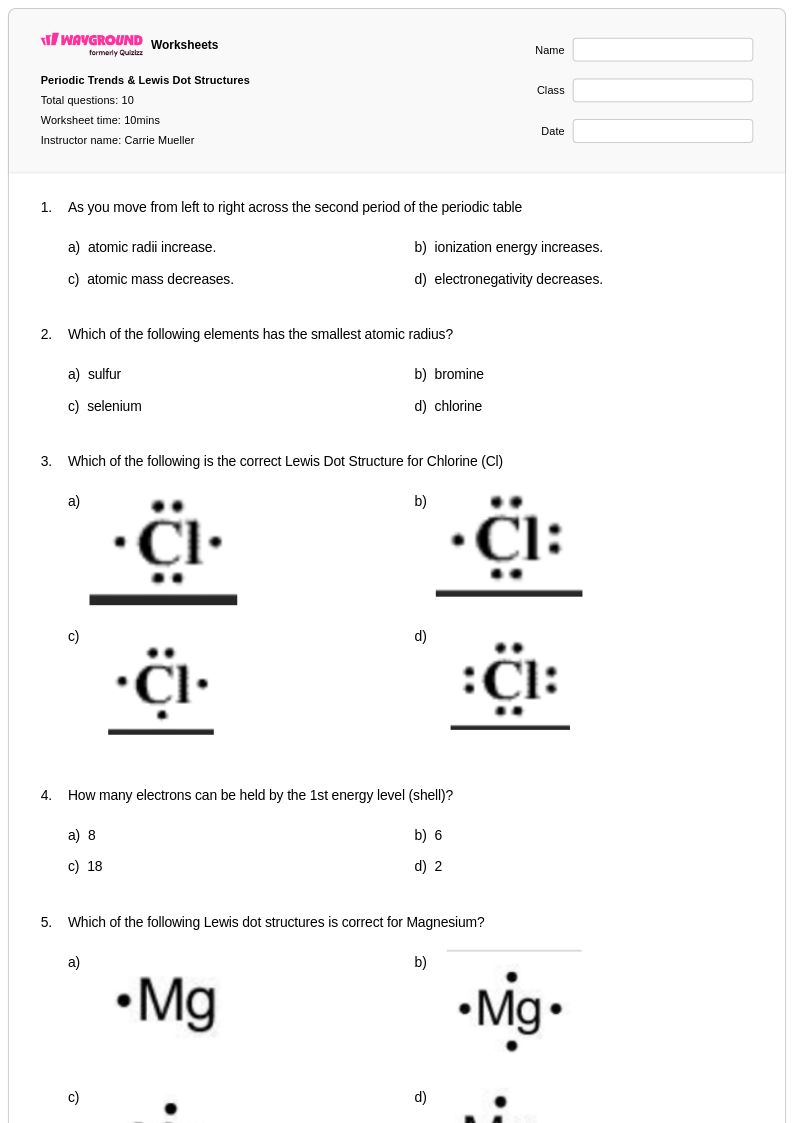
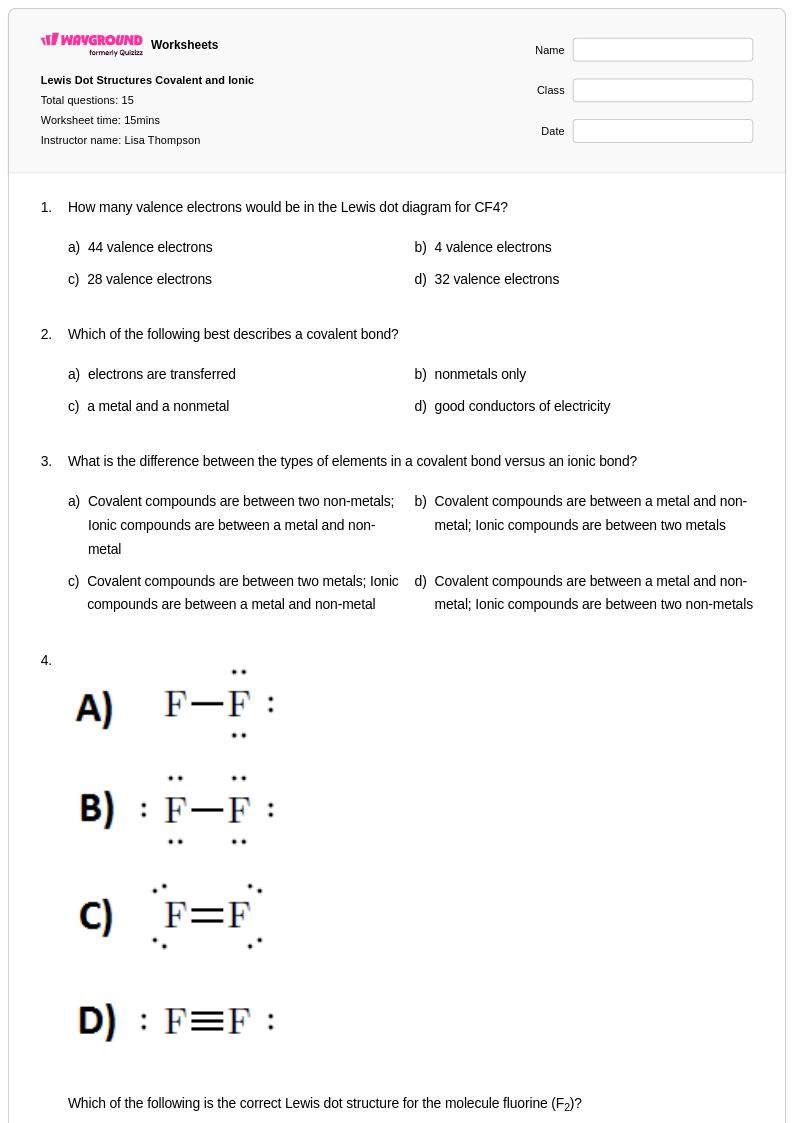
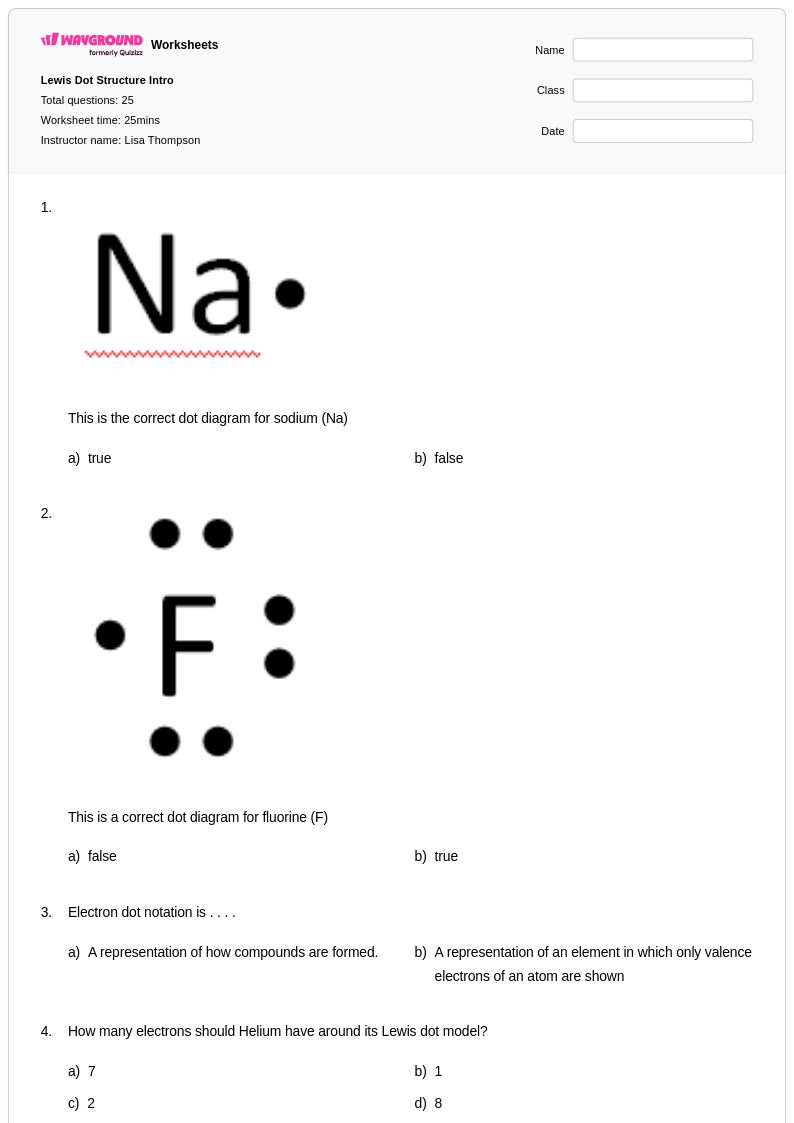
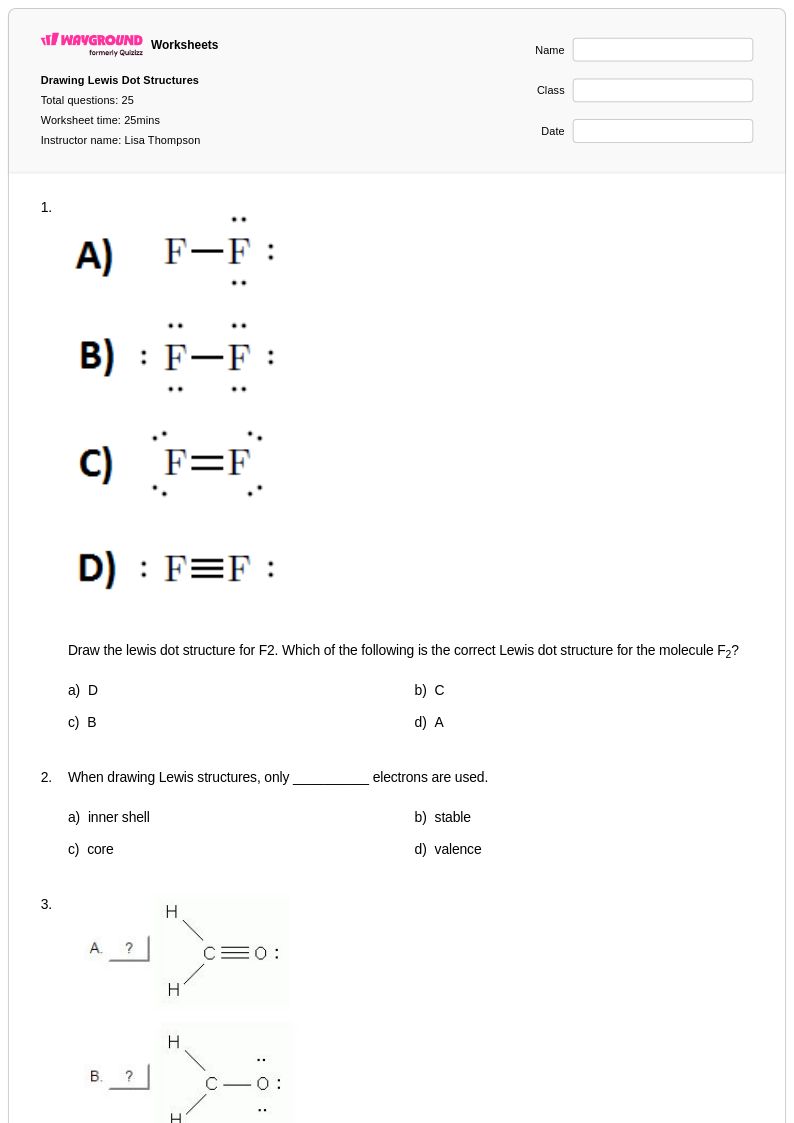
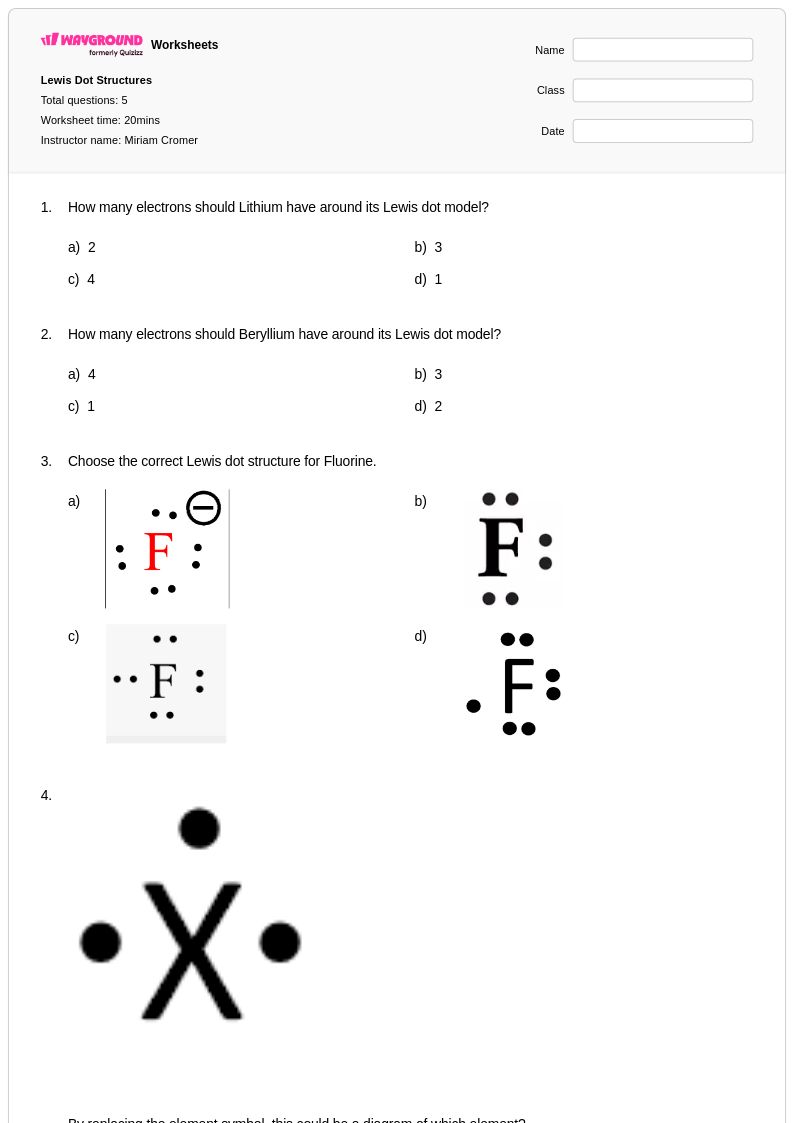
Explore Wayground's comprehensive collection of Lewis Dot Structure worksheets featuring free printables, practice problems, and answer keys to help students master electron configuration and chemical bonding fundamentals.
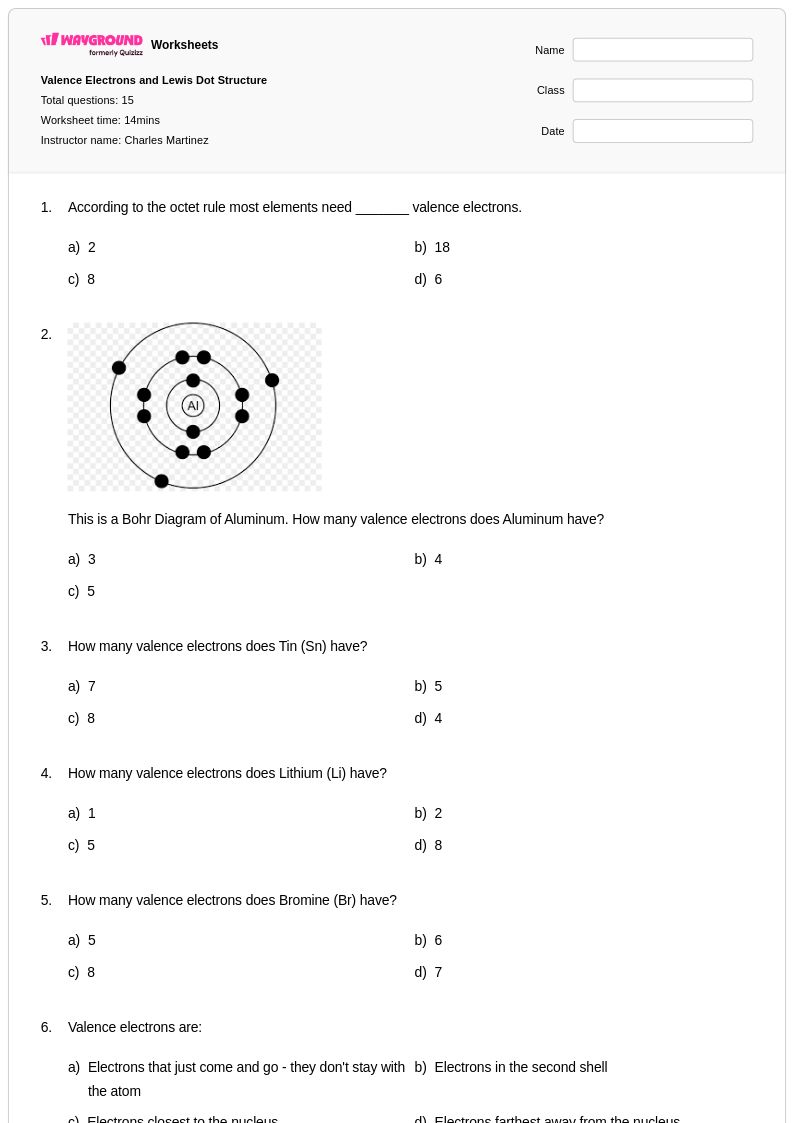
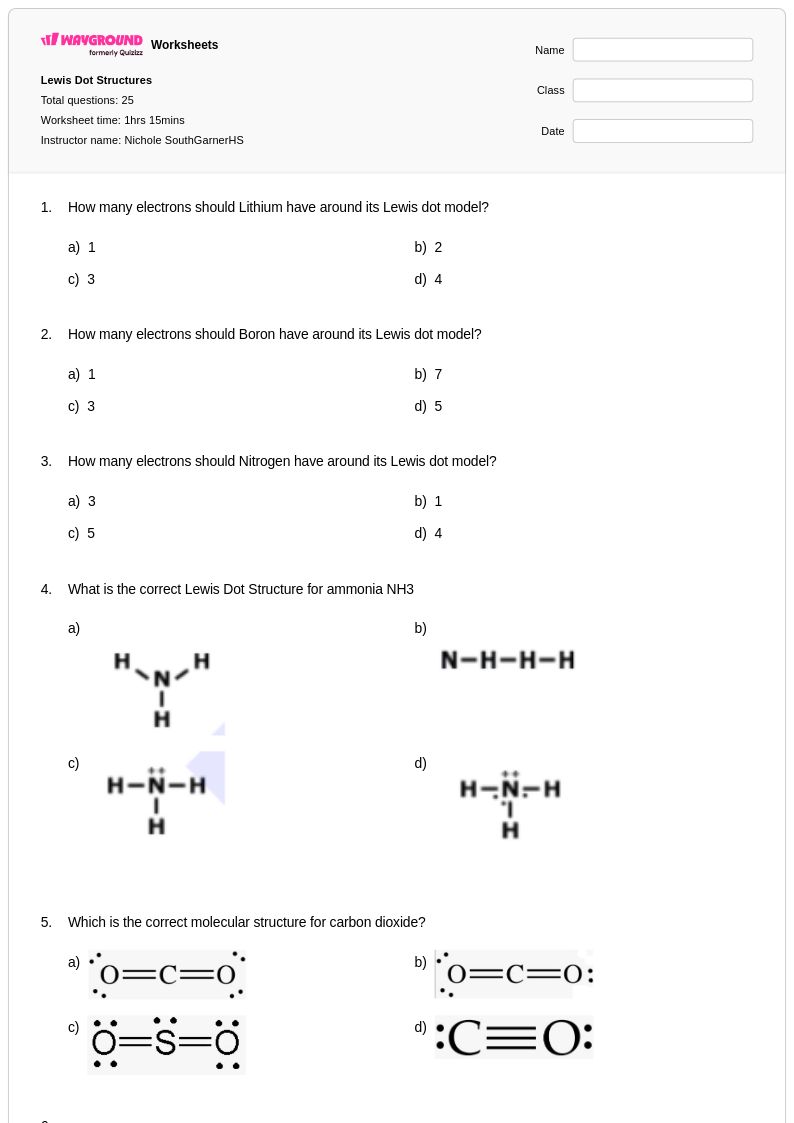
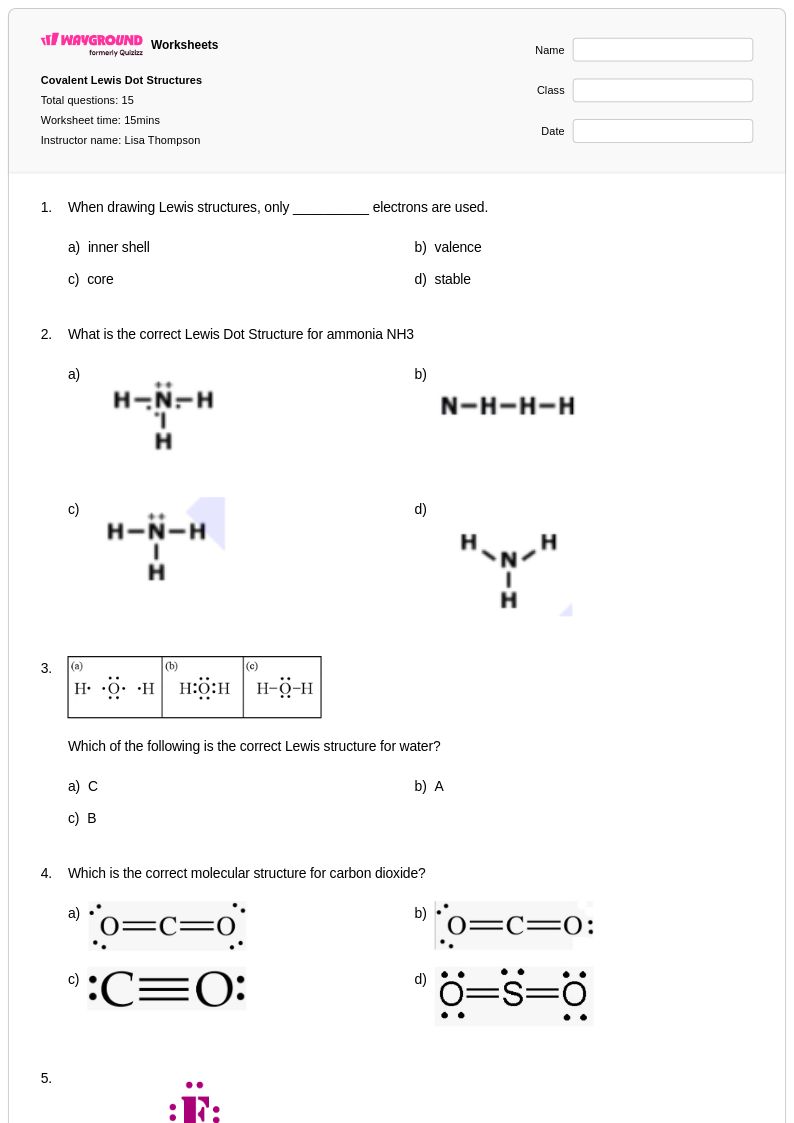
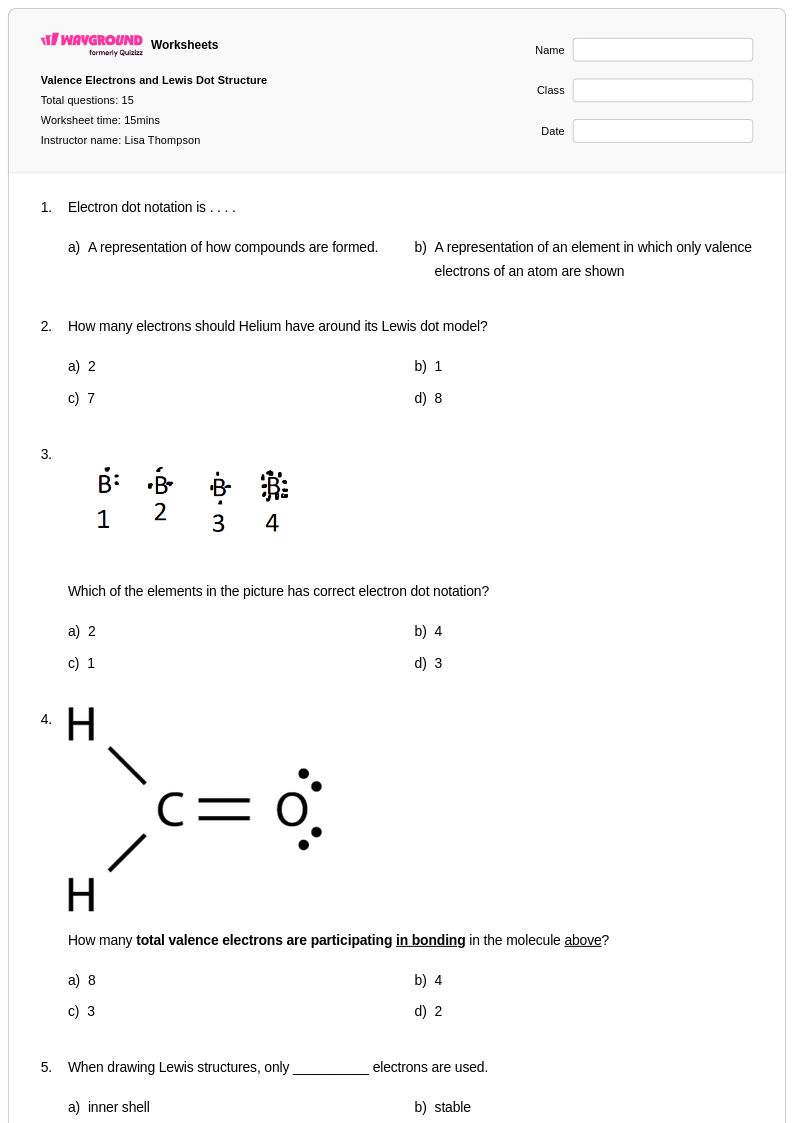
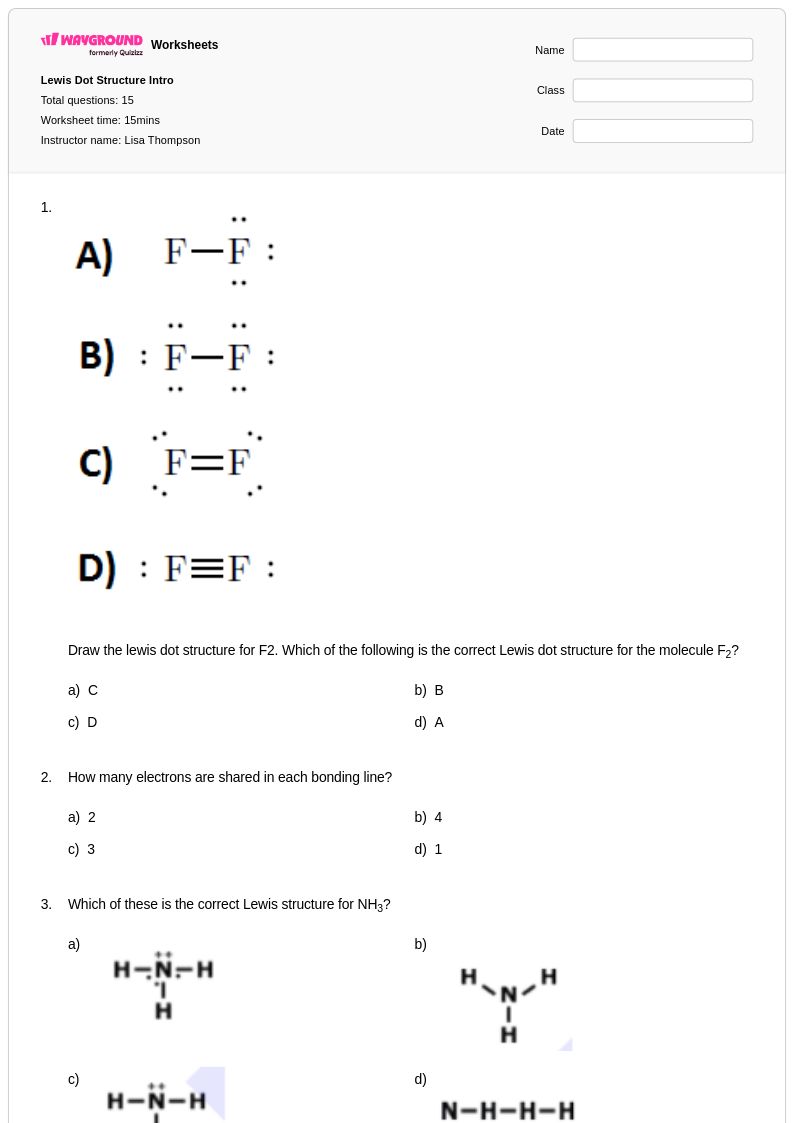
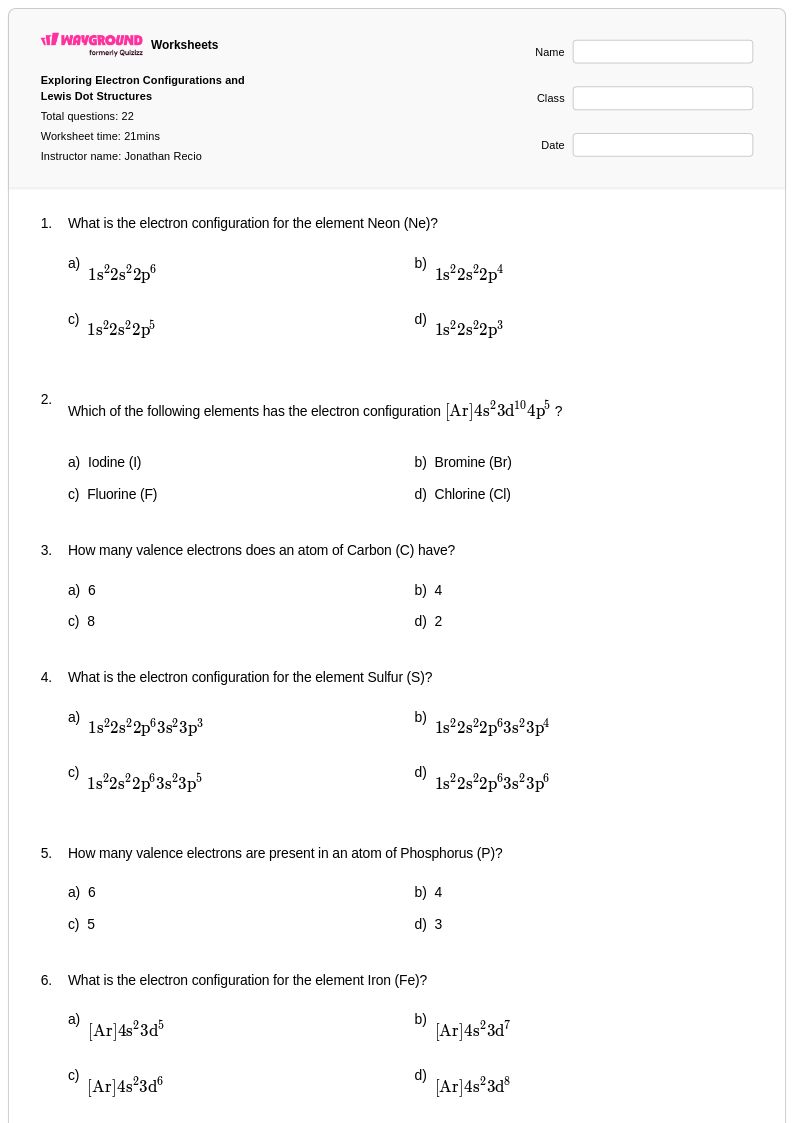
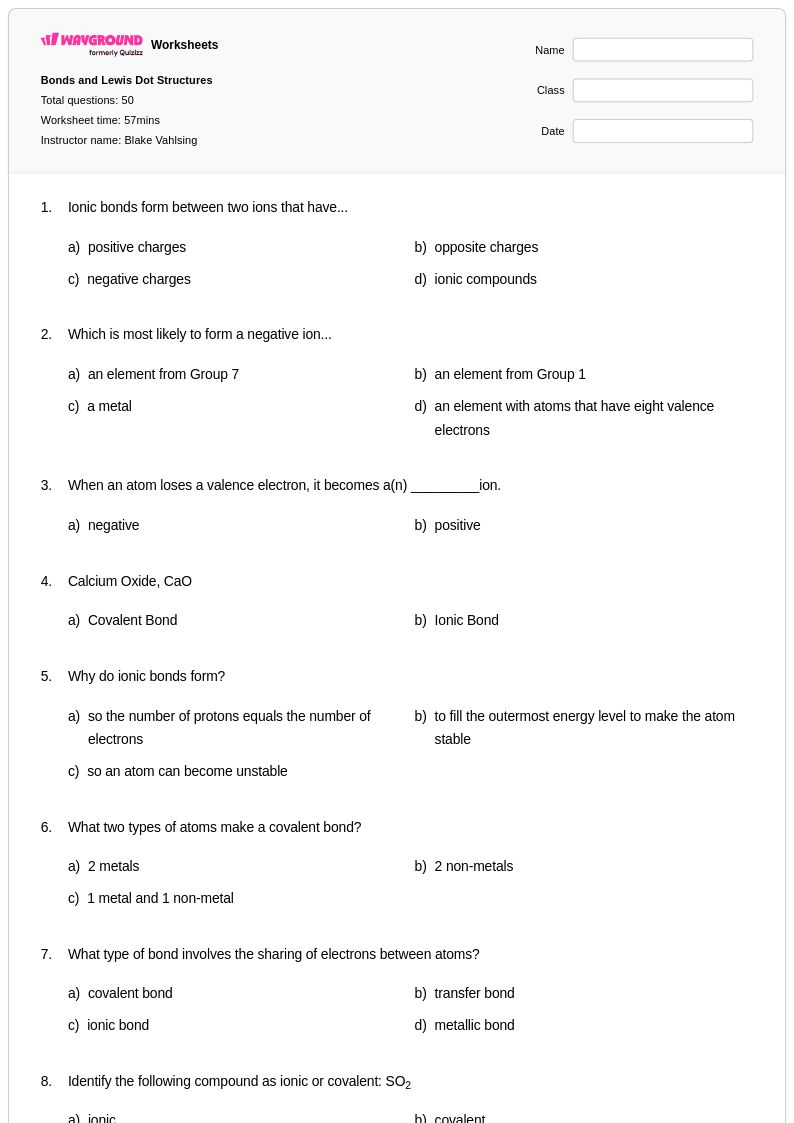
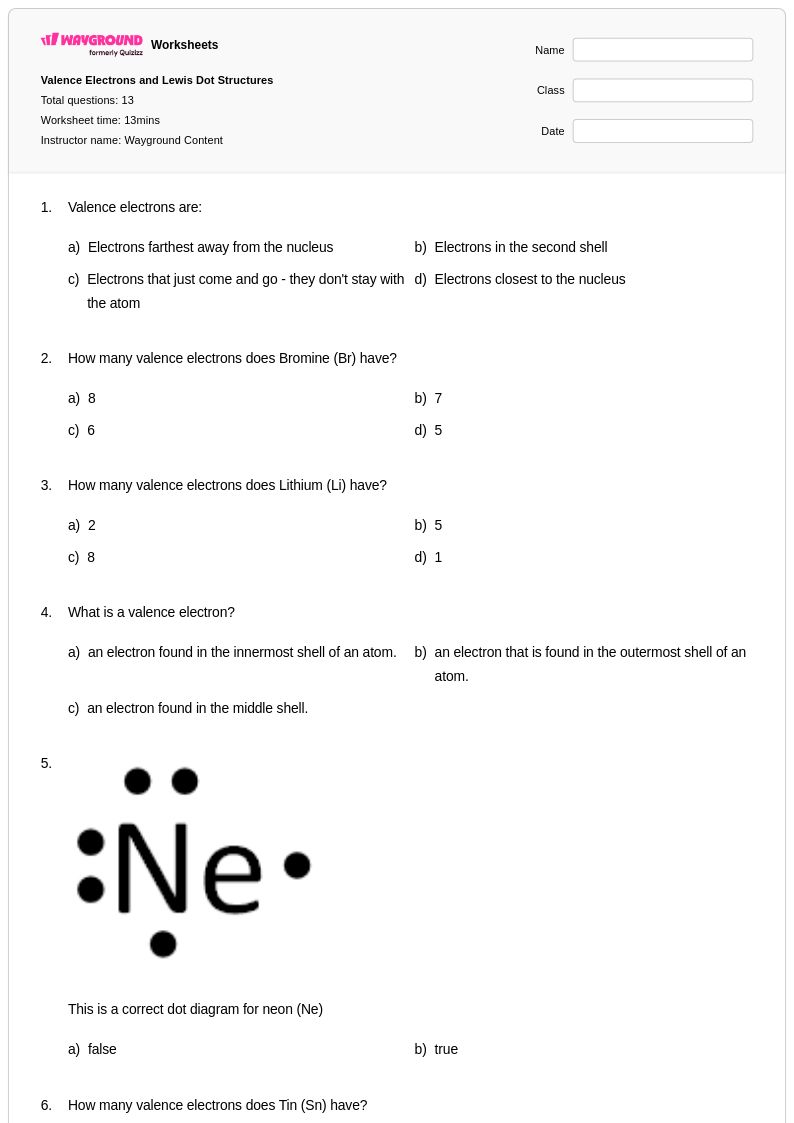
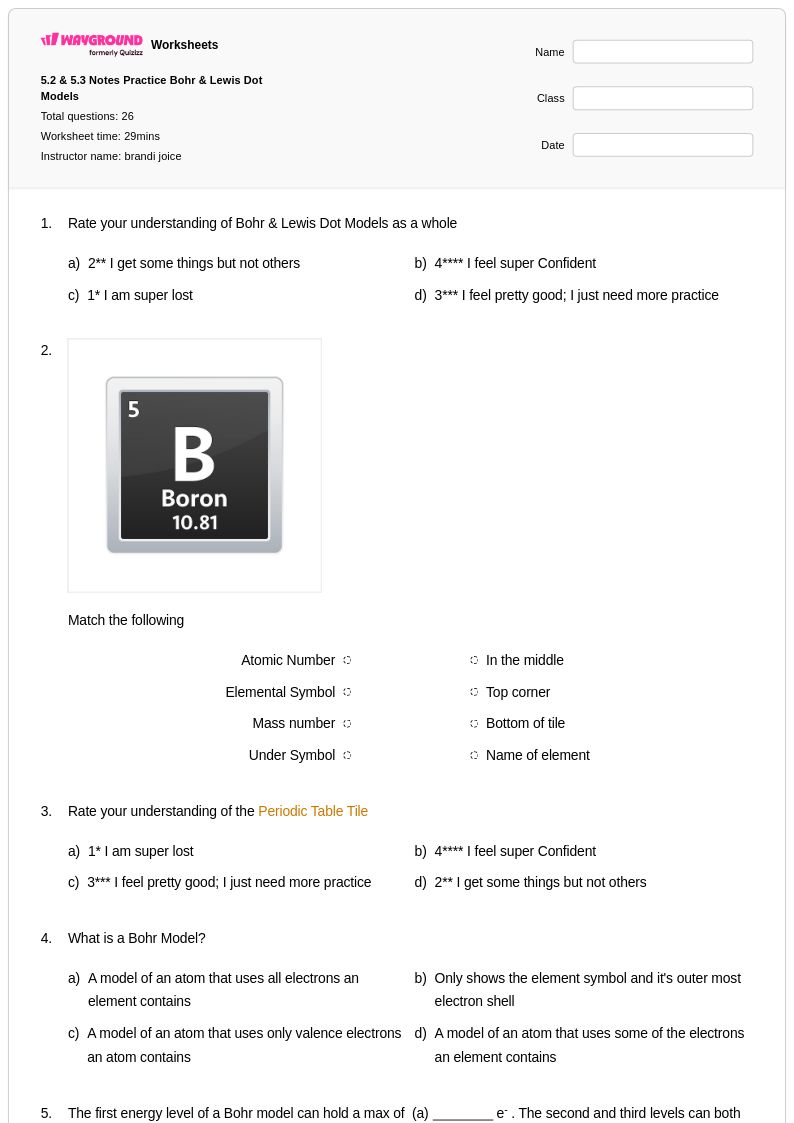
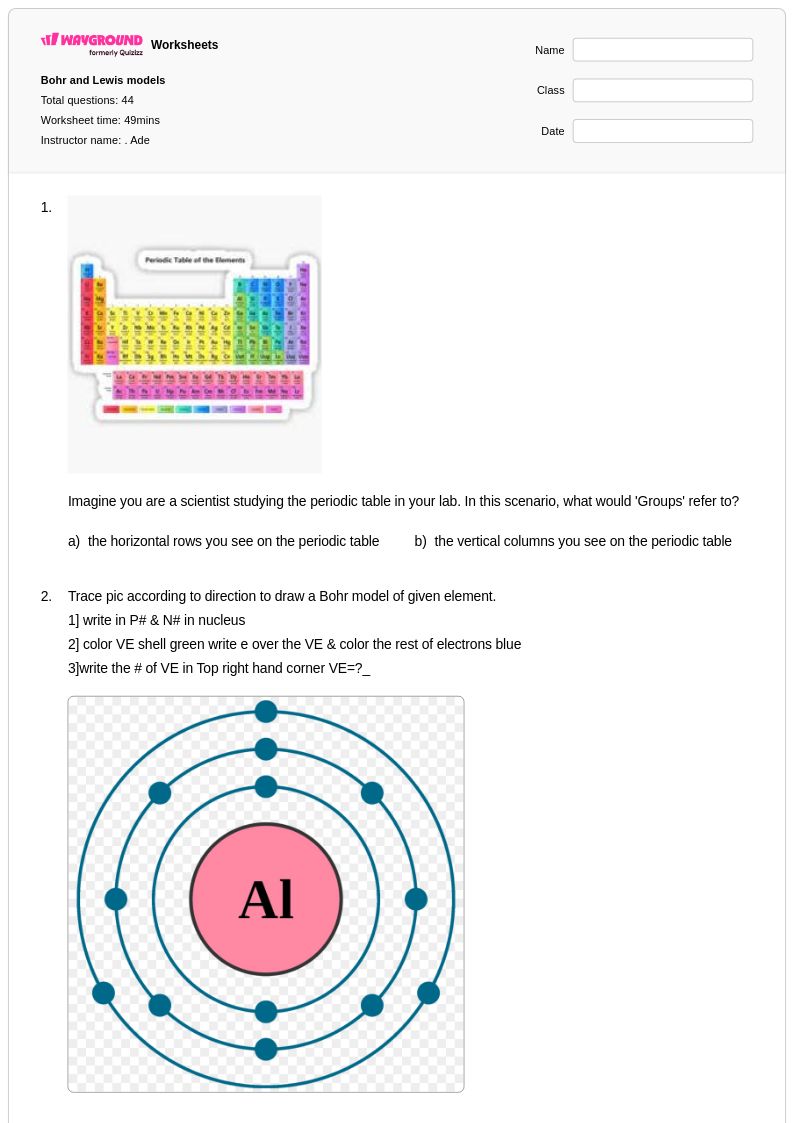
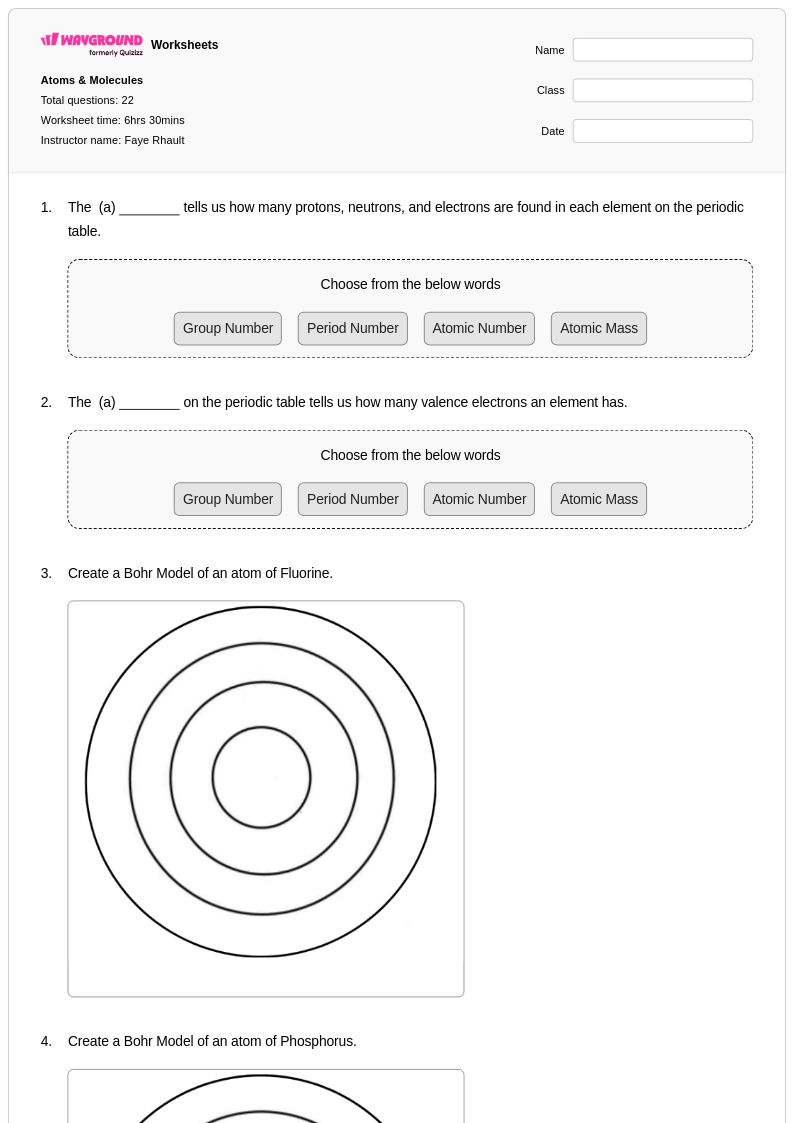
Lewis dot structure worksheets available through Wayground (formerly Quizizz) provide comprehensive practice for students learning to represent valence electrons and chemical bonding patterns. These expertly crafted resources strengthen essential chemistry skills including electron counting, octet rule application, formal charge calculations, and molecular geometry prediction. Students work through systematic practice problems that progress from simple atoms and ions to complex polyatomic molecules, developing the visual and analytical thinking required for advanced chemical concepts. Each worksheet collection includes detailed answer keys and step-by-step solutions, with free printables available in convenient pdf formats that support both classroom instruction and independent study.
Wayground (formerly Quizizz) empowers chemistry teachers with millions of educator-created Lewis dot structure resources that streamline lesson planning and differentiated instruction. The platform's robust search and filtering capabilities allow teachers to quickly locate worksheets aligned with specific chemistry standards, whether focusing on basic electron dot notation or advanced resonance structures and molecular polarity. Customization tools enable educators to modify existing materials or combine multiple worksheet sets to meet diverse learning needs, supporting everything from foundational skill practice to enrichment activities for advanced students. These versatile resources are available in both digital and printable pdf formats, making them ideal for traditional classrooms, hybrid learning environments, and targeted remediation sessions that help students master this fundamental chemistry concept.
FAQs
How do I teach Lewis dot structures to chemistry students?
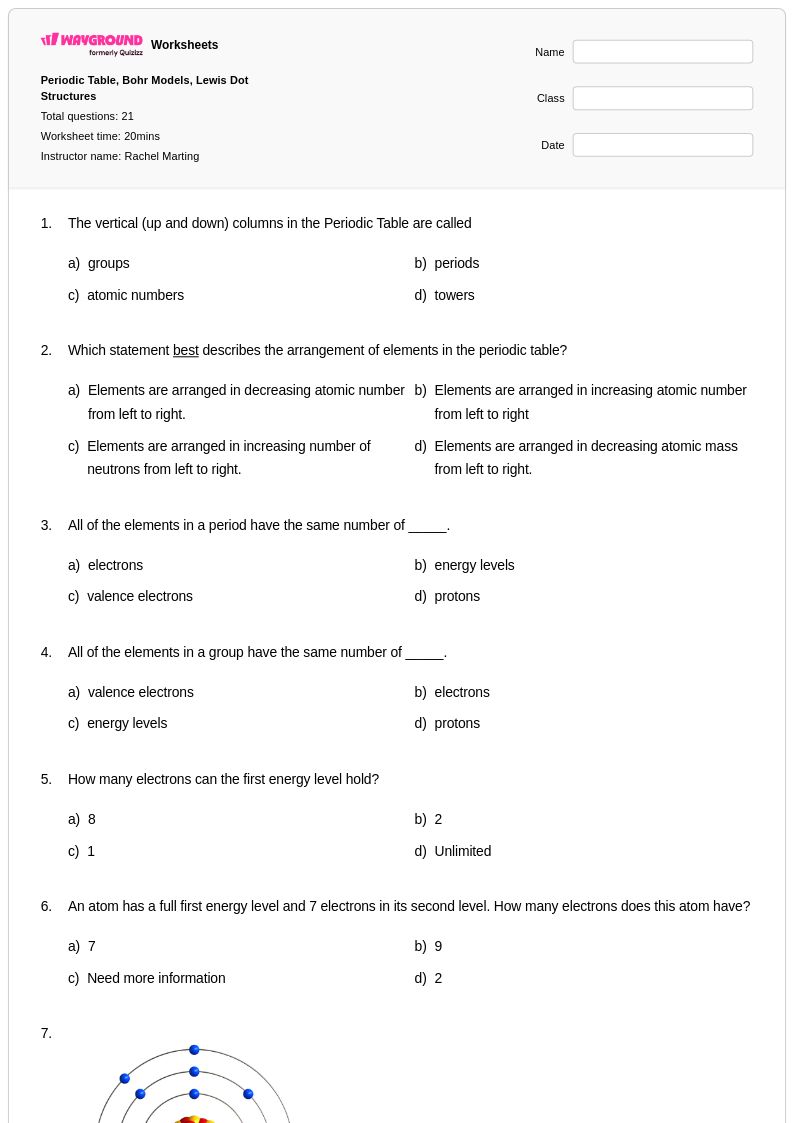
Start by grounding students in valence electron counting before introducing dot notation, since the entire system depends on knowing how many electrons an atom contributes. Use the periodic table as a reference tool so students can identify valence electrons by group number. Progress from single atoms to diatomic molecules, then to polyatomic molecules, allowing students to build confidence before tackling exceptions like expanded octets or formal charges. Visual modeling and repeated practice with feedback are essential because Lewis dot structures require both procedural fluency and spatial reasoning.
What exercises help students practice drawing Lewis dot structures?
Effective practice sequences move from simple to complex: begin with neutral atoms and monatomic ions, then advance to covalent molecules like H₂O and CO₂, and finally introduce polyatomic ions and resonance structures. Exercises that ask students to count total valence electrons before drawing help reinforce the procedural foundation. Practice problems that require students to calculate formal charges and determine the most stable resonance structure develop the analytical thinking needed for AP Chemistry and beyond.
What mistakes do students commonly make when drawing Lewis dot structures?
The most frequent error is miscounting total valence electrons, especially when the molecule carries a formal charge — students often forget to add electrons for negative ions or subtract for positive ones. Another common mistake is placing lone pairs on the central atom before satisfying the octet of surrounding atoms, which inverts the correct procedure. Students also frequently confuse single, double, and triple bonds when trying to complete octets, and struggle to recognize when expanded octets or incomplete octets apply to elements like sulfur, phosphorus, or boron.
How does practicing Lewis dot structures connect to other chemistry concepts?
Lewis dot structures serve as the gateway to molecular geometry, VSEPR theory, bond polarity, and intermolecular forces, which means errors at this stage compound into misconceptions across an entire unit. Students who can accurately draw and interpret Lewis structures are significantly better prepared to predict molecular shape, identify polar bonds, and explain physical properties like boiling point and solubility. Consistent practice with these structures builds the visual and analytical fluency that advanced chemistry depends on.
How can I use Lewis dot structure worksheets from Wayground in my classroom?
Wayground's Lewis dot structure worksheets are available as printable PDFs for traditional classroom use and in digital formats for technology-integrated or hybrid learning environments. Teachers can also host worksheets as an interactive quiz directly on Wayground, which supports real-time student responses and automatic grading. For students who need additional support, Wayground's accommodation tools allow teachers to enable features like read aloud or reduced answer choices on an individual basis, without disrupting the experience for the rest of the class.
How do I differentiate Lewis dot structure instruction for students at different levels?
For students who are still building foundational skills, focus practice on neutral molecules with straightforward octets and provide periodic table references to scaffold valence electron counting. Advanced students benefit from problems involving resonance structures, formal charge minimization, and exceptions to the octet rule such as expanded octets in sulfur compounds. On Wayground, teachers can apply individual accommodations — such as extended time or reduced answer choices — to specific students while the rest of the class works through standard problem sets, making differentiation manageable without creating separate assignments.