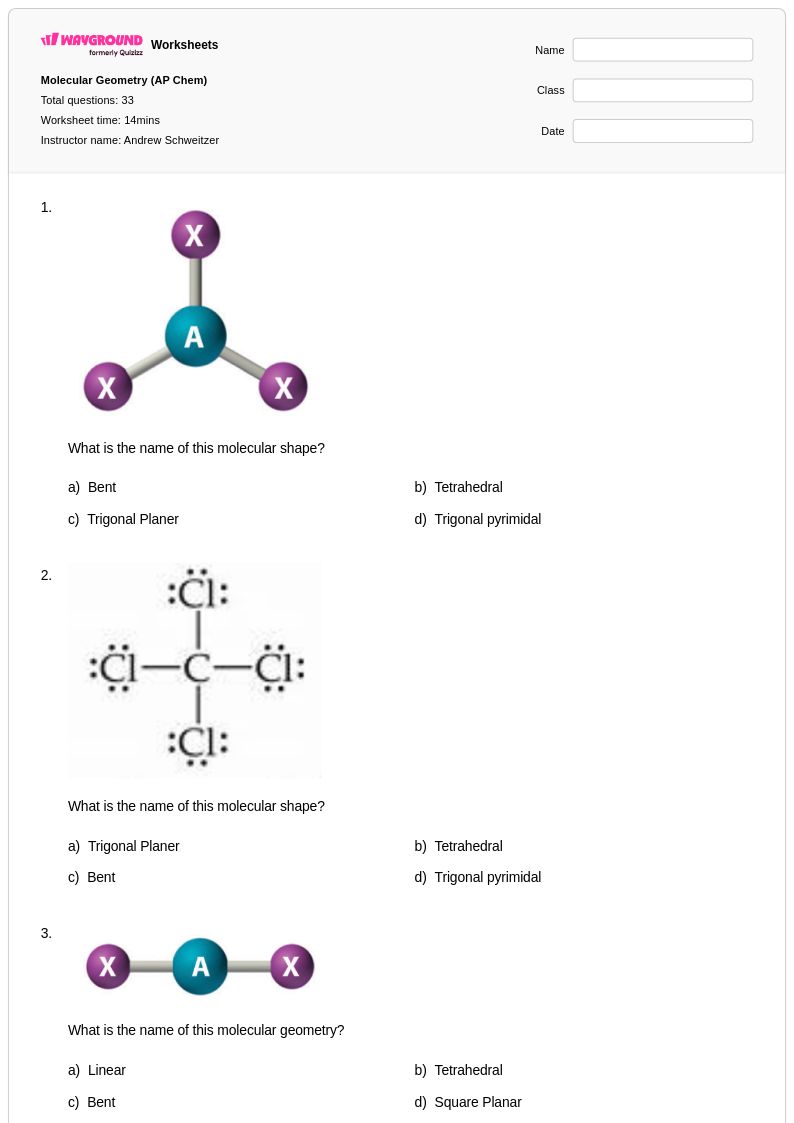
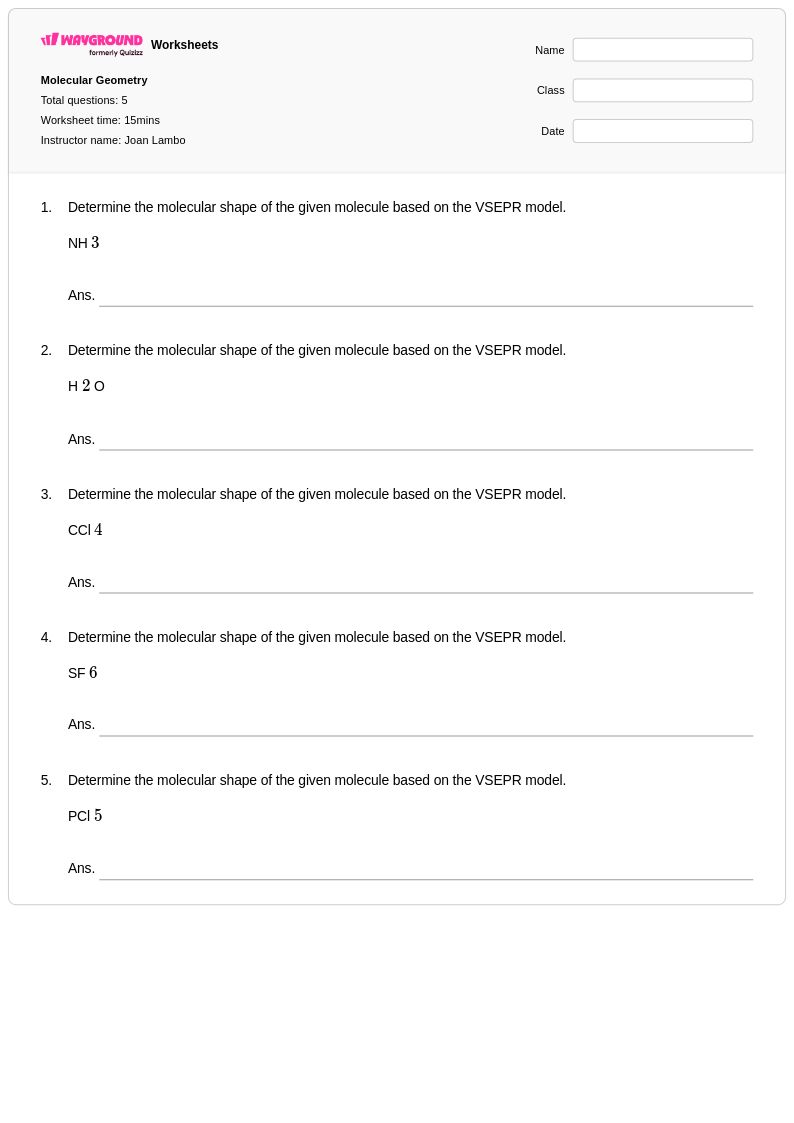
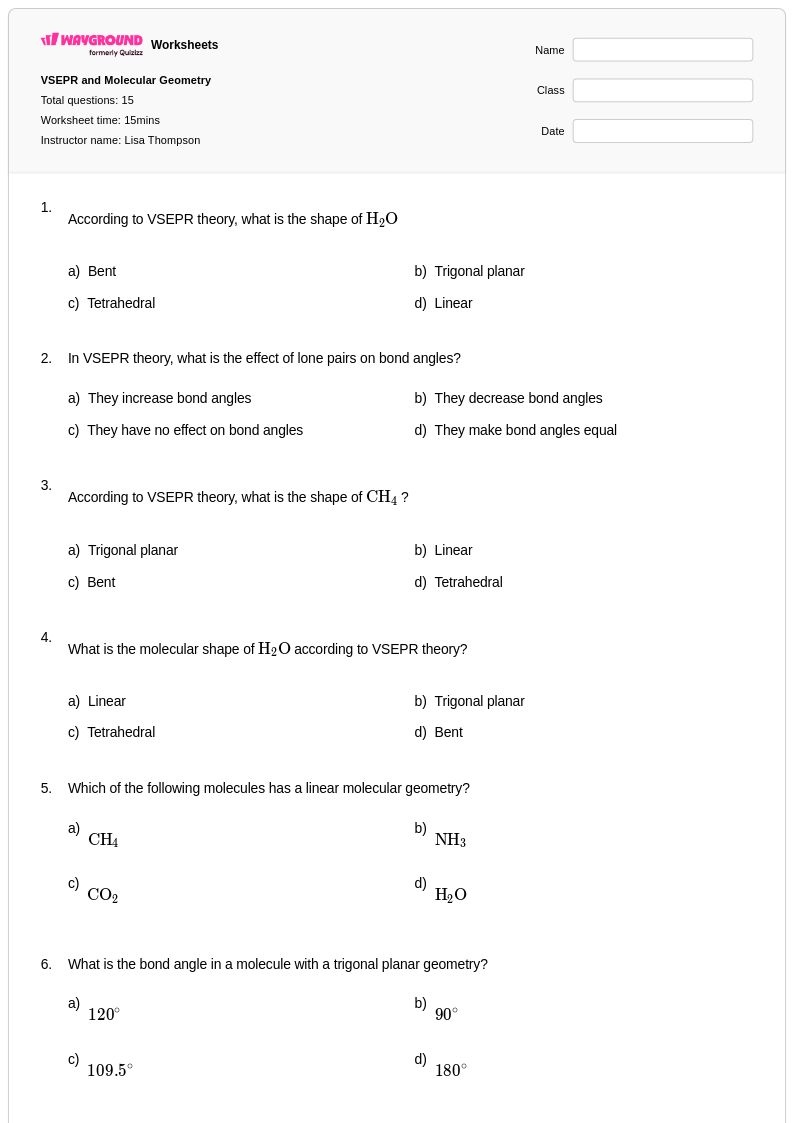
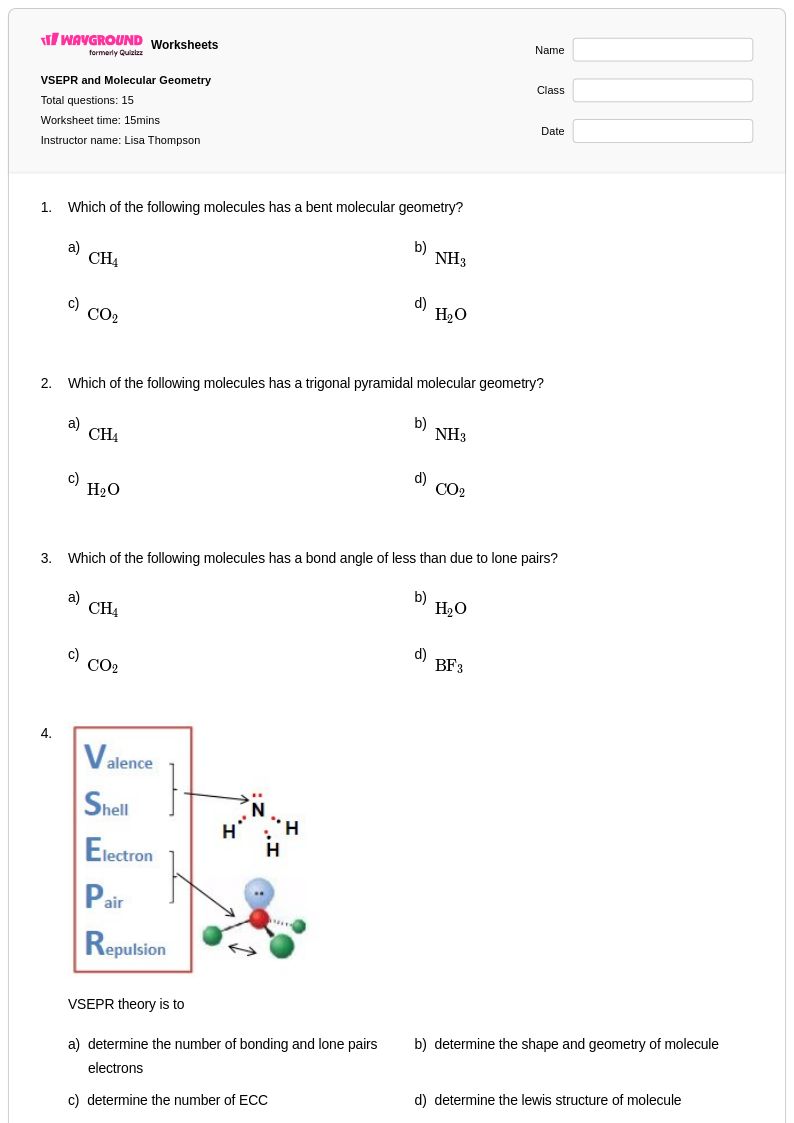
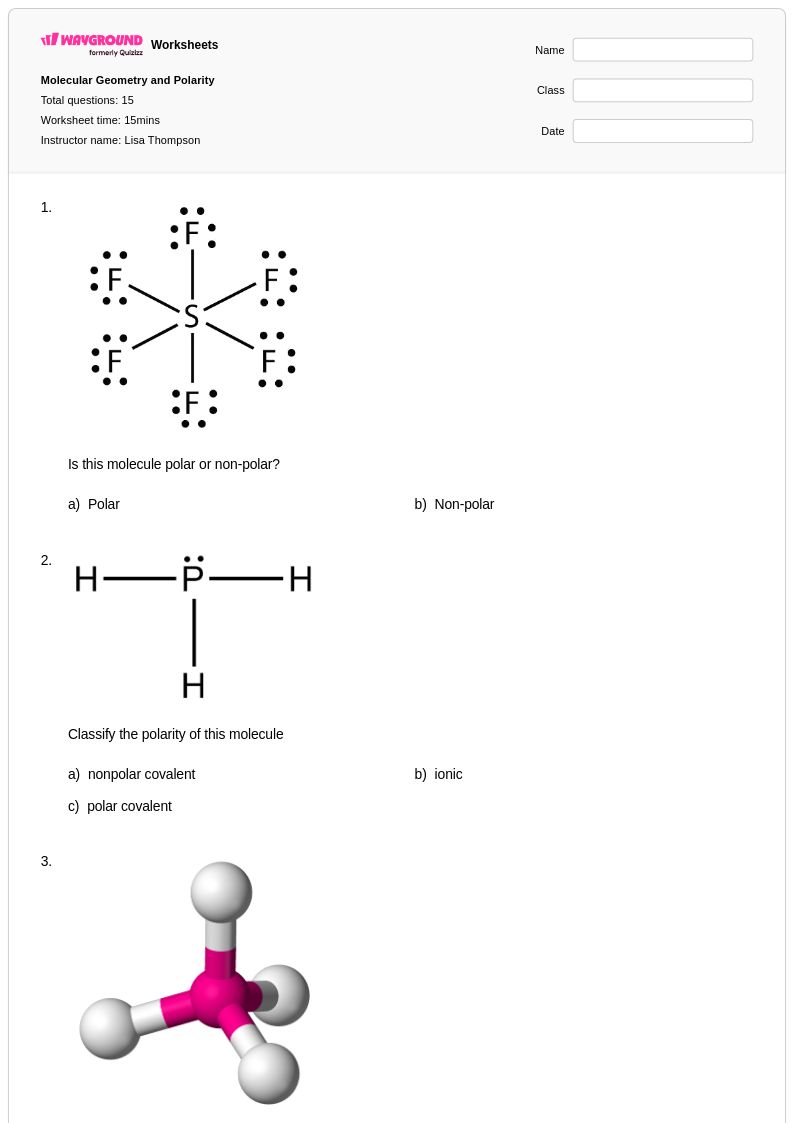
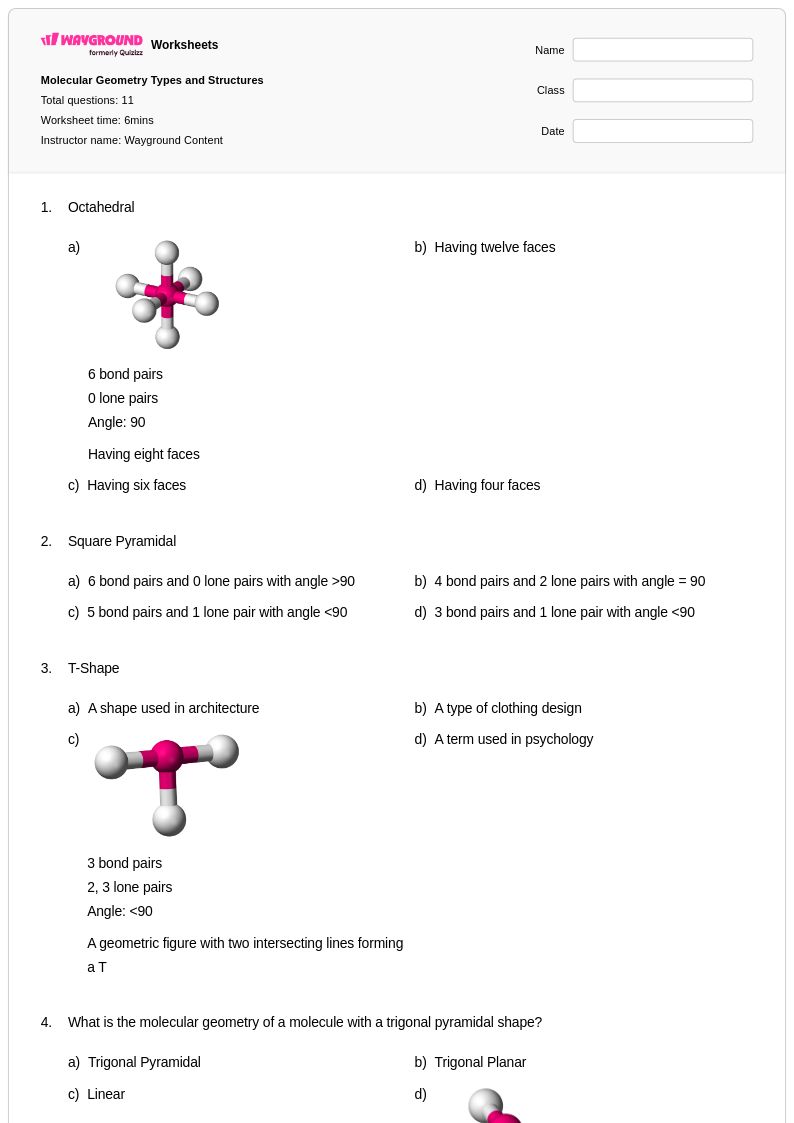
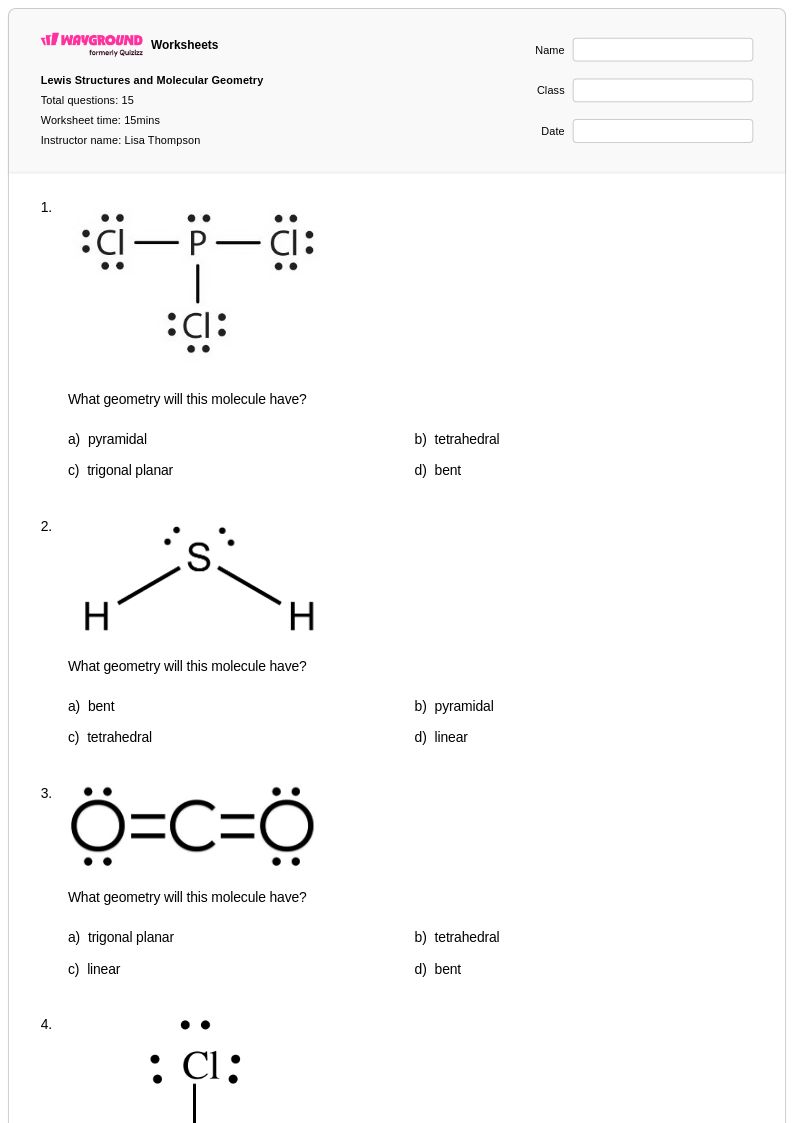
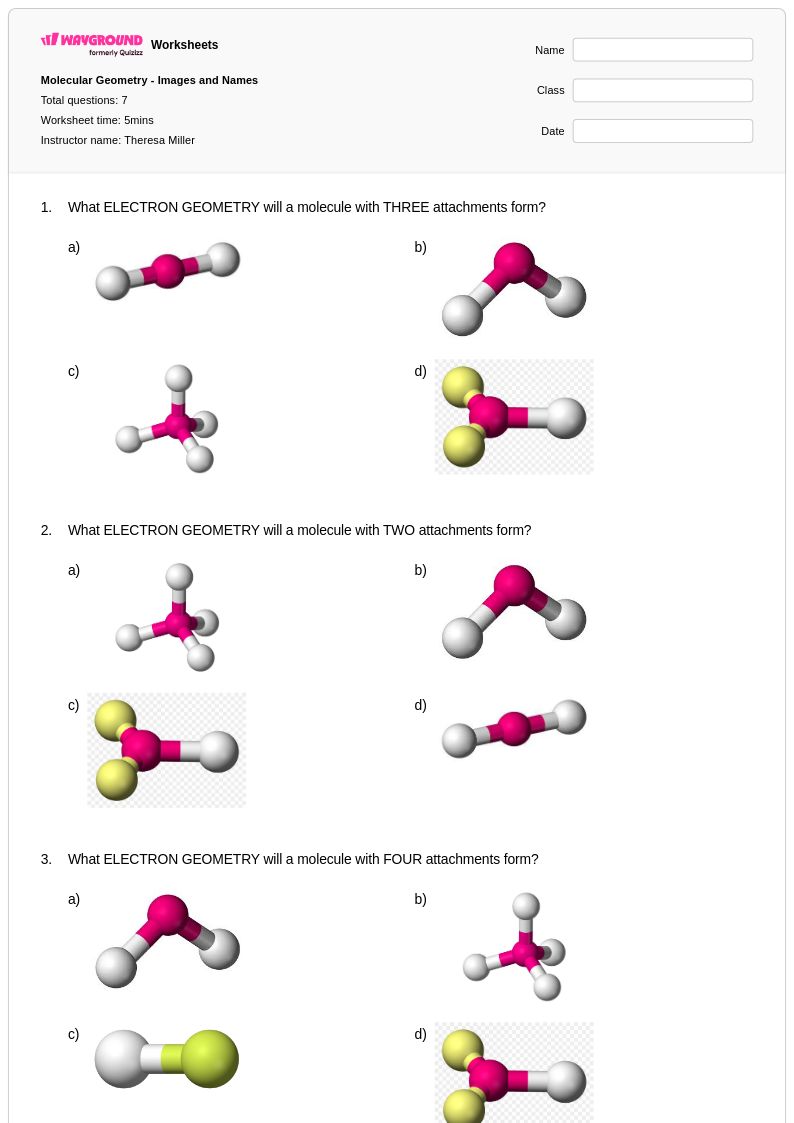
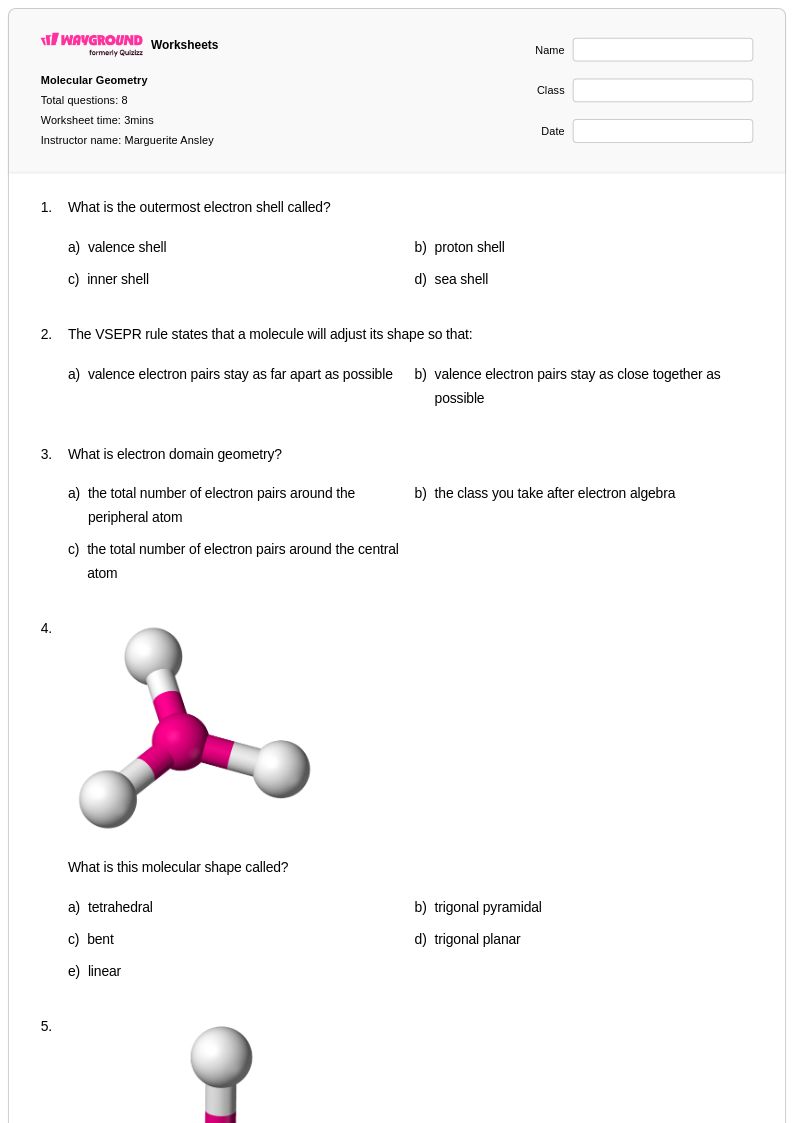
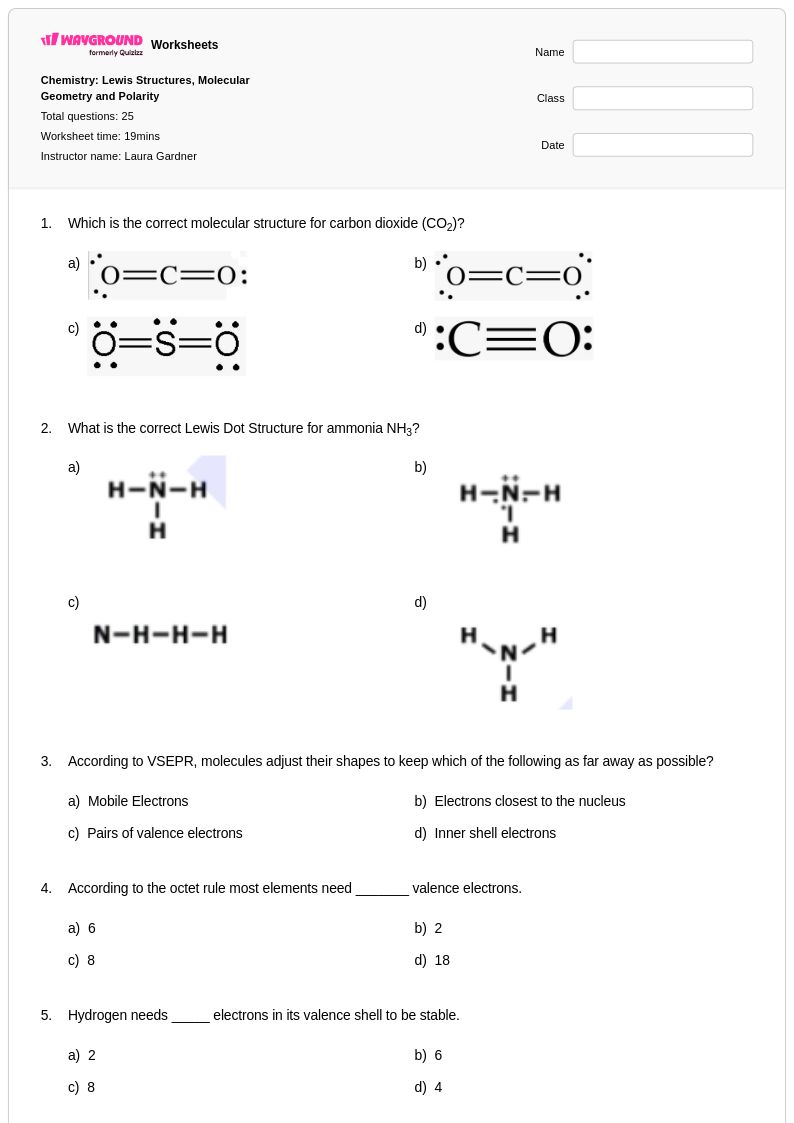
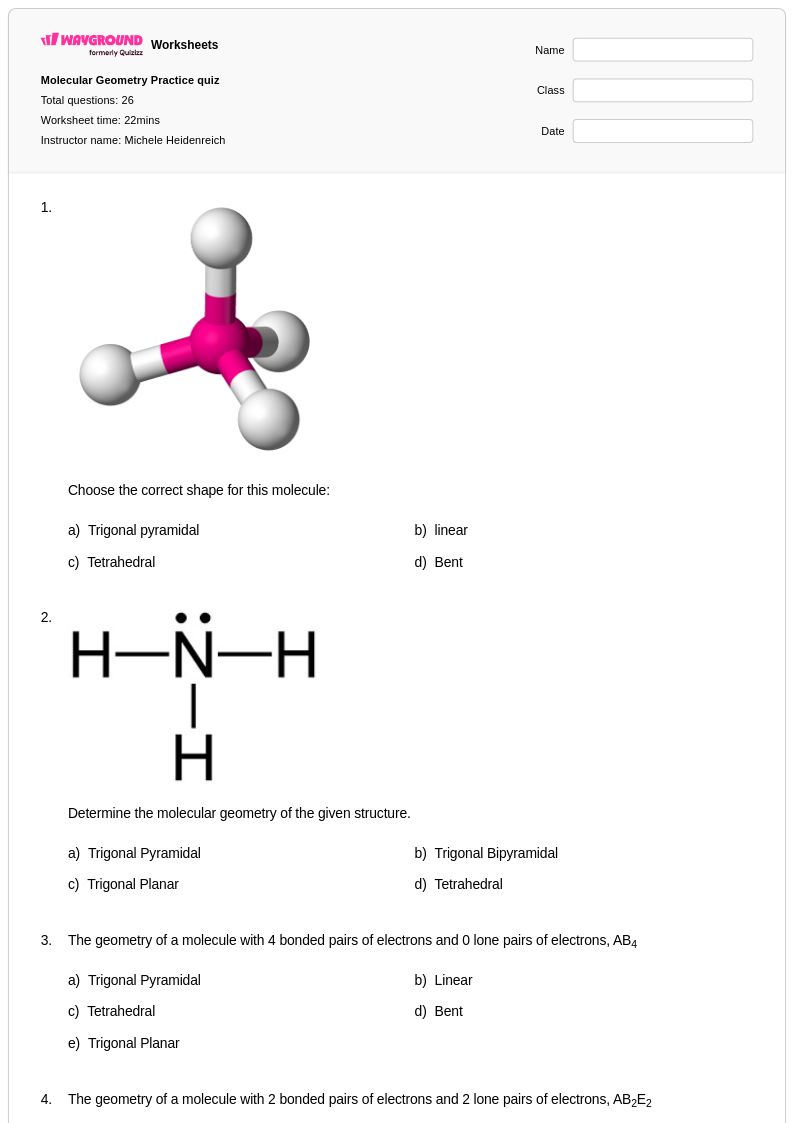
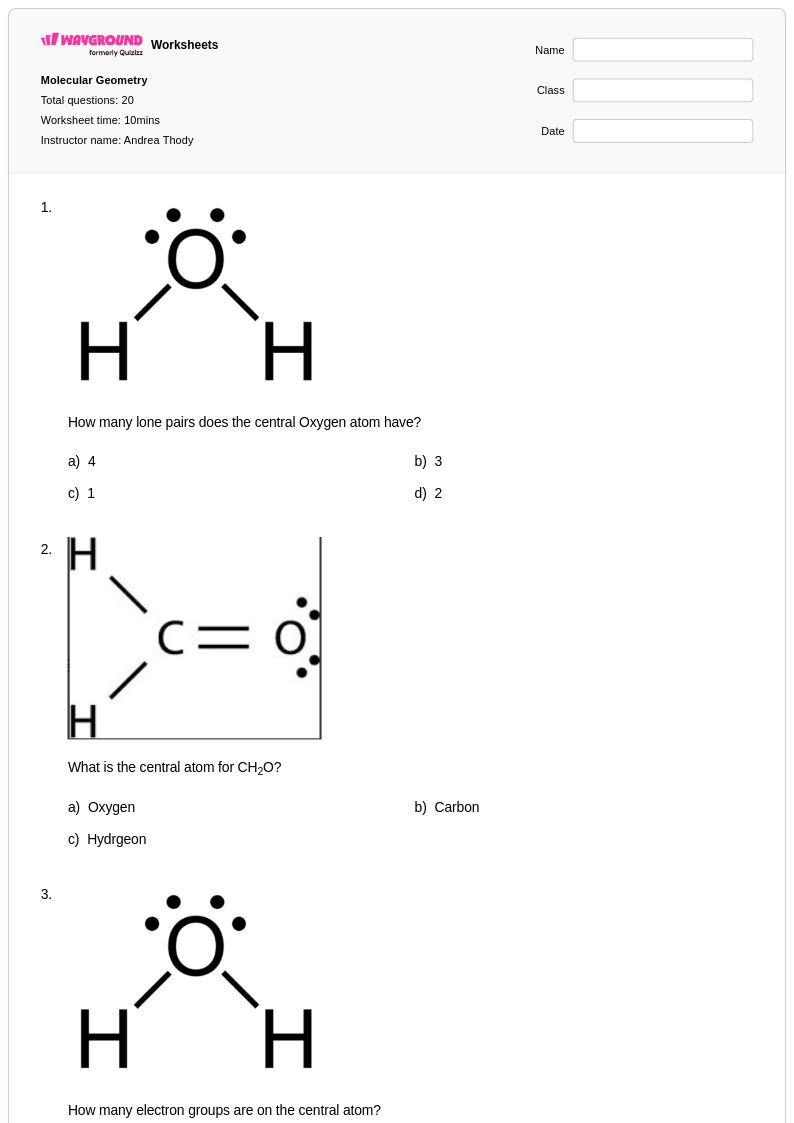
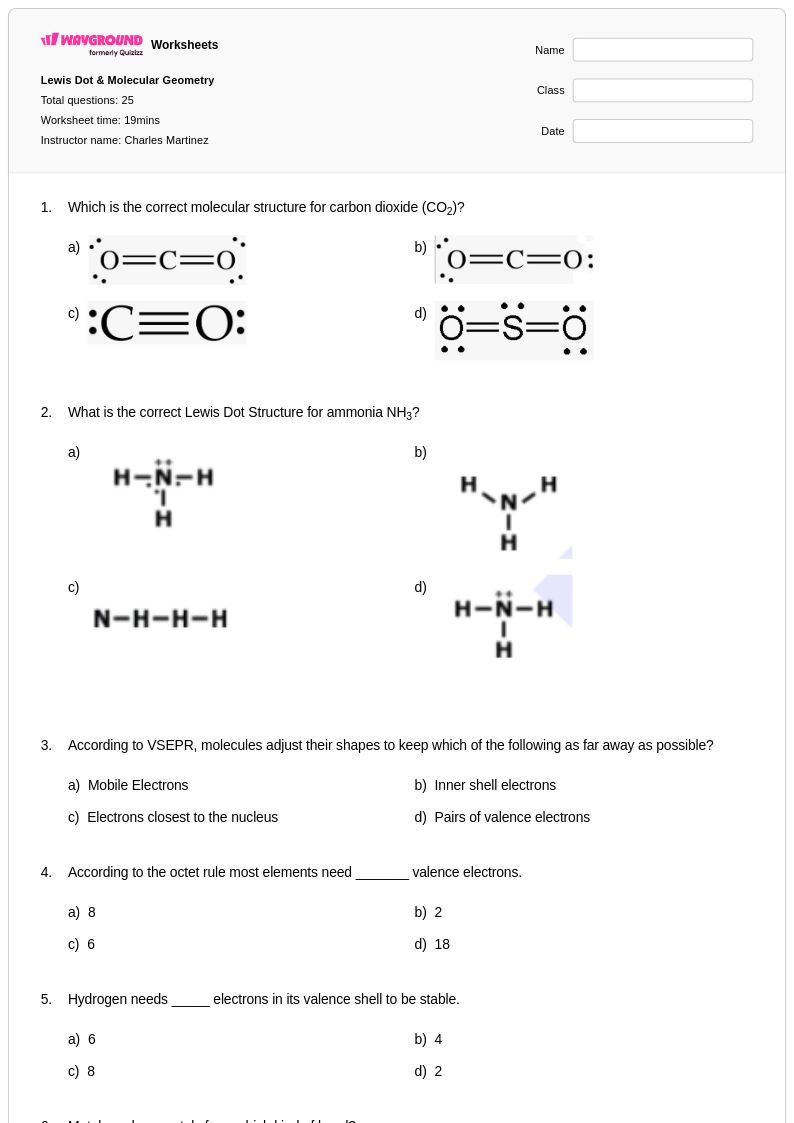
Explore Wayground's free molecular geometry worksheets and printables that help chemistry students master VSEPR theory, bond angles, and three-dimensional molecular structures through comprehensive practice problems with answer keys.
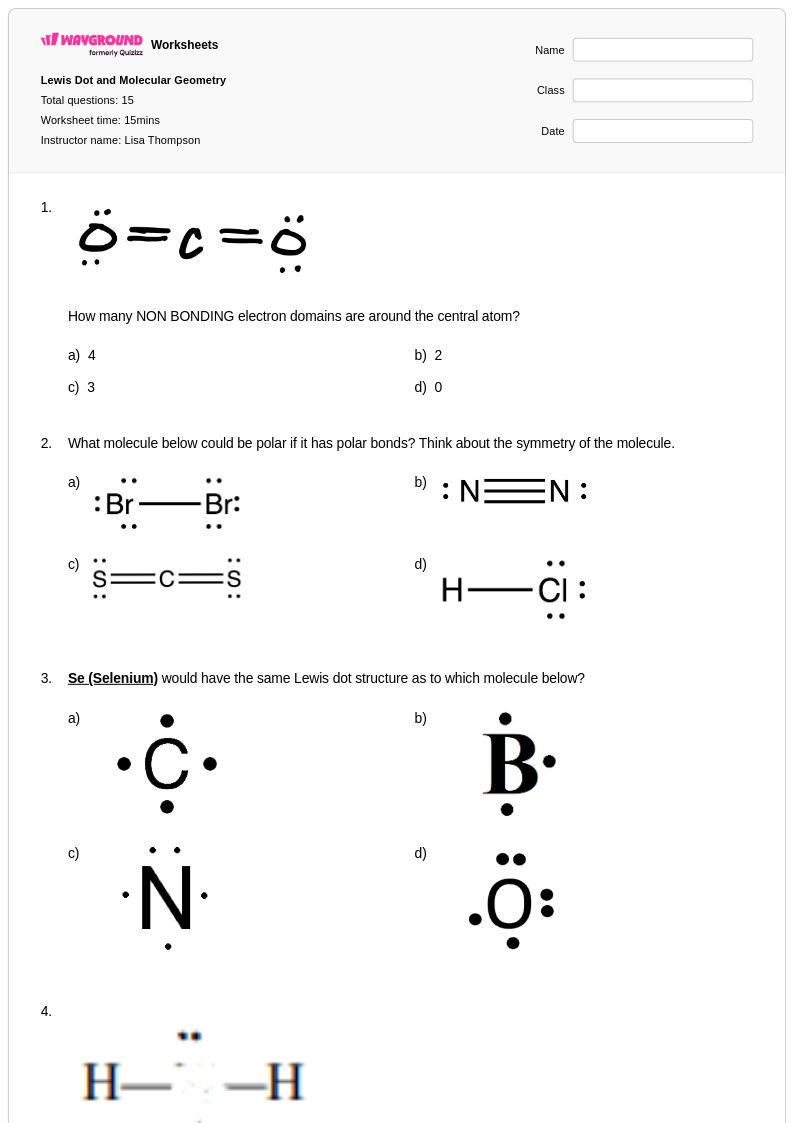
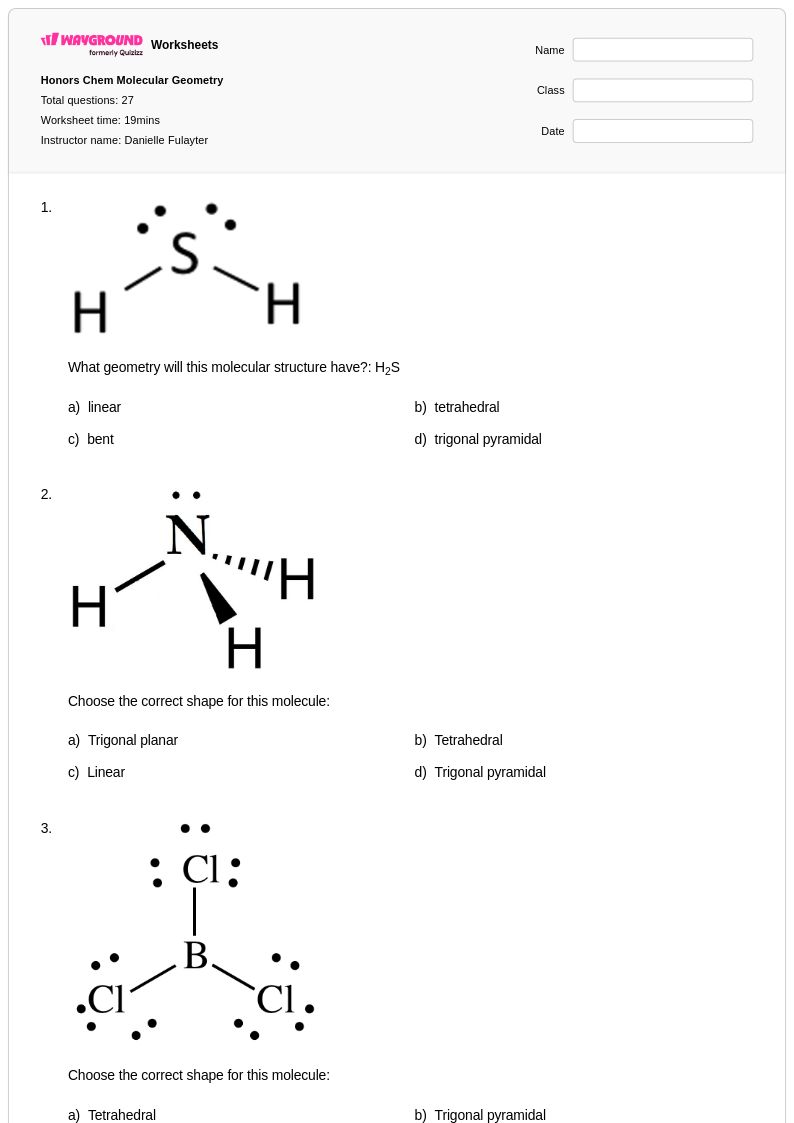
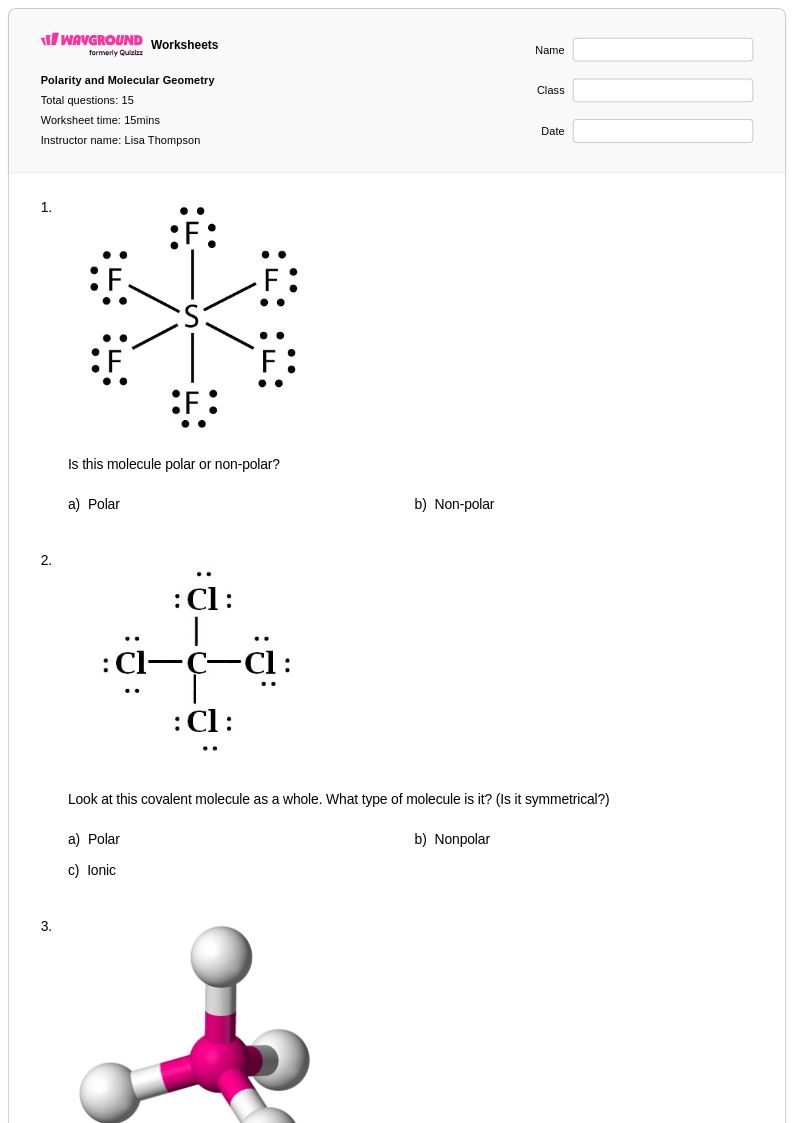
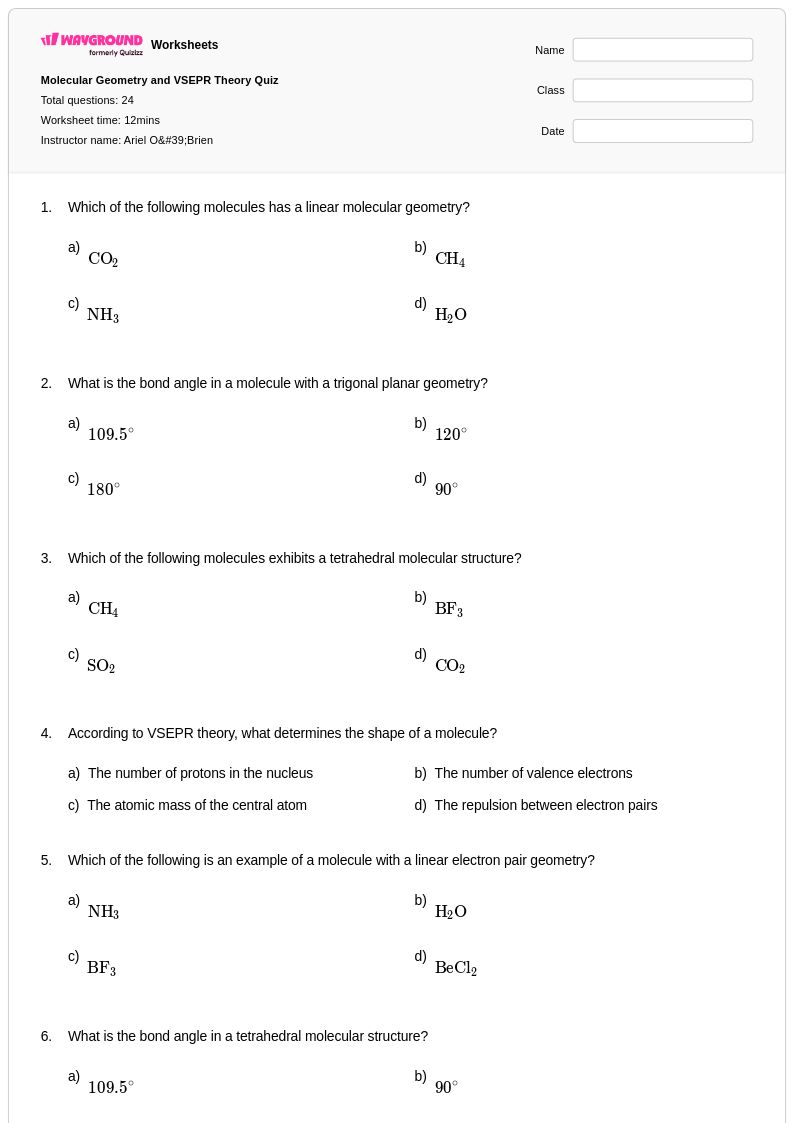
Molecular geometry worksheets available through Wayground (formerly Quizizz) provide comprehensive practice materials that help students master the three-dimensional arrangements of atoms within molecules. These expertly crafted worksheets strengthen essential chemistry skills including VSEPR theory application, bond angle prediction, electron pair geometry identification, and molecular shape determination. Students work through practice problems that cover linear, trigonal planar, tetrahedral, trigonal bipyramidal, and octahedral geometries, while developing spatial visualization abilities crucial for understanding chemical bonding and molecular behavior. Each worksheet collection includes detailed answer keys and is available as free printable pdf resources, allowing students to systematically build their understanding of how electron pair repulsion influences molecular architecture.
Wayground (formerly Quizizz) empowers chemistry teachers with millions of teacher-created molecular geometry resources that feature robust search and filtering capabilities aligned to educational standards. The platform's differentiation tools enable educators to customize worksheets based on individual student needs, offering both printable pdf formats for traditional classroom use and digital versions for interactive learning environments. These flexible molecular geometry collections support comprehensive lesson planning while providing targeted materials for remediation of struggling students and enrichment opportunities for advanced learners. Teachers can efficiently locate resources that match specific curriculum requirements, from basic Lewis structure interpretation to complex hybridization concepts, ensuring consistent skill practice and assessment across diverse learning objectives in chemistry education.
FAQs
How do I teach molecular geometry using VSEPR theory?
Start by ensuring students are confident with Lewis structures before introducing VSEPR theory, since electron pair geometry depends entirely on accurate dot diagrams. Teach students to count both bonding pairs and lone pairs around the central atom, then use that count to determine the electron geometry before identifying the molecular shape. Physical models or digital 3D visualizations help students grasp why lone pairs compress bond angles more than bonding pairs, which is one of the most commonly misunderstood aspects of VSEPR.
What exercises help students practice predicting molecular shapes and bond angles?
Effective practice involves giving students a molecule formula, having them draw the Lewis structure, identify the number of electron domains, name the electron pair geometry, and then determine the molecular geometry and approximate bond angles as a sequential process. Worksheets that cover all five main geometries — linear, trigonal planar, tetrahedral, trigonal bipyramidal, and octahedral — alongside their lone-pair variants (such as bent or see-saw) build systematic fluency. Including bond angle prediction alongside shape identification reinforces why geometry and angle are two separate but connected determinations.
What mistakes do students commonly make when identifying molecular geometry?
The most frequent error is confusing electron pair geometry with molecular geometry — students often report the electron geometry as the molecular shape, ignoring that lone pairs are invisible in the final shape but still affect bond angles. A second common mistake is undercounting lone pairs on the central atom, especially when students rush through Lewis structures. Students also tend to memorize shape names without understanding the spatial reasoning behind them, which causes errors when they encounter unfamiliar molecules on assessments.
How can I differentiate molecular geometry instruction for students at different levels?
For struggling students, begin with molecules that have no lone pairs (such as BF₃ or CH₄) before introducing lone pair effects on geometry. Advanced learners can extend their practice to hybridization, polarity, and the relationship between molecular geometry and physical properties like boiling point. On Wayground, teachers can apply accommodations such as reduced answer choices and read-aloud features to individual students, and extended time can be configured per student so that students who need more processing time are supported without disrupting the rest of the class.
How do I use Wayground's molecular geometry worksheets in my chemistry class?
Wayground's molecular geometry worksheets are available as printable PDFs for traditional classroom use and in digital formats for technology-integrated environments, including the option to host them as a quiz directly on Wayground. Teachers can assign worksheets as in-class practice, homework, or formative assessments, and each worksheet includes a complete answer key to streamline grading. The platform's search and filtering tools allow teachers to locate resources aligned to specific curriculum standards, from basic shape identification to more complex hybridization and polarity concepts.
How do I assess whether students truly understand molecular geometry versus just memorizing shapes?
Effective assessment goes beyond asking students to name a shape from a given formula — instead, ask them to justify their answer by identifying the number of bonding and lone electron pairs and explaining how repulsion determines the geometry. Asking students to predict bond angles and explain deviations (for example, why water's angle is 104.5° rather than 109.5°) reveals conceptual depth. Including novel molecules students haven't seen before on assessments is the clearest way to distinguish genuine understanding from rote memorization.