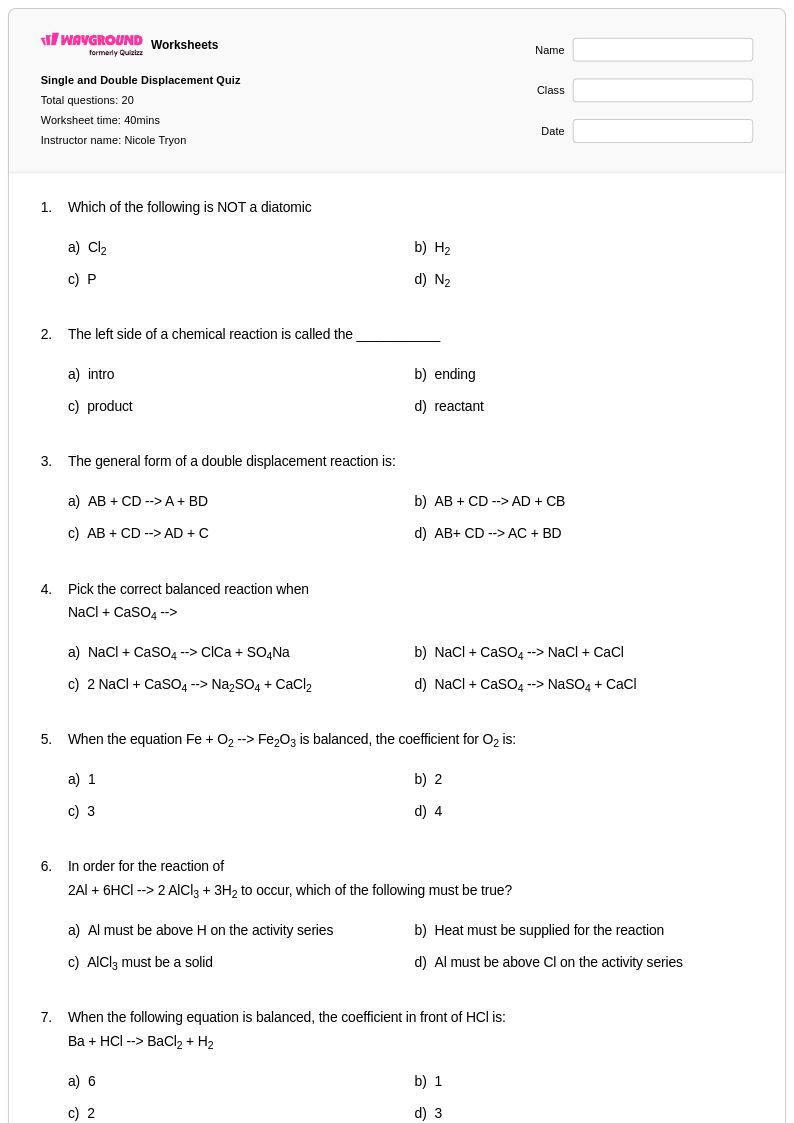
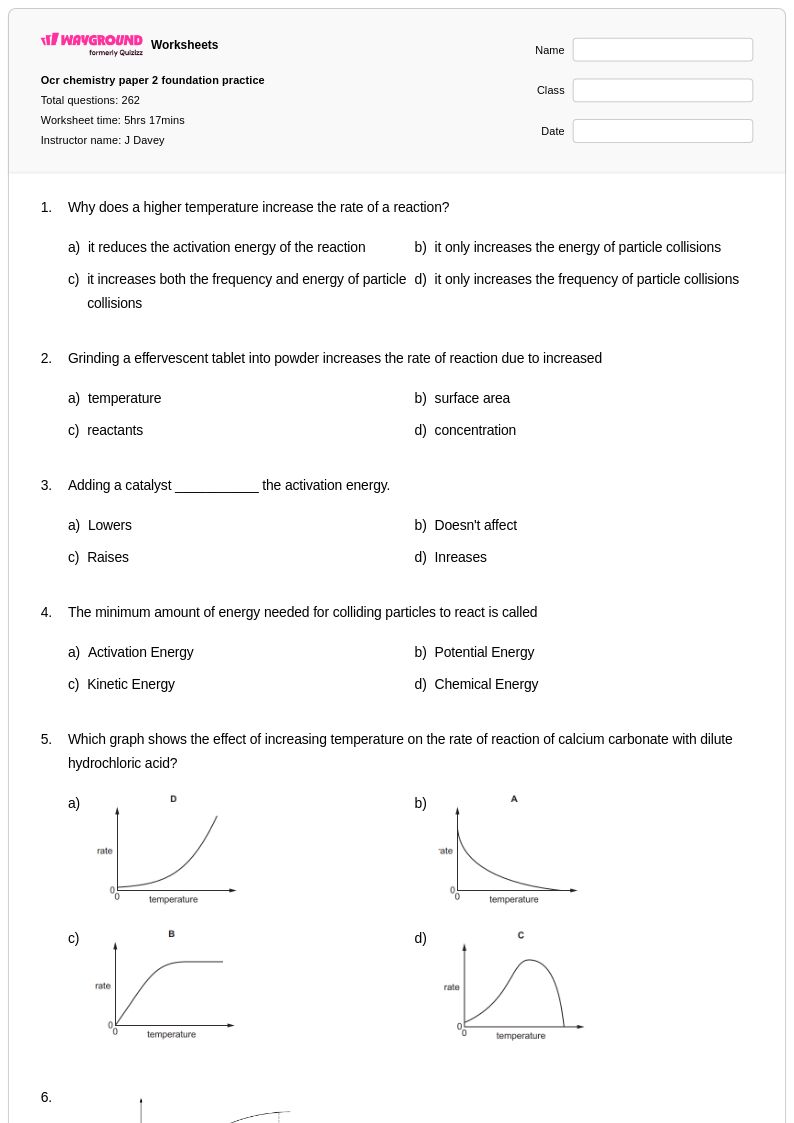
Explore Wayground's comprehensive collection of reaction order worksheets and printables that help chemistry students master kinetics concepts through targeted practice problems, free PDF resources, and detailed answer keys.
Reaction order worksheets available through Wayground (formerly Quizizz) provide comprehensive coverage of this fundamental kinetics concept, enabling students to master the mathematical relationships between reactant concentrations and reaction rates. These expertly designed resources focus on developing critical analytical skills including determining reaction order from experimental data, calculating rate constants, and interpreting integrated rate laws for zero, first, and second-order reactions. The collection features diverse practice problems that progress from basic order determination exercises to complex multi-step kinetics scenarios, complete with detailed answer keys that guide students through systematic problem-solving approaches. Available as free printables and interactive digital formats, these worksheets strengthen students' ability to analyze concentration-time graphs, apply differential and integrated rate equations, and connect molecular-level mechanisms to observable kinetic behavior.
Wayground's extensive worksheet collection draws from millions of teacher-created resources, offering educators powerful search and filtering capabilities to locate precisely targeted reaction order materials that align with their curriculum standards and student needs. The platform's sophisticated differentiation tools enable teachers to customize worksheets for varying skill levels, from introductory rate law concepts to advanced kinetics applications involving complex reaction mechanisms. These resources are available in both printable pdf formats for traditional classroom use and digital versions that provide immediate feedback and adaptive questioning. Teachers can efficiently plan comprehensive kinetics units, identify students requiring additional remediation in mathematical analysis skills, and provide enrichment opportunities for advanced learners ready to explore sophisticated kinetic models, making reaction order instruction more effective and engaging across diverse learning environments.
FAQs
How do I teach reaction order to chemistry students?
Effective reaction order instruction begins with helping students understand the conceptual relationship between reactant concentration and reaction rate before introducing mathematical formalism. Start with experimental data tables and ask students to identify how rate changes as concentration doubles, which builds intuition for zero, first, and second-order behavior. Once students can reason qualitatively, introduce differential rate laws and then integrated rate laws as tools for quantitative analysis. Graphical interpretation, particularly linearizing concentration-time data to identify reaction order, is a high-leverage skill that bridges data analysis and kinetic theory.
What practice problems help students get better at determining reaction order?
Students strengthen their understanding of reaction order most effectively through problems that require them to extract order from experimental rate data, calculate rate constants using the appropriate integrated rate law, and interpret concentration-time graphs for zero, first, and second-order reactions. Progressing from single-reactant scenarios to multi-reactant rate law problems builds the analytical flexibility students need for AP Chemistry and college-level kinetics. Problems that require students to select and apply the correct integrated rate equation, rather than being told which to use, are particularly effective at consolidating understanding.
What mistakes do students commonly make when working with reaction order?
The most frequent error is confusing reaction order with stoichiometric coefficients, leading students to incorrectly read rate law exponents directly from a balanced equation rather than from experimental data. Students also struggle with distinguishing differential rate laws from integrated rate laws and applying them in the wrong context. A common computational mistake is misidentifying graph linearity when determining order, particularly confusing first-order ln[A] vs. time plots with second-order 1/[A] vs. time plots. Targeted practice problems that require students to justify their order determination from data, rather than simply calculate, help address these persistent misconceptions.
How can I use reaction order worksheets to differentiate instruction in my chemistry class?
Reaction order worksheets can be sequenced to match student readiness, starting with basic order determination from rate tables for students building foundational skills and progressing to integrated rate law applications and mechanism-to-rate-law problems for advanced learners. On Wayground, teachers can apply individual accommodations such as read aloud support, extended time, and reduced answer choices for students who need them, while the rest of the class works under default settings. These accommodations are saved per student and carry across future sessions, reducing the administrative burden of differentiation. This allows a single worksheet set to serve a range of learners within the same class period.
How do I use Wayground's reaction order worksheets in my classroom?
Wayground's reaction order worksheets are available as printable PDFs for traditional classroom use and in digital formats for technology-integrated environments, including the option to host them as a quiz directly on Wayground. Printable versions are well suited for in-class practice, homework, or test preparation, while digital formats provide immediate feedback that helps students self-correct during independent work. Each worksheet includes a detailed answer key that walks students through systematic problem-solving, making them effective for both guided instruction and independent review.
How do concentration-time graphs connect to reaction order, and how should I teach this?
Concentration-time graphs are one of the most direct tools for experimentally determining reaction order, and teaching students to linearize these graphs is a core kinetics skill. A plot of [A] vs. time that is linear indicates zero-order kinetics, while a linear ln[A] vs. time plot signals first-order behavior, and a linear 1/[A] vs. time plot indicates second order. Students should practice generating these plots from data and interpreting their slopes in terms of rate constants. Connecting graph shape to the underlying integrated rate law equation, rather than memorizing which plot looks linear, gives students a durable conceptual framework.