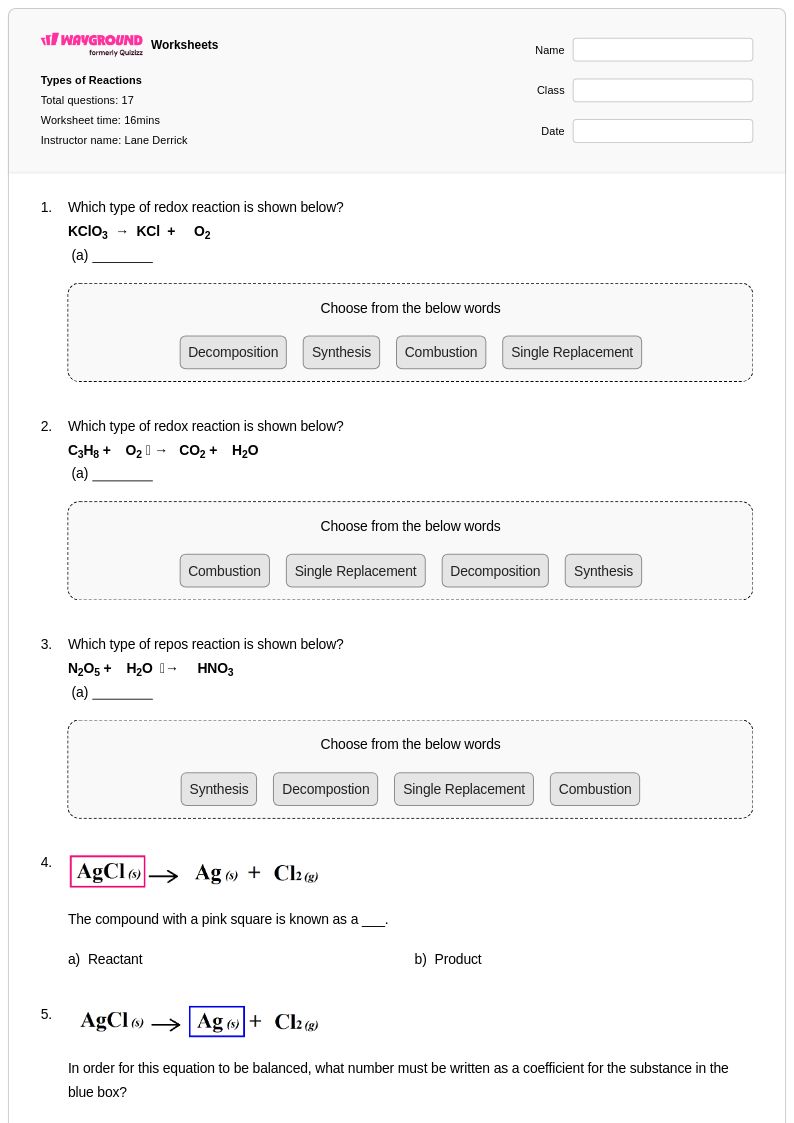
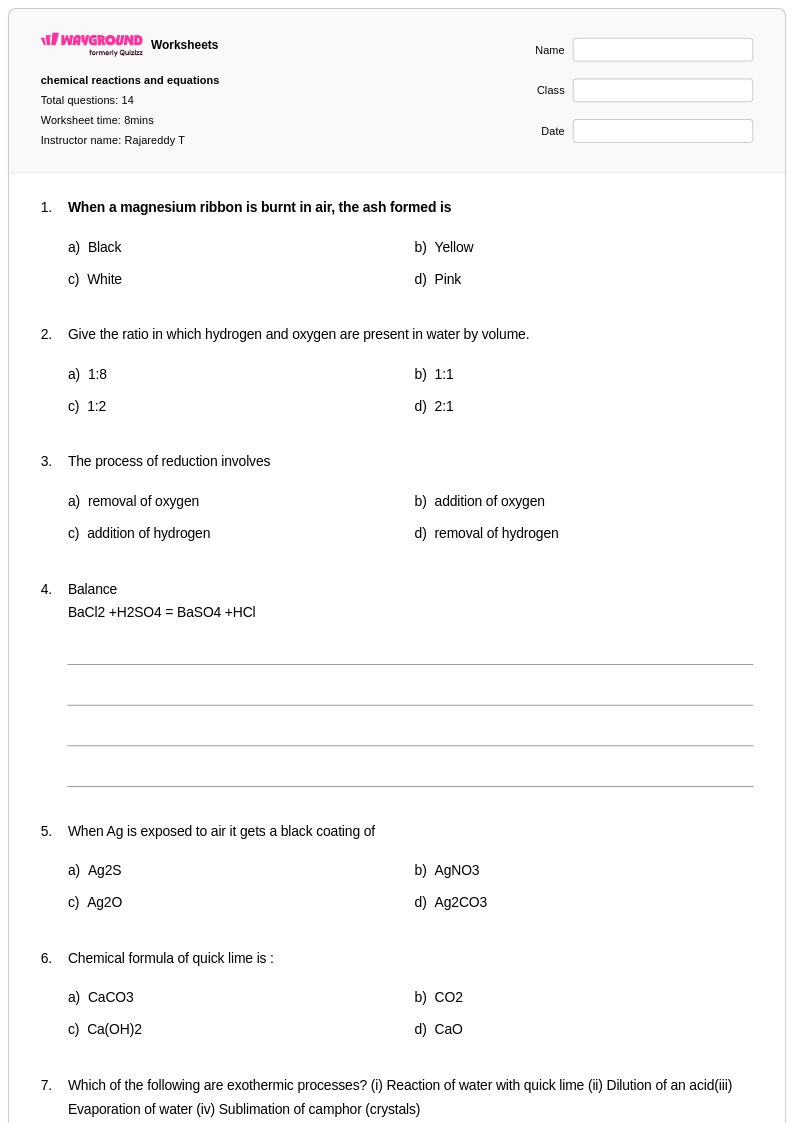
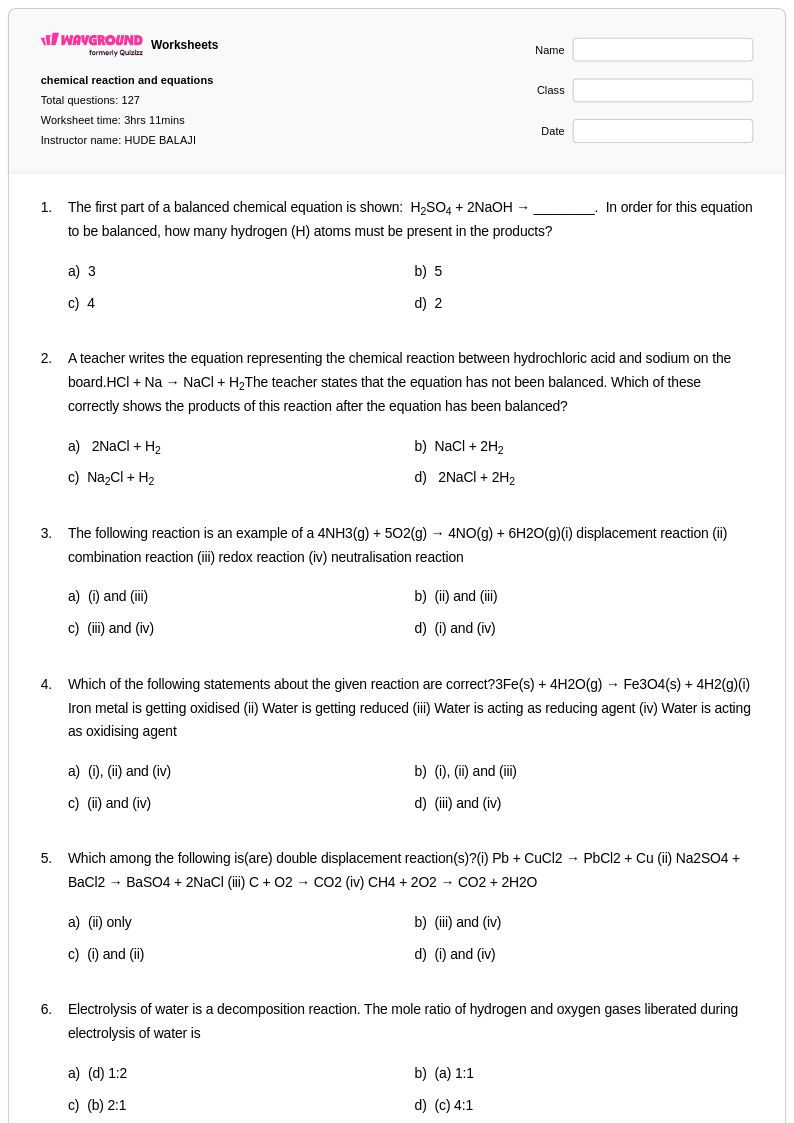
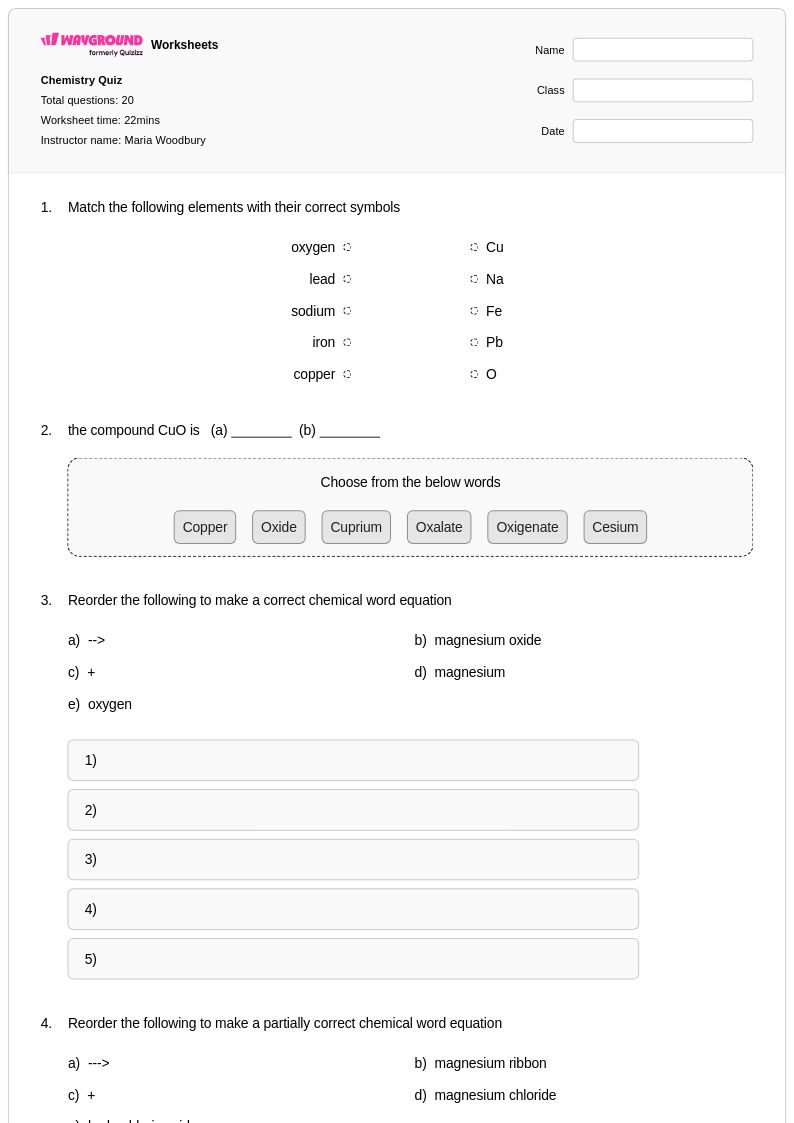
Master redox equations with Wayground's comprehensive collection of free chemistry worksheets featuring balanced practice problems, step-by-step solutions, and printable PDFs with complete answer keys for effective learning.
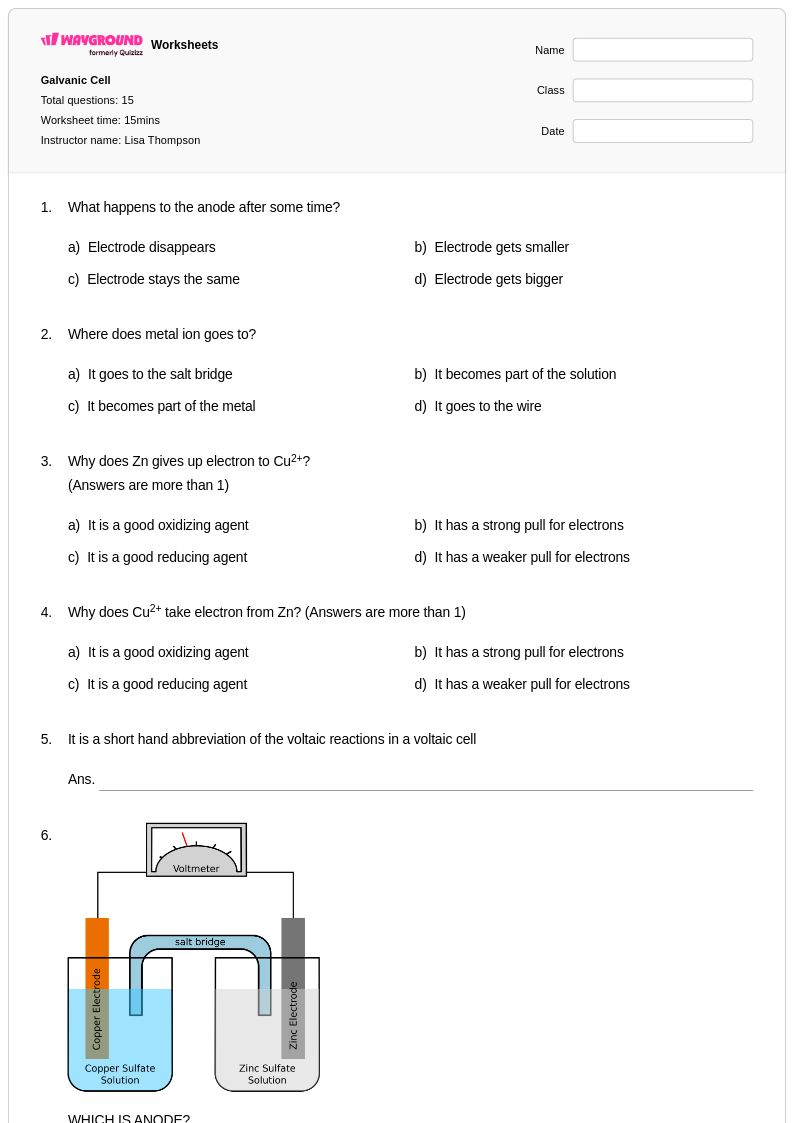
Redox equations represent one of the most challenging yet fundamental concepts in chemistry, requiring students to master the intricate balance of electron transfer reactions and oxidation-reduction processes. Wayground's comprehensive collection of redox equation worksheets provides educators with expertly designed practice problems that guide students through the systematic approach of balancing chemical equations involving electron exchange. These free printable resources strengthen critical analytical skills including identifying oxidation states, recognizing reducing and oxidizing agents, and applying half-reaction methods to achieve balanced equations. Each worksheet includes detailed answer keys that enable students to verify their understanding of complex redox processes, while the variety of problem types ensures thorough coverage of everything from simple metal displacement reactions to sophisticated electrochemical cell equations available in convenient PDF format.
Wayground (formerly Quizizz) empowers chemistry educators with access to millions of teacher-created redox equation worksheets that streamline lesson planning and enhance student learning outcomes. The platform's robust search and filtering capabilities allow teachers to quickly locate resources tailored to specific learning objectives, whether targeting fundamental oxidation-reduction concepts or advanced electrochemistry applications. Standards-aligned content ensures curricular coherence, while built-in differentiation tools enable educators to customize worksheets for varying skill levels within their classrooms. Available in both printable PDF formats and interactive digital versions, these resources support flexible implementation for remediation sessions, enrichment activities, and regular skill practice, giving teachers the versatility needed to address diverse student needs and reinforce mastery of complex redox equation balancing techniques.
FAQs
How do I teach redox equations to chemistry students?
Start by ensuring students have a solid grasp of oxidation states before introducing electron transfer. Teach the half-reaction method as a structured, step-by-step process: separate the reaction into oxidation and reduction halves, balance atoms and charges independently, then combine. Using concrete examples like zinc displacing copper from solution helps students visualize electron transfer before moving to more abstract electrochemical cell equations.
What are the best exercises for practicing redox equation balancing?
Effective practice should progress from simple metal displacement reactions to more complex half-reaction balancing in acidic and basic solutions. Worksheets that require students to explicitly identify oxidation states, label the oxidizing and reducing agents, and show each balancing step separately are especially effective because they build systematic habits rather than encouraging guessing. Varied problem types across these levels ensure thorough skill development.
What mistakes do students commonly make when balancing redox equations?
The most frequent errors are assigning incorrect oxidation states, especially to elements in polyatomic ions, and failing to balance both mass and charge simultaneously. Students often balance atoms correctly but forget to equalize the number of electrons transferred between the two half-reactions before recombining them. Another common mistake is neglecting to account for water molecules and hydrogen ions when balancing reactions in acidic or basic solution.
How do I help students distinguish between oxidizing and reducing agents in redox reactions?
Teach students to track oxidation state changes: the species that increases in oxidation state is being oxidized and is therefore the reducing agent, while the species that decreases in oxidation state is being reduced and is the oxidizing agent. A consistent mnemonic like OIL RIG (Oxidation Is Loss, Reduction Is Gain) reinforces this. Practice problems that require explicit labeling of agents before any balancing begins are particularly effective at building this habit.
How can I use Wayground's redox equations worksheets in my classroom?
Wayground's redox equation worksheets are available as printable PDFs for traditional classroom use and in digital formats for technology-integrated environments, making them suitable for in-class practice, homework, or remote learning. You can host them as a quiz directly on Wayground, allowing students to work through problems interactively while you monitor results. Complete answer keys are included with every worksheet, so students can check their own work or teachers can streamline grading.
How do I differentiate redox equation instruction for students at different skill levels?
Begin lower-level learners with straightforward metal displacement reactions that require only oxidation state identification, and reserve half-reaction balancing in acidic or basic solutions for more advanced students. On Wayground, you can apply accommodations such as reduced answer choices to decrease cognitive load for struggling students, or enable the Read Aloud feature for students who benefit from audio support, while the rest of the class receives standard settings without disruption.