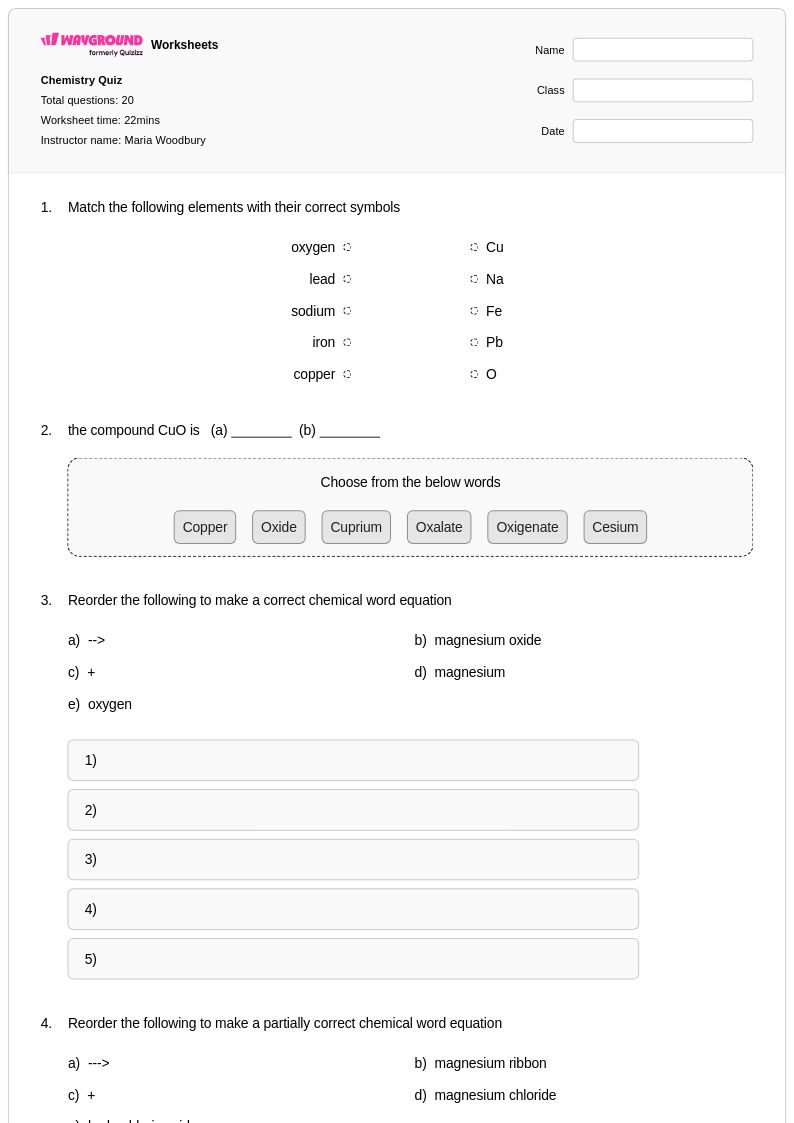
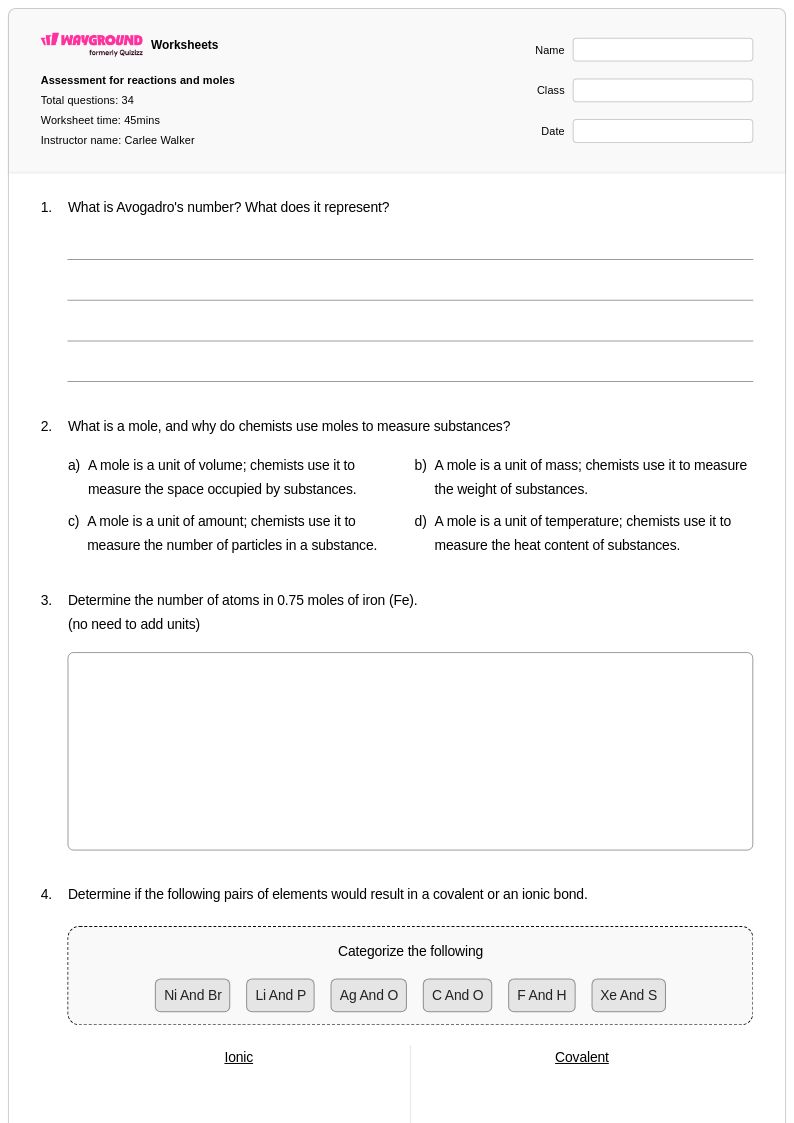
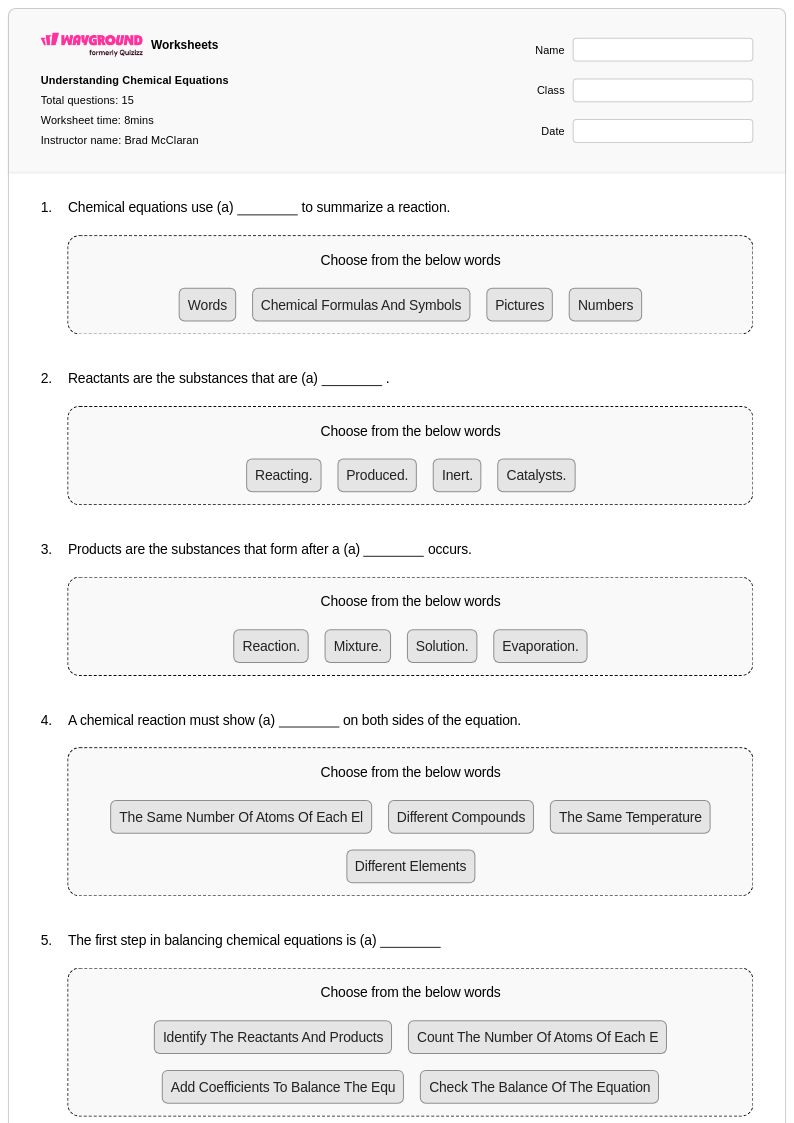
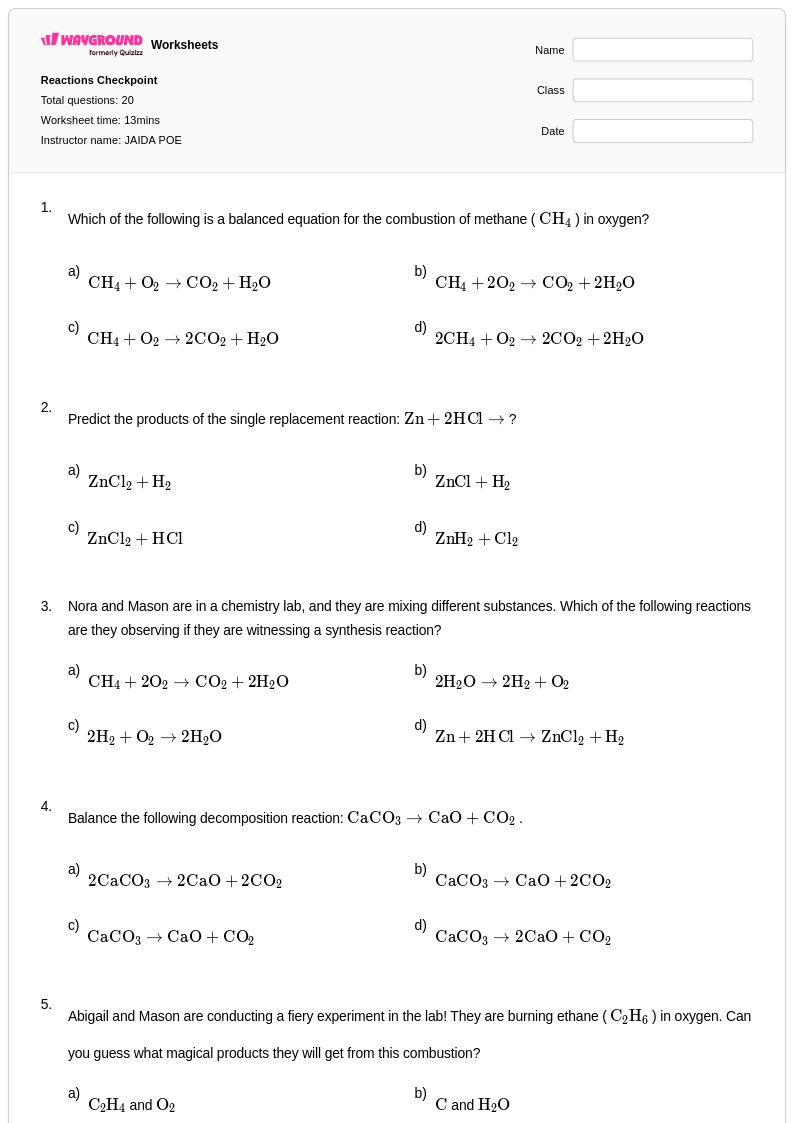
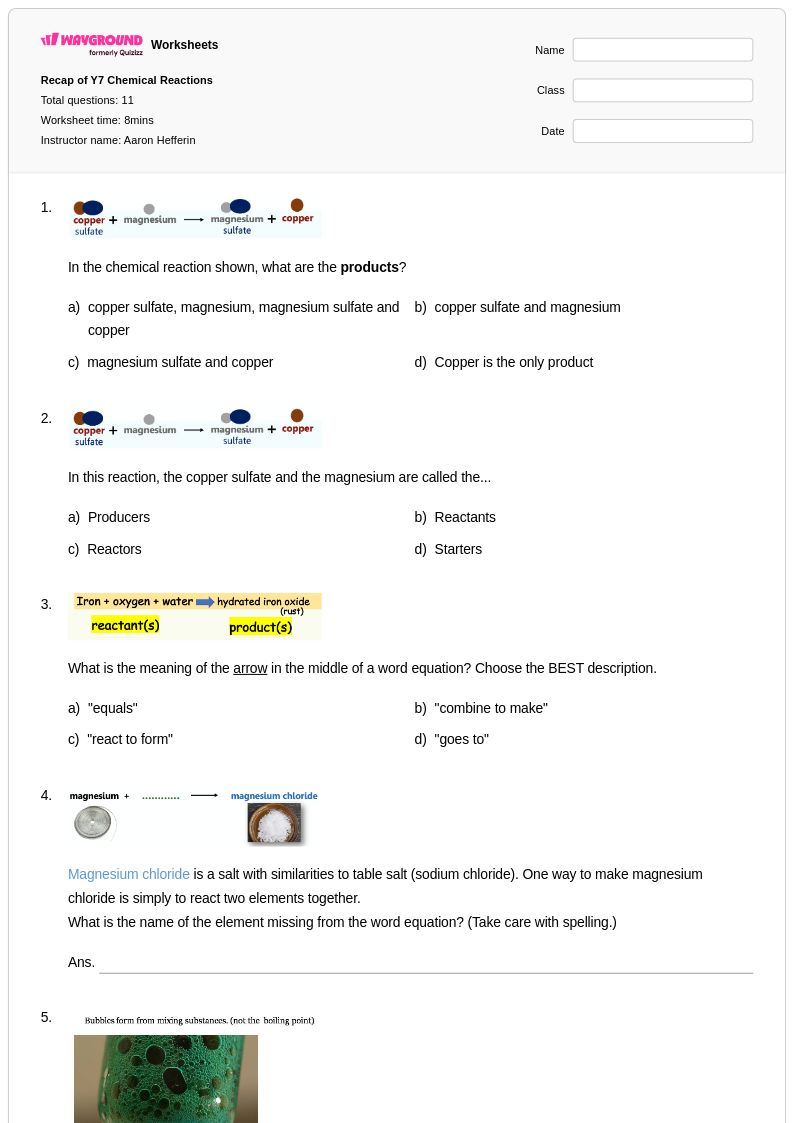
Free Printable Redox Reactions and Electrochemistry worksheets
Master redox reactions and electrochemistry concepts with Wayground's comprehensive collection of free worksheets, featuring printable PDFs with practice problems and detailed answer keys to strengthen your chemistry understanding.
Explore printable Redox Reactions and Electrochemistry worksheets
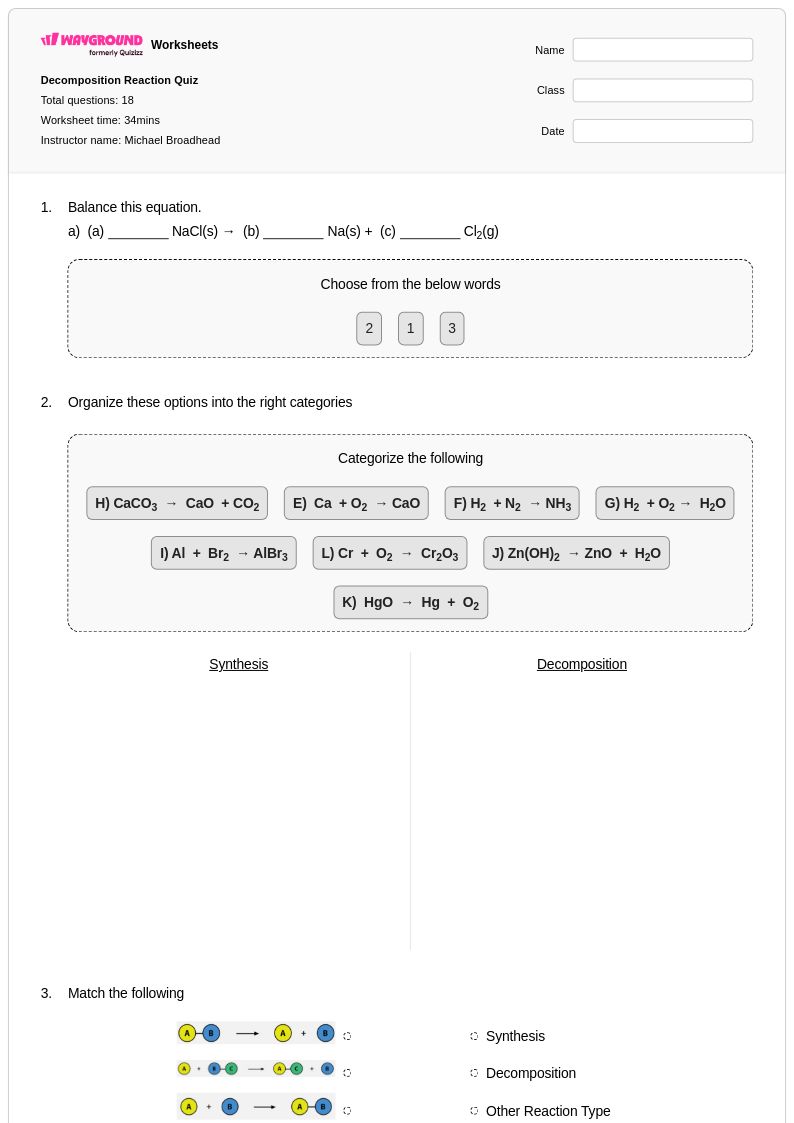
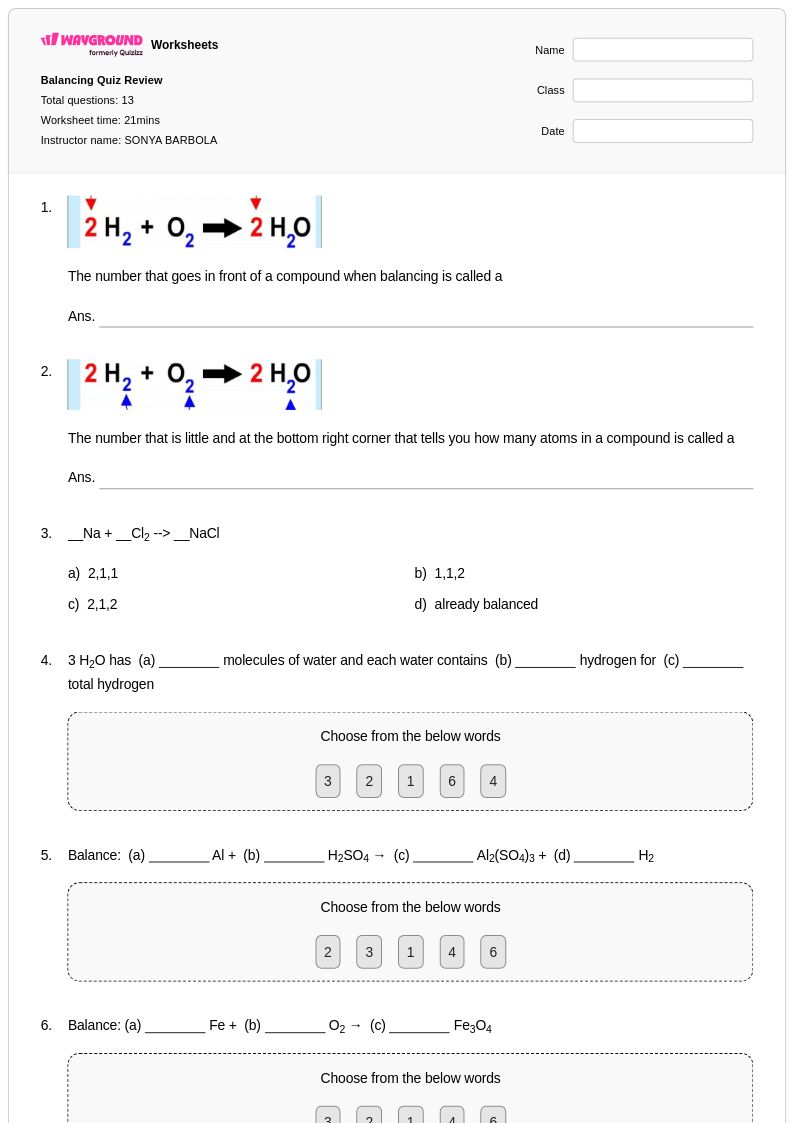
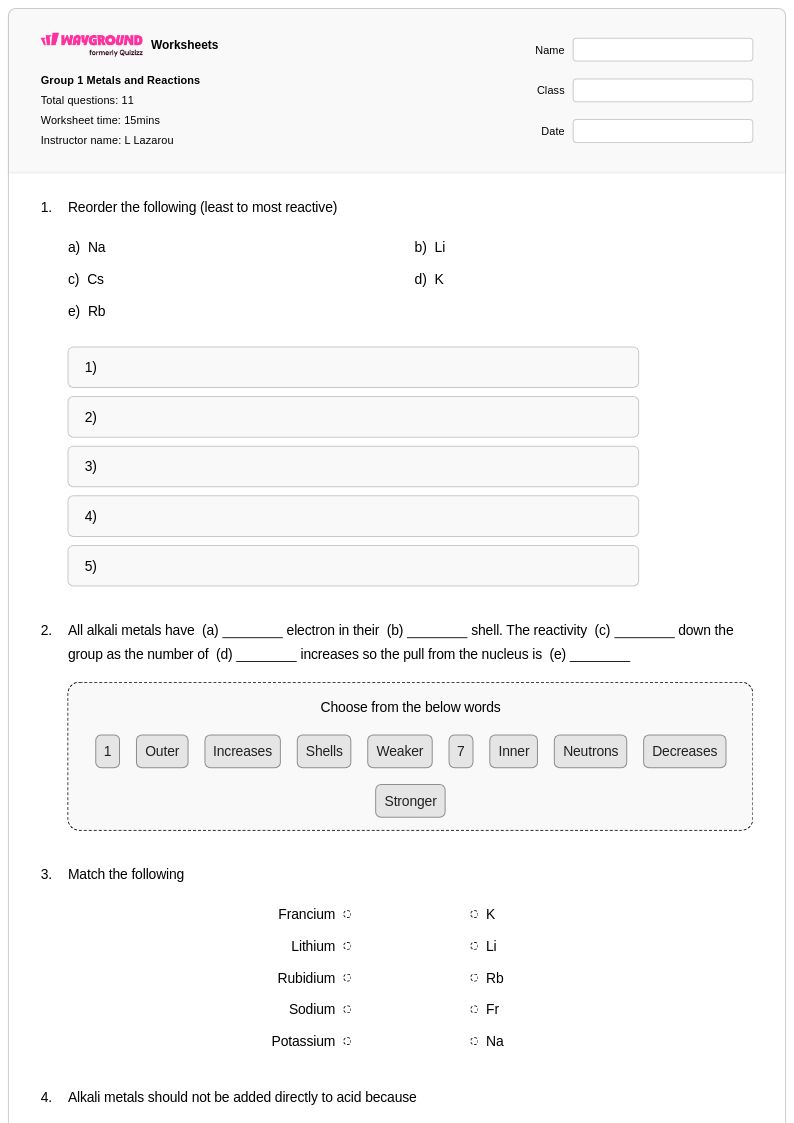
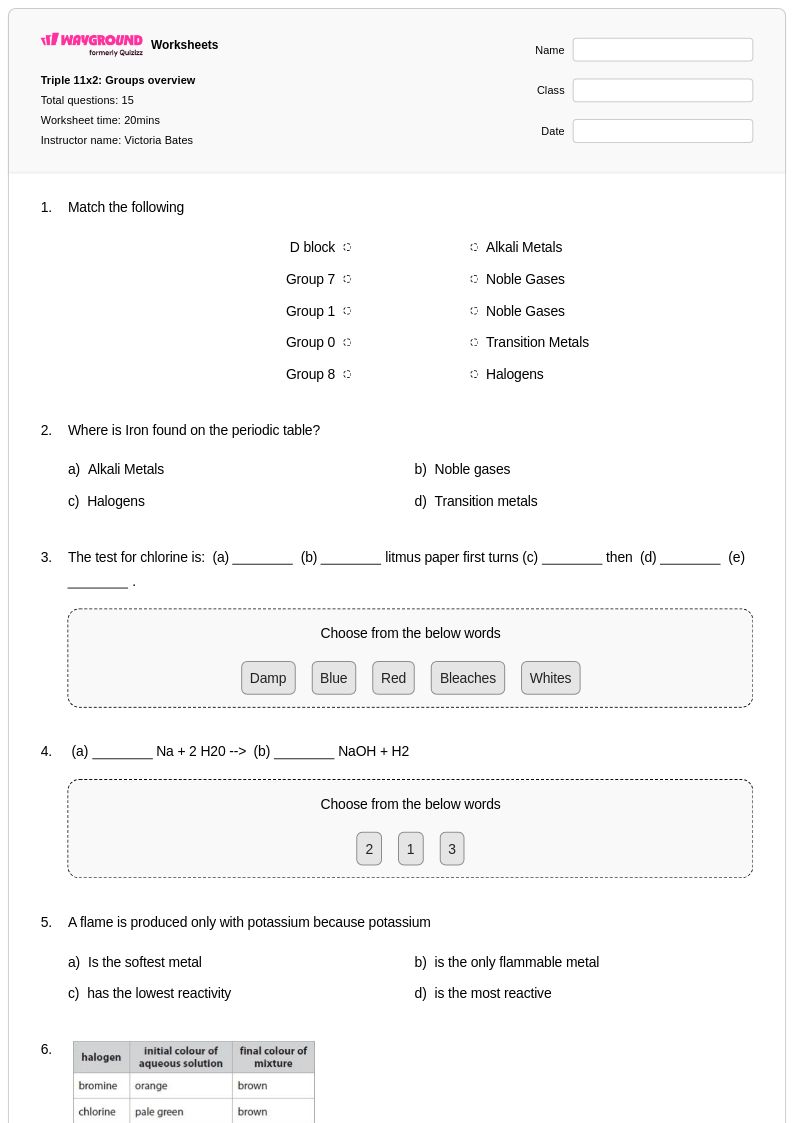
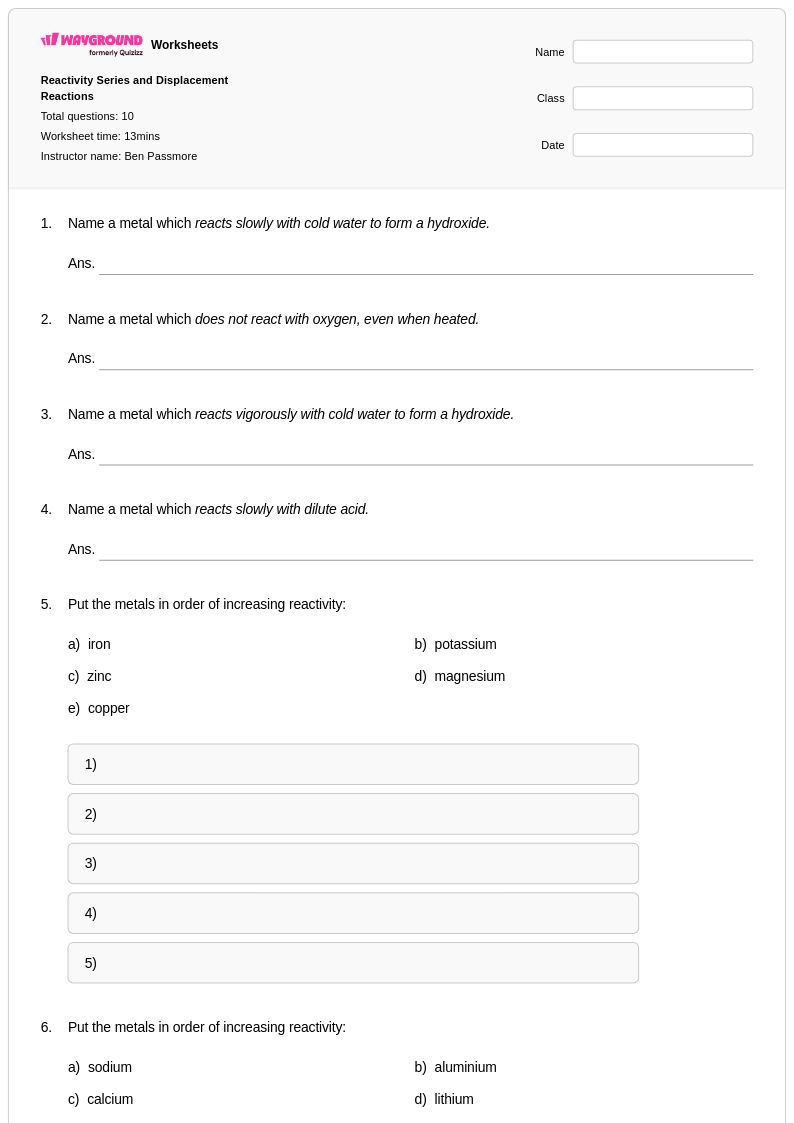
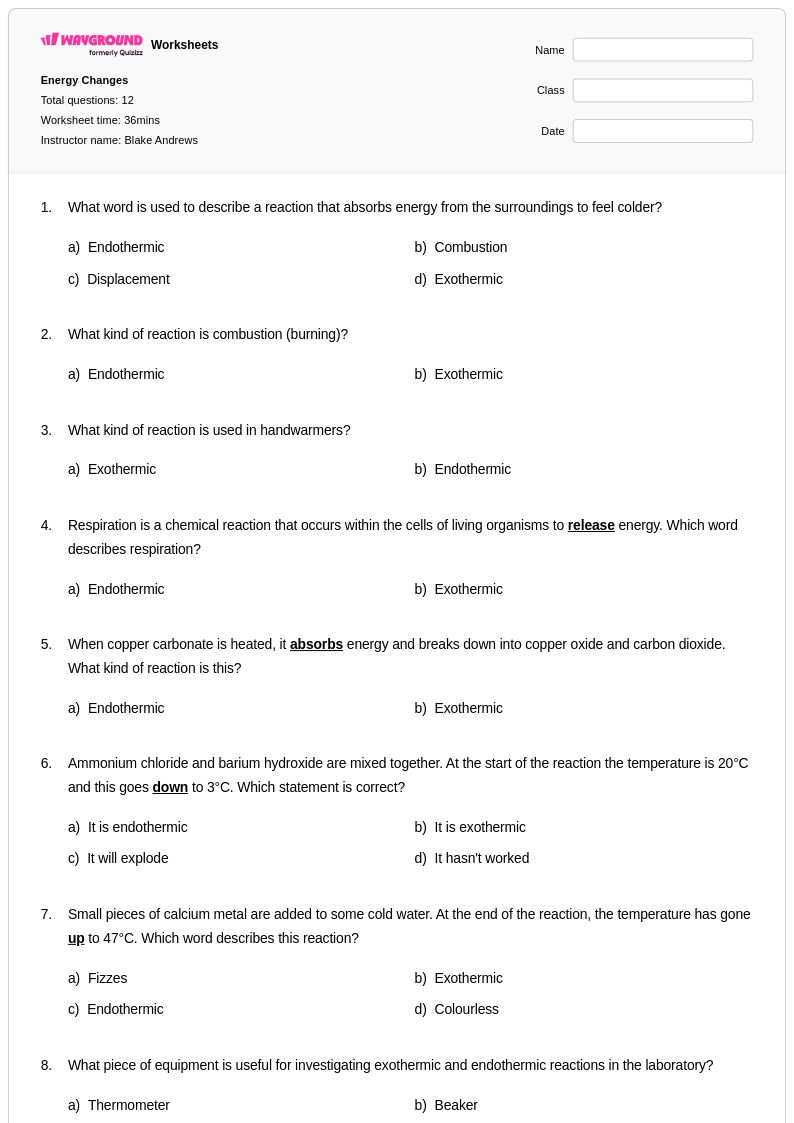
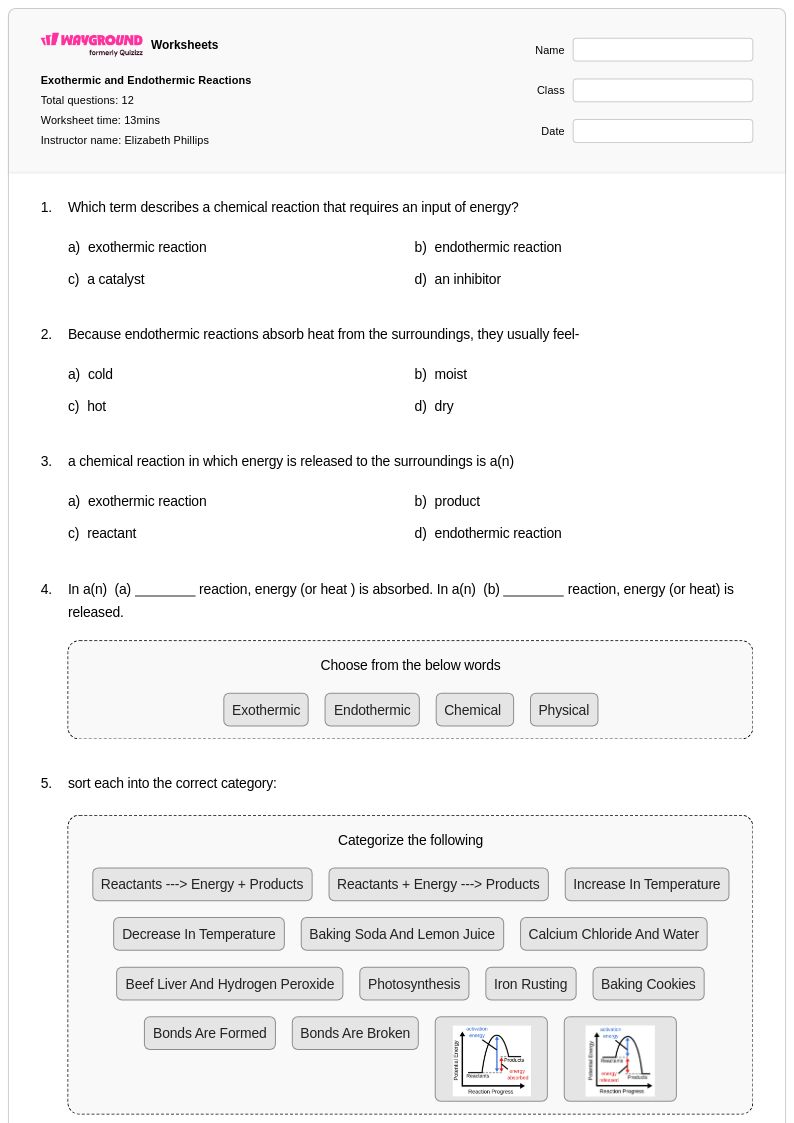
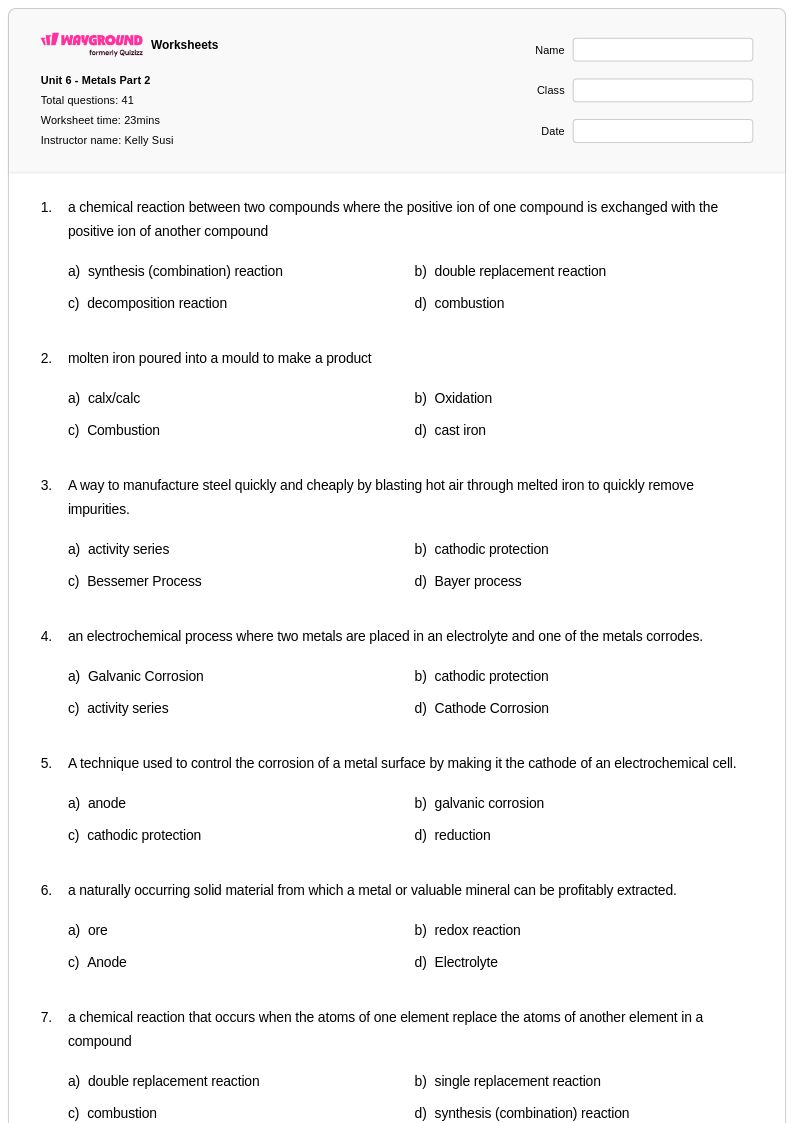
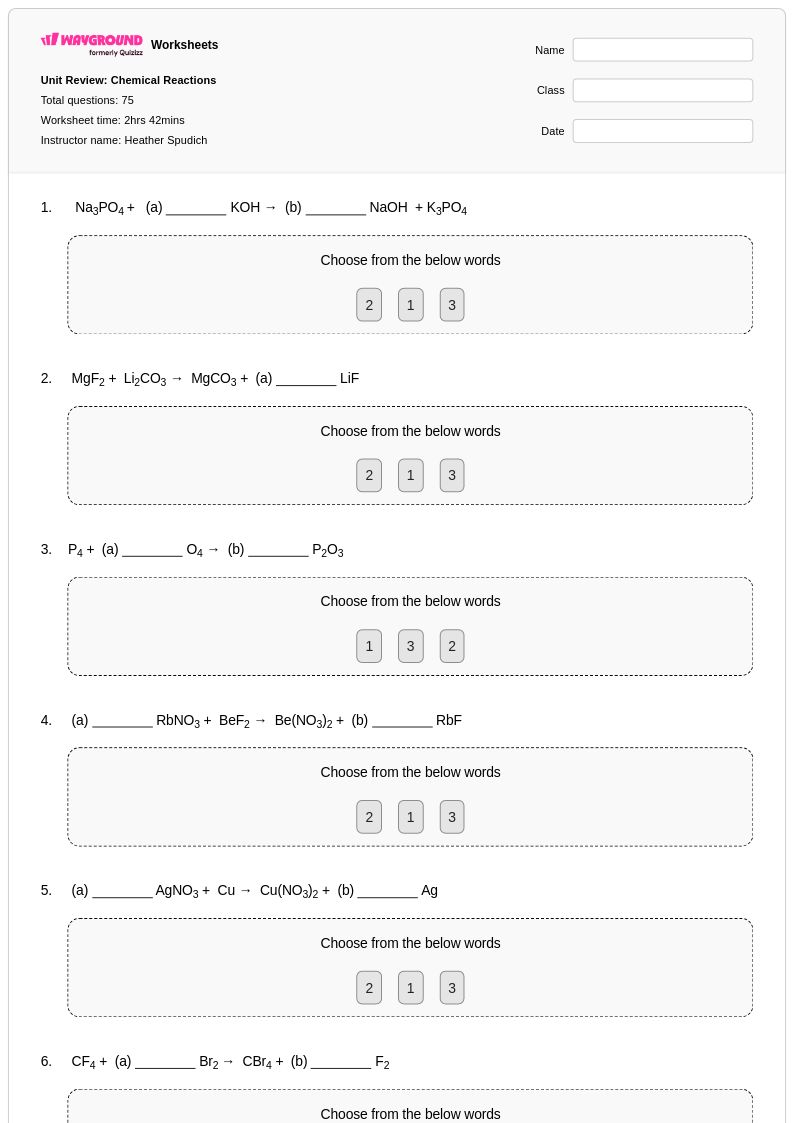
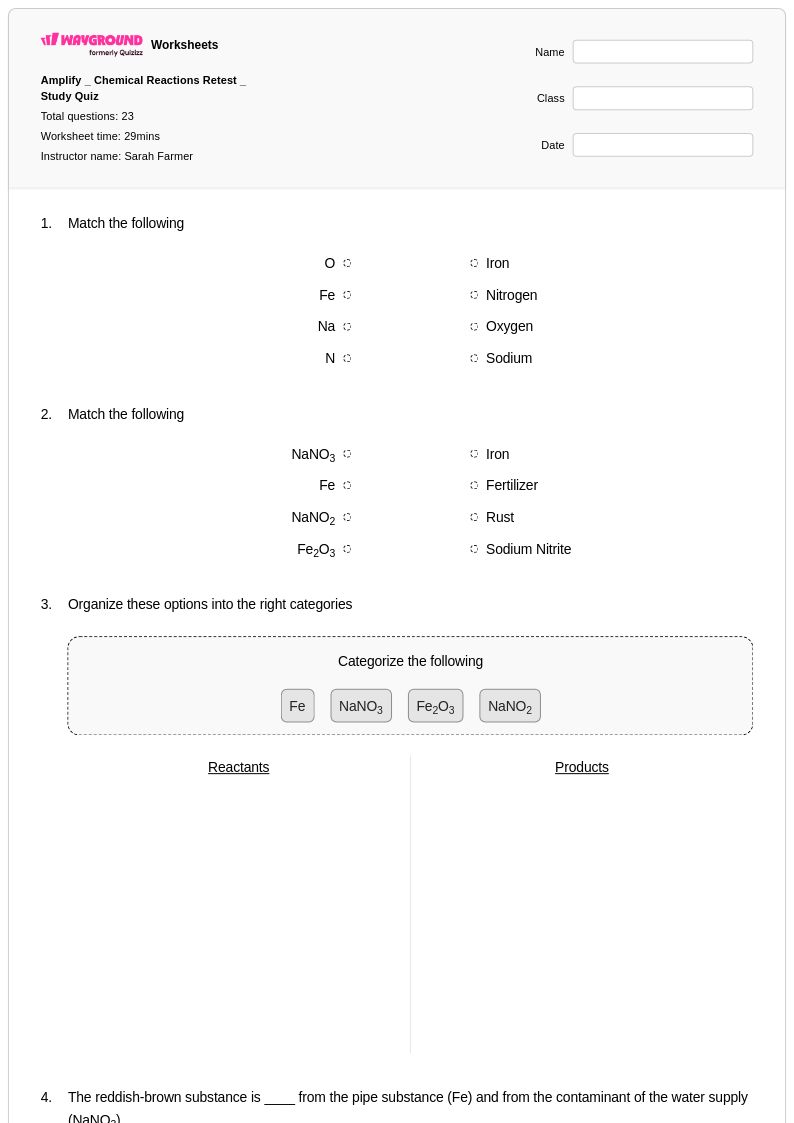
Redox reactions and electrochemistry worksheets available through Wayground (formerly Quizizz) provide comprehensive coverage of electron transfer processes, oxidation-reduction mechanisms, and electrochemical cell operations that form the foundation of advanced chemistry understanding. These expertly designed resources strengthen critical analytical skills including balancing redox equations using half-reaction methods, calculating standard electrode potentials, determining cell voltages, and predicting spontaneity of electrochemical reactions. Students develop proficiency in identifying oxidizing and reducing agents, analyzing galvanic and electrolytic cells, and applying the Nernst equation through structured practice problems that progress from fundamental concepts to complex applications. Each worksheet collection includes detailed answer keys and comprehensive explanations, available as free printables and downloadable pdf formats that support both classroom instruction and independent study.
Wayground (formerly Quizizz) empowers educators with access to millions of teacher-created redox and electrochemistry resources that seamlessly integrate into diverse instructional approaches and curriculum standards. The platform's robust search and filtering capabilities enable teachers to quickly locate materials aligned with specific learning objectives, whether focusing on basic oxidation states or advanced electrochemical thermodynamics. Differentiation tools allow educators to customize worksheet difficulty levels and problem types to meet individual student needs, supporting both remediation for struggling learners and enrichment opportunities for advanced students. Available in both printable and interactive digital formats, these resources facilitate flexible lesson planning while providing consistent opportunities for skill practice, formative assessment, and targeted intervention that helps students master the complex relationships between chemical reactivity and electrical energy.
FAQs
How do I teach redox reactions and electrochemistry effectively in a high school chemistry class?
Start by building a strong foundation in oxidation states before introducing electron transfer and half-reactions. Use concrete analogies like electron "donors" and "acceptors" to help students visualize what's happening at the atomic level. From there, progress to galvanic and electrolytic cells, connecting the chemistry to real-world applications like batteries and electroplating. Structured practice with balancing redox equations using the half-reaction method reinforces the conceptual framework.
What are the best exercises for practicing balancing redox equations?
The half-reaction method is the most reliable approach for students learning to balance redox equations, and worksheets that walk through acidic and basic solution conditions separately help students master each case before combining them. Practice problems should progress from simple oxidation-reduction pairs to multi-step equations involving polyatomic ions. Repeated structured practice with immediate feedback through answer keys is especially effective for building procedural fluency with this skill.
What mistakes do students commonly make when working with redox reactions and electrochemistry?
One of the most common errors is incorrectly assigning oxidation states, especially for elements in polyatomic ions or compounds with multiple oxidation possibilities like transition metals. Students also frequently confuse the direction of electron flow in galvanic versus electrolytic cells, or misidentify which electrode is the anode and which is the cathode. Another persistent misconception is assuming that a more negative standard reduction potential always means a weaker oxidizing agent, without accounting for reaction direction.
How do I help students understand the Nernst equation and when to apply it?
Students often struggle with the Nernst equation because they treat it as a formula to memorize rather than a tool with a specific purpose. Emphasize that the Nernst equation adjusts the standard cell potential for non-standard conditions, particularly when ion concentrations differ from 1 M. Practice problems should include scenarios where students must first determine whether standard conditions apply before deciding whether to use the standard potential alone or the Nernst equation.
How do I use Wayground's redox reactions and electrochemistry worksheets in my classroom?
Wayground's redox and electrochemistry worksheets are available as printable PDFs for traditional classroom use and in digital formats for technology-integrated environments, giving teachers flexibility in how they assign and deliver practice. You can also host worksheets directly as a quiz on Wayground, which supports formative assessment and real-time progress monitoring. All worksheets include detailed answer keys, making them suitable for independent practice, guided instruction, or homework assignments.
How can I differentiate redox and electrochemistry practice for students at different skill levels?
For students who are still building foundational understanding, start with problems focused solely on assigning oxidation states and identifying oxidizing and reducing agents before introducing cell voltage calculations. More advanced students can be challenged with spontaneity predictions using Gibbs free energy and the Nernst equation under varied concentration conditions. On Wayground, teachers can apply accommodations such as reduced answer choices or read-aloud settings for individual students, allowing the same worksheet to serve a diverse classroom without requiring separate materials.