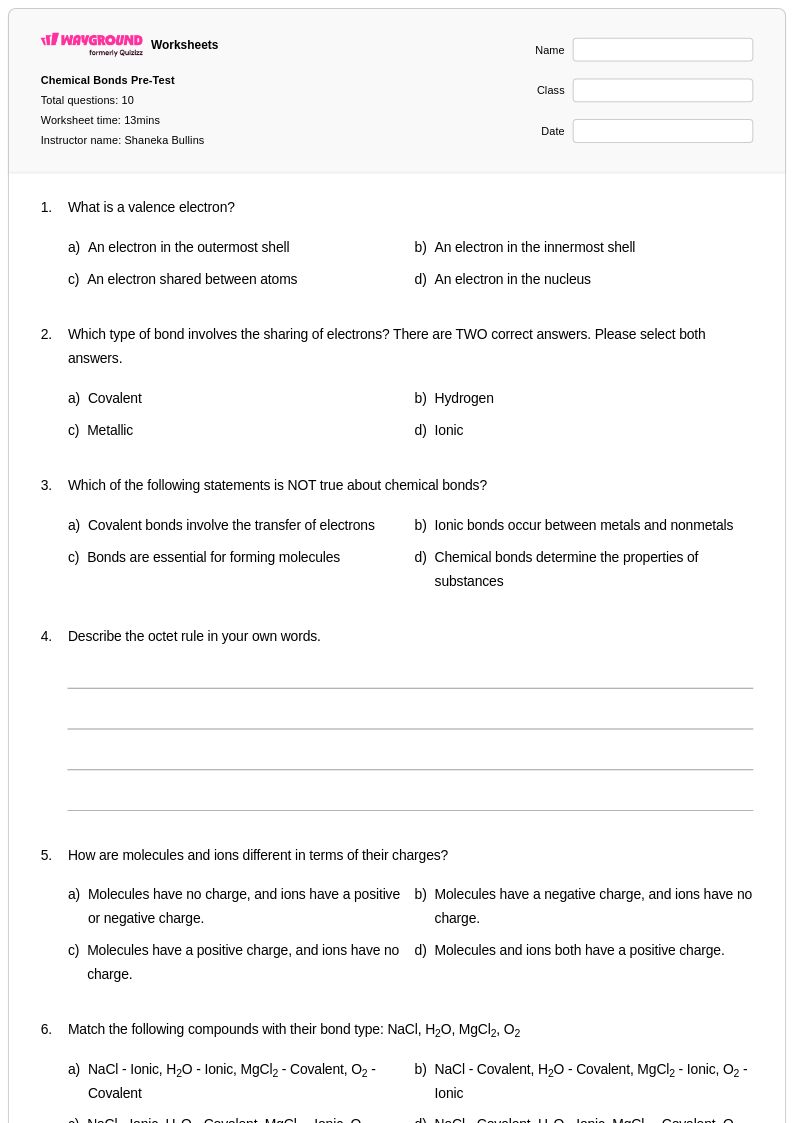
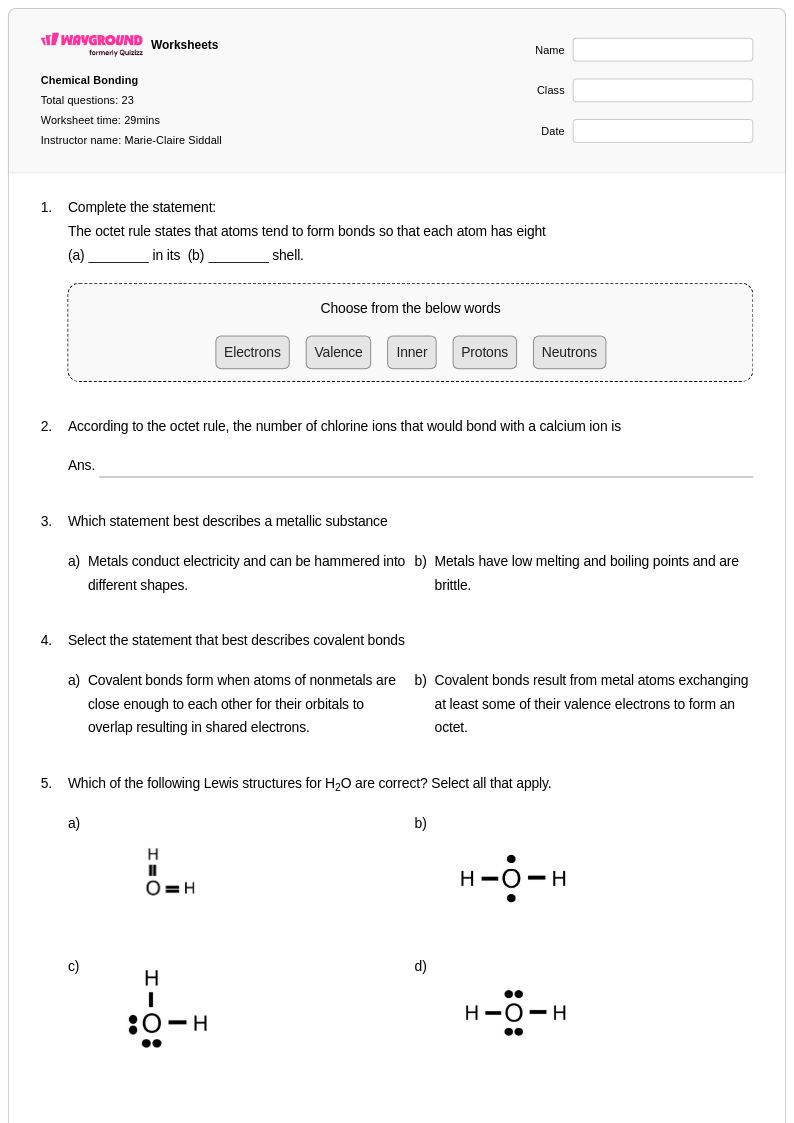
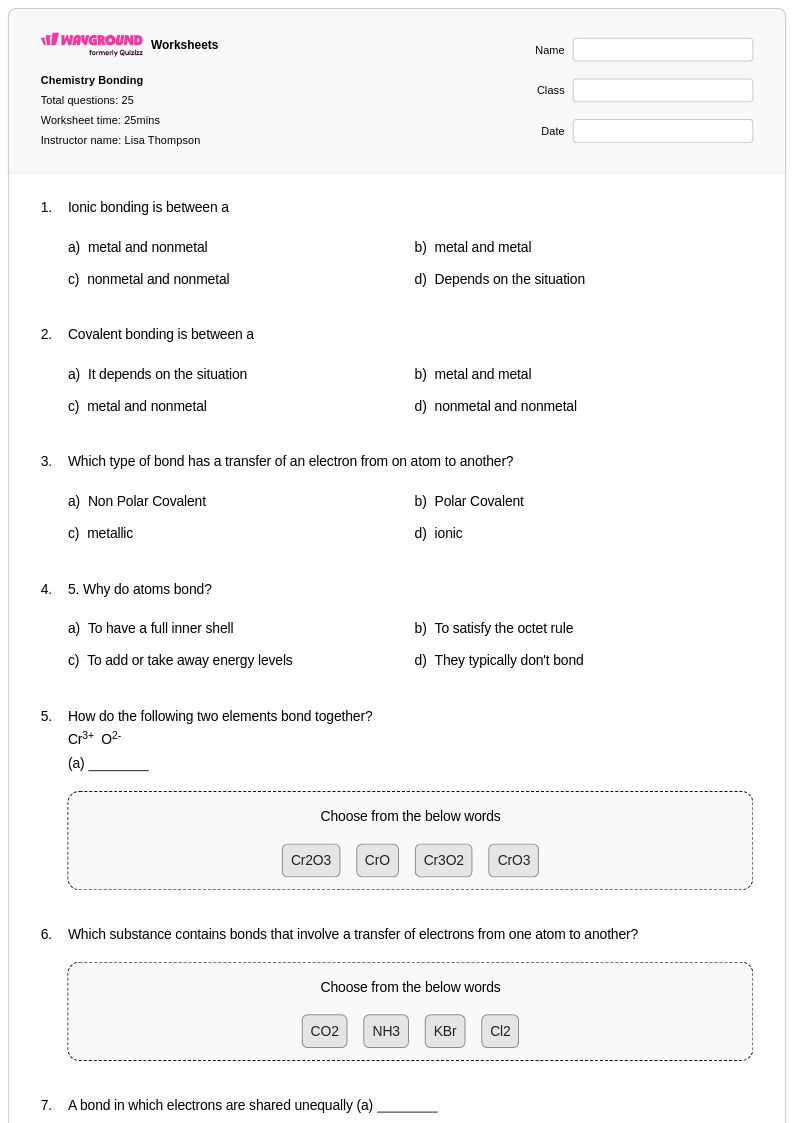
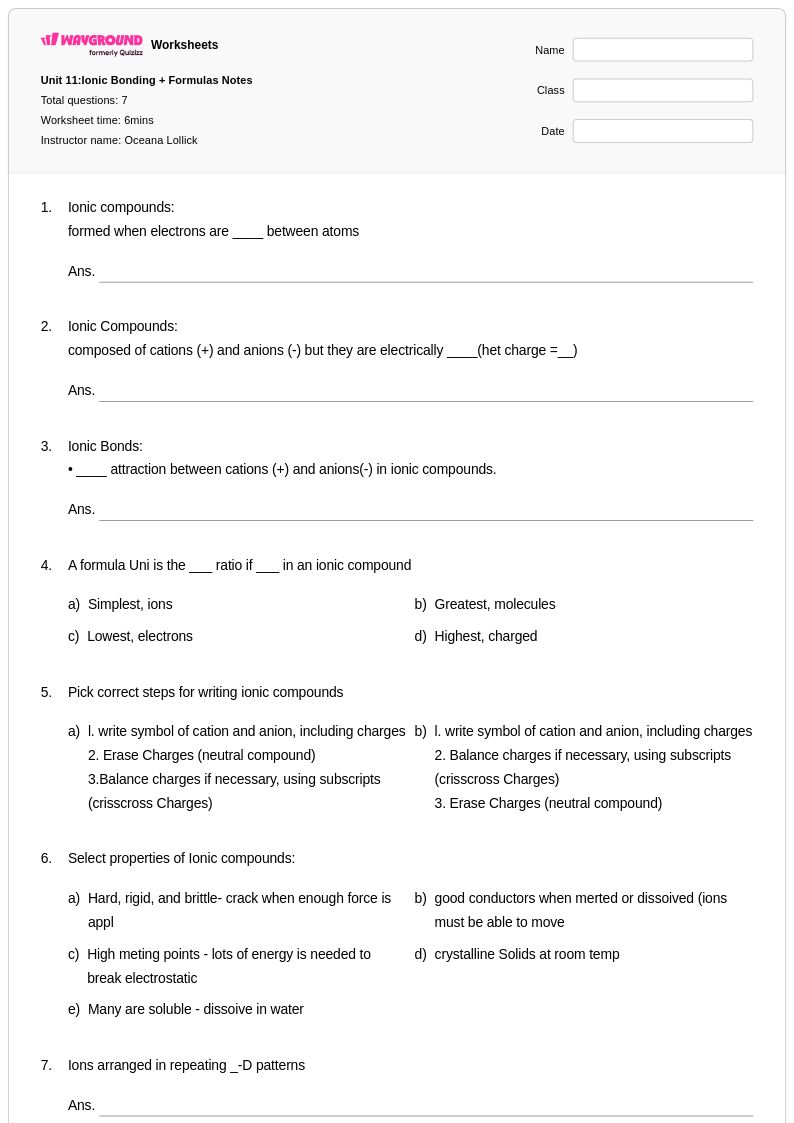
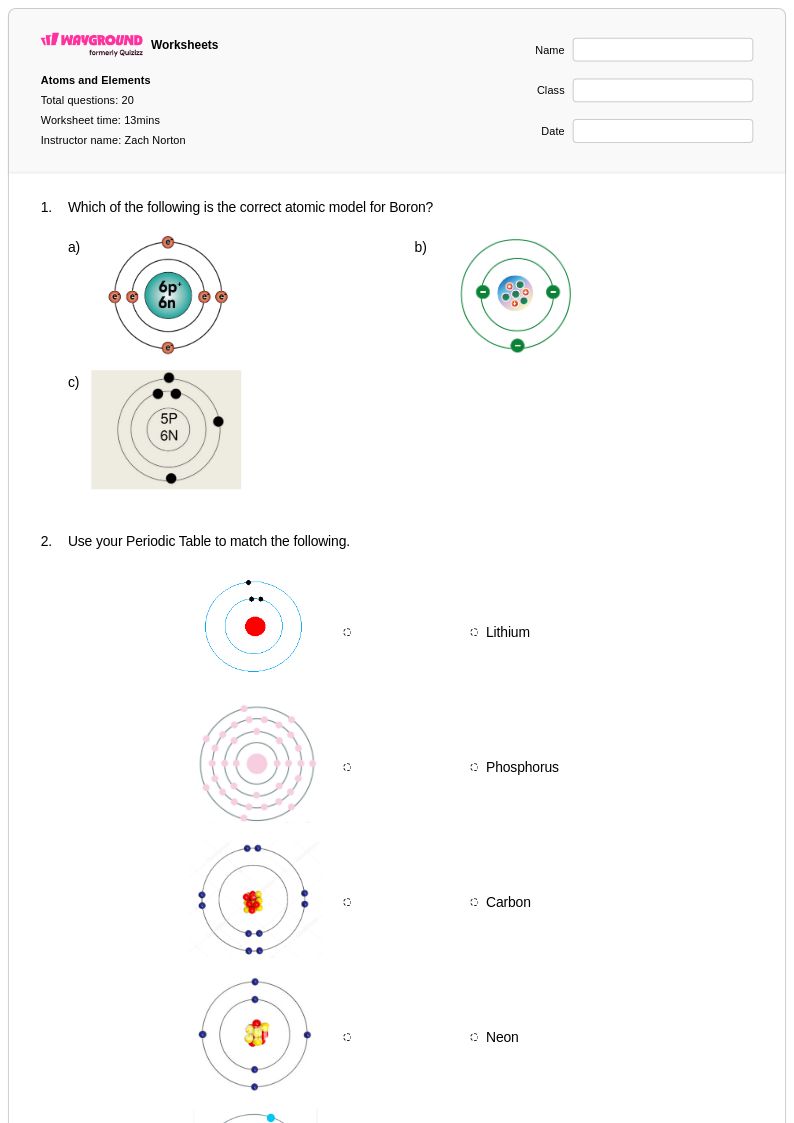
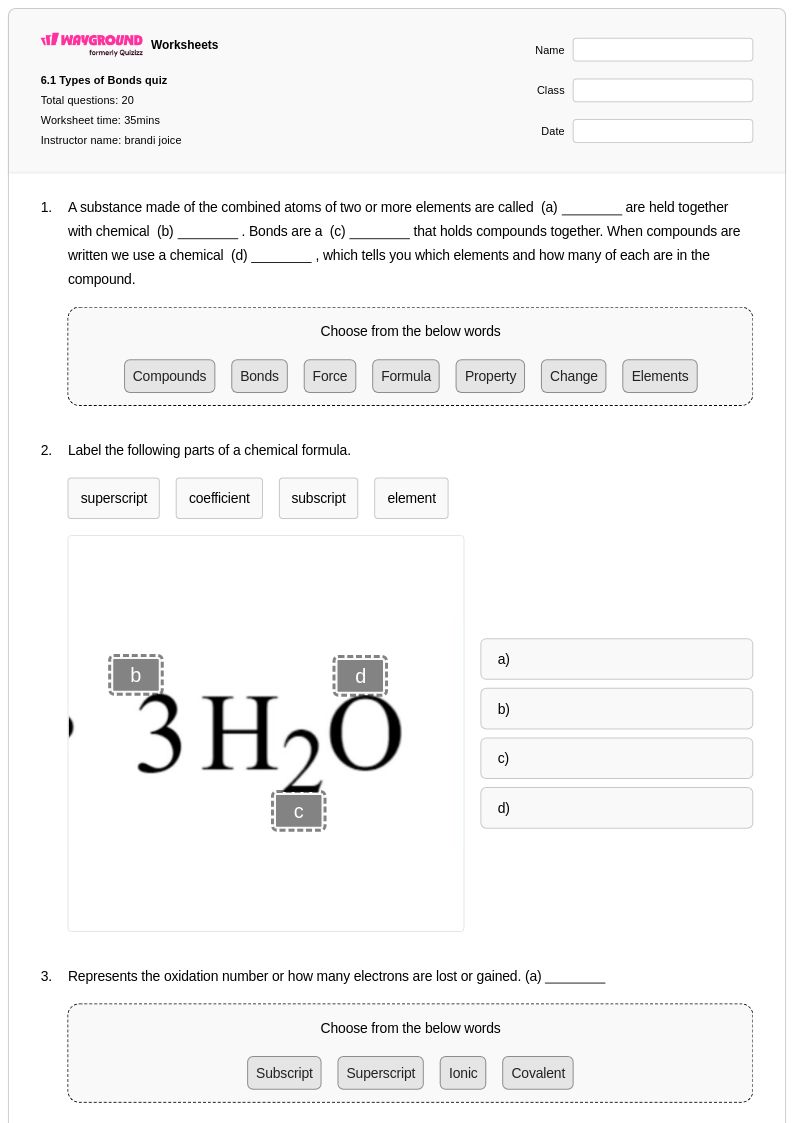
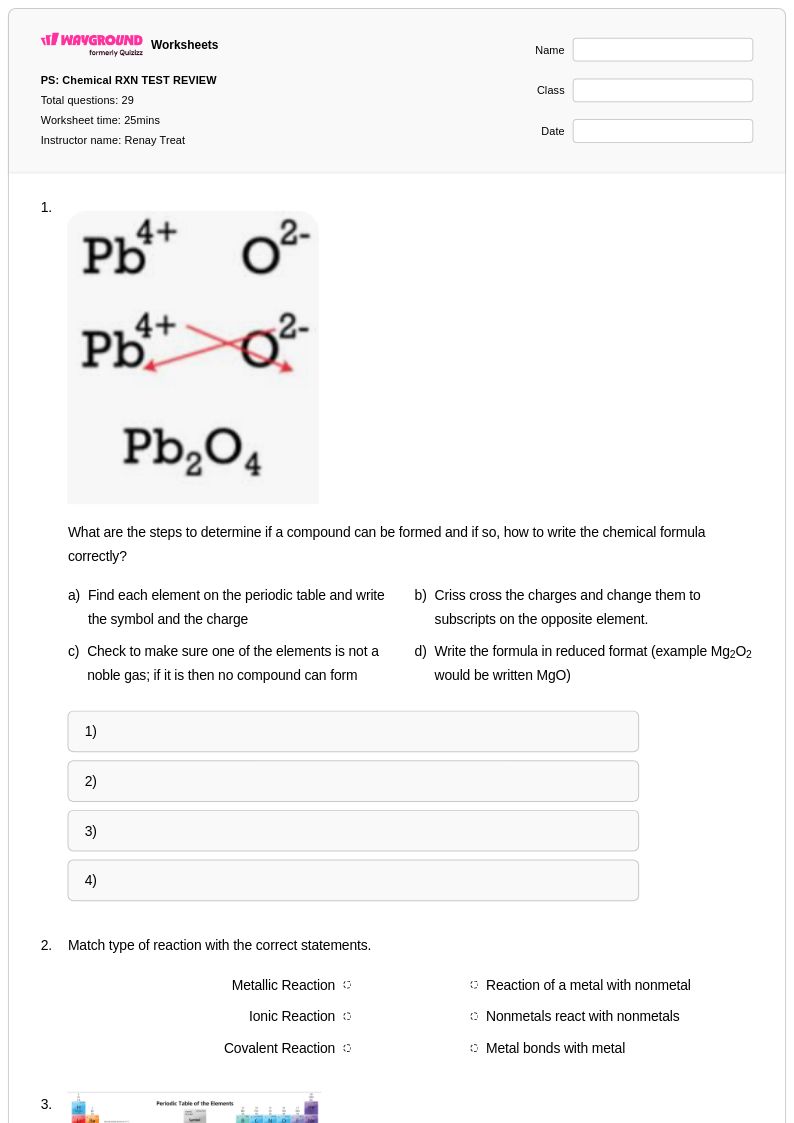
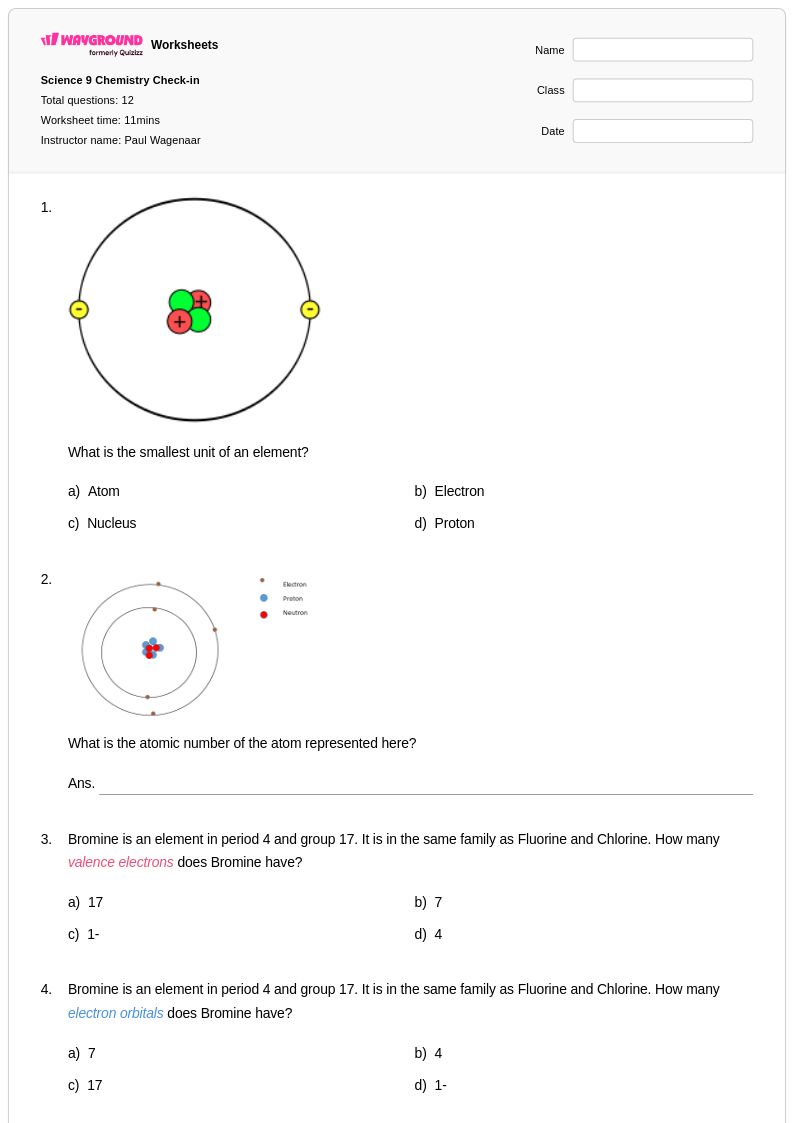
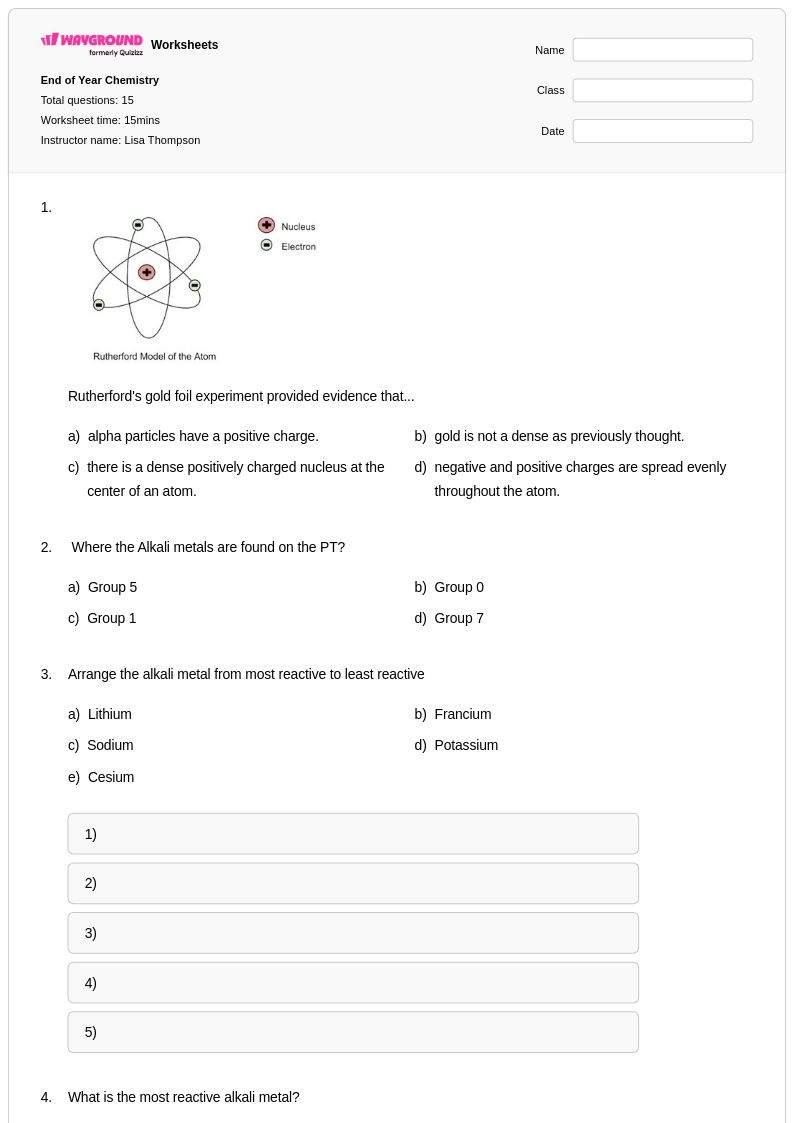
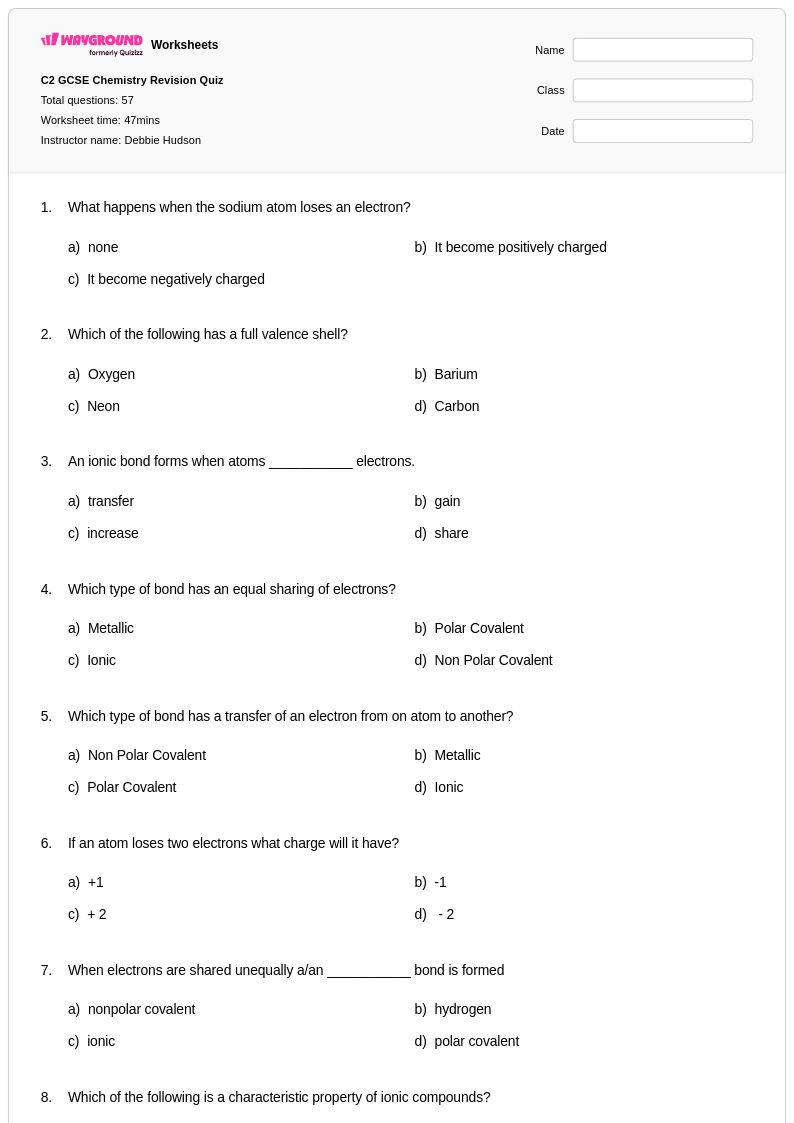
Discover free ionic charges worksheets and printables through Wayground that help chemistry students master electron transfer, ion formation, and charge prediction with comprehensive practice problems and answer keys.
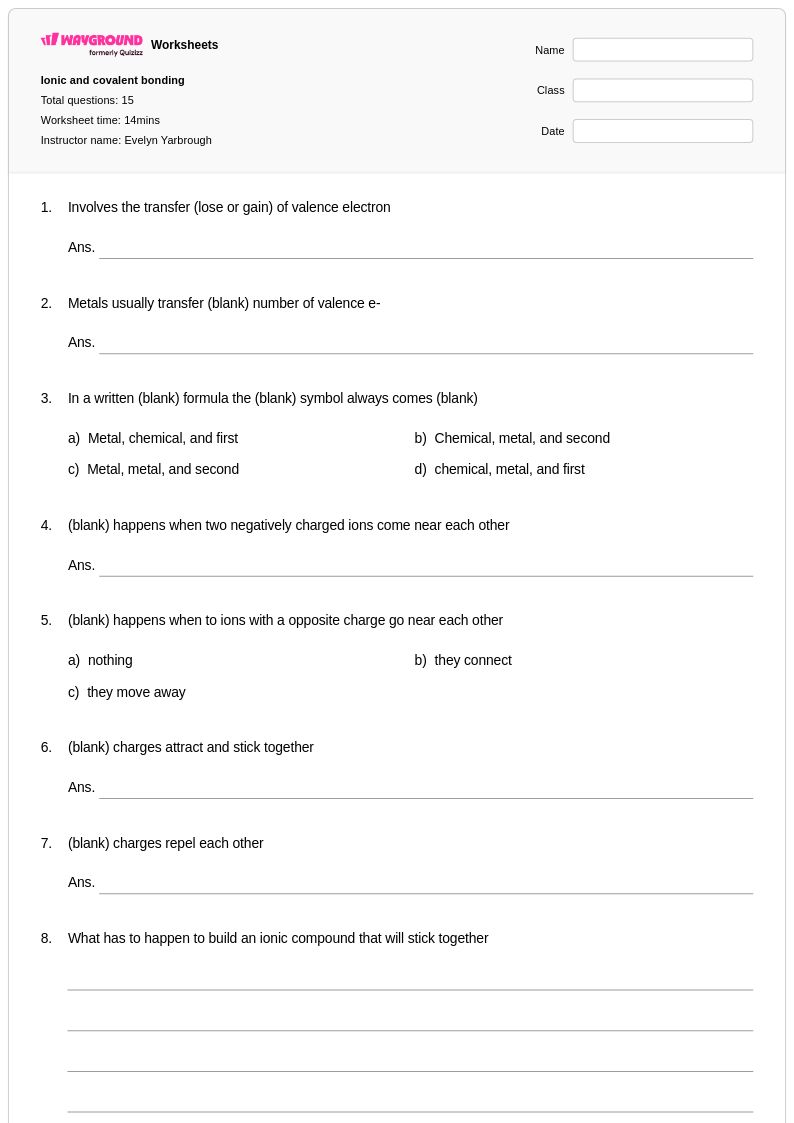
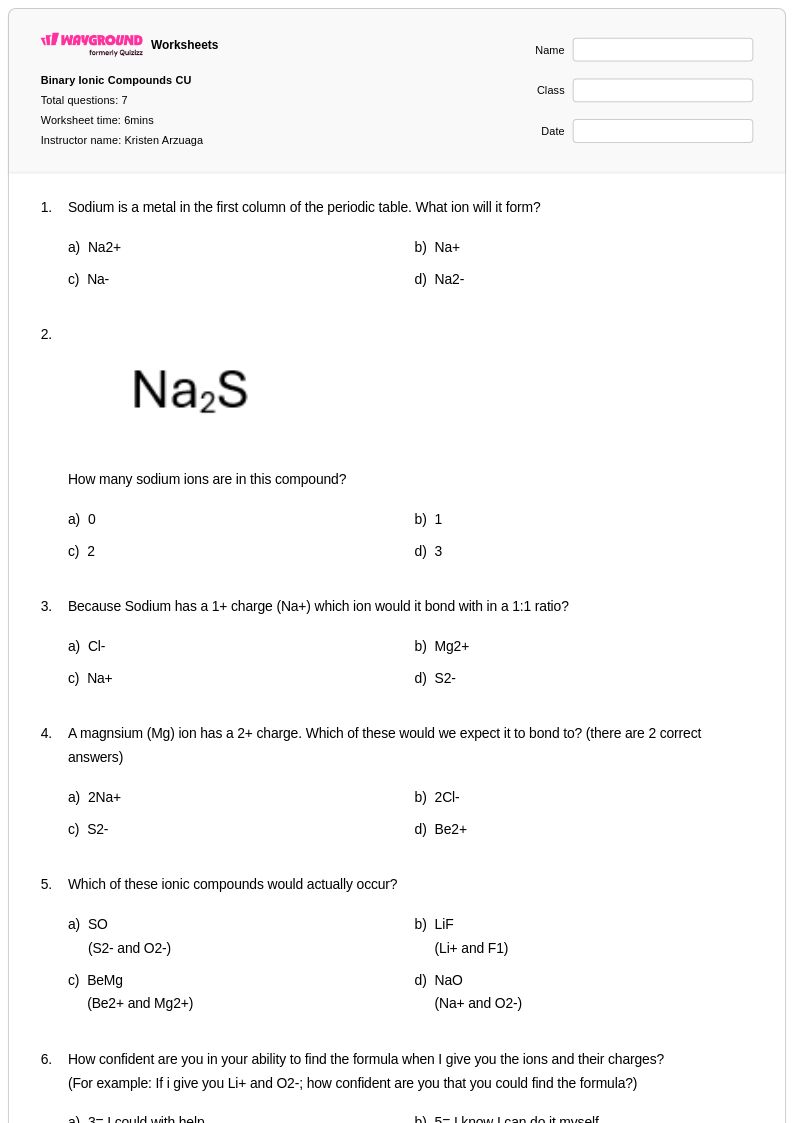
Ionic charges worksheets available through Wayground (formerly Quizizz) provide comprehensive practice for students learning to predict and apply the electrical charges that atoms acquire when forming ions. These expertly crafted chemistry resources strengthen fundamental skills in electron configuration, periodic trends, and the relationship between an element's position on the periodic table and its tendency to gain or lose electrons. Students work through systematic practice problems that reinforce their understanding of cation and anion formation, while developing proficiency in writing correct ionic formulas and predicting charge patterns across different element groups. Each worksheet collection includes detailed answer keys and is available as free printables in convenient pdf format, making them accessible for both classroom instruction and independent study.
Wayground (formerly Quizizz) empowers chemistry teachers with millions of teacher-created ionic charges worksheets that can be easily located through robust search and filtering capabilities aligned with educational standards. The platform's differentiation tools allow educators to customize practice problems based on individual student needs, whether providing foundational support for struggling learners or offering advanced applications for enrichment. Teachers can seamlessly integrate these resources into their lesson planning, utilizing both printable pdf versions for traditional classroom work and digital formats for interactive learning experiences. This flexibility supports effective remediation strategies, targeted skill practice sessions, and comprehensive assessment preparation, enabling educators to address diverse learning styles and academic levels within their chemistry curriculum.
FAQs
How do I teach ionic charges to chemistry students?
Begin by grounding students in atomic structure, particularly the role of valence electrons in determining an atom's tendency to gain or lose electrons. Use the periodic table as a visual anchor — groups 1, 2, and 13-17 offer predictable charge patterns that students can identify before working through transition metals. Connecting ion formation to electron configuration early helps students see ionic charges as a logical outcome of atomic structure rather than arbitrary rules to memorize.
What practice problems help students get better at predicting ionic charges?
Effective practice starts with main group elements, where charge prediction follows clear periodic trends, before moving to transition metals with variable charges. Students benefit from exercises that require them to identify whether an element forms a cation or anion, write the correct ion notation, and predict formulas for ionic compounds. Systematic repetition across element groups builds pattern recognition, which is the core skill behind accurate charge prediction.
What mistakes do students commonly make when working with ionic charges?
The most frequent error is confusing the number of valence electrons with the charge of the resulting ion — for example, assuming an element in Group 16 forms a 6+ rather than a 2- ion. Students also struggle with transition metals, often applying fixed-charge logic to elements like iron or copper that can form multiple ions. A third common mistake is reversing cation and anion formation, incorrectly assuming metals gain electrons.
How do I help struggling students understand the difference between cations and anions?
Anchor the distinction in a simple rule: metals lose electrons and become positively charged cations, while nonmetals gain electrons and become negatively charged anions. Mnemonics and color-coded periodic tables can reinforce which side of the table trends toward each behavior. For students who need additional support, Wayground's reduced answer choices accommodation can lower the cognitive load during digital practice by displaying fewer options per question, helping students build confidence before attempting open-response problems.
How can I use ionic charges worksheets in my chemistry class?
Ionic charges worksheets on Wayground are available as printable PDFs for traditional classroom use and in digital formats for technology-integrated instruction, including the option to host them as a quiz directly on Wayground. Teachers can use them as guided practice after direct instruction, as independent review assignments, or as targeted remediation for students who need additional work on electron transfer and ion formation. The included answer keys make grading straightforward and support self-assessment for students working independently.
How do I address different skill levels in a chemistry class when teaching ionic charges?
For foundational learners, focus first on main group elements where charge prediction is most predictable, using structured worksheets that walk through electron gain and loss step by step. Advanced students can be challenged with transition metal charges, polyatomic ions, and writing ionic formulas for multi-element compounds. Wayground's differentiation tools allow teachers to customize practice by student need, and accommodations such as extended time or read aloud can be assigned to individual students without affecting the rest of the class.